Phagemid and BAC
Vectors
Promila Sheoran
Ph.D. Biotechnology
GJU S&T Hisar
Phagemid vectors
•A plasmid vector that contains origin of replication from a phage in addition to
that of a plasmid is called phagemid.
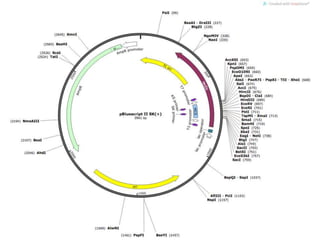
•The pBluescript II phagemids (plasmids with a phage origin) are cloning vectors
designed to simplify commonly used cloning and sequencing procedures, including
the construction of nested deletions for DNA sequencing, generation of RNA
transcripts in vitro and site-specific mutagenesis and gene mapping.
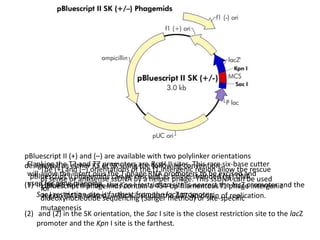
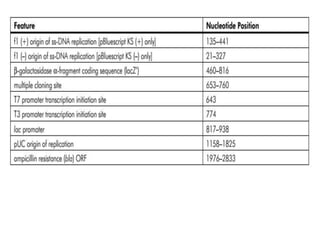
• The pBluescript II phagemids have an extensive polylinker with 21 unique
restriction enzyme recognition sites.
•Flanking the polylinker are T7 and T3 RNA polymerase promoters that can be used
to synthesize RNA in vitro.
• The choice of promoter used to initiate transcription determines which strand of
the insert cloned into the polylinker will be transcribed.
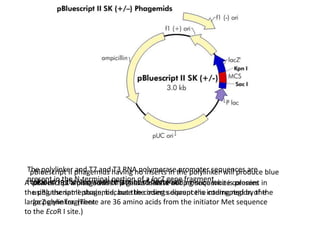
The polylinker and T7 and T3 RNA polymerase promoter sequences are
present in the N-terminal portion of a lacZ gene fragment.A total of 131 amino acids of β-galactosidase coding sequence is present in
the pBluescript II phagemid, but the coding sequence is interrupted by the
large polylinker. (There are 36 amino acids from the initiator Met sequence
to the EcoR I site.)
pBluescript II phagemids having no inserts in the polylinker will produce blue
colonies in the appropriate strains of bacteria.pBluescript II phagemids that have inserts will produce white colonies
using the same strain, because the inserts disrupt the coding region of the
lacZ gene fragment
pBluescript II (+) and (–) are available with two polylinker orientations
designated as either KS or SK using the following convention:
(1) in the KS orientation, the Kpn I restriction site is nearest the lacZ promoter and the
Sac I restriction site is farthest from the lacZ promoter;
(2) and (2) in the SK orientation, the Sac I site is the closest restriction site to the lacZ
promoter and the Kpn I site is the farthest.
Flanking the T3 and T7 promoters are BssH II sites. This rare six-base cutter
will allow the insert plus the T phage RNA promoters to be excised and
used for gene mapping.
pBluescript II phagemids can be rescued as single-stranded (ss) DNA.
pBluescript II phagemids contain a 454-bp filamentous f1 phage intergenic
region (M13 related), which includes the 307-bp origin of replication.
The (+) and (–) orientations of the f1 intergenic region allow the rescue
of sense or antisense ssDNA by a helper phage. This ssDNA can be used
for
dideoxynucleotide sequencing (Sanger method) or site-specific
mutagenesis
LIGATION INTO pBLUESCRIPT II PHAGEMIDS
•Dephosphorylate the digested pBluescript II phagemid with calf intestinal alkaline
phosphatase (CIAP) prior to ligation with the insert DNA.
• If more than one restriction enzyme is used, the background can be reduced further
by electrophoresing the digested vector DNA on an agarose gel and recovering the
desired vector band through electroelution, leaving behind the small fragment that
appears between the two restriction enzyme sites.
After gel purification and ethanol precipitation of the DNA, resuspend in a volume of TE
buffer [5 mM Tris (pH 7.5), 0.1 mM EDTA] that will allow the concentration of the vector
DNA to be the same as the concentration of the insert DNA (~0.1 μg/μl).
•For ligation, the ideal ratio of insert to vector DNA is variable; however, a reasonable
starting point is 2:1 (insert:vector), measured in available picomole ends.
Bacterial Artificial Chromosome (BAC) Vector
•BAC vectors are plasmids constructed with the replication origin of E. coli F factor,
and so can be maintained in a single copy per cell.
•These vectors can hold DNA fragments of up to 300 kb.
•Low copy number helps of BACs helps maintain the DNA inserts without any change
arising from recombination between the copies of DNA inserts that is likely to
happen in case of multicopy vectors.
•BACs were created because of problems faced with YACs, eg., recobination between
copies of inserts and deletion in the DNA inserts.
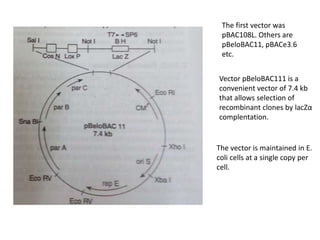
The first vector was
pBAC108L. Others are
pBeloBAC11, pBACe3.6
etc.
Vector pBeloBAC111 is a
convenient vector of 7.4 kb
that allows selection of
recombinant clones by lacZα
complentation.
The vector is maintained in E.
coli cells at a single copy per
cell.
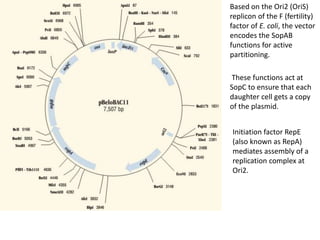
Based on the Ori2 (OriS)
replicon of the F (fertility)
factor of E. coli, the vector
encodes the SopAB
functions for active
partitioning.
These functions act at
SopC to ensure that each
daughter cell gets a copy
of the plasmid.
Initiation factor RepE
(also known as RepA)
mediates assembly of a
replication complex at
Ori2.
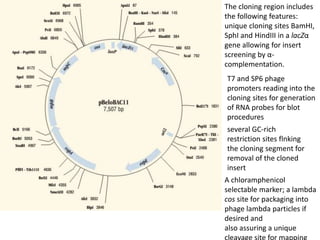
The cloning region includes
the following features:
unique cloning sites BamHI,
SphI and HindIII in a lacZα
gene allowing for insert
screening by α-
complementation.
T7 and SP6 phage
promoters reading into the
cloning sites for generation
of RNA probes for blot
procedures
several GC-rich
restriction sites flnking
the cloning segment for
removal of the cloned
insert
A chloramphenicol
selectable marker; a lambda
cos site for packaging into
phage lambda particles if
desired and
also assuring a unique
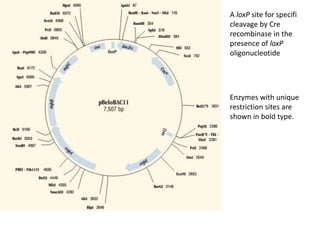
A loxP site for specifi
cleavage by Cre
recombinase in the
presence of loxP
oligonucleotide
Enzymes with unique
restriction sites are
shown in bold type.
•The DNA insert is integrated in cloning sites within lacZ, which allows for
selection of recombinant clones.
•BACs vectors have been extensively used in the analysis of genomes, including
the human genome.
•BAC vectors are stable, more user friendly than YAC vectors.
•Do not suffer from problems of chimersim, and suitable for most applications in
the analysis of large genomes.
•Are able to maintain in stable state even such genomic DNA, e.g., from
genomes of Archaea and mammals, that are normally unstable in high copy
numbers vectors.
•The chief disadvantage of BAC vectors is the somewhat laborious construction
of BAC libraries as in vitro manipulations, such as, restriction digestion etc., have
to be performed in agarose plugs to avoid shearing of the large DNA molecules.
Thank You

Phagemid and bac vectors

  • 1.
    Phagemid and BAC Vectors PromilaSheoran Ph.D. Biotechnology GJU S&T Hisar
  • 2.
    Phagemid vectors •A plasmidvector that contains origin of replication from a phage in addition to that of a plasmid is called phagemid. •The pBluescript II phagemids (plasmids with a phage origin) are cloning vectors designed to simplify commonly used cloning and sequencing procedures, including the construction of nested deletions for DNA sequencing, generation of RNA transcripts in vitro and site-specific mutagenesis and gene mapping. • The pBluescript II phagemids have an extensive polylinker with 21 unique restriction enzyme recognition sites. •Flanking the polylinker are T7 and T3 RNA polymerase promoters that can be used to synthesize RNA in vitro. • The choice of promoter used to initiate transcription determines which strand of the insert cloned into the polylinker will be transcribed.
  • 4.
    The polylinker andT7 and T3 RNA polymerase promoter sequences are present in the N-terminal portion of a lacZ gene fragment.A total of 131 amino acids of β-galactosidase coding sequence is present in the pBluescript II phagemid, but the coding sequence is interrupted by the large polylinker. (There are 36 amino acids from the initiator Met sequence to the EcoR I site.) pBluescript II phagemids having no inserts in the polylinker will produce blue colonies in the appropriate strains of bacteria.pBluescript II phagemids that have inserts will produce white colonies using the same strain, because the inserts disrupt the coding region of the lacZ gene fragment
  • 5.
    pBluescript II (+)and (–) are available with two polylinker orientations designated as either KS or SK using the following convention: (1) in the KS orientation, the Kpn I restriction site is nearest the lacZ promoter and the Sac I restriction site is farthest from the lacZ promoter; (2) and (2) in the SK orientation, the Sac I site is the closest restriction site to the lacZ promoter and the Kpn I site is the farthest. Flanking the T3 and T7 promoters are BssH II sites. This rare six-base cutter will allow the insert plus the T phage RNA promoters to be excised and used for gene mapping. pBluescript II phagemids can be rescued as single-stranded (ss) DNA. pBluescript II phagemids contain a 454-bp filamentous f1 phage intergenic region (M13 related), which includes the 307-bp origin of replication. The (+) and (–) orientations of the f1 intergenic region allow the rescue of sense or antisense ssDNA by a helper phage. This ssDNA can be used for dideoxynucleotide sequencing (Sanger method) or site-specific mutagenesis
  • 7.
    LIGATION INTO pBLUESCRIPTII PHAGEMIDS •Dephosphorylate the digested pBluescript II phagemid with calf intestinal alkaline phosphatase (CIAP) prior to ligation with the insert DNA. • If more than one restriction enzyme is used, the background can be reduced further by electrophoresing the digested vector DNA on an agarose gel and recovering the desired vector band through electroelution, leaving behind the small fragment that appears between the two restriction enzyme sites. After gel purification and ethanol precipitation of the DNA, resuspend in a volume of TE buffer [5 mM Tris (pH 7.5), 0.1 mM EDTA] that will allow the concentration of the vector DNA to be the same as the concentration of the insert DNA (~0.1 μg/μl). •For ligation, the ideal ratio of insert to vector DNA is variable; however, a reasonable starting point is 2:1 (insert:vector), measured in available picomole ends.
  • 8.
    Bacterial Artificial Chromosome(BAC) Vector •BAC vectors are plasmids constructed with the replication origin of E. coli F factor, and so can be maintained in a single copy per cell. •These vectors can hold DNA fragments of up to 300 kb. •Low copy number helps of BACs helps maintain the DNA inserts without any change arising from recombination between the copies of DNA inserts that is likely to happen in case of multicopy vectors. •BACs were created because of problems faced with YACs, eg., recobination between copies of inserts and deletion in the DNA inserts.
  • 9.
    The first vectorwas pBAC108L. Others are pBeloBAC11, pBACe3.6 etc. Vector pBeloBAC111 is a convenient vector of 7.4 kb that allows selection of recombinant clones by lacZα complentation. The vector is maintained in E. coli cells at a single copy per cell.
  • 10.
    Based on theOri2 (OriS) replicon of the F (fertility) factor of E. coli, the vector encodes the SopAB functions for active partitioning. These functions act at SopC to ensure that each daughter cell gets a copy of the plasmid. Initiation factor RepE (also known as RepA) mediates assembly of a replication complex at Ori2.
  • 11.
    The cloning regionincludes the following features: unique cloning sites BamHI, SphI and HindIII in a lacZα gene allowing for insert screening by α- complementation. T7 and SP6 phage promoters reading into the cloning sites for generation of RNA probes for blot procedures several GC-rich restriction sites flnking the cloning segment for removal of the cloned insert A chloramphenicol selectable marker; a lambda cos site for packaging into phage lambda particles if desired and also assuring a unique
  • 12.
    A loxP sitefor specifi cleavage by Cre recombinase in the presence of loxP oligonucleotide Enzymes with unique restriction sites are shown in bold type.
  • 13.
    •The DNA insertis integrated in cloning sites within lacZ, which allows for selection of recombinant clones. •BACs vectors have been extensively used in the analysis of genomes, including the human genome. •BAC vectors are stable, more user friendly than YAC vectors. •Do not suffer from problems of chimersim, and suitable for most applications in the analysis of large genomes. •Are able to maintain in stable state even such genomic DNA, e.g., from genomes of Archaea and mammals, that are normally unstable in high copy numbers vectors. •The chief disadvantage of BAC vectors is the somewhat laborious construction of BAC libraries as in vitro manipulations, such as, restriction digestion etc., have to be performed in agarose plugs to avoid shearing of the large DNA molecules.
  • 14.