Gene cloning, expression  and functional study 基因克隆,表达及功能研究
vectors Cloning vectors:   克隆载体 to clone a gene in a vector Expression vectors:   表达载体 to express a gene from a vector Integration vectors:   整合载体 to integrate a gene in a genome through a vector
Cloning vectors 1  Plasmid vecters 2  Bacteriophage vectors 3  Cosmids & BACs  4  Eukaryotic vectors
Cloning vectors:   allowing the exogenous DNA to be inserted, stored, and manipulated mainly at DNA level.  expression vectors:   allowing the exogenous DNA to be inserted, stored, and expressed.
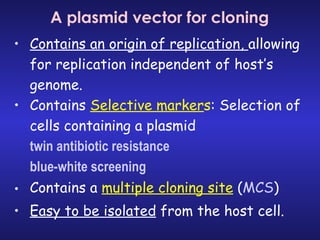
Contains an origin of replication,  allowing for replication independent of host’s genome. Contains  Selective marker s : Selection of cells containing a plasmid   twin antibiotic resistance blue-white screening Contains a  multiple cloning site  ( MCS ) Easy to be isolated  from the host cell. A plasmid vector for cloning
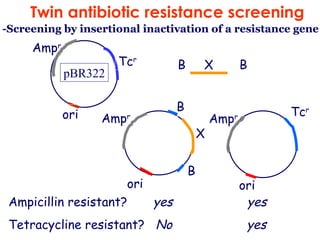
Ampicillin resistant?  yes   yes Tetracycline resistant?  No  yes B  X  B B B X Amp r ori Amp r Tc r ori -Screening by insertional inactivation of a resistance gene Twin antibiotic resistance screening Amp r Tc r ori pBR322
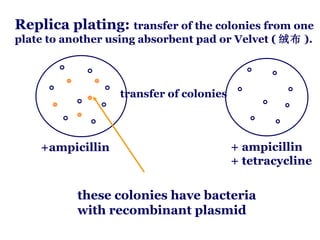
Replica plating:  transfer of the colonies from one plate to another using absorbent pad or Velvet ( 绒布 ). transfer of colonies +ampicillin + ampicillin + tetracycline these colonies have bacteria with recombinant plasmid
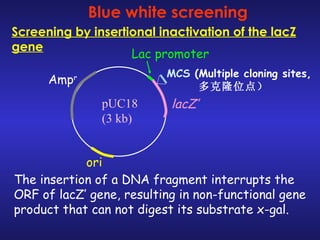
Blue white screening Amp r ori pUC18 (3 kb) MCS   (Multiple cloning sites, 多克隆位点) Lac promoter lacZ’ Screening by insertional inactivation of the lacZ gene The insertion of a DNA fragment interrupts the ORF of lacZ’ gene, resulting in non-functional gene product that can not digest its substrate x-gal.
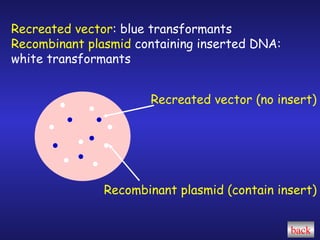
Recreated vector : blue transformants Recombinant plasmid  containing inserted DNA: white transformants Recreated vector (no insert) Recombinant plasmid (contain insert) back
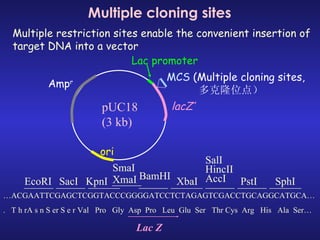
Multiple cloning sites Multiple restriction sites enable the convenient insertion of target DNA into a vector  Amp r ori pUC18 (3 kb) MCS   (Multiple cloning sites, 多克隆位点) Lac promoter lacZ’ … ACGAATTCGAGCTCGGTACCCGGGGATCCTCTAGAGTCGACCTGCAGGCATGCA… .  T h rA s n S er S e r Val  Pro  Gly  Asp  Pro  Leu  Glu  Ser  Thr Cys  Arg  His  Ala  Ser… EcoRI SacI KpnI SmaI XmaI BamHI XbaI SalI HincII AccI PstI SphI Lac Z
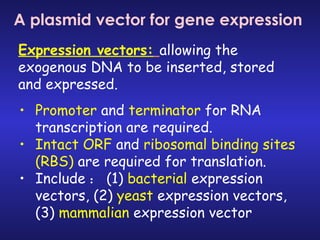
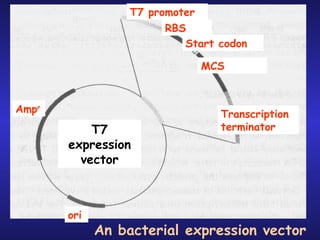
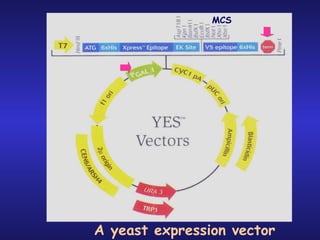
A plasmid vector for gene expression Expression vectors:   allowing the exogenous DNA to be inserted, stored and expressed.  Promoter  and  terminator  for RNA transcription are required. Intact ORF  and  ribosomal binding sites (RBS)  are required for translation. Include : (1)  bacterial  expression vectors, (2)  yeast  expression vectors, (3)  mammalian  expression vector
T7 promoter RBS Start codon MCS Transcription terminator Amp r ori T7 expression vector An bacterial expression vector
A yeast expression vector MCS
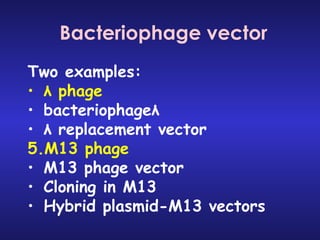
Bacteriophage vector Two examples: λ  phage   bacteriophage λ λ  replacement vector  M13 phage M13 phage vector Cloning in M13 Hybrid plasmid-M13 vectors
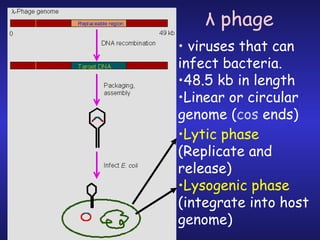
viruses that can infect bacteria.  48.5 kb in length Linear or circular genome ( cos  ends ) Lytic phase  (Replicate and release) Lysogenic phase  (integrate into host genome) λ  phage
Analysis of  eukaryotic  genes and the genome organization of eukaryotes requires  vectors with a   larger capacity for cloned DNA  than plasmids or phage   . Human genome (3 x 10 9  bp): large genome and large gene demand vectors with a large size capacity.  Cloning large DNA fragments (Eukaryotic Genome project)  Genomic library  VS  cDNA library
Cosmid vectors Utilizing the properties of the phage    cos  sites in a plasmid vector. A combination of the plasmid vector and the COS site which allows the target DNA to be inserted into the    head. The insert can be 37-52 kb
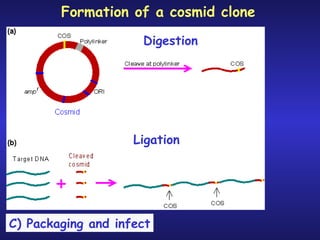
C) Packaging and infect Formation of a cosmid clone Digestion Ligation
YAC  vectors Accommodates genomic DNA fragments of more than 1 Mb, and can be used to clone the entire human genome, but not good in mapping and analysis. (yeast artificial chromosome)
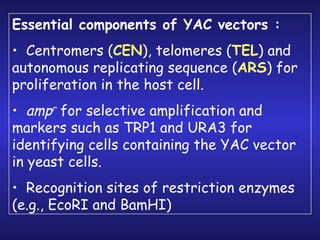
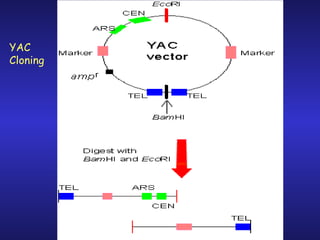
Essential components of YAC vectors : Centromers ( CEN ), telomeres ( TEL ) and autonomous replicating sequence ( ARS ) for proliferation in the host cell.  amp r  for selective amplification and markers such as TRP1 and URA3 for identifying cells containing the YAC vector in yeast cells.  Recognition sites of restriction enzymes (e.g., EcoRI and BamHI)
YAC Cloning
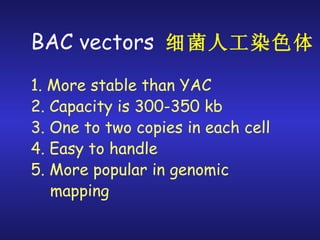
BAC vectors  细菌人工染色体 1. More stable than YAC 2. Capacity is 300-350 kb 3. One to two copies in each cell 4. Easy to handle 5. More popular in genomic mapping
I 1  Genomic libraries   I 1-1  Representative gene libraries  I 1-2  Size of library  I 1-3  Genomic DNA  I 1-4  Vectors Gene libraries and screening
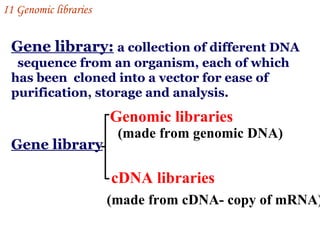
Gene library:   a collection of different DNA  sequence from an organism, each of which has been  cloned into a vector for ease of purification, storage and analysis. Genomic libraries cDNA libraries   Gene library (made from genomic DNA) (made from cDNA- copy of mRNA) I 1  Genomic libraries
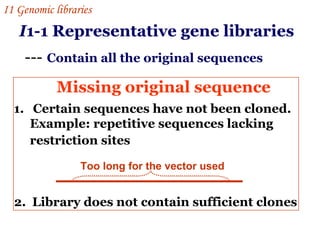
I 1-1 Representative gene libraries  ---  Contain all the original sequences Certain sequences have not been cloned. Example: repetitive sequences lacking restriction sites   2.  Library does not contain sufficient clones Missing original sequence Too long for the vector used I 1  Genomic libraries
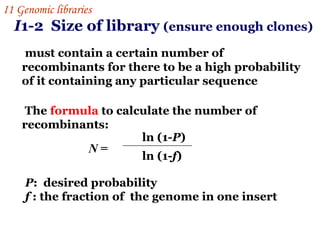
I 1-2  Size of library   (ensure enough clones) must contain a certain number of recombinants for there to be a high probability of it containing any particular sequence The  formula  to calculate the number of recombinants: N  = ln (1 - P ) ln (1- f ) P :  desired probability  f  : the fraction of  the genome in one insert  I 1  Genomic libraries
For example  :for a probability of  0.99  with insert sizes of  20 kb  these values for the  E.coli  (4.6 ×10 6  bp) and  human (3×10 9  bp)  genomes are : N  E.coli =  =  1.1 ×10 3  ln( 1-0.99) ln[1-(2×10 4 /4.6×10 6 )] N human =  =  6.9 ×10 5   ln(1-0.99) ln[1-(2 ×10 4 /3 ×10 9 )] These values explain why it is possible to make good genomic libraries from prokaryotes in plasmids where the insert size is 5-10kb ,as only a few thousand  recombinants will be needed.   I 1  Genomic libraries
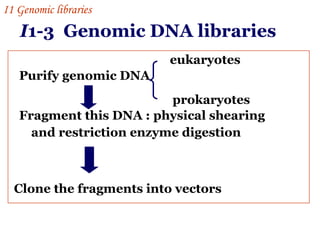
I 1-3  Genomic DNA libraries Purify genomic DNA Fragment this DNA : physical shearing and restriction enzyme digestion   eukaryotes prokaryotes Clone the fragments into vectors I 1  Genomic libraries
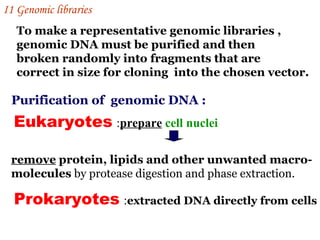
To make a representative genomic libraries , genomic DNA must be purified and then  broken randomly into fragments that are  correct in size for cloning  into the chosen vector .  Purification of  genomic DNA : Prokaryotes   : extracted DNA directly from cells   remove   protein, lipids and other unwanted macro- molecules  by protease digestion and phase extraction. Eukaryotes   : prepare   cell nuclei I 1  Genomic libraries
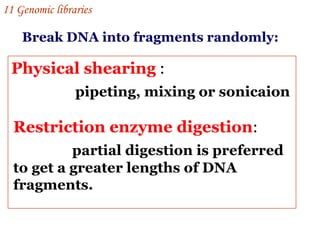
Break DNA into fragments randomly: Physical shearing  : pipeting, mixing or sonicaion   Restriction enzyme digestion :    partial digestion is preferred to get a greater lengths of DNA fragments. I 1  Genomic libraries
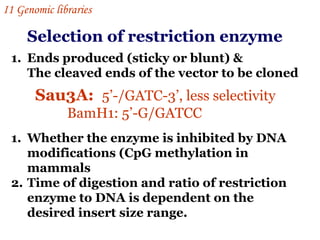
Sau3A:  5’-/GATC-3’, less selectivity BamH1: 5’-G/GATCC Selection of restriction enzyme Ends produced (sticky or blunt) & The cleaved ends of the vector to be cloned Whether the enzyme is inhibited by DNA modifications (CpG methylation in mammals Time of digestion and ratio of restriction enzyme to DNA is dependent on the desired insert size range. I 1  Genomic libraries
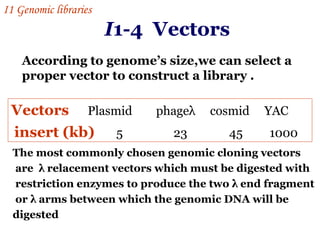
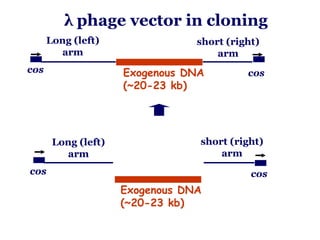
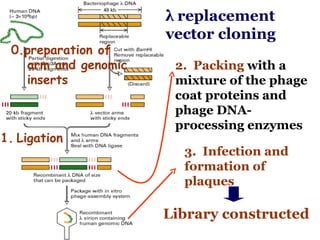
I 1-4  Vectors  According to genome’s size,we can select a proper vector to construct a library . Vectors   Plasmid  phageλ  cosmid  YAC insert (kb)   5  23  45  1000 The most commonly chosen genomic cloning vectors are  λ relacement vectors which must be digested with restriction enzymes to produce the two λ end fragment or λ arms between which the genomic DNA will be  digested I 1  Genomic libraries
cos cos Long (left) arm short (right) arm Exogenous DNA (~20-23 kb) λ  phage vector in cloning  cos cos Long (left) arm short (right) arm Exogenous DNA (~20-23 kb)
λ  replacement vector cloning 2.  Packing   with a mixture of the phage coat proteins and phage DNA-processing enzymes  3.   Infection and formation of plaques Library constructed Ligation 0.preparation of arm and genomic inserts
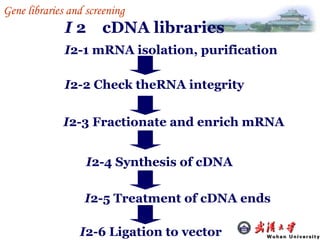
I  2  cDNA libraries I 2-1 mRNA isolation, purification I 2-2 Check theRNA integrity I 2-3 Fractionate and enrich mRNA I 2-4 Synthesis of cDNA  I 2-5 Treatment of cDNA ends I 2-6 Ligation to vector Gene libraries and screening
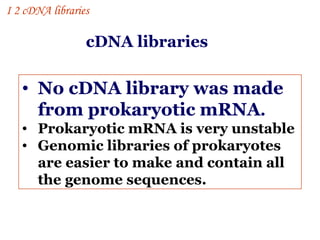
cDNA libraries No cDNA library was made from prokaryotic mRNA .   Prokaryotic mRNA is very unstable Genomic libraries of prokaryotes are easier to make and contain all the genome sequences. I  2 cDNA libraries
cDNA libraries are very useful for eukaryotic gene analysis   Condensed protein encoded gene libraries, have much less junk sequences. cDNAs have no introns    genes can be expressed in  E. coli  directly Are very useful to identify new genes Tissue or cell type specific  (differential expression of genes)  cDNA libraries I  2 cDNA libraries
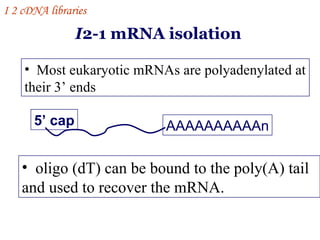
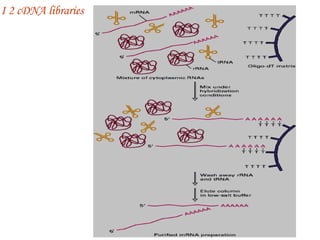
I 2-1 mRNA isolation I  2 cDNA libraries Most eukaryotic mRNAs are polyadenylated at their 3’ ends  oligo (dT) can be bound to the poly(A) tail and used to recover the mRNA. AAAAAAAAAAn 5’ cap
I  2 cDNA libraries
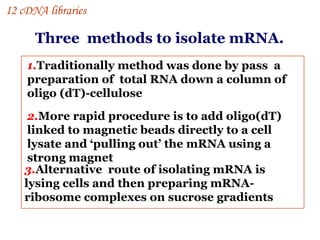
1. Traditionally method was done by pass  a preparation of  total RNA down a column of oligo (dT)-cellulose 2. More rapid procedure is to add oligo(dT) linked to magnetic beads directly to a cell lysate and ‘pulling out’ the mRNA using a strong magnet  3. Alternative  route of isolating mRNA is lysing cells and then preparing mRNA-ribosome complexes on sucrose gradients Three  methods to isolate mRNA. I 2 cDNA libraries
Make sure that the mRNA is not degraded.   Methods: Translating the mRNA  :  use cell-free translation system as wheat germ extract or rabbit reticulocyte lysate to see if the mRNAs can be translated Analysis the mRNAs by gel elctrophoresis :  use agarose or polyacrylamide gels   I 2-2 Check the mRNA integrity I 2  cDNA libraries
I 2-3 Cloning the particular mRNAs Is useful especially one is trying to clone a particular gene rather to make a complete cDNA library.  Fractionate on the gel:   performed on the basis of size, mRNAs of the interested sizes are recovered from agarose gels Enrichment:   carried out by hybridization Example: clone the hormone induced mRNAs (substrated cDNA library) I 2  cDNA libraries
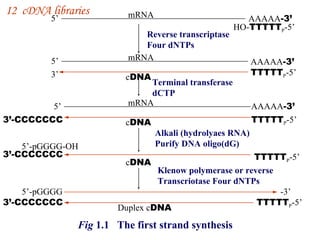
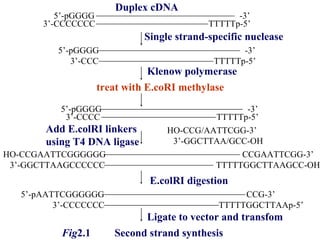
I 2-4 Synthesis of cDNA  : First stand synthesis:   materials as reverse  transcriptase ,primer( oligo(dT) or hexanucleotides) and dNTPs  ( Fig  1.1)   Second strand synthesis:   best way of making full-length cDNA is to ‘tail’ the 3’-end of the first strand and then use a complementary primer to make the second.   ( Fig 2.1 )  I 2  cDNA libraries
5’ mRNA   AAAAA -3’ HO- TTTTT P -5’ 5’ Reverse transcriptase Four dNTPs AAAAA -3’ TTTTT P -5’ mRNA   mRNA   c DNA c DNA c DNA Duplex c DNA AAAAA -3’ TTTTT P -5’ TTTTT P -5’ 3’ 3’-CCCCCCC Terminal transferase dCTP Alkali (hydrolyaes RNA) Purify DNA oligo(dG) Klenow polymerase or reverse Transcriotase Four dNTPs 5’-pGGGG-OH 5’ 3’-CCCCCCC 5’-pGGGG 3’-CCCCCCC TTTTT P -5’ -3’ Fig  1.1  The first strand synthesis I 2  cDNA libraries
5’-pGGGG 3’-CCCCCCC HO-CCGAATTCGGGGGG 3’-GGCTTAAGCCCCCC 5’-pAATTCGGGGGG TTTTTGGCTTAAGCC-OH CCGAATTCGG-3’ 3’-CCCC  3’-CCCCCCC 3’-CCC 5’-pGGGG 5’-pGGGG TTTTTp-5’ -3’ TTTTTp-5’ TTTTTp-5’ -3’ -3’ TTTTTGGCTTAAp-5’ HO-CCG/AATTCGG-3’ 3’-GGCTTAA/GCC-OH CCG-3’ Duplex cDNA Single strand-specific nuclease Klenow polymerase treat with E.coRI methylase Add E.colRI linkers  using T4 DNA ligase E.colRI digestion Ligate to vector and transfom Fig 2.1  Second strand synthesis
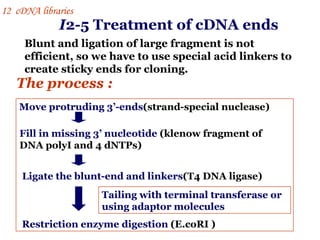
I 2-5 Treatment of cDNA ends Blunt and ligation of large fragment is not efficient, so we have to use special acid linkers to create sticky ends for cloning.  The process : Move protruding 3’-ends (strand-special nuclease) Fill in missing 3’ nucleotide   (klenow fragment of  DNA polyI and 4 dNTPs) Ligate the blunt-end and linkers (T4 DNA ligase) Restriction enzyme digestion   (E.coRI ) Tailing with terminal transferase or using adaptor molecules  I 2  cDNA libraries
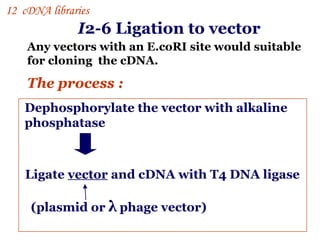
I 2-6 Ligation to vector   Any vectors with an E.coRI site would suitable for cloning  the cDNA. The process :   Dephosphorylate the vector with alkaline phosphatase  Ligate  vector  and cDNA with T4 DNA ligase (plasmid or  λ  phage vector) I 2  cDNA libraries
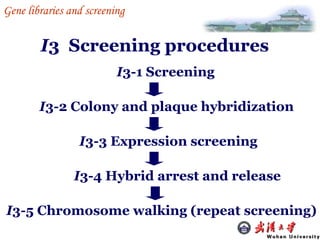
I 3  Screening procedures I 3-1 Screening I 3-2 Colony and plaque hybridization  I 3-3 Expression screening I 3-4 Hybrid arrest and release I 3-5 Chromosome walking (repeat screening) Gene libraries and screening
I 3-1  Screening  The process of identifying one particular clone containing the gene of  interest from among the very large number of others in the gene library .  Using  nucleic acid probe  to screen the library based on hybridization with nucleic acids.  Analyze the  protein product. I 3  Screening procedures
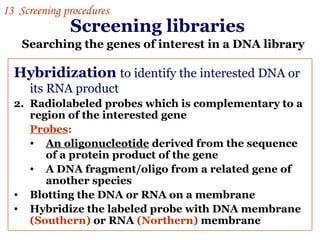
Screening libraries   Hybridization  to identify the interested DNA or its RNA product Radiolabeled probes which is complementary to a region of the interested gene Probes :   An oligonucleotide  derived from the sequence of a protein product of the gene A DNA fragment/oligo from a related gene of another species  Blotting the DNA or RNA on a membrane  Hybridize the labeled probe with DNA   membrane  (Southern)  or RNA  (Northern)  membrane Searching the genes of interest in a DNA library  I 3  Screening procedures
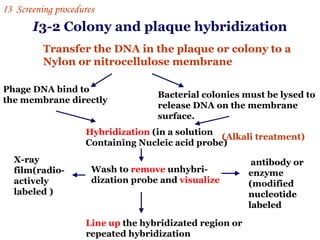
I 3-2 Colony and plaque hybridization  Transfer the DNA in the plaque or colony to a Nylon or nitrocellulose membrane Phage DNA bind to  the membrane directly  Bacterial colonies must be lysed to  release DNA on the membrane surface.  Hybridization  (in a solution  Containing Nucleic acid probe) Wash to  remove  unhybri- dization probe and  visualize   X-ray film(radio- actively labeled ) antibody or enzyme (modified nucleotide labeled  Line up  the hybridizated region or repeated hybridization  (Alkali treatment) I 3  Screening procedures
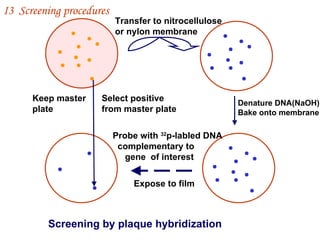
Transfer to nitrocellulose or nylon membrane Denature DNA(NaOH) Bake onto membrane Probe with  32 p-labled DNA  complementary to  gene  of interest Expose to film Select positive  from master plate Keep master  plate Screening by plaque hybridization I 3  Screening procedures
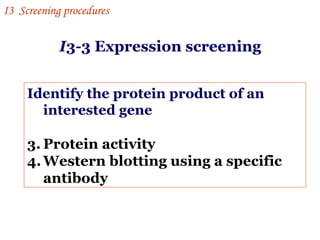
Identify the protein product of an interested gene Protein activity Western blotting using a specific antibody I 3  Screening procedures I 3-3 Expression screening
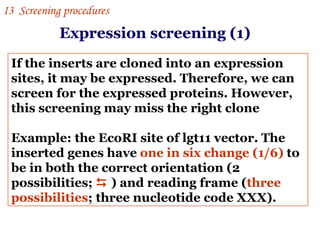
Expression screening (1) If the inserts are cloned into an expression sites, it may be expressed. Therefore, we can screen for the expressed proteins. However, this screening may miss the right clone Example: the EcoRI site of lgt11 vector. The inserted genes have  one in six change (1/6)  to be in both the correct orientation (2 possibilities;    ) and reading frame ( three possibilities ; three nucleotide code XXX). I 3  Screening procedures
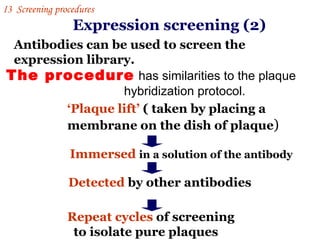
Expression screening (2) The procedure   has similarities to the plaque  hybridization protocol. ‘ Plaque lift’  ( taken by placing a  membrane on the dish of plaque ) Immersed   in a solution of the antibody Detected   by other antibodies   Repeat cycles  of screening  to isolate pure plaques  Antibodies can be used to screen the expression library. I 3  Screening procedures
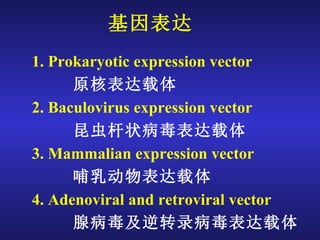
基因表达 1. Prokaryotic expression vector 原核表达载体 2. Baculovirus expression vector 昆虫杆状病毒表达载体 3. Mammalian expression vector 哺乳动物表达载体 4. Adenoviral and retroviral vector 腺病毒及逆转录病毒表达载体
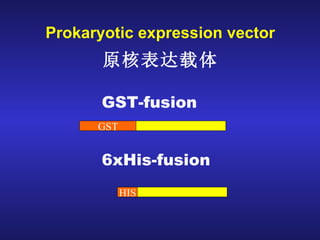
Prokaryotic expression vector 原核表达载体 GST-fusion 6xHis-fusion GST HIS
基因功能研究 Overexpression in cells   超表达,观察表型 RNAi   干扰技术 Yeast two hybrid system   酵母双杂交等技术寻找与目的基因相关的蛋白 Protein expression and antibody preparation 表达蛋白与抗体制备 Localization of protein   蛋白在细胞中的定位
The end

Application1

  • 1.
    Gene cloning, expression and functional study 基因克隆,表达及功能研究
  • 2.
    vectors Cloning vectors: 克隆载体 to clone a gene in a vector Expression vectors: 表达载体 to express a gene from a vector Integration vectors: 整合载体 to integrate a gene in a genome through a vector
  • 3.
    Cloning vectors 1 Plasmid vecters 2 Bacteriophage vectors 3 Cosmids & BACs 4 Eukaryotic vectors
  • 4.
    Cloning vectors: allowing the exogenous DNA to be inserted, stored, and manipulated mainly at DNA level. expression vectors: allowing the exogenous DNA to be inserted, stored, and expressed.
  • 5.
    Contains an originof replication, allowing for replication independent of host’s genome. Contains Selective marker s : Selection of cells containing a plasmid twin antibiotic resistance blue-white screening Contains a multiple cloning site ( MCS ) Easy to be isolated from the host cell. A plasmid vector for cloning
  • 6.
    Ampicillin resistant? yes yes Tetracycline resistant? No yes B X B B B X Amp r ori Amp r Tc r ori -Screening by insertional inactivation of a resistance gene Twin antibiotic resistance screening Amp r Tc r ori pBR322
  • 7.
    Replica plating: transfer of the colonies from one plate to another using absorbent pad or Velvet ( 绒布 ). transfer of colonies +ampicillin + ampicillin + tetracycline these colonies have bacteria with recombinant plasmid
  • 8.
    Blue white screeningAmp r ori pUC18 (3 kb) MCS (Multiple cloning sites, 多克隆位点) Lac promoter lacZ’ Screening by insertional inactivation of the lacZ gene The insertion of a DNA fragment interrupts the ORF of lacZ’ gene, resulting in non-functional gene product that can not digest its substrate x-gal.
  • 9.
    Recreated vector :blue transformants Recombinant plasmid containing inserted DNA: white transformants Recreated vector (no insert) Recombinant plasmid (contain insert) back
  • 10.
    Multiple cloning sitesMultiple restriction sites enable the convenient insertion of target DNA into a vector Amp r ori pUC18 (3 kb) MCS (Multiple cloning sites, 多克隆位点) Lac promoter lacZ’ … ACGAATTCGAGCTCGGTACCCGGGGATCCTCTAGAGTCGACCTGCAGGCATGCA… . T h rA s n S er S e r Val Pro Gly Asp Pro Leu Glu Ser Thr Cys Arg His Ala Ser… EcoRI SacI KpnI SmaI XmaI BamHI XbaI SalI HincII AccI PstI SphI Lac Z
  • 11.
    A plasmid vectorfor gene expression Expression vectors: allowing the exogenous DNA to be inserted, stored and expressed. Promoter and terminator for RNA transcription are required. Intact ORF and ribosomal binding sites (RBS) are required for translation. Include : (1) bacterial expression vectors, (2) yeast expression vectors, (3) mammalian expression vector
  • 12.
    T7 promoter RBSStart codon MCS Transcription terminator Amp r ori T7 expression vector An bacterial expression vector
  • 13.
  • 14.
    Bacteriophage vector Twoexamples: λ phage bacteriophage λ λ replacement vector M13 phage M13 phage vector Cloning in M13 Hybrid plasmid-M13 vectors
  • 15.
    viruses that caninfect bacteria. 48.5 kb in length Linear or circular genome ( cos ends ) Lytic phase (Replicate and release) Lysogenic phase (integrate into host genome) λ phage
  • 16.
    Analysis of eukaryotic genes and the genome organization of eukaryotes requires vectors with a larger capacity for cloned DNA than plasmids or phage  . Human genome (3 x 10 9 bp): large genome and large gene demand vectors with a large size capacity. Cloning large DNA fragments (Eukaryotic Genome project) Genomic library VS cDNA library
  • 17.
    Cosmid vectors Utilizingthe properties of the phage  cos sites in a plasmid vector. A combination of the plasmid vector and the COS site which allows the target DNA to be inserted into the  head. The insert can be 37-52 kb
  • 18.
    C) Packaging andinfect Formation of a cosmid clone Digestion Ligation
  • 19.
    YAC vectorsAccommodates genomic DNA fragments of more than 1 Mb, and can be used to clone the entire human genome, but not good in mapping and analysis. (yeast artificial chromosome)
  • 20.
    Essential components ofYAC vectors : Centromers ( CEN ), telomeres ( TEL ) and autonomous replicating sequence ( ARS ) for proliferation in the host cell. amp r for selective amplification and markers such as TRP1 and URA3 for identifying cells containing the YAC vector in yeast cells. Recognition sites of restriction enzymes (e.g., EcoRI and BamHI)
  • 21.
  • 22.
    BAC vectors 细菌人工染色体 1. More stable than YAC 2. Capacity is 300-350 kb 3. One to two copies in each cell 4. Easy to handle 5. More popular in genomic mapping
  • 23.
    I 1 Genomic libraries I 1-1 Representative gene libraries I 1-2 Size of library I 1-3 Genomic DNA I 1-4 Vectors Gene libraries and screening
  • 24.
    Gene library: a collection of different DNA sequence from an organism, each of which has been cloned into a vector for ease of purification, storage and analysis. Genomic libraries cDNA libraries Gene library (made from genomic DNA) (made from cDNA- copy of mRNA) I 1 Genomic libraries
  • 25.
    I 1-1 Representativegene libraries --- Contain all the original sequences Certain sequences have not been cloned. Example: repetitive sequences lacking restriction sites 2. Library does not contain sufficient clones Missing original sequence Too long for the vector used I 1 Genomic libraries
  • 26.
    I 1-2 Size of library (ensure enough clones) must contain a certain number of recombinants for there to be a high probability of it containing any particular sequence The formula to calculate the number of recombinants: N = ln (1 - P ) ln (1- f ) P : desired probability f : the fraction of the genome in one insert I 1 Genomic libraries
  • 27.
    For example :for a probability of 0.99 with insert sizes of 20 kb these values for the E.coli (4.6 ×10 6 bp) and human (3×10 9 bp) genomes are : N E.coli = = 1.1 ×10 3 ln( 1-0.99) ln[1-(2×10 4 /4.6×10 6 )] N human = = 6.9 ×10 5 ln(1-0.99) ln[1-(2 ×10 4 /3 ×10 9 )] These values explain why it is possible to make good genomic libraries from prokaryotes in plasmids where the insert size is 5-10kb ,as only a few thousand recombinants will be needed. I 1 Genomic libraries
  • 28.
    I 1-3 Genomic DNA libraries Purify genomic DNA Fragment this DNA : physical shearing and restriction enzyme digestion eukaryotes prokaryotes Clone the fragments into vectors I 1 Genomic libraries
  • 29.
    To make arepresentative genomic libraries , genomic DNA must be purified and then broken randomly into fragments that are correct in size for cloning into the chosen vector . Purification of genomic DNA : Prokaryotes : extracted DNA directly from cells remove protein, lipids and other unwanted macro- molecules by protease digestion and phase extraction. Eukaryotes : prepare cell nuclei I 1 Genomic libraries
  • 30.
    Break DNA intofragments randomly: Physical shearing : pipeting, mixing or sonicaion Restriction enzyme digestion : partial digestion is preferred to get a greater lengths of DNA fragments. I 1 Genomic libraries
  • 31.
    Sau3A: 5’-/GATC-3’,less selectivity BamH1: 5’-G/GATCC Selection of restriction enzyme Ends produced (sticky or blunt) & The cleaved ends of the vector to be cloned Whether the enzyme is inhibited by DNA modifications (CpG methylation in mammals Time of digestion and ratio of restriction enzyme to DNA is dependent on the desired insert size range. I 1 Genomic libraries
  • 32.
    I 1-4 Vectors According to genome’s size,we can select a proper vector to construct a library . Vectors Plasmid phageλ cosmid YAC insert (kb) 5 23 45 1000 The most commonly chosen genomic cloning vectors are λ relacement vectors which must be digested with restriction enzymes to produce the two λ end fragment or λ arms between which the genomic DNA will be digested I 1 Genomic libraries
  • 33.
    cos cos Long(left) arm short (right) arm Exogenous DNA (~20-23 kb) λ phage vector in cloning cos cos Long (left) arm short (right) arm Exogenous DNA (~20-23 kb)
  • 34.
    λ replacementvector cloning 2. Packing with a mixture of the phage coat proteins and phage DNA-processing enzymes 3. Infection and formation of plaques Library constructed Ligation 0.preparation of arm and genomic inserts
  • 35.
    I 2 cDNA libraries I 2-1 mRNA isolation, purification I 2-2 Check theRNA integrity I 2-3 Fractionate and enrich mRNA I 2-4 Synthesis of cDNA I 2-5 Treatment of cDNA ends I 2-6 Ligation to vector Gene libraries and screening
  • 36.
    cDNA libraries NocDNA library was made from prokaryotic mRNA . Prokaryotic mRNA is very unstable Genomic libraries of prokaryotes are easier to make and contain all the genome sequences. I 2 cDNA libraries
  • 37.
    cDNA libraries arevery useful for eukaryotic gene analysis Condensed protein encoded gene libraries, have much less junk sequences. cDNAs have no introns  genes can be expressed in E. coli directly Are very useful to identify new genes Tissue or cell type specific (differential expression of genes) cDNA libraries I 2 cDNA libraries
  • 38.
    I 2-1 mRNAisolation I 2 cDNA libraries Most eukaryotic mRNAs are polyadenylated at their 3’ ends oligo (dT) can be bound to the poly(A) tail and used to recover the mRNA. AAAAAAAAAAn 5’ cap
  • 39.
    I 2cDNA libraries
  • 40.
    1. Traditionally methodwas done by pass a preparation of total RNA down a column of oligo (dT)-cellulose 2. More rapid procedure is to add oligo(dT) linked to magnetic beads directly to a cell lysate and ‘pulling out’ the mRNA using a strong magnet 3. Alternative route of isolating mRNA is lysing cells and then preparing mRNA-ribosome complexes on sucrose gradients Three methods to isolate mRNA. I 2 cDNA libraries
  • 41.
    Make sure thatthe mRNA is not degraded. Methods: Translating the mRNA : use cell-free translation system as wheat germ extract or rabbit reticulocyte lysate to see if the mRNAs can be translated Analysis the mRNAs by gel elctrophoresis : use agarose or polyacrylamide gels I 2-2 Check the mRNA integrity I 2 cDNA libraries
  • 42.
    I 2-3 Cloningthe particular mRNAs Is useful especially one is trying to clone a particular gene rather to make a complete cDNA library. Fractionate on the gel: performed on the basis of size, mRNAs of the interested sizes are recovered from agarose gels Enrichment: carried out by hybridization Example: clone the hormone induced mRNAs (substrated cDNA library) I 2 cDNA libraries
  • 43.
    I 2-4 Synthesisof cDNA : First stand synthesis: materials as reverse transcriptase ,primer( oligo(dT) or hexanucleotides) and dNTPs ( Fig 1.1) Second strand synthesis: best way of making full-length cDNA is to ‘tail’ the 3’-end of the first strand and then use a complementary primer to make the second. ( Fig 2.1 ) I 2 cDNA libraries
  • 44.
    5’ mRNA AAAAA -3’ HO- TTTTT P -5’ 5’ Reverse transcriptase Four dNTPs AAAAA -3’ TTTTT P -5’ mRNA mRNA c DNA c DNA c DNA Duplex c DNA AAAAA -3’ TTTTT P -5’ TTTTT P -5’ 3’ 3’-CCCCCCC Terminal transferase dCTP Alkali (hydrolyaes RNA) Purify DNA oligo(dG) Klenow polymerase or reverse Transcriotase Four dNTPs 5’-pGGGG-OH 5’ 3’-CCCCCCC 5’-pGGGG 3’-CCCCCCC TTTTT P -5’ -3’ Fig 1.1 The first strand synthesis I 2 cDNA libraries
  • 45.
    5’-pGGGG 3’-CCCCCCC HO-CCGAATTCGGGGGG3’-GGCTTAAGCCCCCC 5’-pAATTCGGGGGG TTTTTGGCTTAAGCC-OH CCGAATTCGG-3’ 3’-CCCC 3’-CCCCCCC 3’-CCC 5’-pGGGG 5’-pGGGG TTTTTp-5’ -3’ TTTTTp-5’ TTTTTp-5’ -3’ -3’ TTTTTGGCTTAAp-5’ HO-CCG/AATTCGG-3’ 3’-GGCTTAA/GCC-OH CCG-3’ Duplex cDNA Single strand-specific nuclease Klenow polymerase treat with E.coRI methylase Add E.colRI linkers using T4 DNA ligase E.colRI digestion Ligate to vector and transfom Fig 2.1 Second strand synthesis
  • 46.
    I 2-5 Treatmentof cDNA ends Blunt and ligation of large fragment is not efficient, so we have to use special acid linkers to create sticky ends for cloning. The process : Move protruding 3’-ends (strand-special nuclease) Fill in missing 3’ nucleotide (klenow fragment of DNA polyI and 4 dNTPs) Ligate the blunt-end and linkers (T4 DNA ligase) Restriction enzyme digestion (E.coRI ) Tailing with terminal transferase or using adaptor molecules I 2 cDNA libraries
  • 47.
    I 2-6 Ligationto vector Any vectors with an E.coRI site would suitable for cloning the cDNA. The process : Dephosphorylate the vector with alkaline phosphatase Ligate vector and cDNA with T4 DNA ligase (plasmid or λ phage vector) I 2 cDNA libraries
  • 48.
    I 3 Screening procedures I 3-1 Screening I 3-2 Colony and plaque hybridization I 3-3 Expression screening I 3-4 Hybrid arrest and release I 3-5 Chromosome walking (repeat screening) Gene libraries and screening
  • 49.
    I 3-1 Screening The process of identifying one particular clone containing the gene of interest from among the very large number of others in the gene library . Using nucleic acid probe to screen the library based on hybridization with nucleic acids. Analyze the protein product. I 3 Screening procedures
  • 50.
    Screening libraries Hybridization to identify the interested DNA or its RNA product Radiolabeled probes which is complementary to a region of the interested gene Probes : An oligonucleotide derived from the sequence of a protein product of the gene A DNA fragment/oligo from a related gene of another species Blotting the DNA or RNA on a membrane Hybridize the labeled probe with DNA membrane (Southern) or RNA (Northern) membrane Searching the genes of interest in a DNA library I 3 Screening procedures
  • 51.
    I 3-2 Colonyand plaque hybridization Transfer the DNA in the plaque or colony to a Nylon or nitrocellulose membrane Phage DNA bind to the membrane directly Bacterial colonies must be lysed to release DNA on the membrane surface. Hybridization (in a solution Containing Nucleic acid probe) Wash to remove unhybri- dization probe and visualize X-ray film(radio- actively labeled ) antibody or enzyme (modified nucleotide labeled Line up the hybridizated region or repeated hybridization (Alkali treatment) I 3 Screening procedures
  • 52.
    Transfer to nitrocelluloseor nylon membrane Denature DNA(NaOH) Bake onto membrane Probe with 32 p-labled DNA complementary to gene of interest Expose to film Select positive from master plate Keep master plate Screening by plaque hybridization I 3 Screening procedures
  • 53.
    Identify the proteinproduct of an interested gene Protein activity Western blotting using a specific antibody I 3 Screening procedures I 3-3 Expression screening
  • 54.
    Expression screening (1)If the inserts are cloned into an expression sites, it may be expressed. Therefore, we can screen for the expressed proteins. However, this screening may miss the right clone Example: the EcoRI site of lgt11 vector. The inserted genes have one in six change (1/6) to be in both the correct orientation (2 possibilities;  ) and reading frame ( three possibilities ; three nucleotide code XXX). I 3 Screening procedures
  • 55.
    Expression screening (2)The procedure has similarities to the plaque hybridization protocol. ‘ Plaque lift’ ( taken by placing a membrane on the dish of plaque ) Immersed in a solution of the antibody Detected by other antibodies Repeat cycles of screening to isolate pure plaques Antibodies can be used to screen the expression library. I 3 Screening procedures
  • 56.
    基因表达 1. Prokaryoticexpression vector 原核表达载体 2. Baculovirus expression vector 昆虫杆状病毒表达载体 3. Mammalian expression vector 哺乳动物表达载体 4. Adenoviral and retroviral vector 腺病毒及逆转录病毒表达载体
  • 57.
    Prokaryotic expression vector原核表达载体 GST-fusion 6xHis-fusion GST HIS
  • 58.
    基因功能研究 Overexpression incells 超表达,观察表型 RNAi 干扰技术 Yeast two hybrid system 酵母双杂交等技术寻找与目的基因相关的蛋白 Protein expression and antibody preparation 表达蛋白与抗体制备 Localization of protein 蛋白在细胞中的定位
  • 59.