Unit-1: Classification and
Properties of Fuels
Prepared by
Ankur Sachdeva,
Assistant Professor, ME
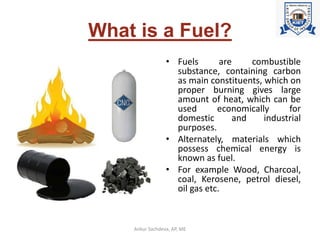
What is a Fuel?
• Fuels are combustible
substance, containing carbon
as main constituents, which on
proper burning gives large
amount of heat, which can be
used economically for
domestic and industrial
purposes.
• Alternately, materials which
possess chemical energy is
known as fuel.
• For example Wood, Charcoal,
coal, Kerosene, petrol diesel,
oil gas etc.
Ankur Sachdeva, AP, ME
Combustion of a fuel
• During the process of combustion of a fuel, the atom of carbon,
hydrogen etc. combine with oxygen with simultaneous liberation of
Heat at rapid rate.
• This energy is liberated due to the “rearrangement of valence
electrons” in these atoms, resulting in the formation of Compounds
like CO2 and H2O.
• These compounds have less energy (heat content) as compared to
reactants.
Ankur Sachdeva, AP, ME
FUEL + O2 PRODUCTS + HEAT
More heat energy content Lesser heat energy content
C (s) + O2(g) CO2(g) + DH= -94.1Kcal/mole
Classification of Fuels
Ankur Sachdeva, AP, ME
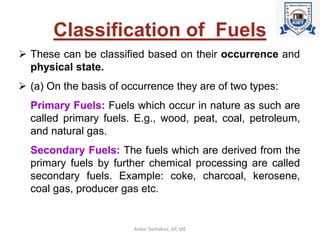
➢ These can be classified based on their occurrence and
physical state.
➢ (a) On the basis of occurrence they are of two types:
Primary Fuels: Fuels which occur in nature as such are
called primary fuels. E.g., wood, peat, coal, petroleum,
and natural gas.
Secondary Fuels: The fuels which are derived from the
primary fuels by further chemical processing are called
secondary fuels. Example: coke, charcoal, kerosene,
coal gas, producer gas etc.
Classification of Fuels
Ankur Sachdeva, AP, ME
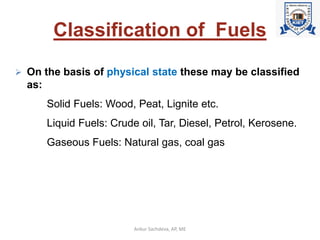
➢ On the basis of physical state these may be classified
as:
Solid Fuels: Wood, Peat, Lignite etc.
Liquid Fuels: Crude oil, Tar, Diesel, Petrol, Kerosene.
Gaseous Fuels: Natural gas, coal gas
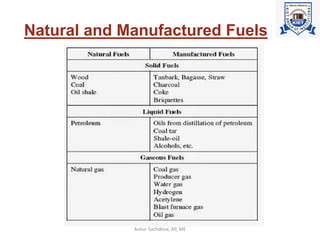
Natural and Manufactured Fuels
Ankur Sachdeva, AP, ME
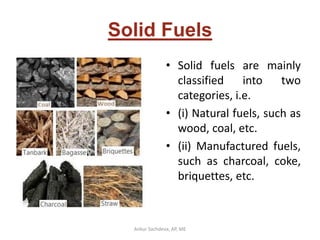
Solid Fuels
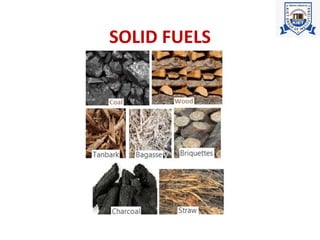
• Solid fuels are mainly
classified into two
categories, i.e.
• (i) Natural fuels, such as
wood, coal, etc.
• (ii) Manufactured fuels,
such as charcoal, coke,
briquettes, etc.
Ankur Sachdeva, AP, ME
Merits & Demerits of Solid Fuels
• The various advantages and disadvantages of solid fuels are given
below :
Advantages
(a) They are easy to transport.
(b) They are convenient to store without any risk of spontaneous
explosion.
(c) Their cost of production is low.
(d) They have moderate ignition temperature.
Disadvantages
(a) Their ash content is high.
(b) Their large proportion of heat is wasted.
(c) They burn with clinker formation.
(d) Their combustion operation cannot be controlled easily.
(e) Their cost of handling is high.
Ankur Sachdeva, AP, ME
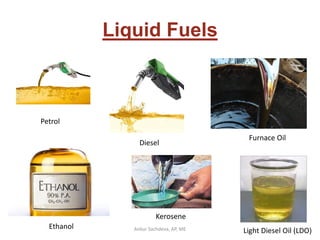
Liquid Fuels
Ankur Sachdeva, AP, ME
Petrol
Diesel
Furnace Oil
Ethanol
Kerosene
Light Diesel Oil (LDO)
Merits of Liquid Fuels
The liquid fuels can be classified as follows :
(a) Natural or crude oil, and
(b) Artificial or manufactured oils.
Advantages
(a) They possess higher calorific value per unit mass than solid fuels.
(b) They burn without dust, ash, clinkers, etc.
(c) Their firing is easier, and fire can be extinguished easily by stopping
liquid fuel supply.
(d) They are easy to transport through pipes.
(e) They can be stored indefinitely without any loss.
(f) They are clean in use and economic to handle.
(g) Loss of heat in chimney is very low due to greater cleanliness.
(h) They require less excess air for complete combustion.
(i) They require less furnace space for combustion.
Ankur Sachdeva, AP, ME
Demerits of Liquid Fuels
Disadvantages
(a) The cost of liquid fuel is relatively much higher as
compared to solid fuel.
(b) Costly special storage tanks are required for storing
liquid fuels.
(c) There is a greater risk of fire hazards, particularly, in
case of highly inflammable and volatile liquid fuels.
(d) They give bad odour.
(e) For efficient burning of liquid fuels, specially
constructed burners and spraying apparatus are required.
Ankur Sachdeva, AP, ME
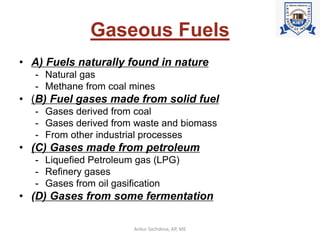
Gaseous Fuels
Ankur Sachdeva, AP, ME
• A) Fuels naturally found in nature
- Natural gas
- Methane from coal mines
• (B) Fuel gases made from solid fuel
- Gases derived from coal
- Gases derived from waste and biomass
- From other industrial processes
• (C) Gases made from petroleum
- Liquefied Petroleum gas (LPG)
- Refinery gases
- Gases from oil gasification
• (D) Gases from some fermentation
Merits of Gaseous Fuels
• Gaseous fuels occur in nature, besides being manufactured from
solid and liquid fuels.
Advantages:
(a) They can be conveyed easily through pipelines to the actual place
of need, thereby eliminating manual labour in transportation.
(b) They can be lighted at ease.
(c) They have high heat contents and hence help us in having higher
temperatures.
(d) They can be pre-heated by the heat of hot waste gases, thereby
affecting economy in heat.
(e) Their combustion can readily by controlled for change in demand
like oxidizing or reducing atmosphere, length flame, temperature, etc.
(f) They are clean in use.
(g) They do not require any special burner.
(h) They burn without any soot, or smoke and ashes.
(i) They are free from impurities found in solid and liquid fuels.
Ankur Sachdeva, AP, ME
Demerits of Gaseous Fuels
• Disadvantages
(a) Very large storage tanks are needed.
(b) They are highly inflammable, so chances of
fire hazards in their use is high.
Ankur Sachdeva, AP, ME
SOLID FUELS
Properties of Solid Fuel
• Fixed Carbon
• Volatile Matter
• Ash Content
• Moisture Content
• Combustion
Characteristics
• Ignition Temperature
• Calorific Value
• Carbon Content
• Hydrogen Content
• Oxygen Content
• Sulphur Content
• Nitrogen Content
Ankur Sachdeva, AP, ME
Wood
• Wood has been used as a
fuel from ancient times.
• Domestic fuel used in
tropical countries where
forest are abundant and
other fuels are not easily
and cheaply available.
• Due to large scale
deforestation, wood is no
longer in the boiler used
for producing steam.
Ankur Sachdeva, AP, ME
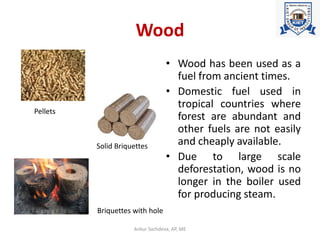
Briquettes with hole
Solid Briquettes
Pellets
Wood
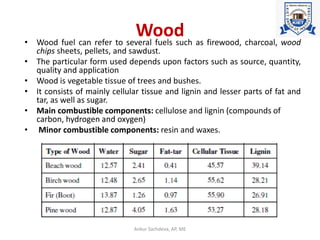
• Wood fuel can refer to several fuels such as firewood, charcoal, wood
chips sheets, pellets, and sawdust.
• The particular form used depends upon factors such as source, quantity,
quality and application
• Wood is vegetable tissue of trees and bushes.
• It consists of mainly cellular tissue and lignin and lesser parts of fat and
tar, as well as sugar.
• Main combustible components: cellulose and lignin (compounds of
carbon, hydrogen and oxygen)
• Minor combustible components: resin and waxes.
Ankur Sachdeva, AP, ME
Constituents of Wood
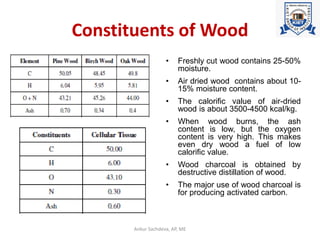
• Freshly cut wood contains 25-50%
moisture.
• Air dried wood contains about 10-
15% moisture content.
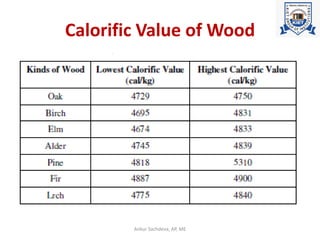
• The calorific value of air-dried
wood is about 3500-4500 kcal/kg.
• When wood burns, the ash
content is low, but the oxygen
content is very high. This makes
even dry wood a fuel of low
calorific value.
• Wood charcoal is obtained by
destructive distillation of wood.
• The major use of wood charcoal is
for producing activated carbon.
Ankur Sachdeva, AP, ME
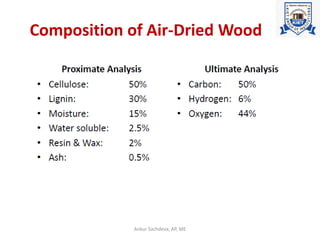
Composition of Air-Dried Wood
Ankur Sachdeva, AP, ME
Calorific Value of Wood
Ankur Sachdeva, AP, ME

Fuels, their types and characteristics .pdf

  • 1.
    Unit-1: Classification and Propertiesof Fuels Prepared by Ankur Sachdeva, Assistant Professor, ME
  • 2.
    What is aFuel? • Fuels are combustible substance, containing carbon as main constituents, which on proper burning gives large amount of heat, which can be used economically for domestic and industrial purposes. • Alternately, materials which possess chemical energy is known as fuel. • For example Wood, Charcoal, coal, Kerosene, petrol diesel, oil gas etc. Ankur Sachdeva, AP, ME
  • 3.
    Combustion of afuel • During the process of combustion of a fuel, the atom of carbon, hydrogen etc. combine with oxygen with simultaneous liberation of Heat at rapid rate. • This energy is liberated due to the “rearrangement of valence electrons” in these atoms, resulting in the formation of Compounds like CO2 and H2O. • These compounds have less energy (heat content) as compared to reactants. Ankur Sachdeva, AP, ME FUEL + O2 PRODUCTS + HEAT More heat energy content Lesser heat energy content C (s) + O2(g) CO2(g) + DH= -94.1Kcal/mole
  • 4.
    Classification of Fuels AnkurSachdeva, AP, ME ➢ These can be classified based on their occurrence and physical state. ➢ (a) On the basis of occurrence they are of two types: Primary Fuels: Fuels which occur in nature as such are called primary fuels. E.g., wood, peat, coal, petroleum, and natural gas. Secondary Fuels: The fuels which are derived from the primary fuels by further chemical processing are called secondary fuels. Example: coke, charcoal, kerosene, coal gas, producer gas etc.
  • 5.
    Classification of Fuels AnkurSachdeva, AP, ME ➢ On the basis of physical state these may be classified as: Solid Fuels: Wood, Peat, Lignite etc. Liquid Fuels: Crude oil, Tar, Diesel, Petrol, Kerosene. Gaseous Fuels: Natural gas, coal gas
  • 6.
    Natural and ManufacturedFuels Ankur Sachdeva, AP, ME
  • 7.
    Solid Fuels • Solidfuels are mainly classified into two categories, i.e. • (i) Natural fuels, such as wood, coal, etc. • (ii) Manufactured fuels, such as charcoal, coke, briquettes, etc. Ankur Sachdeva, AP, ME
  • 8.
    Merits & Demeritsof Solid Fuels • The various advantages and disadvantages of solid fuels are given below : Advantages (a) They are easy to transport. (b) They are convenient to store without any risk of spontaneous explosion. (c) Their cost of production is low. (d) They have moderate ignition temperature. Disadvantages (a) Their ash content is high. (b) Their large proportion of heat is wasted. (c) They burn with clinker formation. (d) Their combustion operation cannot be controlled easily. (e) Their cost of handling is high. Ankur Sachdeva, AP, ME
  • 9.
    Liquid Fuels Ankur Sachdeva,AP, ME Petrol Diesel Furnace Oil Ethanol Kerosene Light Diesel Oil (LDO)
  • 10.
    Merits of LiquidFuels The liquid fuels can be classified as follows : (a) Natural or crude oil, and (b) Artificial or manufactured oils. Advantages (a) They possess higher calorific value per unit mass than solid fuels. (b) They burn without dust, ash, clinkers, etc. (c) Their firing is easier, and fire can be extinguished easily by stopping liquid fuel supply. (d) They are easy to transport through pipes. (e) They can be stored indefinitely without any loss. (f) They are clean in use and economic to handle. (g) Loss of heat in chimney is very low due to greater cleanliness. (h) They require less excess air for complete combustion. (i) They require less furnace space for combustion. Ankur Sachdeva, AP, ME
  • 11.
    Demerits of LiquidFuels Disadvantages (a) The cost of liquid fuel is relatively much higher as compared to solid fuel. (b) Costly special storage tanks are required for storing liquid fuels. (c) There is a greater risk of fire hazards, particularly, in case of highly inflammable and volatile liquid fuels. (d) They give bad odour. (e) For efficient burning of liquid fuels, specially constructed burners and spraying apparatus are required. Ankur Sachdeva, AP, ME
  • 12.
    Gaseous Fuels Ankur Sachdeva,AP, ME • A) Fuels naturally found in nature - Natural gas - Methane from coal mines • (B) Fuel gases made from solid fuel - Gases derived from coal - Gases derived from waste and biomass - From other industrial processes • (C) Gases made from petroleum - Liquefied Petroleum gas (LPG) - Refinery gases - Gases from oil gasification • (D) Gases from some fermentation
  • 13.
    Merits of GaseousFuels • Gaseous fuels occur in nature, besides being manufactured from solid and liquid fuels. Advantages: (a) They can be conveyed easily through pipelines to the actual place of need, thereby eliminating manual labour in transportation. (b) They can be lighted at ease. (c) They have high heat contents and hence help us in having higher temperatures. (d) They can be pre-heated by the heat of hot waste gases, thereby affecting economy in heat. (e) Their combustion can readily by controlled for change in demand like oxidizing or reducing atmosphere, length flame, temperature, etc. (f) They are clean in use. (g) They do not require any special burner. (h) They burn without any soot, or smoke and ashes. (i) They are free from impurities found in solid and liquid fuels. Ankur Sachdeva, AP, ME
  • 14.
    Demerits of GaseousFuels • Disadvantages (a) Very large storage tanks are needed. (b) They are highly inflammable, so chances of fire hazards in their use is high. Ankur Sachdeva, AP, ME
  • 15.
  • 16.
    Properties of SolidFuel • Fixed Carbon • Volatile Matter • Ash Content • Moisture Content • Combustion Characteristics • Ignition Temperature • Calorific Value • Carbon Content • Hydrogen Content • Oxygen Content • Sulphur Content • Nitrogen Content Ankur Sachdeva, AP, ME
  • 17.
    Wood • Wood hasbeen used as a fuel from ancient times. • Domestic fuel used in tropical countries where forest are abundant and other fuels are not easily and cheaply available. • Due to large scale deforestation, wood is no longer in the boiler used for producing steam. Ankur Sachdeva, AP, ME Briquettes with hole Solid Briquettes Pellets
  • 18.
    Wood • Wood fuelcan refer to several fuels such as firewood, charcoal, wood chips sheets, pellets, and sawdust. • The particular form used depends upon factors such as source, quantity, quality and application • Wood is vegetable tissue of trees and bushes. • It consists of mainly cellular tissue and lignin and lesser parts of fat and tar, as well as sugar. • Main combustible components: cellulose and lignin (compounds of carbon, hydrogen and oxygen) • Minor combustible components: resin and waxes. Ankur Sachdeva, AP, ME
  • 19.
    Constituents of Wood •Freshly cut wood contains 25-50% moisture. • Air dried wood contains about 10- 15% moisture content. • The calorific value of air-dried wood is about 3500-4500 kcal/kg. • When wood burns, the ash content is low, but the oxygen content is very high. This makes even dry wood a fuel of low calorific value. • Wood charcoal is obtained by destructive distillation of wood. • The major use of wood charcoal is for producing activated carbon. Ankur Sachdeva, AP, ME
  • 20.
    Composition of Air-DriedWood Ankur Sachdeva, AP, ME
  • 21.
    Calorific Value ofWood Ankur Sachdeva, AP, ME