AYAZ KHAN
ROLL # 11EE58
CATALYTIC CRACKING
IN THE RESPEST OF : SIR SHER
MUHAMMAD GHOTO
Department of Energy and Environment engineering
Quaid-e-Awam University of Engineering,
Science and Technology, Nawabshah
Cracking:
1)Cracking is the name given to breaking up
large hydrocarbon molecules into smaller and
more useful bits. This is achieved by using high
pressures and temperatures without a catalyst,
or lower temperatures and pressures in the
presence of a catalyst.
Types of cracking
1)Thermal cracking(simplest in all).
2) Catalytic cracking( also shorty called cat cracking.
3)Steam cracking.
4)Hydro cracking.
all the process above vary in reactions so products is
also change mostly commonly used is catalytic cracking.
Why cracking process is carried out
1) To increase quality of fuel.
2) To increase quantity of lighterness.
3) To obtain more desirable products.
4) to decrease the amount of residuals.
Catalytic cracking:
 Catalytic reforming breaks complex hydrocarbons into
simpler ones molecules.
 Catalytic cracking comprises a complex network of
reactions, both intra-molecular and inter-molecular
 Use of a catalyst in the cracking reaction increase the
yield of improved quality under much less severe
operating conditions than in thermal cracking
 Typical temperatures are from 850 to 950F at much lower
pressure of 10 to 20 psi.
 The catalyst used in refinery units are typically solid
materials such as zeolite,aluminium hydrosilicate ,treated
bentonite clay etc that comes in the form of
powders,deads,pellets.
Cracking of petroleum
hydrocarbons was originally done
by thermal cracking, which has
been almost completely replaced
by catalytic cracking because it
produces more gasoline with a
higher octane rating.
There are three basic funtions in the
catalytic cracking process;
REACTION: feedstock reacts with
catalyst and cracks into different
hydrocarbons .
REGENERATION: catalyst is reactivated
by burning off coke
FRACTIONATION: cracked hydrocarbons
stream is separated into various
products.
TYPES OF CATALYTIC CRACKING:
1) FLUID CATALYTIC CRACKING(FCC)
2) MOVING BED CATALYTIC CRACKING.
3) THERMOFOR CATALYTIC CRACKING(TCC)
 1) FLUID CATALYTIC CRACKING:
 Fluid catalytic cracking (FCC) is one of the most important conversion processes
used in petroleum refineries. It is widely used to convert the high-boiling, high-
molecular weight hydrocarbon fractions of petroleum crude oils to more
valuable gasoline and other products.
 Oil is cracked in the presence of a finely divided catalyst, which is maintained in
an aerated or fluidized state by the oil vapours
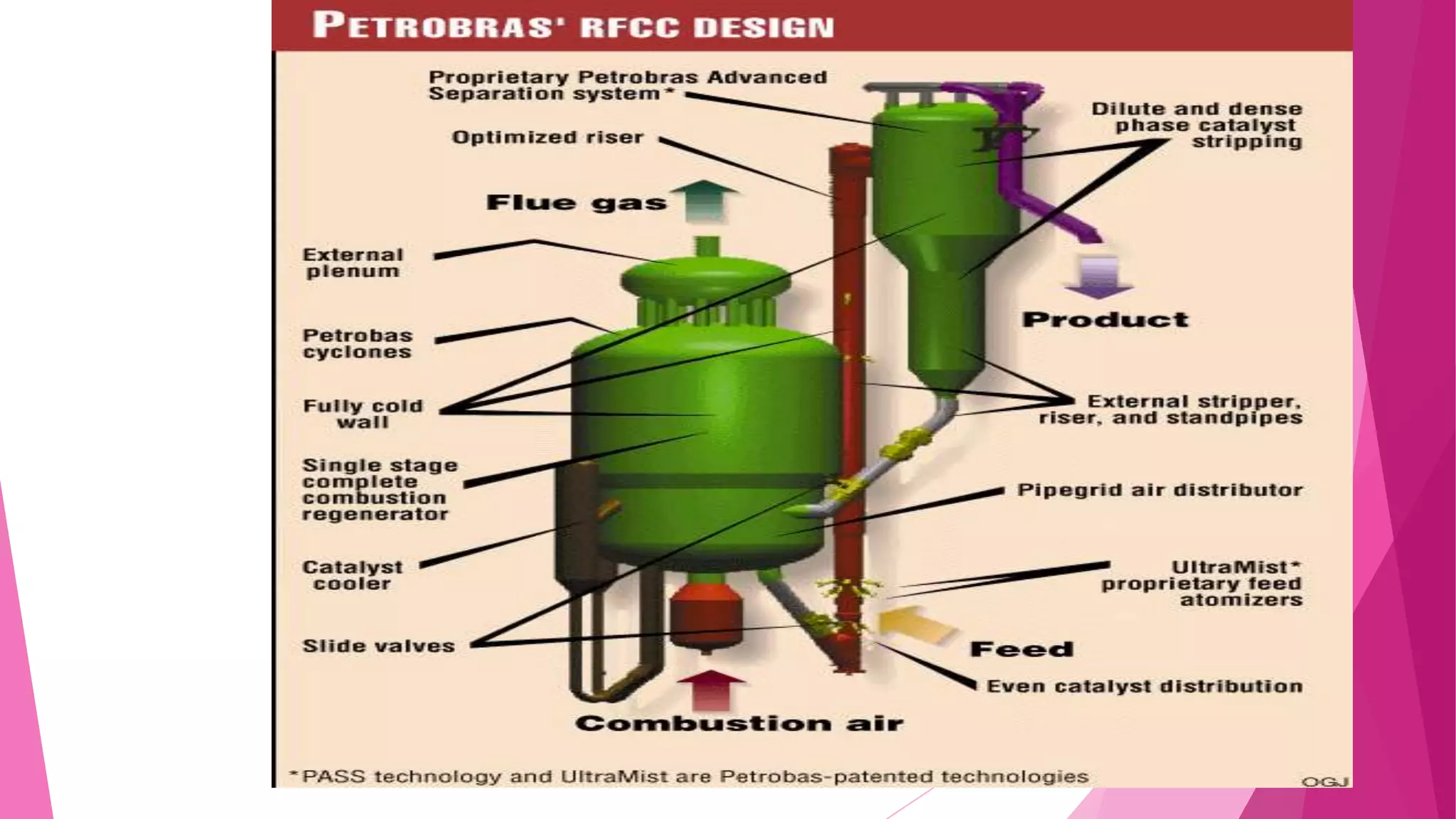
 The catalyst section contains the reactor and regenerator, which, with the
standpipe and riser, form the catalyst circulation unit. The fluid catalyst is
continuously circulated between the reactor and the regenerator.
As the mixture travels up the
riser, the charge is cracked at
10-30 PSI
Spent catalyst flows through the catalyst
stripper to the regenerator, where most of
the coke deposits burn off at the bottom
where preheated air and spent catalyst are
mixed
2) Moving bed catalytic cracking:
 The moving bed catalytic cracking process is similar to the FCC process . The catalyst is in the
form of pellets that are moved continuously to the top of the unit by conveyor or pneumatic
lift tubes to a storage hopper then flow downward by gravity through the reactor anf finally to
a regenerator.
 3) Thermofor catalytic cracking:
 in a typical thermofor catalytic cracking unit , the
preheated feedstock flows by gravity through the catalytic
reactor bed . The vapours are separated from the catalyst
and sent to a fractionating tower .the spent catalyst is
regenerated , cooled, and recycled .the flue gas from
regeneration is sent to a carbon monoxide boiler for heat
recovery.
Thank You

catalytic reforming

  • 2.
    AYAZ KHAN ROLL #11EE58 CATALYTIC CRACKING IN THE RESPEST OF : SIR SHER MUHAMMAD GHOTO Department of Energy and Environment engineering Quaid-e-Awam University of Engineering, Science and Technology, Nawabshah
  • 4.
    Cracking: 1)Cracking is thename given to breaking up large hydrocarbon molecules into smaller and more useful bits. This is achieved by using high pressures and temperatures without a catalyst, or lower temperatures and pressures in the presence of a catalyst. Types of cracking 1)Thermal cracking(simplest in all). 2) Catalytic cracking( also shorty called cat cracking. 3)Steam cracking. 4)Hydro cracking. all the process above vary in reactions so products is also change mostly commonly used is catalytic cracking.
  • 5.
    Why cracking processis carried out 1) To increase quality of fuel. 2) To increase quantity of lighterness. 3) To obtain more desirable products. 4) to decrease the amount of residuals.
  • 6.
    Catalytic cracking:  Catalyticreforming breaks complex hydrocarbons into simpler ones molecules.  Catalytic cracking comprises a complex network of reactions, both intra-molecular and inter-molecular  Use of a catalyst in the cracking reaction increase the yield of improved quality under much less severe operating conditions than in thermal cracking  Typical temperatures are from 850 to 950F at much lower pressure of 10 to 20 psi.  The catalyst used in refinery units are typically solid materials such as zeolite,aluminium hydrosilicate ,treated bentonite clay etc that comes in the form of powders,deads,pellets.
  • 7.
    Cracking of petroleum hydrocarbonswas originally done by thermal cracking, which has been almost completely replaced by catalytic cracking because it produces more gasoline with a higher octane rating.
  • 8.
    There are threebasic funtions in the catalytic cracking process; REACTION: feedstock reacts with catalyst and cracks into different hydrocarbons . REGENERATION: catalyst is reactivated by burning off coke FRACTIONATION: cracked hydrocarbons stream is separated into various products.
  • 9.
    TYPES OF CATALYTICCRACKING: 1) FLUID CATALYTIC CRACKING(FCC) 2) MOVING BED CATALYTIC CRACKING. 3) THERMOFOR CATALYTIC CRACKING(TCC)  1) FLUID CATALYTIC CRACKING:  Fluid catalytic cracking (FCC) is one of the most important conversion processes used in petroleum refineries. It is widely used to convert the high-boiling, high- molecular weight hydrocarbon fractions of petroleum crude oils to more valuable gasoline and other products.  Oil is cracked in the presence of a finely divided catalyst, which is maintained in an aerated or fluidized state by the oil vapours  The catalyst section contains the reactor and regenerator, which, with the standpipe and riser, form the catalyst circulation unit. The fluid catalyst is continuously circulated between the reactor and the regenerator.
  • 10.
    As the mixturetravels up the riser, the charge is cracked at 10-30 PSI
  • 16.
    Spent catalyst flowsthrough the catalyst stripper to the regenerator, where most of the coke deposits burn off at the bottom where preheated air and spent catalyst are mixed
  • 17.
    2) Moving bedcatalytic cracking:  The moving bed catalytic cracking process is similar to the FCC process . The catalyst is in the form of pellets that are moved continuously to the top of the unit by conveyor or pneumatic lift tubes to a storage hopper then flow downward by gravity through the reactor anf finally to a regenerator.
  • 18.
     3) Thermoforcatalytic cracking:  in a typical thermofor catalytic cracking unit , the preheated feedstock flows by gravity through the catalytic reactor bed . The vapours are separated from the catalyst and sent to a fractionating tower .the spent catalyst is regenerated , cooled, and recycled .the flue gas from regeneration is sent to a carbon monoxide boiler for heat recovery.
  • 19.