PERSONNEL MANAGEMENT
ALPHONCE PM (BMLS)
TUTORIAL ASSISTANT
PATHOLOGY DEPARTMENT-MUHAS
Personnel Management 1
Learning Objectives
By the end of this session, participants should be
able to;
Define the following terms:
Management
Laboratory Management
Personnel Management
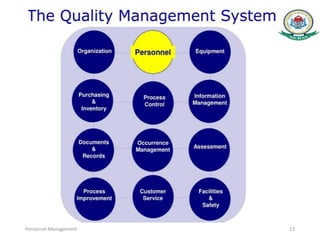
Quality Management System (QMS)
Mention elements of motivation
Describe recruitment process
Explain laboratory human resources planning
Personnel Management 2
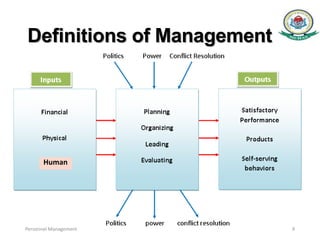
Definitions of Management
● It isvery difficult togiveaprecisedefinitionof theterm
‘m
anagem
ent’.
 Management involves the coordination and
integration of resources to accomplish specific results
 Management is a social process comprising a series
of actions that lead to the accomplishment of
objectives
 Management is defined as “Getting from where we
are to where we want to be with the least
expenditure of time, moneyand effort
Personnel Management 3
Definitions of Management
Management is the universal process of efficiently
getting activities completed with and through other
people
• Another definition which was formulated on
consensus is:
 Management is the guiding of human and
physical resources into dynamic organization
units that achieve their objectives to the
satisfaction of those served and with a high
degree of morale and sense of attainment on
the part of those rendering the service
Personnel Management 4
Definitions of Management
● The definitioncontains fourbasic elements:
 Toward objectives
 Through people
 Using techniques
 In an organization
Personnel Management 5
Definitions of Management
● Toward objectives
 Goals and purposes consistent with
efficient delivery of laboratory services for
quality healthcare.
● Through people
 Guiding "leading and directing" in such a
manner that these professional laboratory
technicians feel a sense of responsibilities and
attainment "achievement"
Personnel Management 6
Definitions of Management
● Using techniques
 Physical resources such as laboratory
equipment, computers, space and so forth
● Inanorganization
 Into dynamic organizational units implying
division of labor, specialization, protocols and
procedures, and functional processing units
Personnel Management 7
Definitions of Management
● It must be pointed out that management is an
activity, it is not letting each day take care of itself,
and rather it is making things happen
● Too often laboratory managers fall into the
trap of "fighting fires" on daily basis
● For management to be effective, and to ensure
efficient operation of the laboratory
 it must be in control,
 planning ahead the steps
Personnel Management 8
Definitions of Management
Personnel Management 9
Human
Laboratory Management
● Laboratory management: is the integration and
coordination of organizational resources so that
quality laboratory services can be provided as
effectively and efficiently as possible
● Organizational resources include personnel,
equipment, money, time and space
Personnel Management 10
Medical Laboratory
Services
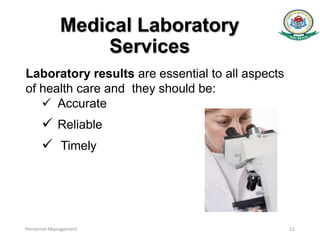
Laboratory results are essential to all aspects
of health care and they should be:
 Accurate
 Reliable
 Timely
Personnel Management 11
QUALITY MANAGEMENT
SYSTEM (QMS)
• QMS: is a systematic, integrated set of
activities to establish and control the
work processes from pre-analytical
through post-analytical processes,
manage resources, conduct evaluations,
and make continual improvements to
ensure consistent quality results
Personnel Management 12
Personnel Management 13
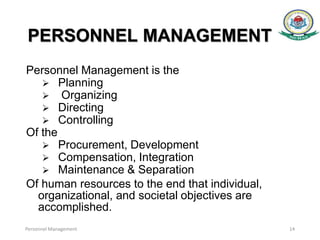
PERSONNEL MANAGEMENT
Personnel Management is the
 Planning
 Organizing
 Directing
 Controlling
Of the
 Procurement, Development
 Compensation, Integration
 Maintenance & Separation
Of human resources to the end that individual,
organizational, and societal objectives are
accomplished.
Personnel Management 14
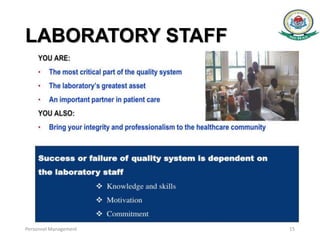
LABORATORY STAFF
Personnel Management 15
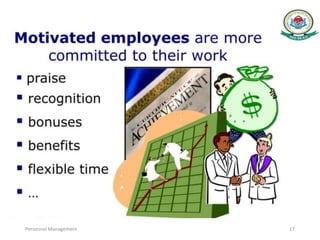
Importance of motivation
• Motivated employees are more likely
committed to their work.
Elements of motivation
– concrete rewards such as bonuses and
praise
– flexible work schedule
– Recognition
• The manager can motivate the team by
emphasizing that everyone’s job is important
Personnel Management 16
Personnel Management 17
Personnel Management 18
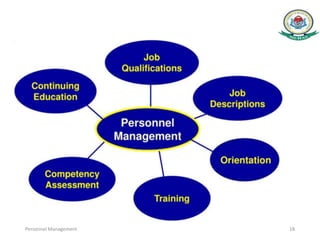
Role of laboratory director
• Hire an appropriate number of staff to
cover workload.
• Verify that items on the job application
are correct.
• Develop complete and thorough job
descriptions for each employee.
• Train each employee in their specific
duties.
Personnel Management 19
Role of laboratory director
• Provide orientation for new employees. Even
with a credible background, differences
between laboratories are common, so a
manager needs to assure new employees have
adequate orientation and training.
• Conduct and record competency assessments
on all personnel. It is management’s
responsibility to verify that trained employees
are sufficiently competent to do their work.
Personnel Management 20
Role of laboratory director
• Provide opportunities for continuing
education; new techniques or updates for
existing methods can be introduced using
continuing education courses.
• Conduct annual employee performance
appraisals.
Personnel Management 21
Role of Quality Manager
• provide employees with orientation and
training;
• keep track of employee records and
make sure they are confidential;
• include policies relevant to personnel in
the Quality Manual
Personnel Management 22
Role of laboratorian
• Participate in training and continuing
education opportunities.

• Request training that may be needed as
job responsibilities increase.
• Maintain records of personal professional
development.
Personnel Management 23
Staff Recruitment
• Management must establish appropriate
personnel qualifications for all positions in the
laboratory.
• These should include requirements for
– education, skills, knowledge, and
experience.
• When defining qualifications, keep in mind any
special skills and knowledge that are needed
such as language, information technology, and
biosafety.
Personnel Management 24
Staff Retention
• Migration and turn-over of staff have been
described as major challenges in many
countries.
• Reasons
 Economic factors,
Lack of good working environment
 Improper management practices can
contribute to loss of staff.
• A good personnel management program can
contribute to the retention of staff.
Personnel Management 25
Orientation
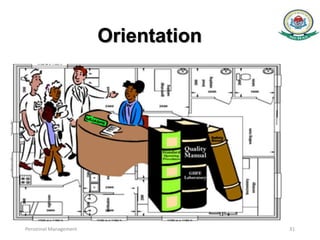
• Orientation is the process of introducing
a new staff member to the new work
environment and to their specific tasks or
duties.
• Nothing is more frustrating to an
employee than not knowing where to find
the necessary resources.
• Orientation is different from training.
Personnel Management 26
Orientation
• Orientation of laboratory personnel should include
the following aspects:
General orientation:
A tour of the workplace and introduction to all
management and staff. Information about
How the organization fits into the medical
community and/or the public health system
 Key personnel and lines of authority
 The laboratory interaction with both users and
customers of the laboratory;
The policies and procedures regarding facilities
and safety.
Personnel Management 27
Orientation
Personnel policies:
Ethics
Confidentiality
 Employee benefits
Work schedules
Personnel Management 28
Orientation
• An employee handbook that outlines the
policies of the organization and
information about the laboratory quality
system.
• A copy of the employee’s job description
and a detailed review of its contents.
• An overview of standard operating
procedures (SOPs).
Personnel Management 29
Orientation
• A checklist that addresses each aspect of
the orientation is important.
• Ask employees to initial and date the
checklist to document discussion of each
topic.
Personnel Management 30
Orientation
Personnel Management 31
Personnel Management 32
Personnel Management 33

PERSONNEL MANAGEMENT 2023.pptx

  • 1.
    PERSONNEL MANAGEMENT ALPHONCE PM(BMLS) TUTORIAL ASSISTANT PATHOLOGY DEPARTMENT-MUHAS Personnel Management 1
  • 2.
    Learning Objectives By theend of this session, participants should be able to; Define the following terms: Management Laboratory Management Personnel Management Quality Management System (QMS) Mention elements of motivation Describe recruitment process Explain laboratory human resources planning Personnel Management 2
  • 3.
    Definitions of Management ●It isvery difficult togiveaprecisedefinitionof theterm ‘m anagem ent’.  Management involves the coordination and integration of resources to accomplish specific results  Management is a social process comprising a series of actions that lead to the accomplishment of objectives  Management is defined as “Getting from where we are to where we want to be with the least expenditure of time, moneyand effort Personnel Management 3
  • 4.
    Definitions of Management Managementis the universal process of efficiently getting activities completed with and through other people • Another definition which was formulated on consensus is:  Management is the guiding of human and physical resources into dynamic organization units that achieve their objectives to the satisfaction of those served and with a high degree of morale and sense of attainment on the part of those rendering the service Personnel Management 4
  • 5.
    Definitions of Management ●The definitioncontains fourbasic elements:  Toward objectives  Through people  Using techniques  In an organization Personnel Management 5
  • 6.
    Definitions of Management ●Toward objectives  Goals and purposes consistent with efficient delivery of laboratory services for quality healthcare. ● Through people  Guiding "leading and directing" in such a manner that these professional laboratory technicians feel a sense of responsibilities and attainment "achievement" Personnel Management 6
  • 7.
    Definitions of Management ●Using techniques  Physical resources such as laboratory equipment, computers, space and so forth ● Inanorganization  Into dynamic organizational units implying division of labor, specialization, protocols and procedures, and functional processing units Personnel Management 7
  • 8.
    Definitions of Management ●It must be pointed out that management is an activity, it is not letting each day take care of itself, and rather it is making things happen ● Too often laboratory managers fall into the trap of "fighting fires" on daily basis ● For management to be effective, and to ensure efficient operation of the laboratory  it must be in control,  planning ahead the steps Personnel Management 8
  • 9.
  • 10.
    Laboratory Management ● Laboratorymanagement: is the integration and coordination of organizational resources so that quality laboratory services can be provided as effectively and efficiently as possible ● Organizational resources include personnel, equipment, money, time and space Personnel Management 10
  • 11.
    Medical Laboratory Services Laboratory resultsare essential to all aspects of health care and they should be:  Accurate  Reliable  Timely Personnel Management 11
  • 12.
    QUALITY MANAGEMENT SYSTEM (QMS) •QMS: is a systematic, integrated set of activities to establish and control the work processes from pre-analytical through post-analytical processes, manage resources, conduct evaluations, and make continual improvements to ensure consistent quality results Personnel Management 12
  • 13.
  • 14.
    PERSONNEL MANAGEMENT Personnel Managementis the  Planning  Organizing  Directing  Controlling Of the  Procurement, Development  Compensation, Integration  Maintenance & Separation Of human resources to the end that individual, organizational, and societal objectives are accomplished. Personnel Management 14
  • 15.
  • 16.
    Importance of motivation •Motivated employees are more likely committed to their work. Elements of motivation – concrete rewards such as bonuses and praise – flexible work schedule – Recognition • The manager can motivate the team by emphasizing that everyone’s job is important Personnel Management 16
  • 17.
  • 18.
  • 19.
    Role of laboratorydirector • Hire an appropriate number of staff to cover workload. • Verify that items on the job application are correct. • Develop complete and thorough job descriptions for each employee. • Train each employee in their specific duties. Personnel Management 19
  • 20.
    Role of laboratorydirector • Provide orientation for new employees. Even with a credible background, differences between laboratories are common, so a manager needs to assure new employees have adequate orientation and training. • Conduct and record competency assessments on all personnel. It is management’s responsibility to verify that trained employees are sufficiently competent to do their work. Personnel Management 20
  • 21.
    Role of laboratorydirector • Provide opportunities for continuing education; new techniques or updates for existing methods can be introduced using continuing education courses. • Conduct annual employee performance appraisals. Personnel Management 21
  • 22.
    Role of QualityManager • provide employees with orientation and training; • keep track of employee records and make sure they are confidential; • include policies relevant to personnel in the Quality Manual Personnel Management 22
  • 23.
    Role of laboratorian •Participate in training and continuing education opportunities. • Request training that may be needed as job responsibilities increase. • Maintain records of personal professional development. Personnel Management 23
  • 24.
    Staff Recruitment • Managementmust establish appropriate personnel qualifications for all positions in the laboratory. • These should include requirements for – education, skills, knowledge, and experience. • When defining qualifications, keep in mind any special skills and knowledge that are needed such as language, information technology, and biosafety. Personnel Management 24
  • 25.
    Staff Retention • Migrationand turn-over of staff have been described as major challenges in many countries. • Reasons  Economic factors, Lack of good working environment  Improper management practices can contribute to loss of staff. • A good personnel management program can contribute to the retention of staff. Personnel Management 25
  • 26.
    Orientation • Orientation isthe process of introducing a new staff member to the new work environment and to their specific tasks or duties. • Nothing is more frustrating to an employee than not knowing where to find the necessary resources. • Orientation is different from training. Personnel Management 26
  • 27.
    Orientation • Orientation oflaboratory personnel should include the following aspects: General orientation: A tour of the workplace and introduction to all management and staff. Information about How the organization fits into the medical community and/or the public health system  Key personnel and lines of authority  The laboratory interaction with both users and customers of the laboratory; The policies and procedures regarding facilities and safety. Personnel Management 27
  • 28.
    Orientation Personnel policies: Ethics Confidentiality  Employeebenefits Work schedules Personnel Management 28
  • 29.
    Orientation • An employeehandbook that outlines the policies of the organization and information about the laboratory quality system. • A copy of the employee’s job description and a detailed review of its contents. • An overview of standard operating procedures (SOPs). Personnel Management 29
  • 30.
    Orientation • A checklistthat addresses each aspect of the orientation is important. • Ask employees to initial and date the checklist to document discussion of each topic. Personnel Management 30
  • 31.
  • 32.
  • 33.