Check cell, Preparation
and Importance
Group members
Farrukh Siyyer
Shahzaib
Hammad Hassan
Habiba Faraz
Rehan Asghar
Introduction
• Checks cells are those red blood cells that have immunoglobulins on
there surface
• These are also called sensitized red blood cells
• The antibodies that are attached on the surface of red blood cells are
IgG antibodies
• These antibodies are also called incomplete antibodies because they do
not show agglutination in saline bodies
Purpose
• These are used as the control of coombs test or cross match
• The check cells are used when the coombs test is negative to check its
validity
• When the checks are added if it cause agglutination then it means
test is valid
• If it does not cause agglutination it means the test has false result
Preparation
Material required:
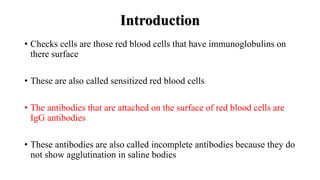
• O + red blood cells
• Test tubes
• Rh antibodies IGg
Normal saline
Procedure
• Pool O + red blood cells are required for check cells preparation
• For this purpose we take the blood from 10 O + people because every
person have different concentration of Rh + antigens this is called
pooling
• The blood is taken in the test tube and washed 3 times by normal
saline to get maximum concentration of Rh + antigens on red cells
surface
• Then we take 1ml red blood cells from the tube that are pure red blood cells
• Then we add one to two drops IGg antibodies in these red cells and incubate
at 37 ℃
• So the IGg antibodies attached to the red cells surface but some may remain
unattached
• In order to remove these unattached antibodies again we wash the red cells
with normal saline
• Then we obtain red cells that have antibodies attached on its surface these red
cells are called check cells
• These check cells can be used for 7 days if these
are stored at 2-6℃
• These can be used for 24 hours if it is kept at
25℃
• The tube should not be exposed to room
temperature it is used in elequates
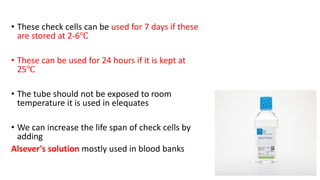
• We can increase the life span of check cells by
adding
Alsever's solution mostly used in blood banks
Importance
• Functional validation of AHG reagents
• Procedural validation of Test
• Direct coombs test
• Compatibility testing
• Antibody screening
• Detection of Du red cells
Thank You

Check cell, Preparation and Importance.pptx

  • 1.
    Check cell, Preparation andImportance Group members Farrukh Siyyer Shahzaib Hammad Hassan Habiba Faraz Rehan Asghar
  • 2.
    Introduction • Checks cellsare those red blood cells that have immunoglobulins on there surface • These are also called sensitized red blood cells • The antibodies that are attached on the surface of red blood cells are IgG antibodies • These antibodies are also called incomplete antibodies because they do not show agglutination in saline bodies
  • 3.
    Purpose • These areused as the control of coombs test or cross match • The check cells are used when the coombs test is negative to check its validity • When the checks are added if it cause agglutination then it means test is valid • If it does not cause agglutination it means the test has false result
  • 4.
    Preparation Material required: • O+ red blood cells • Test tubes
  • 5.
    • Rh antibodiesIGg Normal saline
  • 6.
    Procedure • Pool O+ red blood cells are required for check cells preparation • For this purpose we take the blood from 10 O + people because every person have different concentration of Rh + antigens this is called pooling • The blood is taken in the test tube and washed 3 times by normal saline to get maximum concentration of Rh + antigens on red cells surface
  • 7.
    • Then wetake 1ml red blood cells from the tube that are pure red blood cells • Then we add one to two drops IGg antibodies in these red cells and incubate at 37 ℃ • So the IGg antibodies attached to the red cells surface but some may remain unattached • In order to remove these unattached antibodies again we wash the red cells with normal saline • Then we obtain red cells that have antibodies attached on its surface these red cells are called check cells
  • 8.
    • These checkcells can be used for 7 days if these are stored at 2-6℃ • These can be used for 24 hours if it is kept at 25℃ • The tube should not be exposed to room temperature it is used in elequates • We can increase the life span of check cells by adding Alsever's solution mostly used in blood banks
  • 9.
    Importance • Functional validationof AHG reagents • Procedural validation of Test • Direct coombs test • Compatibility testing • Antibody screening • Detection of Du red cells
  • 10.