DR LUKMAN SHITTU
DEPT OF CHEMICAL
PATHOLOGY
DR LUKMAN SHITTU
DEPT OF CHEMICAL PATHOLOGY
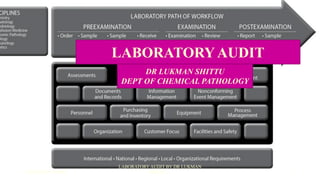
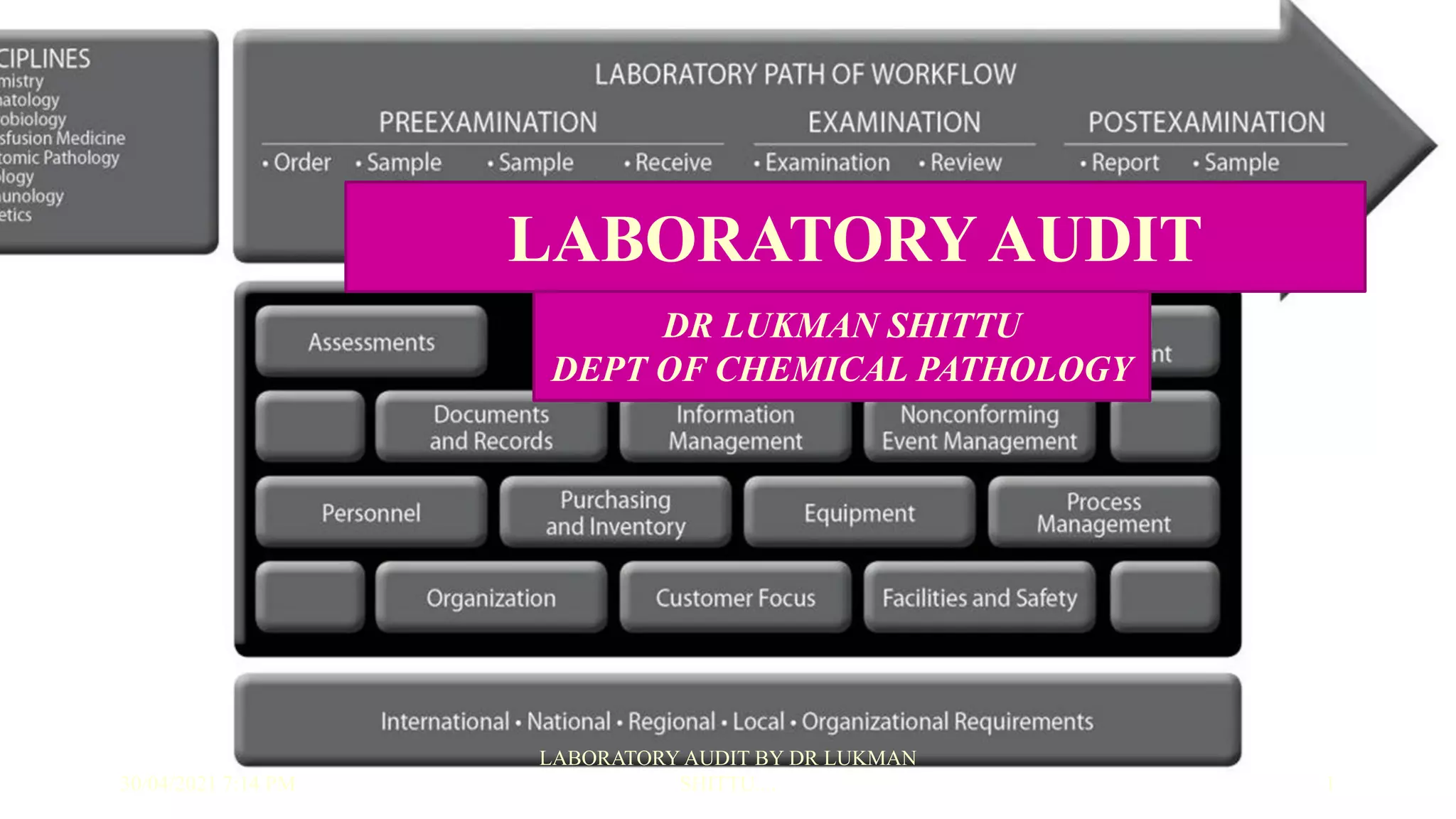
LABORATORY AUDIT
30/04/2021 7:14 PM
LABORATORY AUDIT BY DR LUKMAN
SHITTU.... 1
OUTLINE
INTRODUCTION
TYPES OF AUDIT
INTERNAL AUDIT
EXTERNAL AUDIT
SUDDEN
ESSENTIAL RE
RESPONSIBILITY
WITNESSING
ISO REQUIRED
INTERNAL AUDIT
OBJECTIVES
AUDIT PROCESS
EXTERNAL AUDIT SUMMARY REFERENCES
30/04/2021 7:14 PM
LABORATORY AUDIT BY DR LUKMAN
SHITTU.... 2
INTRODUCTION….
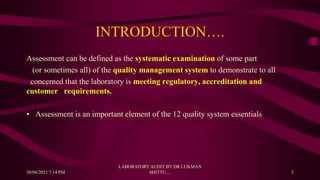
Assessment can be defined as the systematic examination of some part
(or sometimes all) of the quality management system to demonstrate to all
concerned that the laboratory is meeting regulatory, accreditation and
customer requirements.
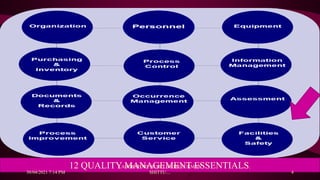
• Assessment is an important element of the 12 quality system essentials
30/04/2021 7:14 PM
LABORATORY AUDIT BY DR LUKMAN
SHITTU.... 3
INTRODUCTION……
12 QUALITY MANAGEMENT ESSENTIALS.
30/04/2021 7:14 PM
LABORATORY AUDIT BY DR LUKMAN
SHITTU.... 4
INTRODUCTION……
• Assessment can be achieved by;
• Laboratory accreditation.
• External quality assessment or proficiency testing.
• Laboratory audit.
30/04/2021 7:14 PM
LABORATORY AUDIT BY DR LUKMAN
SHITTU.... 5
INTRODUCTION…
• LABORATORY AUDIT is defined as a planned and
documented activity performed in accordance with written
procedures and check-lists to verify by investigation, and
the examination and evaluation of objective evidence, that
applicable elements of a quality assurance programme
have been developed, documented and implemented.
•
30/04/2021 7:14 PM
LABORATORY AUDIT BY DR LUKMAN
SHITTU.... 6
INTRODUCTION….
• Audit is an essential part of the quality assurance program
of a laboratory.
• A quality assurance program covers all aspects of the
service provided.
• Audit is a means of assessing whether one is achieving
one's stated objectives.
30/04/2021 7:14 PM
LABORATORY AUDIT BY DR LUKMAN
SHITTU.... 7
INTRODUCTION….
• Total Quality Management involves comprehensive quality
assurance programme which must include The Quality System
Essentials, with the development, documentation and
implementation of General Guidelines and Standards Operating
Procedures (SOP) .
• Internal Audit is a component of TQM and involves the process of
Monitoring and Evaluation of the implementation of developed
guideline and SOP.
30/04/2021 7:14 PM
LABORATORY AUDIT BY DR LUKMAN
SHITTU.... 8
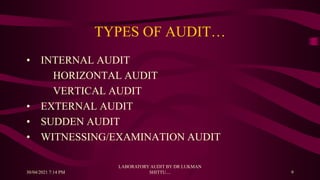
TYPES OF AUDIT…
• INTERNAL AUDIT
HORIZONTAL AUDIT
VERTICAL AUDIT
• EXTERNAL AUDIT
• SUDDEN AUDIT
• WITNESSING/EXAMINATION AUDIT
30/04/2021 7:14 PM
LABORATORY AUDIT BY DR LUKMAN
SHITTU.... 9
TYPES OF AUDIT…
EXTERNAL AUDIT:
• Assessments conducted by groups or agencies from outside
the laboratories are called external audits.
• They can include assessments for the purpose of
accreditation, certification or licensure
30/04/2021 7:14 PM
LABORATORY AUDIT BY DR LUKMAN
SHITTU.... 10
INTERNAL AUDIT
• A type of assessment of a laboratory where staff working in one area of the
laboratory conduct assessments on another area of the same laboratory.
• This provides information quickly and easily on how the laboratory is
performing and whether it is in compliance with policy requirements.
• Both horizontal and vertical audits should be carried out.
30/04/2021 7:14 PM
LABORATORY AUDIT BY DR LUKMAN
SHITTU.... 11
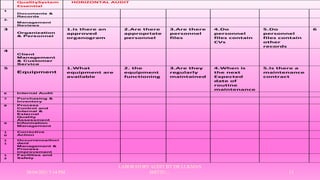
HORIZONTAL AUDITS:
• Checking one aspect of the Quality System (for example,
equipment), for all the associated requirements.
30/04/2021 7:14 PM
LABORATORY AUDIT BY DR LUKMAN
SHITTU.... 12
QualitySystem
Essential
HORIZONTAL AUDIT
1
Documents &
Records
2.
Management
Reviews
3
Organization
& Personnel
1.Is there an
approved
organogram
2.Are there
appropriate
personnel
3.Are there
personnel
files
4.Do
personnel
files contain
CVs
5.Do
personnel
files contain
other
records
6
4
Client
Management
& Customer
Service
5
Equipment
1.What
equipment are
available
2. the
equipment
functioning
3.Are they
regularly
maintained
4.When is
the next
Expected
date of
routine
maintenance
5.Is there a
maintenance
contract
6 Internal Audit
7 Purchasing &
Inventory
8 Process
Control and
Internal &
External
Quality
Assessment
9 Information
Management
1
0
Corrective
Action
1
1
Occurrence/Inci
dent
Management &
Process
improvement
1
2
Facilities and
Safety
30/04/2021 7:14 PM
LABORATORY AUDIT BY DR LUKMAN
SHITTU.... 13
TYPES OF AUDIT….
VERTICAL AUDITS:
• Test samples are selected at random from work that has recently passed through
the laboratory and each operation associated with those samples is checked.
• The route of entry into the audit system when performing vertical audits can be
varied, for example, by selecting different items (test reports, worksheets or
retained samples) on different occasions
30/04/2021 7:14 PM
LABORATORY AUDIT BY DR LUKMAN
SHITTU.... 14
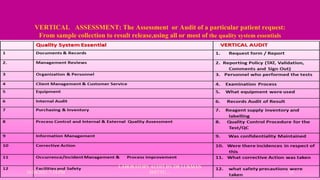
VERTICAL ASSESSMENT: The Assessment or Audit of a particular patient request:
From sample collection to result release,using all or most of the quality system essentials
30/04/2021 7:14 PM
LABORATORY AUDIT BY DR LUKMAN
SHITTU.... 15
TYPES OF AUDIT…
UNSCHEDULED AUDITS
• In addition to the planned programme, it may be necessary to carry
out unscheduled audits whenever there is reason to doubt the
effectiveness of the Quality System.
30/04/2021 7:14 PM
LABORATORY AUDIT BY DR LUKMAN
SHITTU.... 16
TYPES OF AUDIT…
WITNESSING/ EXAMINATION AUDIT
• An examination (test) procedure, currently being carried out in the laboratory
and randomly selected is witnessed as it is performed.
• To ensure that what is being done reflects what is described in the procedure,
• And that the person carrying out the examination has a good understanding of
all aspects of the procedure.
30/04/2021 7:14 PM
LABORATORY AUDIT BY DR LUKMAN
SHITTU.... 17
INTERNAL AUDIT…
• ISO REQUIREMENT:
• ISO standards put much emphasis on internal audits, and for those seeking
accreditation under ISO, internal audits are required. ISO requirements state
that:
• the laboratory must have an audit programme;
• the auditors should be independent of the activity;
• audits must be documented and reports retained;
• results must be reported to management for review;
• problems identified in the audits must be promptly addressed and appropriate
actions taken
30/04/2021 7:14 PM
LABORATORY AUDIT BY DR LUKMAN
SHITTU.... 18
INTERNAL AUDIT…
OBJECTIVES OF AUDIT
• Audits are planned to establish that:
• management objectives are met in full.
• all staff are carrying out their assigned duties and responsibilities satisfactorily.
• procedures detailed in the Quality System manual are being followed
• Audits are designed to reveal the extent to which the laboratory complies with
requirements in all the aspects examined.
30/04/2021 7:14 PM
LABORATORY AUDIT BY DR LUKMAN
SHITTU.... 19
INTERNAL AUDIT
• ESSENTIAL REQUIREMENTS OF AUDITS
• Audits should be carried out according to a pre-planned programme devised
by the Quality control committee headed by the laboratory director.
• Auditors should be nominated by the Quality control committee as the persons
responsible for carrying out audits.
• Audit procedures should be documented and all results recorded.
• Corrective action should be initiated to resolve all non-compliances identified
within an agreed timescale.
• Such corrective action should be effective and completed promptly.
30/04/2021 7:14 PM
LABORATORY AUDIT BY DR LUKMAN
SHITTU.... 20
INTERNAL AUDIT…
• AUDITOR:
• is a technically qualified individual who evaluates the activity being audited.
• Any knowledgeable person in the laboratory can perform internal audits, not
just the manager or supervisor. E.g. HODs, Pathologist & their designated reps
like the CMLS e.t.c.
• It is very important, and required by ISO standards, that the auditors are
independent of the area audited.
30/04/2021 7:14 PM
LABORATORY AUDIT BY DR LUKMAN
SHITTU.... 21
INTERNAL AUDIT..
• Criteria for Selection of Auditors
• Must have technical skills in the area being audited.
• Must understand the laboratory’s QMS
• Must be able to pay attention to detail
• Must be able to communicate effectively and diplomatically
• Must be trained – in-house/ external
• Poor auditors = Poor audit
• The laboratory may hire a consultant for internal audit process
30/04/2021 7:14 PM
LABORATORY AUDIT BY DR LUKMAN
SHITTU.... 22
INERNAL AUDIT..
• VALUES OF INTERNAL AUDIT:
• The internal audit is a valuable tool in a quality management system. An internal
audit can help the laboratory to:
• prepare for an external audit;
• increase staff awareness of quality system requirements;
• identify the gaps or nonconformities that need to be corrected—the
• opportunities for improvement;
• understand where preventive or corrective action is needed;
• identify areas where education or training needs to occur;
• determine if the laboratory is meeting its own quality standards
30/04/2021 7:14 PM
LABORATORY AUDIT BY DR LUKMAN
SHITTU.... 23
INTERNAL AUDIT…
• AUDIT PROCESS:
• There are five key questions in the audit process:
• what should we do?
• what do we do?
• Are we doing what we should be doing?
• Can we improve what we do?
• Have we improved?
30/04/2021 7:14 PM
LABORATORY AUDIT BY DR LUKMAN
SHITTU.... 24
INTERNAL AUDIT..
• THE QUALITY MANAGER or other designated qualified personnel should organize the
internal audit following these steps:
• develop a formal plan
• prepare a checklist based on selected guidelines or standards
• meet with all staff and explain the audit process
• select staff to serve as auditors
• collect and analyze information
• share results with staff
• prepare a report
• present the report to management
• retain the report as a permanent laboratory record
30/04/2021 7:14 PM
LABORATORY AUDIT BY DR LUKMAN
SHITTU.... 25
INTERNAL AUDIT
• During audits, information is gathered about:
• processes and operating procedures
• staff competence and training
• equipment
• environment
• handling of samples
• quality control and verification of results
• recording and reporting practices.
30/04/2021 7:14 PM
LABORATORY AUDIT BY DR LUKMAN
SHITTU.... 26
INTERNAL AUDIT
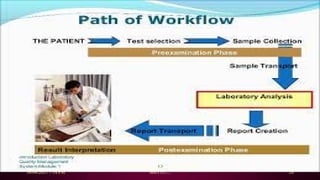
• Audits should include the evaluation of steps in the whole laboratory path of
workflow.
• They should be able to detect problems throughout the entire process.
• The findings are compared with the laboratory’s internal policies and to a
standard or external benchmark. Any breakdown in the system or departure
from procedures will be identified.
• The advantages of internal audits are that laboratories can perform them as
frequently as needed, and at very little or no cost.
30/04/2021 7:14 PM
LABORATORY AUDIT BY DR LUKMAN
SHITTU.... 27
30/04/2021 7:14 PM
LABORATORY AUDIT BY DR LUKMAN
SHITTU.... 28
INTERNAL AUDIT..
• SELECT AREA FOR AUDIT.
• Focus on defined areas of the laboratory activities, identified by issues such as customer
complaints or quality control problems.
• horizontal or vertical.
30/04/2021 7:14 PM
LABORATORY AUDIT BY DR LUKMAN
SHITTU.... 29
INTERNAL AUDIT…
ESTABLISH A SCHEDULE.
• ISO 15189:2007 [4.14.2] states:
The main elements of the quality management system should normally be subject to internal audit
once every twelve months
• In general, audit regularly
• consider three to six-month intervals between audits.
• If audits reveal specific problems, it may be necessary to include more frequent audits.
30/04/2021 7:14 PM
LABORATORY AUDIT BY DR LUKMAN
SHITTU.... 30
INTERNAL AUDIT..
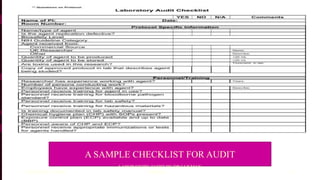
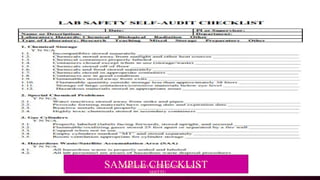
CHECKLISTS AND FORMS USED
When developing checklists for internal audits:
• Take into account any established national policies and standards.
• Ensure checklists are easy to use and include areas for recording information.
• Forms will be needed for recording corrective actions and for making reports.
30/04/2021 7:14 PM
LABORATORY AUDIT BY DR LUKMAN
SHITTU.... 31
A SAMPLE CHECKLIST FOR AUDIT
30/04/2021 7:14 PM
LABORATORY AUDIT BY DR LUKMAN
SHITTU.... 32
SAMPLE CHECKLIST
30/04/2021 7:14 PM
LABORATORY AUDIT BY DR LUKMAN
SHITTU.... 33
INTERNAL AUDIT…...
RECORDS OF AUDIT:
• The laboratory should maintain detailed documentary records of all audits to
provide management with a continuous history of performance and a means of
identifying particular areas of weakness.
• Records should be kept by the Quality Manager and they may be checked
during inspections by accreditation bodies.
30/04/2021 7:14 PM
LABORATORY AUDIT BY DR LUKMAN
SHITTU.... 34
INTERNAL AUDIT….
CONTINUOUS MONITORING
• Continuous monitoring is the key element to success in the quality system.
• It is through this process that we are able to achieve the continual improvement that is our
overall goal.
30/04/2021 7:14 PM
LABORATORY AUDIT BY DR LUKMAN
SHITTU.... 35
EXTERNAL AUDIT
Assessments conducted by groups or agencies from outside the laboratory are called external audits.
• EXTERNAL AUDITORS:
• Health authorities;
• Accreditation bodies are organizations that provide accreditation or certification.
• Public health programmes, or by agencies that provide funding for programmes. (WHO) Polio
Initiative regularly assess disease-specific laboratories according to their own standards with
their own checklists.
30/04/2021 7:14 PM
LABORATORY AUDIT BY DR LUKMAN
SHITTU.... 36
EXERNAL AUDIT
• THE STANDARDS
• In conducting external audits, the assessors will verify that laboratory policies, processes and
procedures are documented and comply with designated standards.
• Different standards can be used for the assessment processes, ranging from international
standards to a locally developed checklist.
30/04/2021 7:14 PM
LABORATORY AUDIT BY DR LUKMAN
SHITTU.... 37
EXTERNAL AUDIT…
• PREPARATION
To be ready for the external audit, it is necessary to:
• plan thoroughly and carefully;
• organize everything ahead of time, including documents and records, to save valuable time
during the audit;
• make all staff aware of the audit, and arrange schedules so that all staff needed for the audit will
be available.
30/04/2021 7:14 PM
LABORATORY AUDIT BY DR LUKMAN
SHITTU.... 38
EXTERNAL AUDIT..
AUDIT REPORT AND PLAN OF ACTION.
• After the audit, the recommendations of the assessors are often presented as a verbal summary to the
laboratory management and staff, which are then followed by a thorough written report.
After the external audit has been completed the laboratory should:
• review the recommendations of the assessors;
• identify gaps or nonconformities, learning where benchmarks or standards were not fully met;
• plan to correct the nonconformities
• record all results and actions taken
30/04/2021 7:14 PM
LABORATORY AUDIT BY DR LUKMAN
SHITTU.... 39
EXTERNAL AUDIT….
• ACTIONS AS A RESULT OF AUDIT:
• Audits should lead to actions—this is why laboratories conduct them, to further the process of
continual improvement in the laboratory.
• Audits identify opportunities for improvement (OFIs).
• Both preventive and corrective actions are steps taken to improve a process or to correct a
problem.
30/04/2021 7:14 PM
LABORATORY AUDIT BY DR LUKMAN
SHITTU.... 40
SUMMARY
Assessment is important in monitoring the effectiveness of the laboratory quality management
system.
Both external and internal audits yield useful information.
Audits are used to identify problems in the laboratory, in order to improve processes and
procedures.
An outcome of assessment is finding root causes of problems and taking corrective actions.
30/04/2021 7:14 PM
LABORATORY AUDIT BY DR LUKMAN
SHITTU.... 41
REFERENCES.
30/04/2021 7:14 PM
LABORATORY AUDIT BY DR LUKMAN
SHITTU.... 42

Laboratory audit ls

  • 1.
    DR LUKMAN SHITTU DEPTOF CHEMICAL PATHOLOGY DR LUKMAN SHITTU DEPT OF CHEMICAL PATHOLOGY LABORATORY AUDIT 30/04/2021 7:14 PM LABORATORY AUDIT BY DR LUKMAN SHITTU.... 1
  • 2.
    OUTLINE INTRODUCTION TYPES OF AUDIT INTERNALAUDIT EXTERNAL AUDIT SUDDEN ESSENTIAL RE RESPONSIBILITY WITNESSING ISO REQUIRED INTERNAL AUDIT OBJECTIVES AUDIT PROCESS EXTERNAL AUDIT SUMMARY REFERENCES 30/04/2021 7:14 PM LABORATORY AUDIT BY DR LUKMAN SHITTU.... 2
  • 3.
    INTRODUCTION…. Assessment can bedefined as the systematic examination of some part (or sometimes all) of the quality management system to demonstrate to all concerned that the laboratory is meeting regulatory, accreditation and customer requirements. • Assessment is an important element of the 12 quality system essentials 30/04/2021 7:14 PM LABORATORY AUDIT BY DR LUKMAN SHITTU.... 3
  • 4.
    INTRODUCTION…… 12 QUALITY MANAGEMENTESSENTIALS. 30/04/2021 7:14 PM LABORATORY AUDIT BY DR LUKMAN SHITTU.... 4
  • 5.
    INTRODUCTION…… • Assessment canbe achieved by; • Laboratory accreditation. • External quality assessment or proficiency testing. • Laboratory audit. 30/04/2021 7:14 PM LABORATORY AUDIT BY DR LUKMAN SHITTU.... 5
  • 6.
    INTRODUCTION… • LABORATORY AUDITis defined as a planned and documented activity performed in accordance with written procedures and check-lists to verify by investigation, and the examination and evaluation of objective evidence, that applicable elements of a quality assurance programme have been developed, documented and implemented. • 30/04/2021 7:14 PM LABORATORY AUDIT BY DR LUKMAN SHITTU.... 6
  • 7.
    INTRODUCTION…. • Audit isan essential part of the quality assurance program of a laboratory. • A quality assurance program covers all aspects of the service provided. • Audit is a means of assessing whether one is achieving one's stated objectives. 30/04/2021 7:14 PM LABORATORY AUDIT BY DR LUKMAN SHITTU.... 7
  • 8.
    INTRODUCTION…. • Total QualityManagement involves comprehensive quality assurance programme which must include The Quality System Essentials, with the development, documentation and implementation of General Guidelines and Standards Operating Procedures (SOP) . • Internal Audit is a component of TQM and involves the process of Monitoring and Evaluation of the implementation of developed guideline and SOP. 30/04/2021 7:14 PM LABORATORY AUDIT BY DR LUKMAN SHITTU.... 8
  • 9.
    TYPES OF AUDIT… •INTERNAL AUDIT HORIZONTAL AUDIT VERTICAL AUDIT • EXTERNAL AUDIT • SUDDEN AUDIT • WITNESSING/EXAMINATION AUDIT 30/04/2021 7:14 PM LABORATORY AUDIT BY DR LUKMAN SHITTU.... 9
  • 10.
    TYPES OF AUDIT… EXTERNALAUDIT: • Assessments conducted by groups or agencies from outside the laboratories are called external audits. • They can include assessments for the purpose of accreditation, certification or licensure 30/04/2021 7:14 PM LABORATORY AUDIT BY DR LUKMAN SHITTU.... 10
  • 11.
    INTERNAL AUDIT • Atype of assessment of a laboratory where staff working in one area of the laboratory conduct assessments on another area of the same laboratory. • This provides information quickly and easily on how the laboratory is performing and whether it is in compliance with policy requirements. • Both horizontal and vertical audits should be carried out. 30/04/2021 7:14 PM LABORATORY AUDIT BY DR LUKMAN SHITTU.... 11
  • 12.
    HORIZONTAL AUDITS: • Checkingone aspect of the Quality System (for example, equipment), for all the associated requirements. 30/04/2021 7:14 PM LABORATORY AUDIT BY DR LUKMAN SHITTU.... 12
  • 13.
    QualitySystem Essential HORIZONTAL AUDIT 1 Documents & Records 2. Management Reviews 3 Organization &Personnel 1.Is there an approved organogram 2.Are there appropriate personnel 3.Are there personnel files 4.Do personnel files contain CVs 5.Do personnel files contain other records 6 4 Client Management & Customer Service 5 Equipment 1.What equipment are available 2. the equipment functioning 3.Are they regularly maintained 4.When is the next Expected date of routine maintenance 5.Is there a maintenance contract 6 Internal Audit 7 Purchasing & Inventory 8 Process Control and Internal & External Quality Assessment 9 Information Management 1 0 Corrective Action 1 1 Occurrence/Inci dent Management & Process improvement 1 2 Facilities and Safety 30/04/2021 7:14 PM LABORATORY AUDIT BY DR LUKMAN SHITTU.... 13
  • 14.
    TYPES OF AUDIT…. VERTICALAUDITS: • Test samples are selected at random from work that has recently passed through the laboratory and each operation associated with those samples is checked. • The route of entry into the audit system when performing vertical audits can be varied, for example, by selecting different items (test reports, worksheets or retained samples) on different occasions 30/04/2021 7:14 PM LABORATORY AUDIT BY DR LUKMAN SHITTU.... 14
  • 15.
    VERTICAL ASSESSMENT: TheAssessment or Audit of a particular patient request: From sample collection to result release,using all or most of the quality system essentials 30/04/2021 7:14 PM LABORATORY AUDIT BY DR LUKMAN SHITTU.... 15
  • 16.
    TYPES OF AUDIT… UNSCHEDULEDAUDITS • In addition to the planned programme, it may be necessary to carry out unscheduled audits whenever there is reason to doubt the effectiveness of the Quality System. 30/04/2021 7:14 PM LABORATORY AUDIT BY DR LUKMAN SHITTU.... 16
  • 17.
    TYPES OF AUDIT… WITNESSING/EXAMINATION AUDIT • An examination (test) procedure, currently being carried out in the laboratory and randomly selected is witnessed as it is performed. • To ensure that what is being done reflects what is described in the procedure, • And that the person carrying out the examination has a good understanding of all aspects of the procedure. 30/04/2021 7:14 PM LABORATORY AUDIT BY DR LUKMAN SHITTU.... 17
  • 18.
    INTERNAL AUDIT… • ISOREQUIREMENT: • ISO standards put much emphasis on internal audits, and for those seeking accreditation under ISO, internal audits are required. ISO requirements state that: • the laboratory must have an audit programme; • the auditors should be independent of the activity; • audits must be documented and reports retained; • results must be reported to management for review; • problems identified in the audits must be promptly addressed and appropriate actions taken 30/04/2021 7:14 PM LABORATORY AUDIT BY DR LUKMAN SHITTU.... 18
  • 19.
    INTERNAL AUDIT… OBJECTIVES OFAUDIT • Audits are planned to establish that: • management objectives are met in full. • all staff are carrying out their assigned duties and responsibilities satisfactorily. • procedures detailed in the Quality System manual are being followed • Audits are designed to reveal the extent to which the laboratory complies with requirements in all the aspects examined. 30/04/2021 7:14 PM LABORATORY AUDIT BY DR LUKMAN SHITTU.... 19
  • 20.
    INTERNAL AUDIT • ESSENTIALREQUIREMENTS OF AUDITS • Audits should be carried out according to a pre-planned programme devised by the Quality control committee headed by the laboratory director. • Auditors should be nominated by the Quality control committee as the persons responsible for carrying out audits. • Audit procedures should be documented and all results recorded. • Corrective action should be initiated to resolve all non-compliances identified within an agreed timescale. • Such corrective action should be effective and completed promptly. 30/04/2021 7:14 PM LABORATORY AUDIT BY DR LUKMAN SHITTU.... 20
  • 21.
    INTERNAL AUDIT… • AUDITOR: •is a technically qualified individual who evaluates the activity being audited. • Any knowledgeable person in the laboratory can perform internal audits, not just the manager or supervisor. E.g. HODs, Pathologist & their designated reps like the CMLS e.t.c. • It is very important, and required by ISO standards, that the auditors are independent of the area audited. 30/04/2021 7:14 PM LABORATORY AUDIT BY DR LUKMAN SHITTU.... 21
  • 22.
    INTERNAL AUDIT.. • Criteriafor Selection of Auditors • Must have technical skills in the area being audited. • Must understand the laboratory’s QMS • Must be able to pay attention to detail • Must be able to communicate effectively and diplomatically • Must be trained – in-house/ external • Poor auditors = Poor audit • The laboratory may hire a consultant for internal audit process 30/04/2021 7:14 PM LABORATORY AUDIT BY DR LUKMAN SHITTU.... 22
  • 23.
    INERNAL AUDIT.. • VALUESOF INTERNAL AUDIT: • The internal audit is a valuable tool in a quality management system. An internal audit can help the laboratory to: • prepare for an external audit; • increase staff awareness of quality system requirements; • identify the gaps or nonconformities that need to be corrected—the • opportunities for improvement; • understand where preventive or corrective action is needed; • identify areas where education or training needs to occur; • determine if the laboratory is meeting its own quality standards 30/04/2021 7:14 PM LABORATORY AUDIT BY DR LUKMAN SHITTU.... 23
  • 24.
    INTERNAL AUDIT… • AUDITPROCESS: • There are five key questions in the audit process: • what should we do? • what do we do? • Are we doing what we should be doing? • Can we improve what we do? • Have we improved? 30/04/2021 7:14 PM LABORATORY AUDIT BY DR LUKMAN SHITTU.... 24
  • 25.
    INTERNAL AUDIT.. • THEQUALITY MANAGER or other designated qualified personnel should organize the internal audit following these steps: • develop a formal plan • prepare a checklist based on selected guidelines or standards • meet with all staff and explain the audit process • select staff to serve as auditors • collect and analyze information • share results with staff • prepare a report • present the report to management • retain the report as a permanent laboratory record 30/04/2021 7:14 PM LABORATORY AUDIT BY DR LUKMAN SHITTU.... 25
  • 26.
    INTERNAL AUDIT • Duringaudits, information is gathered about: • processes and operating procedures • staff competence and training • equipment • environment • handling of samples • quality control and verification of results • recording and reporting practices. 30/04/2021 7:14 PM LABORATORY AUDIT BY DR LUKMAN SHITTU.... 26
  • 27.
    INTERNAL AUDIT • Auditsshould include the evaluation of steps in the whole laboratory path of workflow. • They should be able to detect problems throughout the entire process. • The findings are compared with the laboratory’s internal policies and to a standard or external benchmark. Any breakdown in the system or departure from procedures will be identified. • The advantages of internal audits are that laboratories can perform them as frequently as needed, and at very little or no cost. 30/04/2021 7:14 PM LABORATORY AUDIT BY DR LUKMAN SHITTU.... 27
  • 28.
    30/04/2021 7:14 PM LABORATORYAUDIT BY DR LUKMAN SHITTU.... 28
  • 29.
    INTERNAL AUDIT.. • SELECTAREA FOR AUDIT. • Focus on defined areas of the laboratory activities, identified by issues such as customer complaints or quality control problems. • horizontal or vertical. 30/04/2021 7:14 PM LABORATORY AUDIT BY DR LUKMAN SHITTU.... 29
  • 30.
    INTERNAL AUDIT… ESTABLISH ASCHEDULE. • ISO 15189:2007 [4.14.2] states: The main elements of the quality management system should normally be subject to internal audit once every twelve months • In general, audit regularly • consider three to six-month intervals between audits. • If audits reveal specific problems, it may be necessary to include more frequent audits. 30/04/2021 7:14 PM LABORATORY AUDIT BY DR LUKMAN SHITTU.... 30
  • 31.
    INTERNAL AUDIT.. CHECKLISTS ANDFORMS USED When developing checklists for internal audits: • Take into account any established national policies and standards. • Ensure checklists are easy to use and include areas for recording information. • Forms will be needed for recording corrective actions and for making reports. 30/04/2021 7:14 PM LABORATORY AUDIT BY DR LUKMAN SHITTU.... 31
  • 32.
    A SAMPLE CHECKLISTFOR AUDIT 30/04/2021 7:14 PM LABORATORY AUDIT BY DR LUKMAN SHITTU.... 32
  • 33.
    SAMPLE CHECKLIST 30/04/2021 7:14PM LABORATORY AUDIT BY DR LUKMAN SHITTU.... 33
  • 34.
    INTERNAL AUDIT…... RECORDS OFAUDIT: • The laboratory should maintain detailed documentary records of all audits to provide management with a continuous history of performance and a means of identifying particular areas of weakness. • Records should be kept by the Quality Manager and they may be checked during inspections by accreditation bodies. 30/04/2021 7:14 PM LABORATORY AUDIT BY DR LUKMAN SHITTU.... 34
  • 35.
    INTERNAL AUDIT…. CONTINUOUS MONITORING •Continuous monitoring is the key element to success in the quality system. • It is through this process that we are able to achieve the continual improvement that is our overall goal. 30/04/2021 7:14 PM LABORATORY AUDIT BY DR LUKMAN SHITTU.... 35
  • 36.
    EXTERNAL AUDIT Assessments conductedby groups or agencies from outside the laboratory are called external audits. • EXTERNAL AUDITORS: • Health authorities; • Accreditation bodies are organizations that provide accreditation or certification. • Public health programmes, or by agencies that provide funding for programmes. (WHO) Polio Initiative regularly assess disease-specific laboratories according to their own standards with their own checklists. 30/04/2021 7:14 PM LABORATORY AUDIT BY DR LUKMAN SHITTU.... 36
  • 37.
    EXERNAL AUDIT • THESTANDARDS • In conducting external audits, the assessors will verify that laboratory policies, processes and procedures are documented and comply with designated standards. • Different standards can be used for the assessment processes, ranging from international standards to a locally developed checklist. 30/04/2021 7:14 PM LABORATORY AUDIT BY DR LUKMAN SHITTU.... 37
  • 38.
    EXTERNAL AUDIT… • PREPARATION Tobe ready for the external audit, it is necessary to: • plan thoroughly and carefully; • organize everything ahead of time, including documents and records, to save valuable time during the audit; • make all staff aware of the audit, and arrange schedules so that all staff needed for the audit will be available. 30/04/2021 7:14 PM LABORATORY AUDIT BY DR LUKMAN SHITTU.... 38
  • 39.
    EXTERNAL AUDIT.. AUDIT REPORTAND PLAN OF ACTION. • After the audit, the recommendations of the assessors are often presented as a verbal summary to the laboratory management and staff, which are then followed by a thorough written report. After the external audit has been completed the laboratory should: • review the recommendations of the assessors; • identify gaps or nonconformities, learning where benchmarks or standards were not fully met; • plan to correct the nonconformities • record all results and actions taken 30/04/2021 7:14 PM LABORATORY AUDIT BY DR LUKMAN SHITTU.... 39
  • 40.
    EXTERNAL AUDIT…. • ACTIONSAS A RESULT OF AUDIT: • Audits should lead to actions—this is why laboratories conduct them, to further the process of continual improvement in the laboratory. • Audits identify opportunities for improvement (OFIs). • Both preventive and corrective actions are steps taken to improve a process or to correct a problem. 30/04/2021 7:14 PM LABORATORY AUDIT BY DR LUKMAN SHITTU.... 40
  • 41.
    SUMMARY Assessment is importantin monitoring the effectiveness of the laboratory quality management system. Both external and internal audits yield useful information. Audits are used to identify problems in the laboratory, in order to improve processes and procedures. An outcome of assessment is finding root causes of problems and taking corrective actions. 30/04/2021 7:14 PM LABORATORY AUDIT BY DR LUKMAN SHITTU.... 41
  • 42.
    REFERENCES. 30/04/2021 7:14 PM LABORATORYAUDIT BY DR LUKMAN SHITTU.... 42