Laboratory Quality
Management System
Lesson one
Prepared by MD Zeinab Omar
Objective
 Management Requirements
 Organization and management
responsibilities
 Legal entity
 Ethical conduct
 Management commitment, quality
policy, quality objectives and planning,
responsibilities and interrelationship
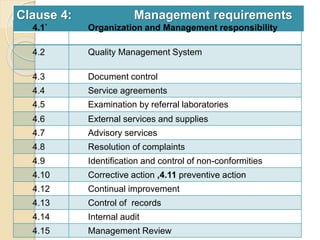
Clause 4: Management requirements
4.1` Organization and Management responsibility
4.2 Quality Management System
4.3 Document control
4.4 Service agreements
4.5 Examination by referral laboratories
4.6 External services and supplies
4.7 Advisory services
4.8 Resolution of complaints
4.9 Identification and control of non-conformities
4.10 Corrective action ,4.11 preventive action
4.12 Continual improvement
4.13 Control of records
4.14 Internal audit
4.15 Management Review
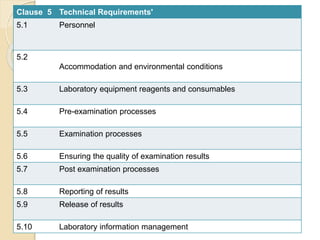
Clause 5 Technical Requirements'
5.1 Personnel
5.2
Accommodation and environmental conditions
5.3 Laboratory equipment reagents and consumables
5.4 Pre-examination processes
5.5 Examination processes
5.6 Ensuring the quality of examination results
5.7 Post examination processes
5.8 Reporting of results
5.9 Release of results
5.10 Laboratory information management
Organization and Management
Responsibility
(ISO 15189 Clause 4.1)
&
Quality Management System
(ISO 15189 Clause 4.2)
Organization (4.1.1)
An ORGANIZATION is a team/unit of
people, structured and managed, to
achieve a purpose or a goal taking into
account the client’s needs and purpose.
“organization” indicates the management
and the supporting organizational
structure of the laboratory. Organization
is one of the essential elements of the
quality system which when coordinated
with assigned responsibilities forms
pillars of a quality management system
Legal Entity (ISO 15189:
4.1.1.2
Legal entity is an association,
corporation, partnership,
proprietorship, trust, or an individual,
that has legal standing in the eyes of
law
Need for legal entity
A medical laboratory must produce relevant
evidence of legal identification which can be any
government notification in support of
establishment of institution / laboratory or any
approval from local or regulatory bodies.
Compliance requirements
Laboratory should comply with local / regional /
national requirements, as applicable.
A few statutory compliances have been listed below:
 No objection certificate from the Competent Fire
Authority
 Authorisation under Bio-medical Waste
Management Rules,
 Clearance from State Pollution Control Board
Ethical Conduct (ISO 15189:
4.1.1.3)
Ethical Conduct (ISO 15189: 4.1.1.3)
WHAT IS ETHICS?
“A discipline dealing with what is good
and bad, with moral duty and
obligation.”
“The set of moral principles by which
people conduct themselves
personally, socially or professionally.”
The principles of doing “good” and not
doing “harm” are the essence of every
code of medical ethics and the same is
applicable in medical laboratories.
Principles that form fundamental in
medical ethics are:
Assignment two:-
Identify the principle that form fundamental
in medical ethics
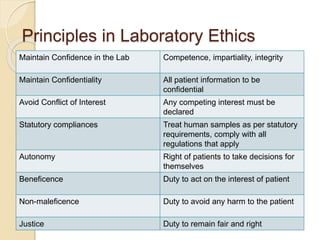
Principles in Laboratory Ethics
Maintain Confidence in the Lab Competence, impartiality, integrity
Maintain Confidentiality All patient information to be
confidential
Avoid Conflict of Interest Any competing interest must be
declared
Statutory compliances Treat human samples as per statutory
requirements, comply with all
regulations that apply
Autonomy Right of patients to take decisions for
themselves
Beneficence Duty to act on the interest of patient
Non-maleficence Duty to avoid any harm to the patient
Justice Duty to remain fair and right
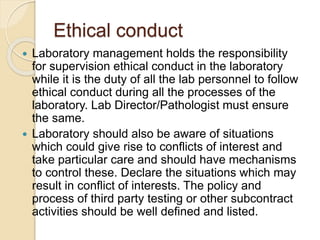
Ethical conduct
 Laboratory management holds the responsibility
for supervision ethical conduct in the laboratory
while it is the duty of all the lab personnel to follow
ethical conduct during all the processes of the
laboratory. Lab Director/Pathologist must ensure
the same.
 Laboratory should also be aware of situations
which could give rise to conflicts of interest and
take particular care and should have mechanisms
to control these. Declare the situations which may
result in conflict of interests. The policy and
process of third party testing or other subcontract
activities should be well defined and listed.
Ethical conduct
 Ethics should become an important part of
induction training
 Policies and processes should be made to
safeguard the confidentiality of information
related to patient sample and test results.
Undertaking of confidentiality must be taken
at the time of induction training.
 Record of patient’s consent must be
maintained.
 Ensure authorized access to results.
 Standardization of system and work
Ethical conduct
 Make adequate arrangements related to facility,
workforce, finance or any other resources to
refrain lab personnel from any financial,
commercial or any other pressure which may
affect the quality of the services provided by the
laboratory.
 Handle patient samples (human samples, tissues
or remains) as per specified legal requirements.
 Work authorization should be given and
documented to all the personnel in their individual
job descriptions. This should be a part of induction
Organizational Structure
Defining of organizational structure (ISO
15189 Clause 4.1.2.5)
 The defining of organizational
structure leads to efficient and
effective laboratory operation and
meeting the quality goals.
 The organizational structure in a
medical laboratory is explained ideally
in the form of an organogram or an
organizational chart depicting the
designations, reporting relationship
and hierarchy.
Organizational Structure
Key Requirements:
 Clear designation of authority, inter-
relationships and responsibility at
each level with an escalation matrix
 Accurate assessment of available
personnel to perform different
activities
What is an organizational
chart?
 Organizational chart defines the
working structure for the organization;
organizes jobs along lines of authority;
defines reporting structure and span of
control; defines authority to make
decisions and accountability for
results; works together with job
descriptions to define the working
structure of the organization.
(Laboratory Quality Management
System Handbook, WHO
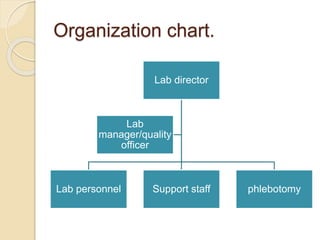
Organization chart.
Lab director
Lab personnel Support staff phlebotomy
Lab
manager/quality
officer
Why do we need an
organizational chart?
 For establishing core authority and
responsibility
 For clarifying different authorities and
responsibilities for the Laboratory
Director/doctors, the Laboratory
manager and the Technical supervisors
and support staff (e.g. IT, Administration,
HR, etc.)
 For identifying hierarchies and
relationships
 For clarifying reporting lines
 For clarifying expectations
Assignment :-
Discuss the Responsibilities of
1. Quality Manager
2. Quality Director
3. Quality officer (as per ISO 15189):
Management
commitment
Management commitment
2.2. Need for Management Commitment (4.1.2.1)
 Implementation of quality management system
requires resources, facilities and review processes for
continuous improvement which is only possible
through commitment from management. Only with
coordination between management and technical staff
in the organization can QMS be supported and
implemented in the laboratory.
 Laboratory management should be committed to
provide necessary qualified and competent human
and financial resource along with infrastructure
facilities to maintain laboratory quality management
system as per ISO 15189.
2.2. Need for Management
Commitment (4.1.2.1)
 Management participation should be
visible. This can happen through
management review meetings (MRM),
interaction with staff, sharing customer
expectations, rewarding staff good
performance, etc.
2.2. Need for Management
Commitment (4.1.2.1)
Management also designates/ recruits
key personnel that ensure adherence
to the requirements and
implementation of QMS likeQuality
Manager and Laboratory Director.
2.2. Need for Management
Commitment (4.1.2.1)
“Management Commitment” is the primary
and essential element for successful
establishment, implementation and
monitoring of Quality Management
System. The top or senior management
must accept the responsibility and
involve themselves in the establishment
and maintenance of quality system in the
laboratory. Management must visibly
demonstrate and communicate this
commitment
Understanding and meet the needs of users(ISO
15189:2012 CLAUSE 4.1.2.2 Clause 4.7)
 Laboratory management must ensure
arrangements for best laboratory
services along with appropriate advisory
and interpretive services for fulfilling the
needs and requirements of patients /
users
 Ensure that the lab meets the
requirements of regulation and
accreditation.
 The same should be communicated
effectively to the laboratory personnel for
better understanding of support and
Expressing the Commitment towards Quality
through Formulating and Establishing Quality
Policy: (ISO 15189 Clause 4.1.2.3)
 Laboratory management is responsible for defining the
quality policy of the laboratory.
 The quality policy is the mission statement and
expresses the intent of the management to establish a
QMS.
 This should:
1. Be appropriate to the services provided by the
laboratory.
2. Include commitment to good professional practice,
quality of examinations, complies with the International
Standard and continual improvement of the quality of
laboratory services.
3. Provide a framework for establishing and reviewing
quality objectives.
4. Be communicated and understood within the
Ensuring Continual Improvement through
Quality Objectives (ISO 15189 Clause
4.1.2.4)
Laboratory management should identify
the challenges in the working of the lab
and set measurable objectives
 These must be consistent with the
quality policy.
 Quality indicators should be set for all
objectives as per requirement to enable
measurement of progress.
 Quality objectives and indicators should
be defined in consensus with all levels of
lab staff. Improvements or the lack
thereof should be regularly
communicated.
Defining Responsibility, Authority
and Interrelations:(ISO 15189
Clause 4.1.2.5)
As described previously, the laboratory
management should define and
document job responsibilities,
authorities and interrelationships of all
the personnel for each laboratory
function. If required, deputies should
be appointed for key managerial and
technical personnel.
Reference
 WHO Library Cataloguing-in-
Publication Data Laboratory quality
management system: handbook.
1.Laboratories — organization and
administration. 2. Laboratories —
handbooks. 3.Laboratories techniques
and procedures — standards.
4.Quality control. 5.Manuals. I.World
Health Organization.

Lab qms lesson one

  • 1.
    Laboratory Quality Management System Lessonone Prepared by MD Zeinab Omar
  • 2.
    Objective  Management Requirements Organization and management responsibilities  Legal entity  Ethical conduct  Management commitment, quality policy, quality objectives and planning, responsibilities and interrelationship
  • 3.
    Clause 4: Managementrequirements 4.1` Organization and Management responsibility 4.2 Quality Management System 4.3 Document control 4.4 Service agreements 4.5 Examination by referral laboratories 4.6 External services and supplies 4.7 Advisory services 4.8 Resolution of complaints 4.9 Identification and control of non-conformities 4.10 Corrective action ,4.11 preventive action 4.12 Continual improvement 4.13 Control of records 4.14 Internal audit 4.15 Management Review
  • 4.
    Clause 5 TechnicalRequirements' 5.1 Personnel 5.2 Accommodation and environmental conditions 5.3 Laboratory equipment reagents and consumables 5.4 Pre-examination processes 5.5 Examination processes 5.6 Ensuring the quality of examination results 5.7 Post examination processes 5.8 Reporting of results 5.9 Release of results 5.10 Laboratory information management
  • 5.
    Organization and Management Responsibility (ISO15189 Clause 4.1) & Quality Management System (ISO 15189 Clause 4.2)
  • 6.
    Organization (4.1.1) An ORGANIZATIONis a team/unit of people, structured and managed, to achieve a purpose or a goal taking into account the client’s needs and purpose. “organization” indicates the management and the supporting organizational structure of the laboratory. Organization is one of the essential elements of the quality system which when coordinated with assigned responsibilities forms pillars of a quality management system
  • 7.
    Legal Entity (ISO15189: 4.1.1.2 Legal entity is an association, corporation, partnership, proprietorship, trust, or an individual, that has legal standing in the eyes of law
  • 8.
    Need for legalentity A medical laboratory must produce relevant evidence of legal identification which can be any government notification in support of establishment of institution / laboratory or any approval from local or regulatory bodies. Compliance requirements Laboratory should comply with local / regional / national requirements, as applicable. A few statutory compliances have been listed below:  No objection certificate from the Competent Fire Authority  Authorisation under Bio-medical Waste Management Rules,  Clearance from State Pollution Control Board
  • 9.
    Ethical Conduct (ISO15189: 4.1.1.3)
  • 10.
    Ethical Conduct (ISO15189: 4.1.1.3) WHAT IS ETHICS? “A discipline dealing with what is good and bad, with moral duty and obligation.” “The set of moral principles by which people conduct themselves personally, socially or professionally.”
  • 11.
    The principles ofdoing “good” and not doing “harm” are the essence of every code of medical ethics and the same is applicable in medical laboratories. Principles that form fundamental in medical ethics are: Assignment two:- Identify the principle that form fundamental in medical ethics
  • 12.
    Principles in LaboratoryEthics Maintain Confidence in the Lab Competence, impartiality, integrity Maintain Confidentiality All patient information to be confidential Avoid Conflict of Interest Any competing interest must be declared Statutory compliances Treat human samples as per statutory requirements, comply with all regulations that apply Autonomy Right of patients to take decisions for themselves Beneficence Duty to act on the interest of patient Non-maleficence Duty to avoid any harm to the patient Justice Duty to remain fair and right
  • 13.
    Ethical conduct  Laboratorymanagement holds the responsibility for supervision ethical conduct in the laboratory while it is the duty of all the lab personnel to follow ethical conduct during all the processes of the laboratory. Lab Director/Pathologist must ensure the same.  Laboratory should also be aware of situations which could give rise to conflicts of interest and take particular care and should have mechanisms to control these. Declare the situations which may result in conflict of interests. The policy and process of third party testing or other subcontract activities should be well defined and listed.
  • 14.
    Ethical conduct  Ethicsshould become an important part of induction training  Policies and processes should be made to safeguard the confidentiality of information related to patient sample and test results. Undertaking of confidentiality must be taken at the time of induction training.  Record of patient’s consent must be maintained.  Ensure authorized access to results.  Standardization of system and work
  • 15.
    Ethical conduct  Makeadequate arrangements related to facility, workforce, finance or any other resources to refrain lab personnel from any financial, commercial or any other pressure which may affect the quality of the services provided by the laboratory.  Handle patient samples (human samples, tissues or remains) as per specified legal requirements.  Work authorization should be given and documented to all the personnel in their individual job descriptions. This should be a part of induction
  • 16.
  • 17.
    Organizational Structure Defining oforganizational structure (ISO 15189 Clause 4.1.2.5)  The defining of organizational structure leads to efficient and effective laboratory operation and meeting the quality goals.  The organizational structure in a medical laboratory is explained ideally in the form of an organogram or an organizational chart depicting the designations, reporting relationship and hierarchy.
  • 18.
    Organizational Structure Key Requirements: Clear designation of authority, inter- relationships and responsibility at each level with an escalation matrix  Accurate assessment of available personnel to perform different activities
  • 19.
    What is anorganizational chart?  Organizational chart defines the working structure for the organization; organizes jobs along lines of authority; defines reporting structure and span of control; defines authority to make decisions and accountability for results; works together with job descriptions to define the working structure of the organization. (Laboratory Quality Management System Handbook, WHO
  • 20.
    Organization chart. Lab director Labpersonnel Support staff phlebotomy Lab manager/quality officer
  • 21.
    Why do weneed an organizational chart?  For establishing core authority and responsibility  For clarifying different authorities and responsibilities for the Laboratory Director/doctors, the Laboratory manager and the Technical supervisors and support staff (e.g. IT, Administration, HR, etc.)  For identifying hierarchies and relationships  For clarifying reporting lines  For clarifying expectations
  • 22.
    Assignment :- Discuss theResponsibilities of 1. Quality Manager 2. Quality Director 3. Quality officer (as per ISO 15189):
  • 23.
  • 24.
    Management commitment 2.2. Needfor Management Commitment (4.1.2.1)  Implementation of quality management system requires resources, facilities and review processes for continuous improvement which is only possible through commitment from management. Only with coordination between management and technical staff in the organization can QMS be supported and implemented in the laboratory.  Laboratory management should be committed to provide necessary qualified and competent human and financial resource along with infrastructure facilities to maintain laboratory quality management system as per ISO 15189.
  • 25.
    2.2. Need forManagement Commitment (4.1.2.1)  Management participation should be visible. This can happen through management review meetings (MRM), interaction with staff, sharing customer expectations, rewarding staff good performance, etc.
  • 26.
    2.2. Need forManagement Commitment (4.1.2.1) Management also designates/ recruits key personnel that ensure adherence to the requirements and implementation of QMS likeQuality Manager and Laboratory Director.
  • 27.
    2.2. Need forManagement Commitment (4.1.2.1) “Management Commitment” is the primary and essential element for successful establishment, implementation and monitoring of Quality Management System. The top or senior management must accept the responsibility and involve themselves in the establishment and maintenance of quality system in the laboratory. Management must visibly demonstrate and communicate this commitment
  • 28.
    Understanding and meetthe needs of users(ISO 15189:2012 CLAUSE 4.1.2.2 Clause 4.7)  Laboratory management must ensure arrangements for best laboratory services along with appropriate advisory and interpretive services for fulfilling the needs and requirements of patients / users  Ensure that the lab meets the requirements of regulation and accreditation.  The same should be communicated effectively to the laboratory personnel for better understanding of support and
  • 29.
    Expressing the Commitmenttowards Quality through Formulating and Establishing Quality Policy: (ISO 15189 Clause 4.1.2.3)  Laboratory management is responsible for defining the quality policy of the laboratory.  The quality policy is the mission statement and expresses the intent of the management to establish a QMS.  This should: 1. Be appropriate to the services provided by the laboratory. 2. Include commitment to good professional practice, quality of examinations, complies with the International Standard and continual improvement of the quality of laboratory services. 3. Provide a framework for establishing and reviewing quality objectives. 4. Be communicated and understood within the
  • 30.
    Ensuring Continual Improvementthrough Quality Objectives (ISO 15189 Clause 4.1.2.4) Laboratory management should identify the challenges in the working of the lab and set measurable objectives  These must be consistent with the quality policy.  Quality indicators should be set for all objectives as per requirement to enable measurement of progress.  Quality objectives and indicators should be defined in consensus with all levels of lab staff. Improvements or the lack thereof should be regularly communicated.
  • 31.
    Defining Responsibility, Authority andInterrelations:(ISO 15189 Clause 4.1.2.5) As described previously, the laboratory management should define and document job responsibilities, authorities and interrelationships of all the personnel for each laboratory function. If required, deputies should be appointed for key managerial and technical personnel.
  • 32.
    Reference  WHO LibraryCataloguing-in- Publication Data Laboratory quality management system: handbook. 1.Laboratories — organization and administration. 2. Laboratories — handbooks. 3.Laboratories techniques and procedures — standards. 4.Quality control. 5.Manuals. I.World Health Organization.