
Essentials of Educational
Management
By:
Cristina Marie M. Juanzo
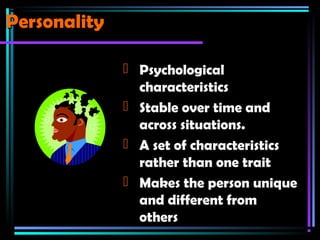
PersonalityPersonality
 Psychological
characteristics
 Stable over time and
across situations.
 A set of characteristics
rather than one trait
 Makes the person unique
and different from
others
Personality has two
meanings:
1. It refers to the impression a
person makes on others
2. It refers to the underlying ,
unseen structures and
processes inside a person that
explain why we behave the way
we do.
Personality Traits and Leadership
• Traits refer to recurring regularities or
trends in a person’s behavior.
• The trait approach to personality
maintains that people behave the way
they do because of the strengths of
the traits they possess.
Personality Traits and Leadership
(continued)
• Personality traits are useful concepts
for explaining why people act fairly
consistently from one situation to the
next.
• Knowing how two people differ on a
particular personality trait can help us
predict more accurately how they
will tend to act in a variety of
situations.
Personality Traits and Leadership
(continued)
• A leader’s behavior reflects an
interaction between his or her
personality traits and various
situational factors:
– Weak situations
– Strong situations
Personality Traits
Personality Traits: Include
tendencies to be enthusiastic,
demanding, easy-going, nervous,
etc.
-Each trait can be viewed on a
continuum, from low to high.
There is no “wrong” trait, but rather
leaders have a complex mix of traits.
Personality Traits (cont.)
MBTI (Myers-Briggs Type
Indicator)
Curphy Version
MBTI Sample
Personality Traits
MBTI (Myers-Briggs Type Indicator)
Preferences distinguish one personality
from another, based on four basic
dimensions used to create one of 16
possible psychological styles.
Extraversion-and-introversion
Sensing-and-intuition
Thinking-and-feeling
Judging-and-perceiving
Extraversion-and-Introversion
The extraversion-and-introversion dimension is
fundamentally concerned with where people get
their energy.
Some leaders are naturally gregarious and
outgoing.
Their spontaneous sociability makes it
easy for them to strike up conversations
with anyone about almost anything.
Not surprisingly, such extraverts have a
breadth of interests and a large circle of
acquaintances. They are energized by
being around others, but their tendency
to “think out loud” and speak whatever
is on their mind can sometimes get
them into trouble.
Extraversion-and-Introversion
(cont.)
Other leaders are more comfortable alone, or
with just a few others.
Introverts can interact effectively with others,
but they are fundamentally both more
reserved and more deliberate than extraverts.
Introverted leaders prefer to think things
through and only announce their final
decisions, and followers may have a difficult
time understanding the process the leaders
used to reach his or her conclusions.
Sensing-and-Intuition
The sensing-and-intuition dimension is concerned
with how people look at data.
Leaders who prefer their sensing mode like facts
and details; the focus of information gathering
concerns the real, the actual, the literal, the specific,
and the present.
Hence, sensing leaders tend to be practical,
orderly, and down-to-earth decision makers.
• By contrast, leaders who rely on their
intuition look for the big picture beyond
particular facts or details; information is
most meaningful for its pattern,
framework, figurative meaning, and
future possibilities.
• Intuitive leaders tend to be innovative
and conceptual (though sometimes
impractical), and are more comfortable
with their hunches.
Thinking-and-Feeling
The thinking-and-feeling dimension is
concerned with the considerations
leaders prefer when making decision.
Thinking leaders like to analyze,
criticize, and approach decisions
impersonally and objectively.
They use their heads to adopt a
relatively detached stance toward
decisions and pay more attention to
operational, bottom-line considerations.
• Feeling leaders naturally
empathize and appreciate, and
prefer to approach decisions
personally and subjectively.
• They value humaneness and
social harmony and use their
hearts to weigh the impact of any
decision on particular people.
Judging-and-Perceiving
The judging-and-perceiving
dimension has to do with the
amount of information a leader
needs before feeling comfortable
making a decision.
Judging leaders
• strive for closure;
• they like things to be settled and come
across as decisive, methodical and
organized
• make poorer decisions.
• get nervous before decisions are made
and only want a minimal amount of
information when making decisions.
• Although they make up their minds
quickly, they may not have all relevant
facts and as a result
Perceiving leaders like to keep their
options open; they are curious,
spontaneous, and flexible.
Perceivers prefer to collect as much
information as possible before making a
decision or a commitment.
Perceivers often get nervous after a
decision is made, as they may not feel
that enough information was collected
or data was analyzed.
Big Five Model
• Advantages of the Big Five Model
– Most personality researchers currently use
one form of the Big Five Model
– The model is usefully categorized
– It is a useful heuristic (shortcut)for
categorizing or profiling people
– It appears to be universally applicable
across cultures
Big Five Model (cont.)
• Disadvantages of the Big Five Model
– Some argue that five factors are not
enough to adequately encompass all the
different personality traits
– The Big Five personality dimensions tend
to be fairly heterogeneous internally, which
makes them poor predictors of job
performance as compared to personality
traits.
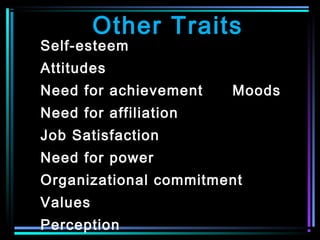
Other Traits
Self-esteem
Attitudes
Need for achievement Moods
Need for affiliation
Job Satisfaction
Need for power
Organizational commitment
Values
Perception
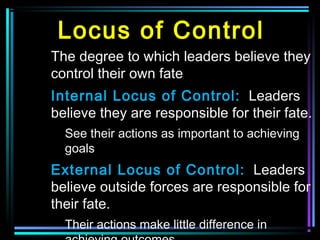
Locus of Control
The degree to which leaders believe they
control their own fate
Internal Locus of Control: Leaders
believe they are responsible for their fate.
See their actions as important to achieving
goals
External Locus of Control: Leaders
believe outside forces are responsible for
their fate.
Their actions make little difference in
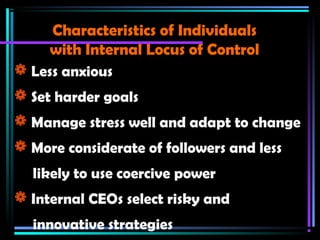
 Less anxious
 Set harder goals
 Manage stress well and adapt to change
 More considerate of followers and less
likely to use coercive power
 Internal CEOs select risky and
innovative strategies
Characteristics of IndividualsCharacteristics of Individuals
with Internal Locus of Controlwith Internal Locus of Control
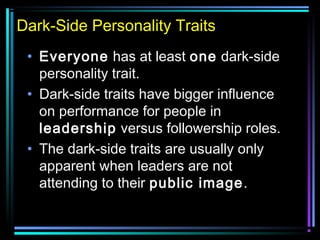
Dark-Side Personality Traits
• Everyone has at least one dark-side
personality trait.
• Dark-side traits have bigger influence
on performance for people in
leadership versus followership roles.
• The dark-side traits are usually only
apparent when leaders are not
attending to their public image.
Dark-side Personality Traits
• Dark-side personality traits are irritating
or counterproductive behavioral
tendencies which interfere with a
leader’s ability to form cohesive teams
and cause followers to exert less effort
towards goal accomplishment.
Dark-Side Personality Traits
• Dark-side traits co-vary with social skills and
are difficult to detect in interviews, assessment
centers, or with bright-side personality
inventories.
• The behaviors associated with dark-side
personality traits can occur at any leadership
level, and many times organizations tolerate
these behaviors because the leader is smart,
experienced, or possesses unique skills.
Dark-Side Personality Traits
• Argumentative
• Interpersonal
insensitivity
• Narcissism
Dark-Side Personality Trait, continued
• Fear of failure
• Perfectionism
• Impulsivity
A persistent tendency to feel and behave in
a favorable or unfavorable way toward a
specific person, object, or idea.
Attitudes
Important Conclusions
• Reasonably stable
• Directed toward some person, object or idea
• Relates to one’s behavior toward that object
or person
• People tend to behave in ways that are
consistent with their feelings
• Behaviors are also influenced by
motivational forces and situational factors
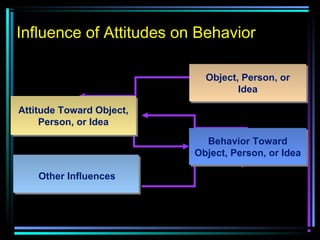
Object, Person, or
Idea
Attitude Toward Object,
Person, or Idea
Behavior Toward
Object, Person, or Idea
Other Influences
Influence of Attitudes on Behavior
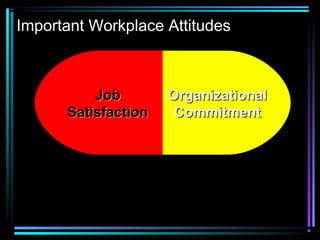
Important Workplace Attitudes
JobJob
SatisfactionSatisfaction
OrganizationalOrganizational
CommitmentCommitment
Job Satisfaction
A collection of feelings and
beliefs that managers have
about their current jobs.
JobJob
SatisfactionSatisfaction
Job Satisfaction Outcomes
• Highly positive effect on intentions to stay in
the job
• Modest effect on actually staying in the job
• Modestly positive effect on regular attendance
at work
• Positive effect on performance (may also be
positively affected by performance)
• Moderately strong relationship with motivation
JobJob
SatisfactionSatisfaction
•Managers high on job satisfaction
have a positive view of their jobs.
•Levels of job satisfaction tend to
increase as managers move up in
the hierarchy in an organization.
JobJob
SatisfactionSatisfaction
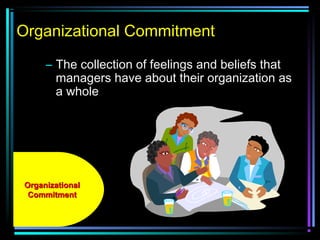
Organizational Commitment
– The collection of feelings and beliefs that
managers have about their organization as
a whole
OrganizationalOrganizational
CommitmentCommitment
Organizational Commitment
Outcomes
• Positive effects on intentions to stay in the job
• Modest effects on actually staying in the job
and attending work regularly
• Significantly related to motivation
• Positive effects on job performance
OrganizationalOrganizational
CommitmentCommitment
• Role ambiguity
• Supervision/leadership
• Pay and benefits
• Nature of the job
• Organization climate
• Stress
• Perceptions of fair treatment
Causes
OrganizationalOrganizational
CommitmentCommitment
Values are “constructs representing
generalized behaviors or states of
affairs that are considered by the
individual to be important.”
---(simply said, representations of our
behavior based on what we see as
important).
What Are Values?
Values cont..
–Describe what managers try to achieve
through work and how they think they
should behave
• Individuals in the same work unit can
have considerably different values.
• We can only make inferences about
people’s values based on their
behavior.
Value System
–What a person is striving to
achieve in life and how they
want to behave
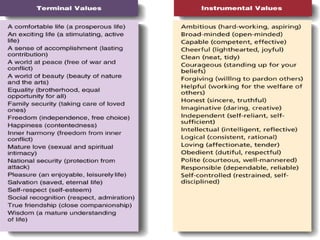
Terminal Values
– A personal conviction about life-long goals
Instrumental Values
– A personal conviction about desired modes
of conduct or ways of behaving
Values are a primary determinant in what data
are reviewed by leaders and how they define
problems.
Values often influence leader’s perceptions of
individual and organizational successes as well as
the manner in which these successes are
achieved.
Values help leaders choose right from wrong,
and between ethical and unethical behavior.
How Values Impact Leadership
Leaders tend to like followers with similar
values and dislike those with dissimilar
values.
It is important for leaders to surround
themselves with followers who possess
divergent values.
Leaders are motivated to act in ways
consistent with their values, and they
typically spend most of their time engaged
in activities that are consistent with their
values.
Implications
Implications for leaders and managers:
Knowing about one’s personality, values, and
attitude, can help one understand why people
act differently and why working with people
with different personalities can be a source of
harmonious relationship or a conflict in an
organization.
It gives leaders ideas on how to deal with a
certain problem.
There are no certain personality traits
that will guarantee one will be a
successful leader or manager.
The impact of any personality trait on
behavior will vary with the situation.
• Leaders should expect to face a
variety of challenges to their own
system of ethics, values, or attitudes
during their careers.
• Interacting with individuals and
groups holding divergent and
conflicting values is inevitable.
• Leaders in particular have a
responsibility not to let their own
personal values interfere with
professional leader-subordinate
relationships.

Personality, values, and attitudes

  • 1.
  • 2.
    PersonalityPersonality  Psychological characteristics  Stableover time and across situations.  A set of characteristics rather than one trait  Makes the person unique and different from others
  • 3.
    Personality has two meanings: 1.It refers to the impression a person makes on others 2. It refers to the underlying , unseen structures and processes inside a person that explain why we behave the way we do.
  • 4.
    Personality Traits andLeadership • Traits refer to recurring regularities or trends in a person’s behavior. • The trait approach to personality maintains that people behave the way they do because of the strengths of the traits they possess.
  • 5.
    Personality Traits andLeadership (continued) • Personality traits are useful concepts for explaining why people act fairly consistently from one situation to the next. • Knowing how two people differ on a particular personality trait can help us predict more accurately how they will tend to act in a variety of situations.
  • 6.
    Personality Traits andLeadership (continued) • A leader’s behavior reflects an interaction between his or her personality traits and various situational factors: – Weak situations – Strong situations
  • 7.
    Personality Traits Personality Traits:Include tendencies to be enthusiastic, demanding, easy-going, nervous, etc. -Each trait can be viewed on a continuum, from low to high. There is no “wrong” trait, but rather leaders have a complex mix of traits.
  • 8.
    Personality Traits (cont.) MBTI(Myers-Briggs Type Indicator) Curphy Version MBTI Sample
  • 9.
    Personality Traits MBTI (Myers-BriggsType Indicator) Preferences distinguish one personality from another, based on four basic dimensions used to create one of 16 possible psychological styles. Extraversion-and-introversion Sensing-and-intuition Thinking-and-feeling Judging-and-perceiving
  • 10.
    Extraversion-and-Introversion The extraversion-and-introversion dimensionis fundamentally concerned with where people get their energy. Some leaders are naturally gregarious and outgoing.
  • 11.
    Their spontaneous sociabilitymakes it easy for them to strike up conversations with anyone about almost anything. Not surprisingly, such extraverts have a breadth of interests and a large circle of acquaintances. They are energized by being around others, but their tendency to “think out loud” and speak whatever is on their mind can sometimes get them into trouble.
  • 12.
    Extraversion-and-Introversion (cont.) Other leaders aremore comfortable alone, or with just a few others. Introverts can interact effectively with others, but they are fundamentally both more reserved and more deliberate than extraverts. Introverted leaders prefer to think things through and only announce their final decisions, and followers may have a difficult time understanding the process the leaders used to reach his or her conclusions.
  • 13.
    Sensing-and-Intuition The sensing-and-intuition dimensionis concerned with how people look at data. Leaders who prefer their sensing mode like facts and details; the focus of information gathering concerns the real, the actual, the literal, the specific, and the present. Hence, sensing leaders tend to be practical, orderly, and down-to-earth decision makers.
  • 14.
    • By contrast,leaders who rely on their intuition look for the big picture beyond particular facts or details; information is most meaningful for its pattern, framework, figurative meaning, and future possibilities. • Intuitive leaders tend to be innovative and conceptual (though sometimes impractical), and are more comfortable with their hunches.
  • 15.
    Thinking-and-Feeling The thinking-and-feeling dimensionis concerned with the considerations leaders prefer when making decision. Thinking leaders like to analyze, criticize, and approach decisions impersonally and objectively. They use their heads to adopt a relatively detached stance toward decisions and pay more attention to operational, bottom-line considerations.
  • 16.
    • Feeling leadersnaturally empathize and appreciate, and prefer to approach decisions personally and subjectively. • They value humaneness and social harmony and use their hearts to weigh the impact of any decision on particular people.
  • 17.
    Judging-and-Perceiving The judging-and-perceiving dimension hasto do with the amount of information a leader needs before feeling comfortable making a decision.
  • 18.
    Judging leaders • strivefor closure; • they like things to be settled and come across as decisive, methodical and organized • make poorer decisions. • get nervous before decisions are made and only want a minimal amount of information when making decisions. • Although they make up their minds quickly, they may not have all relevant facts and as a result
  • 19.
    Perceiving leaders liketo keep their options open; they are curious, spontaneous, and flexible. Perceivers prefer to collect as much information as possible before making a decision or a commitment. Perceivers often get nervous after a decision is made, as they may not feel that enough information was collected or data was analyzed.
  • 20.
    Big Five Model •Advantages of the Big Five Model – Most personality researchers currently use one form of the Big Five Model – The model is usefully categorized – It is a useful heuristic (shortcut)for categorizing or profiling people – It appears to be universally applicable across cultures
  • 21.
    Big Five Model(cont.) • Disadvantages of the Big Five Model – Some argue that five factors are not enough to adequately encompass all the different personality traits – The Big Five personality dimensions tend to be fairly heterogeneous internally, which makes them poor predictors of job performance as compared to personality traits.
  • 22.
    Other Traits Self-esteem Attitudes Need forachievement Moods Need for affiliation Job Satisfaction Need for power Organizational commitment Values Perception
  • 23.
    Locus of Control Thedegree to which leaders believe they control their own fate Internal Locus of Control: Leaders believe they are responsible for their fate. See their actions as important to achieving goals External Locus of Control: Leaders believe outside forces are responsible for their fate. Their actions make little difference in
  • 24.
     Less anxious Set harder goals  Manage stress well and adapt to change  More considerate of followers and less likely to use coercive power  Internal CEOs select risky and innovative strategies Characteristics of IndividualsCharacteristics of Individuals with Internal Locus of Controlwith Internal Locus of Control
  • 25.
    Dark-Side Personality Traits •Everyone has at least one dark-side personality trait. • Dark-side traits have bigger influence on performance for people in leadership versus followership roles. • The dark-side traits are usually only apparent when leaders are not attending to their public image.
  • 26.
    Dark-side Personality Traits •Dark-side personality traits are irritating or counterproductive behavioral tendencies which interfere with a leader’s ability to form cohesive teams and cause followers to exert less effort towards goal accomplishment.
  • 27.
    Dark-Side Personality Traits •Dark-side traits co-vary with social skills and are difficult to detect in interviews, assessment centers, or with bright-side personality inventories. • The behaviors associated with dark-side personality traits can occur at any leadership level, and many times organizations tolerate these behaviors because the leader is smart, experienced, or possesses unique skills.
  • 28.
    Dark-Side Personality Traits •Argumentative • Interpersonal insensitivity • Narcissism
  • 29.
    Dark-Side Personality Trait,continued • Fear of failure • Perfectionism • Impulsivity
  • 30.
    A persistent tendencyto feel and behave in a favorable or unfavorable way toward a specific person, object, or idea. Attitudes
  • 31.
    Important Conclusions • Reasonablystable • Directed toward some person, object or idea • Relates to one’s behavior toward that object or person • People tend to behave in ways that are consistent with their feelings • Behaviors are also influenced by motivational forces and situational factors
  • 32.
    Object, Person, or Idea AttitudeToward Object, Person, or Idea Behavior Toward Object, Person, or Idea Other Influences Influence of Attitudes on Behavior
  • 33.
  • 34.
    Job Satisfaction A collectionof feelings and beliefs that managers have about their current jobs. JobJob SatisfactionSatisfaction
  • 35.
    Job Satisfaction Outcomes •Highly positive effect on intentions to stay in the job • Modest effect on actually staying in the job • Modestly positive effect on regular attendance at work • Positive effect on performance (may also be positively affected by performance) • Moderately strong relationship with motivation JobJob SatisfactionSatisfaction
  • 36.
    •Managers high onjob satisfaction have a positive view of their jobs. •Levels of job satisfaction tend to increase as managers move up in the hierarchy in an organization. JobJob SatisfactionSatisfaction
  • 37.
    Organizational Commitment – Thecollection of feelings and beliefs that managers have about their organization as a whole OrganizationalOrganizational CommitmentCommitment
  • 38.
    Organizational Commitment Outcomes • Positiveeffects on intentions to stay in the job • Modest effects on actually staying in the job and attending work regularly • Significantly related to motivation • Positive effects on job performance OrganizationalOrganizational CommitmentCommitment
  • 39.
    • Role ambiguity •Supervision/leadership • Pay and benefits • Nature of the job • Organization climate • Stress • Perceptions of fair treatment Causes OrganizationalOrganizational CommitmentCommitment
  • 40.
    Values are “constructsrepresenting generalized behaviors or states of affairs that are considered by the individual to be important.” ---(simply said, representations of our behavior based on what we see as important). What Are Values?
  • 41.
    Values cont.. –Describe whatmanagers try to achieve through work and how they think they should behave
  • 42.
    • Individuals inthe same work unit can have considerably different values. • We can only make inferences about people’s values based on their behavior.
  • 43.
    Value System –What aperson is striving to achieve in life and how they want to behave
  • 44.
    Terminal Values – Apersonal conviction about life-long goals Instrumental Values – A personal conviction about desired modes of conduct or ways of behaving
  • 46.
    Values are aprimary determinant in what data are reviewed by leaders and how they define problems. Values often influence leader’s perceptions of individual and organizational successes as well as the manner in which these successes are achieved. Values help leaders choose right from wrong, and between ethical and unethical behavior. How Values Impact Leadership
  • 47.
    Leaders tend tolike followers with similar values and dislike those with dissimilar values. It is important for leaders to surround themselves with followers who possess divergent values. Leaders are motivated to act in ways consistent with their values, and they typically spend most of their time engaged in activities that are consistent with their values.
  • 48.
    Implications Implications for leadersand managers: Knowing about one’s personality, values, and attitude, can help one understand why people act differently and why working with people with different personalities can be a source of harmonious relationship or a conflict in an organization. It gives leaders ideas on how to deal with a certain problem.
  • 49.
    There are nocertain personality traits that will guarantee one will be a successful leader or manager. The impact of any personality trait on behavior will vary with the situation.
  • 50.
    • Leaders shouldexpect to face a variety of challenges to their own system of ethics, values, or attitudes during their careers. • Interacting with individuals and groups holding divergent and conflicting values is inevitable.
  • 51.
    • Leaders inparticular have a responsibility not to let their own personal values interfere with professional leader-subordinate relationships.