MG 6851 PRINCIPLES OF
MANAGEMENT
UNIT 4
DIRECTING AS A FUNCTION OF
MANAGEMENT
Compiled by Dr.M.Balasubramanian
FOUNDATION OF INDIVIDUAL AND
GROUP BEHAVIOUR
Compiled by Dr.M.Balasubramanian
INDIVIDUAL BEHAVIOUR
Study of
• Personality - Appearance
Biological factors like hereidity, Brain and physical features
Cultural and Social Factors
• Attitudes
• Learning and Behaviour Modification
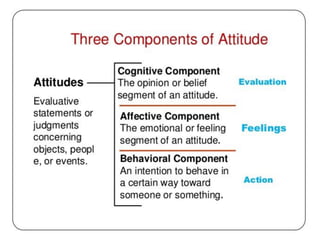
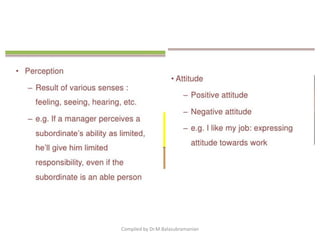
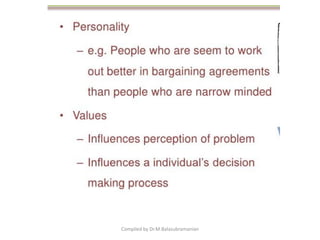
• Perception Compiled by Dr.M.Balasubramanian
An individual’s personality is the combination of the psychological
traits that characterize that person. Literally dozens of traits are
attributed to an individual’s behavior. Researchers attempted to
focus specifically on which traits would identify sources of one’s
personality. Two of these efforts have been widely recognized—
the Myers-Briggs Type Indicator and the Big Five-model of
personality.
Compiled by Dr.M.Balasubramanian
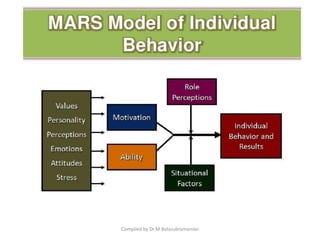
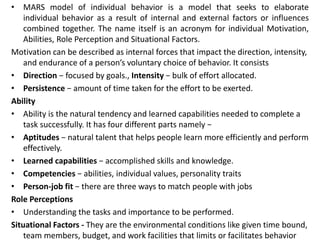
• MARS model of individual behavior is a model that seeks to elaborate
individual behavior as a result of internal and external factors or influences
combined together. The name itself is an acronym for individual Motivation,
Abilities, Role Perception and Situational Factors.
Motivation can be described as internal forces that impact the direction, intensity,
and endurance of a person’s voluntary choice of behavior. It consists
• Direction − focused by goals., Intensity − bulk of effort allocated.
• Persistence − amount of time taken for the effort to be exerted.
Ability
• Ability is the natural tendency and learned capabilities needed to complete a
task successfully. It has four different parts namely −
• Aptitudes − natural talent that helps people learn more efficiently and perform
effectively.
• Learned capabilities − accomplished skills and knowledge.
• Competencies − abilities, individual values, personality traits
• Person-job fit − there are three ways to match people with jobs
Role Perceptions
• Understanding the tasks and importance to be performed.
Situational Factors - They are the environmental conditions like given time bound,
team members, budget, and work facilities that limits or facilitates behavior
Leon Festinger, in the late 1950s, proposed the theory of cognitive dissonance. This
theory sought to explain the relationship between attitudes and behavior.
Dissonance in this case means inconsistency. Cognitive dissonance refers to any
incompatibility that an individual might perceive between attitudes or between his
or her behavior and attitudes.
Festinger argued that any form of inconsistency is uncomfortable and that
individuals will attempt to reduce the dissonance and the discomfort.
Festinger proposed that the desire to reduce dissonance is determined by the
importance of the elements creating the dissonance.
Cognitive dissonance theory is founded on the assumption that individuals seek
consistency between their expectations and their reality. Because of this, people
engage in a process called dissonance reduction to bring their cognitions and
actions in line with one another. This creation of uniformity allows for a lessening
of psychological tension and distress. Dissonance is felt when people are
confronted with information that is inconsistent with their beliefs. If the dissonance
is not reduced by changing one's belief, the dissonance can result in restoring
consonance through misperception, rejection or refutation of the information,
seeking support from others who share the beliefs and attempting to persuade
others.
What Is Cognitive Dissonance Theory
11
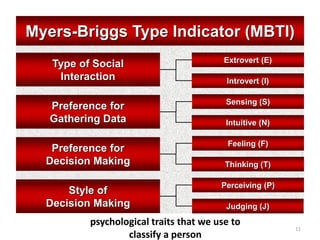
Style of
Decision Making Judging (J)
Perceiving (P)
Preference for
Decision Making Thinking (T)
Feeling (F)
Type of Social
Interaction Introvert (I)
Extrovert (E)
Preference for
Gathering Data Intuitive (N)
Sensing (S)
Myers-Briggs Type Indicator (MBTI)
psychological traits that we use to
classify a person
Extraversion and Introversion - If you prefer to direct your energy to deal with
people, things, situations, or "the outer world", then your preference is for
Extraversion. If you prefer to direct your energy to deal with ideas, information,
explanations or beliefs, or "the inner world", then your preference is for
Introversion.
Sensing and Intuition - If you prefer to deal with facts, what you know, to have
clarity, or to describe what you see, then your preference is for Sensing. If you
prefer to deal with ideas, look into the unknown, to generate new possibilities or
to anticipate what isn't obvious, then your preference is for Intuition. The letter N
is used for intuition because I has already been allocated to Introversion.
Thinking and Feeling - If you prefer to decide on the basis of objective logic, using
an analytic approach, then your preference is for Thinking. If you prefer to decide
using values - i.e. on the basis of what or who you believe is important - then your
preference is for Feeling.
Judgment and Perception - If you prefer your life to be planned, stable and
organised then your preference is for Judging. If you prefer to go with the flow, to
maintain flexibility and respond to things as they arise, then your preference is for
Perception.
ESTJ strengths
ESTJs drive themselves to reach their goal, organising people and resources in
order to achieve it. They have an extensive network of contacts and are willing to
make tough decisions when necessary. They tend to value competence highly
13
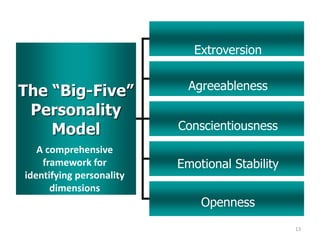
The “Big-Five”
Personality
Model
Extroversion
Agreeableness
Conscientiousness
Emotional Stability
Openness
A comprehensive
framework for
identifying personality
dimensions
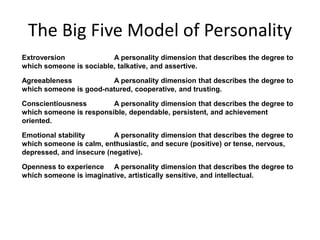
The Big Five Model of Personality
Extroversion A personality dimension that describes the degree to
which someone is sociable, talkative, and assertive.
Agreeableness A personality dimension that describes the degree to
which someone is good-natured, cooperative, and trusting.
Conscientiousness A personality dimension that describes the degree to
which someone is responsible, dependable, persistent, and achievement
oriented.
Emotional stability A personality dimension that describes the degree to
which someone is calm, enthusiastic, and secure (positive) or tense, nervous,
depressed, and insecure (negative).
Openness to experience A personality dimension that describes the degree to
which someone is imaginative, artistically sensitive, and intellectual.
15
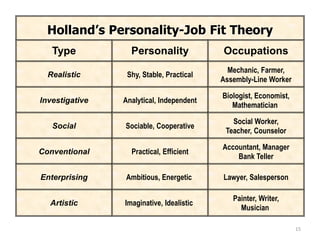
Holland’s Personality-Job Fit Theory
Type Personality Occupations
Realistic
Investigative
Social
Conventional
Enterprising
Artistic
Shy, Stable, Practical
Analytical, Independent
Sociable, Cooperative
Practical, Efficient
Ambitious, Energetic
Imaginative, Idealistic
Mechanic, Farmer,
Assembly-Line Worker
Biologist, Economist,
Mathematician
Social Worker,
Teacher, Counselor
Accountant, Manager
Bank Teller
Lawyer, Salesperson
Painter, Writer,
Musician
16
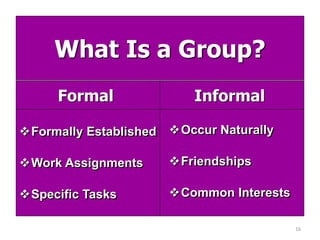
InformalFormal
What Is a Group?
Formally Established
Work Assignments
Specific Tasks
Occur Naturally
Friendships
Common Interests
17
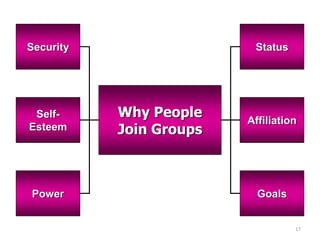
Why People
Join Groups
Affiliation
Status
Goals
Security
Self-
Esteem
Power
8-18
Foundations of Group Behavior
8-19
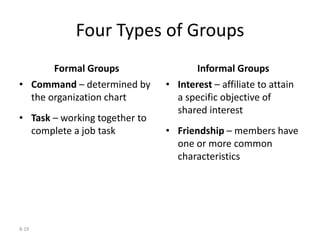
Four Types of Groups
Formal Groups
• Command – determined by
the organization chart
• Task – working together to
complete a job task
Informal Groups
• Interest – affiliate to attain
a specific objective of
shared interest
• Friendship – members have
one or more common
characteristics
8-20
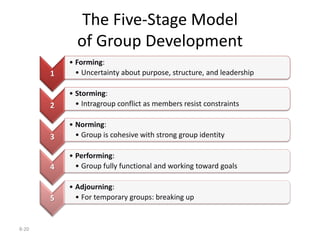
The Five-Stage Model
of Group Development
1
• Forming:
• Uncertainty about purpose, structure, and leadership
2
• Storming:
• Intragroup conflict as members resist constraints
3
• Norming:
• Group is cohesive with strong group identity
4
• Performing:
• Group fully functional and working toward goals
5
• Adjourning:
• For temporary groups: breaking up
8-21
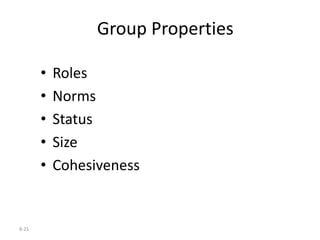
Group Properties
• Roles
• Norms
• Status
• Size
• Cohesiveness
8-22
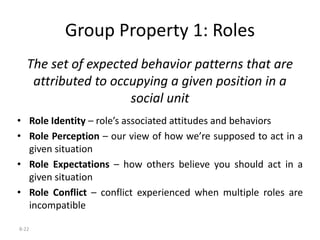
Group Property 1: Roles
The set of expected behavior patterns that are
attributed to occupying a given position in a
social unit
• Role Identity – role’s associated attitudes and behaviors
• Role Perception – our view of how we’re supposed to act in a
given situation
• Role Expectations – how others believe you should act in a
given situation
• Role Conflict – conflict experienced when multiple roles are
incompatible
8-23
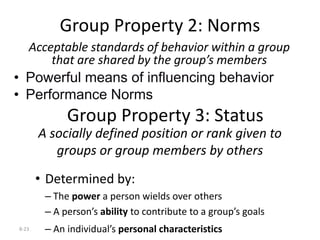
Group Property 2: Norms
Acceptable standards of behavior within a group
that are shared by the group’s members
• Powerful means of influencing behavior
• Performance Norms
Group Property 3: Status
A socially defined position or rank given to
groups or group members by others
• Determined by:
– The power a person wields over others
– A person’s ability to contribute to a group’s goals
– An individual’s personal characteristics
8-24
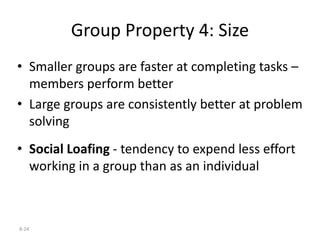
Group Property 4: Size
• Smaller groups are faster at completing tasks –
members perform better
• Large groups are consistently better at problem
solving
• Social Loafing - tendency to expend less effort
working in a group than as an individual
8-25
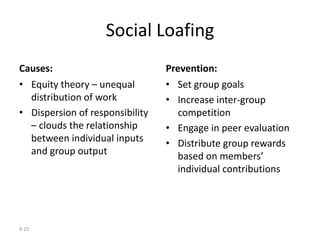
Social Loafing
Causes:
• Equity theory – unequal
distribution of work
• Dispersion of responsibility
– clouds the relationship
between individual inputs
and group output
Prevention:
• Set group goals
• Increase inter-group
competition
• Engage in peer evaluation
• Distribute group rewards
based on members’
individual contributions
8-26
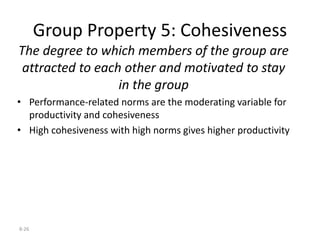
Group Property 5: Cohesiveness
The degree to which members of the group are
attracted to each other and motivated to stay
in the group
• Performance-related norms are the moderating variable for
productivity and cohesiveness
• High cohesiveness with high norms gives higher productivity
8-27
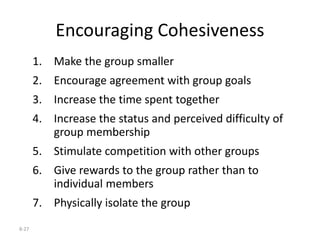
Encouraging Cohesiveness
1. Make the group smaller
2. Encourage agreement with group goals
3. Increase the time spent together
4. Increase the status and perceived difficulty of
group membership
5. Stimulate competition with other groups
6. Give rewards to the group rather than to
individual members
7. Physically isolate the group
28
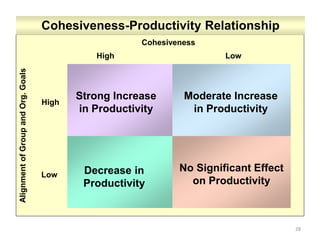
Strong Increase
in Productivity
Moderate Increase
in Productivity
No Significant Effect
on Productivity
Decrease in
Productivity
Cohesiveness
AlignmentofGroupandOrg.Goals
High Low
Cohesiveness-Productivity Relationship
High
Low
Compiled by Dr.M.Balasubramanian
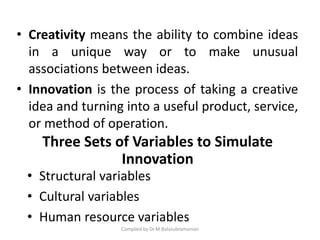
• Creativity means the ability to combine ideas
in a unique way or to make unusual
associations between ideas.
• Innovation is the process of taking a creative
idea and turning into a useful product, service,
or method of operation.
• Structural variables
• Cultural variables
• Human resource variables
Three Sets of Variables to Simulate
Innovation
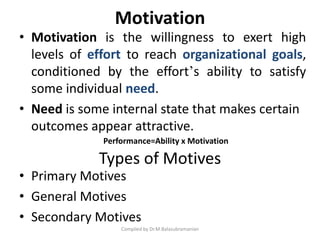
Motivation
• Motivation is the willingness to exert high
levels of effort to reach organizational goals,
conditioned by the effort’s ability to satisfy
some individual need.
• Need is some internal state that makes certain
outcomes appear attractive.
Compiled by Dr.M.Balasubramanian
• Primary Motives
• General Motives
• Secondary Motives
Types of Motives
Performance=Ability x Motivation
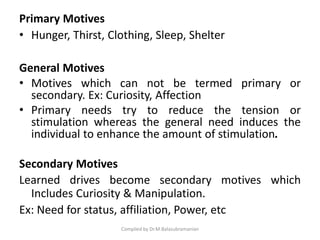
Primary Motives
• Hunger, Thirst, Clothing, Sleep, Shelter
General Motives
• Motives which can not be termed primary or
secondary. Ex: Curiosity, Affection
• Primary needs try to reduce the tension or
stimulation whereas the general need induces the
individual to enhance the amount of stimulation.
Secondary Motives
Learned drives become secondary motives which
Includes Curiosity & Manipulation.
Ex: Need for status, affiliation, Power, etc
Compiled by Dr.M.Balasubramanian
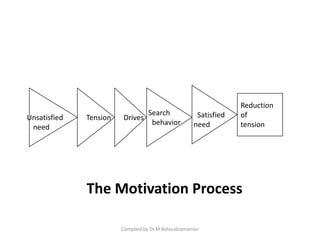
The Motivation Process
Compiled by Dr.M.Balasubramanian
Unsatisfied
need
Tension Drives
Search
behavior
Satisfied
need
Reduction
of
tension
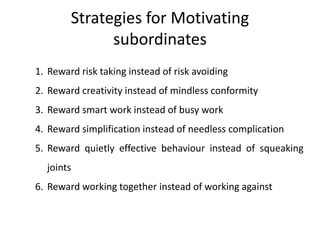
Strategies for Motivating
subordinates
1. Reward risk taking instead of risk avoiding
2. Reward creativity instead of mindless conformity
3. Reward smart work instead of busy work
4. Reward simplification instead of needless complication
5. Reward quietly effective behaviour instead of squeaking
joints
6. Reward working together instead of working against
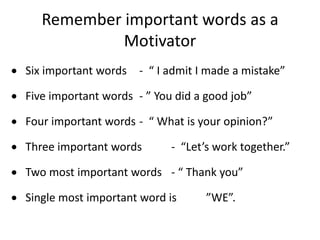
Remember important words as a
Motivator
 Six important words - “ I admit I made a mistake”
 Five important words - ” You did a good job”
 Four important words - “ What is your opinion?”
 Three important words - “Let’s work together.”
 Two most important words - “ Thank you”
 Single most important word is ”WE”.
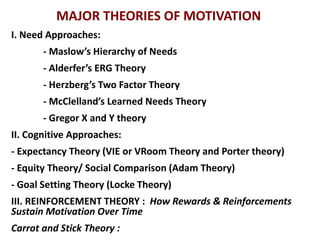
MAJOR THEORIES OF MOTIVATION
I. Need Approaches:
- Maslow’s Hierarchy of Needs
- Alderfer’s ERG Theory
- Herzberg’s Two Factor Theory
- McClelland’s Learned Needs Theory
- Gregor X and Y theory
II. Cognitive Approaches:
- Expectancy Theory (VIE or VRoom Theory and Porter theory)
- Equity Theory/ Social Comparison (Adam Theory)
- Goal Setting Theory (Locke Theory)
III. REINFORCEMENT THEORY : How Rewards & Reinforcements
Sustain Motivation Over Time
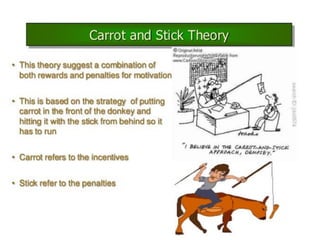
Carrot and Stick Theory :
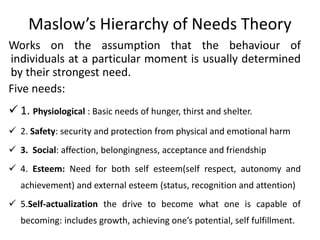
Maslow’s Hierarchy of Needs Theory
Works on the assumption that the behaviour of
individuals at a particular moment is usually determined
by their strongest need.
Five needs:
 1. Physiological : Basic needs of hunger, thirst and shelter.
 2. Safety: security and protection from physical and emotional harm
 3. Social: affection, belongingness, acceptance and friendship
 4. Esteem: Need for both self esteem(self respect, autonomy and
achievement) and external esteem (status, recognition and attention)
 5.Self-actualization the drive to become what one is capable of
becoming: includes growth, achieving one’s potential, self fulfillment.
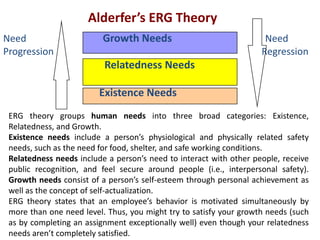
Alderfer’s ERG Theory
Need Growth Needs Need
Progression Regression
Relatedness Needs
Existence Needs
ERG theory groups human needs into three broad categories: Existence,
Relatedness, and Growth.
Existence needs include a person’s physiological and physically related safety
needs, such as the need for food, shelter, and safe working conditions.
Relatedness needs include a person’s need to interact with other people, receive
public recognition, and feel secure around people (i.e., interpersonal safety).
Growth needs consist of a person’s self-esteem through personal achievement as
well as the concept of self-actualization.
ERG theory states that an employee’s behavior is motivated simultaneously by
more than one need level. Thus, you might try to satisfy your growth needs (such
as by completing an assignment exceptionally well) even though your relatedness
needs aren’t completely satisfied.
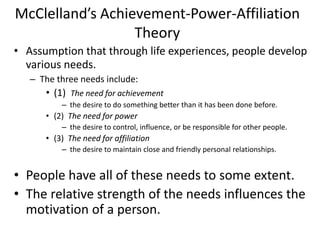
McClelland’s Achievement-Power-Affiliation
Theory
• Assumption that through life experiences, people develop
various needs.
– The three needs include:
• (1) The need for achievement
– the desire to do something better than it has been done before.
• (2) The need for power
– the desire to control, influence, or be responsible for other people.
• (3) The need for affiliation
– the desire to maintain close and friendly personal relationships.
• People have all of these needs to some extent.
• The relative strength of the needs influences the
motivation of a person.
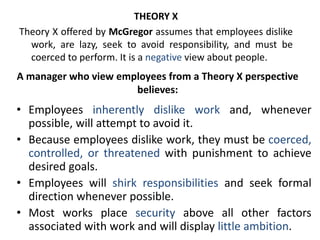
A manager who view employees from a Theory X perspective
believes:
• Employees inherently dislike work and, whenever
possible, will attempt to avoid it.
• Because employees dislike work, they must be coerced,
controlled, or threatened with punishment to achieve
desired goals.
• Employees will shirk responsibilities and seek formal
direction whenever possible.
• Most works place security above all other factors
associated with work and will display little ambition.
THEORY X
Theory X offered by McGregor assumes that employees dislike
work, are lazy, seek to avoid responsibility, and must be
coerced to perform. It is a negative view about people.
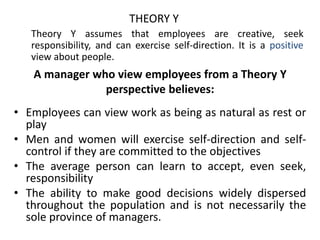
A manager who view employees from a Theory Y
perspective believes:
• Employees can view work as being as natural as rest or
play
• Men and women will exercise self-direction and self-
control if they are committed to the objectives
• The average person can learn to accept, even seek,
responsibility
• The ability to make good decisions widely dispersed
throughout the population and is not necessarily the
sole province of managers.
THEORY Y
Theory Y assumes that employees are creative, seek
responsibility, and can exercise self-direction. It is a positive
view about people.
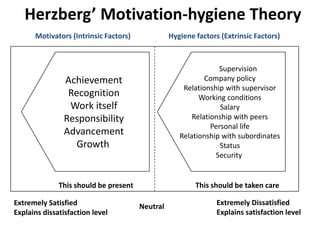
Achievement
Recognition
Work itself
Responsibility
Advancement
Growth
Supervision
Company policy
Relationship with supervisor
Working conditions
Salary
Relationship with peers
Personal life
Relationship with subordinates
Status
Security
Motivators (Intrinsic Factors) Hygiene factors (Extrinsic Factors)
Extremely Satisfied
Explains dissatisfaction level
Neutral Extremely Dissatisfied
Explains satisfaction level
Herzberg’ Motivation-hygiene Theory
This should be present This should be taken care
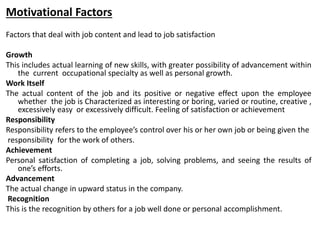
Motivational Factors
Factors that deal with job content and lead to job satisfaction
Growth
This includes actual learning of new skills, with greater possibility of advancement within
the current occupational specialty as well as personal growth.
Work Itself
The actual content of the job and its positive or negative effect upon the employee
whether the job is Characterized as interesting or boring, varied or routine, creative ,
excessively easy or excessively difficult. Feeling of satisfaction or achievement
Responsibility
Responsibility refers to the employee’s control over his or her own job or being given the
responsibility for the work of others.
Achievement
Personal satisfaction of completing a job, solving problems, and seeing the results of
one’s efforts.
Advancement
The actual change in upward status in the company.
Recognition
This is the recognition by others for a job well done or personal accomplishment.
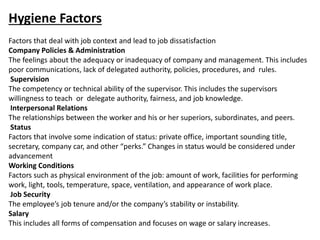
Hygiene Factors
Factors that deal with job context and lead to job dissatisfaction
Company Policies & Administration
The feelings about the adequacy or inadequacy of company and management. This includes
poor communications, lack of delegated authority, policies, procedures, and rules.
Supervision
The competency or technical ability of the supervisor. This includes the supervisors
willingness to teach or delegate authority, fairness, and job knowledge.
Interpersonal Relations
The relationships between the worker and his or her superiors, subordinates, and peers.
Status
Factors that involve some indication of status: private office, important sounding title,
secretary, company car, and other “perks.” Changes in status would be considered under
advancement
Working Conditions
Factors such as physical environment of the job: amount of work, facilities for performing
work, light, tools, temperature, space, ventilation, and appearance of work place.
Job Security
The employee’s job tenure and/or the company’s stability or instability.
Salary
This includes all forms of compensation and focuses on wage or salary increases.
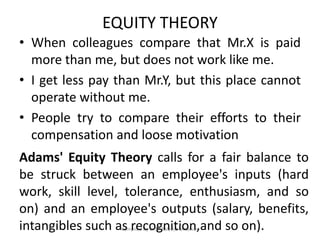
EQUITY THEORY
• When colleagues compare that Mr.X is paid
more than me, but does not work like me.
• I get less pay than Mr.Y, but this place cannot
operate without me.
• People try to compare their efforts to their
compensation and loose motivation
Compiled by Dr.M.Balasubramanian
Adams' Equity Theory calls for a fair balance to
be struck between an employee's inputs (hard
work, skill level, tolerance, enthusiasm, and so
on) and an employee's outputs (salary, benefits,
intangibles such as recognition,and so on).
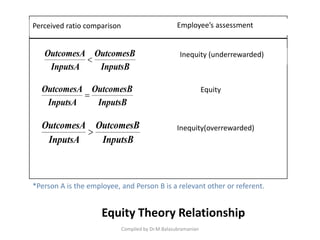
Equity Theory Relationship
Compiled by Dr.M.Balasubramanian
Perceived ratio comparison Employee’s assessment
InputsB
OutcomesB
InputsA
OutcomesA

InputsB
OutcomesB
InputsA
OutcomesA

InputsB
OutcomesB
InputsA
OutcomesA

Inequity (underrewarded)
Equity
Inequity(overrewarded)
*Person A is the employee, and Person B is a relevant other or referent.
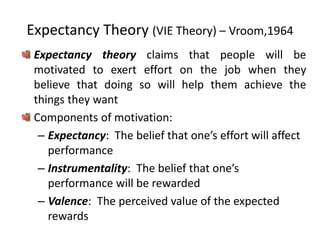
Expectancy Theory (VIE Theory) – Vroom,1964
Expectancy theory claims that people will be
motivated to exert effort on the job when they
believe that doing so will help them achieve the
things they want
Components of motivation:
– Expectancy: The belief that one’s effort will affect
performance
– Instrumentality: The belief that one’s
performance will be rewarded
– Valence: The perceived value of the expected
rewards
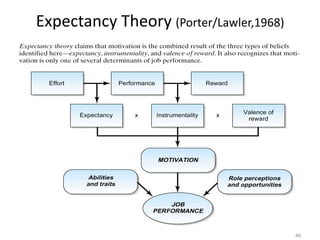
Expectancy Theory (Porter/Lawler,1968)
48
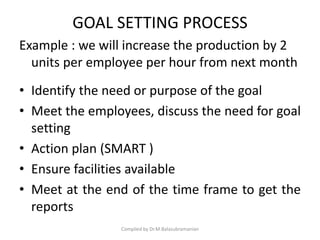
GOAL SETTING PROCESS
Example : we will increase the production by 2
units per employee per hour from next month
• Identify the need or purpose of the goal
• Meet the employees, discuss the need for goal
setting
• Action plan (SMART )
• Ensure facilities available
• Meet at the end of the time frame to get the
reports
Compiled by Dr.M.Balasubramanian
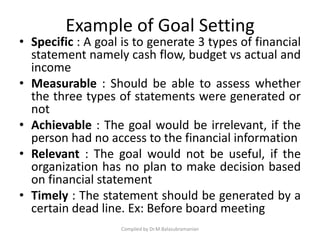
Example of Goal Setting
• Specific : A goal is to generate 3 types of financial
statement namely cash flow, budget vs actual and
income
• Measurable : Should be able to assess whether
the three types of statements were generated or
not
• Achievable : The goal would be irrelevant, if the
person had no access to the financial information
• Relevant : The goal would not be useful, if the
organization has no plan to make decision based
on financial statement
• Timely : The statement should be generated by a
certain dead line. Ex: Before board meeting
Compiled by Dr.M.Balasubramanian
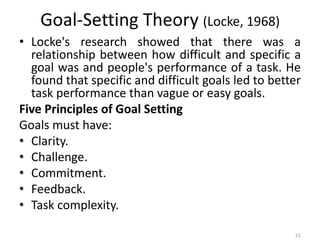
Goal-Setting Theory (Locke, 1968)
• Locke's research showed that there was a
relationship between how difficult and specific a
goal was and people's performance of a task. He
found that specific and difficult goals led to better
task performance than vague or easy goals.
Five Principles of Goal Setting
Goals must have:
• Clarity.
• Challenge.
• Commitment.
• Feedback.
• Task complexity.
51
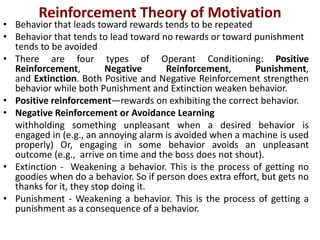
Reinforcement Theory of Motivation
• Behavior that leads toward rewards tends to be repeated
• Behavior that tends to lead toward no rewards or toward punishment
tends to be avoided
• There are four types of Operant Conditioning: Positive
Reinforcement, Negative Reinforcement, Punishment,
and Extinction. Both Positive and Negative Reinforcement strengthen
behavior while both Punishment and Extinction weaken behavior.
• Positive reinforcement—rewards on exhibiting the correct behavior.
• Negative Reinforcement or Avoidance Learning
withholding something unpleasant when a desired behavior is
engaged in (e.g., an annoying alarm is avoided when a machine is used
properly) Or, engaging in some behavior avoids an unpleasant
outcome (e.g., arrive on time and the boss does not shout).
• Extinction - Weakening a behavior. This is the process of getting no
goodies when do a behavior. So if person does extra effort, but gets no
thanks for it, they stop doing it.
• Punishment - Weakening a behavior. This is the process of getting a
punishment as a consequence of a behavior.
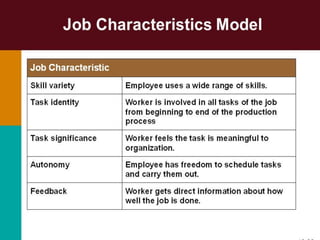
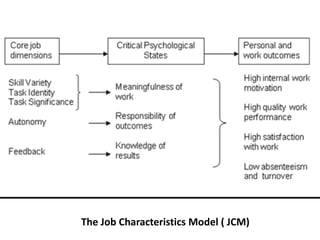
The Job Characteristics Model ( JCM)
Contemporary Issues in Motivation
• What is the key to motivating a diverse
workforce?
• Should employees be paid for performance or
time on the job?
• How can managers motivate minimum-wage
employees?
• What’s different in motivating professional and
technical employees?
• How can flexible work options influence
motivation?(compressed workweek, flextime work,
job sharing, telecommuting )
Compiled by Dr.M.Balasubramanian
Definitions
• Robert Kreitner:
“leadership is a social influence process in
which the leader seeks the voluntary
participation of subordinates in an effort to reach
organizational objectives.”
• Stephen P. Robbins :
“Leadership is the ability to influence a group
towards achievements of goals.”
Compiled by Dr.M.Balasubramanian
Leadership
Leadership Vs Management
• Both of them are inter- related
• Leadership is a component of management
• Management includes planning, organizing,
leading and controlling functions for achieving
goals.
• Leadership involves influencing people in
achieving the goals set by the management .
• Management uses formal authority in making
people work
• Leadership involves creating influence by the use
of personal traits in motivating and inspiring
people to give better performance.
Compiled by Dr.M.Balasubramanian
Function of Leadership
Directing, Supervising, Mediating, Motivating
Directing
• Sharing organizational mission, vision and
objective
• Guiding and leading people
• Divide jobs
• Give instructions
• Assign responsibilities
Compiled by Dr.M.Balasubramanian
Function of Leadership
 Supervising
• Watching, coaching and examining the subordinates
• Ensuring the execution of orders in time
• Helps to improve the performance
Motivating
• Creating willingness to work
• Making others work to achieve organization’s objectives as a
means to satisfy their needs
• Motivate by giving challenging jobs, healthy environment,
sense of belongingness etc
Mediating
• Negotiating between two conflicting parties
• Act as a mediator to resolve the conflict
• Solve problem
Leadership Styles
• Autocratic (Authoritarian)
• Bureaucratic
• Democratic
• Coercive
• Transactional
• Transformational
• Laissez-Faire
Autocratic (Authoritarian)
• Manager retains power (classical approach)
• Manager is decision-making authority
• Manager does not consult employees for input
• Subordinates expected to obey orders without
explanations
• Motivation provided through structured rewards
and punishments
When to use Autocratic
• New, untrained employees
• Employees are motivated
• Employees do not respond to any other
leadership style
• High-volume production needs
• Limited time for decision making
• Manager’s power is challenged by an
employee
Autocratic Style
ADVANTAGES
• Quick decision making
• Maintain discipline
DISADVANTAGES
• Negative motivation
• Lack development of
subordinates
• One way communication
• Not preferred by
subordinates
Compiled by Dr.M.Balasubramanian
Bureaucratic
• Manager manages “by the book¨
• Everything must be done according to
procedure or policy
• If it isn’t covered by the book, the manager
refers to the next level above him or her
• Police officer more than leader
When to use
Bureaucratic
• Performing routine tasks
• Need for standards/procedures
• Use of dangerous or delicate equipment
• Safety or security training being conducted
• Tasks that require handling cash
Democratic
• Often referred to as participative style
• Keeps employees informed
• Shares decision making & problem solving responsibilities
• Gathers information from staff members before making
decisions
• Help employees evaluate their own performance
• Allows employees to establish goals
• Encourages employees to grow on the job and be
promoted
• Recognizes and encourages achievement
• Can produce high quality and high quantity work for long
periods of time
When to use
Democratic
• To keep employees informed
• To encourage employees to share in decision-making
and problem-solving
• To provide opportunities for employees to develop a
high sense of personal growth and job satisfaction
• Complex problems that require a lots of input
• To encourage team building and participation.
Democratic style
ADVANTAGES
• Development of
subordinates
• Better decision making with
the views of subordinates
• Increase employee
satisfaction
• Subordinates become
responsible
• Two way communication
DISADVANTAGES
• Time consuming for
decision making
• Leader may be
misinterpreted as
incompetent and
inefficient
• Leaders may try to avoid
responsibility
• May cause indiscipline
Compiled by Dr.M.Balasubramanian
Coercive
• Power from a person’s authority to punish
• Most obvious types of power a leader has.
• Good leaders use coercive power only as a last resort:
– In today’s sophisticated and complex workplace, excessive use
of coercive power unleashes unpredictable and destabilizing
forces which can ultimately undermine the leader using it.
• To meet very short term goals
• When left with no other choice
• In times of crisis
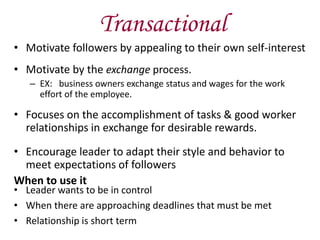
When to use Coercive
Transactional
• Motivate followers by appealing to their own self-interest
• Motivate by the exchange process.
– EX: business owners exchange status and wages for the work
effort of the employee.
• Focuses on the accomplishment of tasks & good worker
relationships in exchange for desirable rewards.
• Encourage leader to adapt their style and behavior to
meet expectations of followers
When to use it
• Leader wants to be in control
• When there are approaching deadlines that must be met
• Relationship is short term
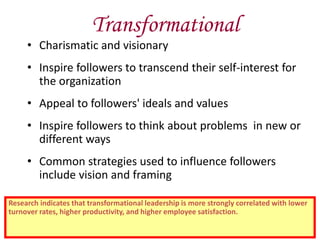
Transformational
• Charismatic and visionary
• Inspire followers to transcend their self-interest for
the organization
• Appeal to followers' ideals and values
• Inspire followers to think about problems in new or
different ways
• Common strategies used to influence followers
include vision and framing
Research indicates that transformational leadership is more strongly correlated with lower
turnover rates, higher productivity, and higher employee satisfaction.
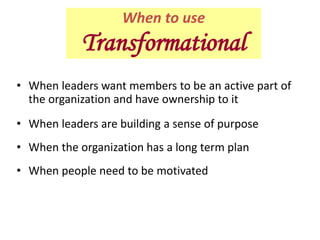
• When leaders want members to be an active part of
the organization and have ownership to it
• When leaders are building a sense of purpose
• When the organization has a long term plan
• When people need to be motivated
When to use
Transformational
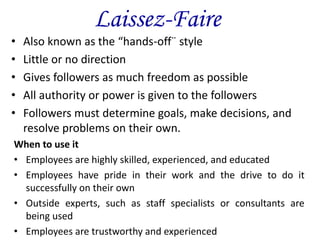
Laissez-Faire
• Also known as the “hands-off¨ style
• Little or no direction
• Gives followers as much freedom as possible
• All authority or power is given to the followers
• Followers must determine goals, make decisions, and
resolve problems on their own.
When to use it
• Employees are highly skilled, experienced, and educated
• Employees have pride in their work and the drive to do it
successfully on their own
• Outside experts, such as staff specialists or consultants are
being used
• Employees are trustworthy and experienced
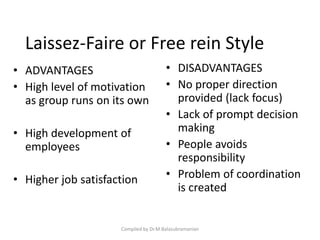
Laissez-Faire or Free rein Style
• ADVANTAGES
• High level of motivation
as group runs on its own
• High development of
employees
• Higher job satisfaction
• DISADVANTAGES
• No proper direction
provided (lack focus)
• Lack of prompt decision
making
• People avoids
responsibility
• Problem of coordination
is created
Compiled by Dr.M.Balasubramanian
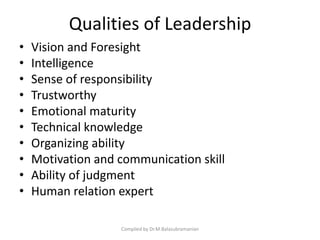
Qualities of Leadership
• Vision and Foresight
• Intelligence
• Sense of responsibility
• Trustworthy
• Emotional maturity
• Technical knowledge
• Organizing ability
• Motivation and communication skill
• Ability of judgment
• Human relation expert
Compiled by Dr.M.Balasubramanian
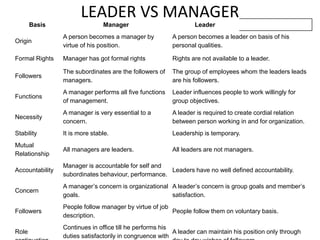
LEADER VS MANAGER
Basis Manager Leader
Origin
A person becomes a manager by
virtue of his position.
A person becomes a leader on basis of his
personal qualities.
Formal Rights Manager has got formal rights Rights are not available to a leader.
Followers
The subordinates are the followers of
managers.
The group of employees whom the leaders leads
are his followers.
Functions
A manager performs all five functions
of management.
Leader influences people to work willingly for
group objectives.
Necessity
A manager is very essential to a
concern.
A leader is required to create cordial relation
between person working in and for organization.
Stability It is more stable. Leadership is temporary.
Mutual
Relationship
All managers are leaders. All leaders are not managers.
Accountability
Manager is accountable for self and
subordinates behaviour, performance.
Leaders have no well defined accountability.
Concern
A manager’s concern is organizational
goals.
A leader’s concern is group goals and member’s
satisfaction.
Followers
People follow manager by virtue of job
description.
People follow them on voluntary basis.
Role
Continues in office till he performs his
duties satisfactorily in congruence with
A leader can maintain his position only through
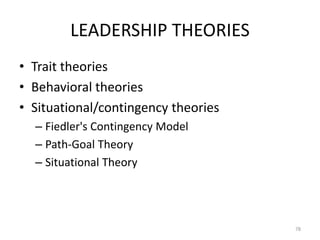
LEADERSHIP THEORIES
• Trait theories
• Behavioral theories
• Situational/contingency theories
– Fiedler's Contingency Model
– Path-Goal Theory
– Situational Theory
78
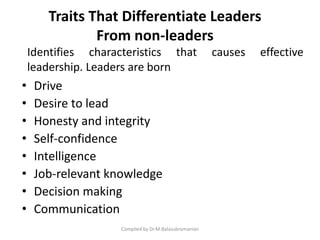
Traits That Differentiate Leaders
From non-leaders
• Drive
• Desire to lead
• Honesty and integrity
• Self-confidence
• Intelligence
• Job-relevant knowledge
• Decision making
• Communication
Compiled by Dr.M.Balasubramanian
Identifies characteristics that causes effective
leadership. Leaders are born
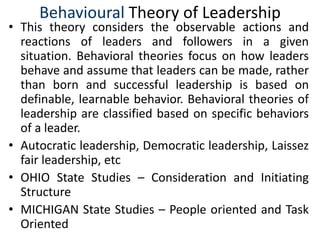
Behavioural Theory of Leadership
• This theory considers the observable actions and
reactions of leaders and followers in a given
situation. Behavioral theories focus on how leaders
behave and assume that leaders can be made, rather
than born and successful leadership is based on
definable, learnable behavior. Behavioral theories of
leadership are classified based on specific behaviors
of a leader.
• Autocratic leadership, Democratic leadership, Laissez
fair leadership, etc
• OHIO State Studies – Consideration and Initiating
Structure
• MICHIGAN State Studies – People oriented and Task
Oriented
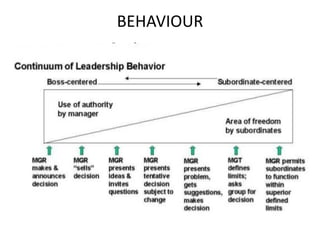
BEHAVIOUR
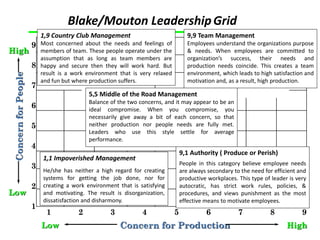
Blake/Mouton LeadershipGrid
High
Low
9
8
7
6
5
4
3
2
1
1 2 3 4 5 6 7 8 9
Concern for Production HighLow
ConcernforPeople
1,1 Impoverished Management
He/she has neither a high regard for creating
systems for getting the job done, nor for
creating a work environment that is satisfying
and motivating. The result is disorganization,
dissatisfaction and disharmony.
1,9 Country Club Management
Most concerned about the needs and feelings of
members of team. These people operate under the
assumption that as long as team members are
happy and secure then they will work hard. But
result is a work environment that is very relaxed
and fun but where production suffers.
9,1 Authority ( Produce or Perish)
People in this category believe employee needs
are always secondary to the need for efficient and
productive workplaces. This type of leader is very
autocratic, has strict work rules, policies, &
procedures, and views punishment as the most
effective means to motivate employees.
9,9 Team Management
Employees understand the organizations purpose
& needs. When employees are committed to
organization’s success, their needs and
production needs coincide. This creates a team
environment, which leads to high satisfaction and
motivation and, as a result, high production.
5,5 Middle of the Road Management
Balance of the two concerns, and it may appear to be an
ideal compromise. When you compromise, you
necessarily give away a bit of each concern, so that
neither production nor people needs are fully met.
Leaders who use this style settle for average
performance.
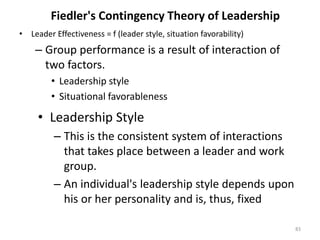
Fiedler's Contingency Theory of Leadership
• Leader Effectiveness = f (leader style, situation favorability)
– Group performance is a result of interaction of
two factors.
• Leadership style
• Situational favorableness
83
• Leadership Style
– This is the consistent system of interactions
that takes place between a leader and work
group.
– An individual's leadership style depends upon
his or her personality and is, thus, fixed
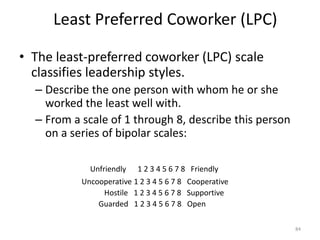
Least Preferred Coworker (LPC)
• The least-preferred coworker (LPC) scale
classifies leadership styles.
– Describe the one person with whom he or she
worked the least well with.
– From a scale of 1 through 8, describe this person
on a series of bipolar scales:
Unfriendly 1 2 3 4 5 6 7 8 Friendly
Uncooperative 1 2 3 4 5 6 7 8 Cooperative
Hostile 1 2 3 4 5 6 7 8 Supportive
Guarded 1 2 3 4 5 6 7 8 Open
84
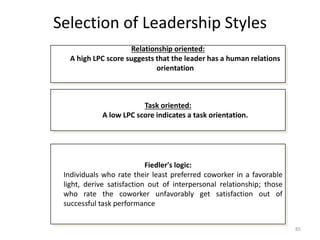
Selection of Leadership Styles
85
Relationship oriented:
A high LPC score suggests that the leader has a human relations
orientation
Task oriented:
A low LPC score indicates a task orientation.
Fiedler's logic:
Individuals who rate their least preferred coworker in a favorable
light, derive satisfaction out of interpersonal relationship; those
who rate the coworker unfavorably get satisfaction out of
successful task performance
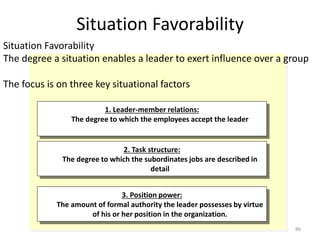
Situation Favorability
86
1. Leader-member relations:
The degree to which the employees accept the leader
2. Task structure:
The degree to which the subordinates jobs are described in
detail
3. Position power:
The amount of formal authority the leader possesses by virtue
of his or her position in the organization.
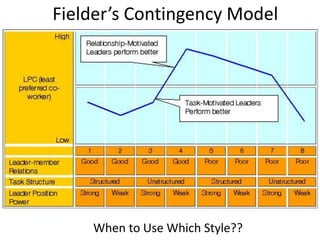
Situation Favorability
The degree a situation enables a leader to exert influence over a group
The focus is on three key situational factors
Fielder’s Contingency Model
When to Use Which Style??
Determining the effective leadership Style
• For instance, imagine that you've just started working at a
new company, replacing a much-loved leader who recently
retired. You're leading a team who views you with distrust (so
your Leader-Member Relations are poor). The task you're all
doing together is well defined (structured), and your position
of power is high because you're the boss, and you're able to
offer reward or punishment to the group.
• The most effective leader in this situation would be high LPC
– that is, a leader who can focus on building relationships
first.
• Or, imagine that you're leading a team who likes and respects
you (so your Leader-Member relations are good). The project
you're working on together is highly creative (unstructured)
and your position of power is high since, again, you're in a
management position of strength. In this situation a task-
focused leadership style would be most effective.
Compiled by Dr.M.Balasubramanian
Contingency theory: Strengths & Weakness
Strength
• Supported by a lot of empirical research
• Looks at the impact of the situation on leaders
• It is predictive
• People need not be effective in all situations
• Way to assess leader style that could be useful to an
organization
Weakness
• Doubt whether the LPC is a true measure of leadership
style
• It is cumbersome to use
• Doesn't explain what to do when there is a mismatch
between style and situation
• Other situational variables, like training and experience,
have an impact in a leader's effectiveness 89
House & Mitchell’s Path–Goal Theory
90
Leaders can influence subordinates’ motivation by:
1. Teaching employees competencies needed
2. Tailoring rewards to meet employees’ needs
3. Acting to support subordinates’ efforts
Assumptions
1. A leader’s behavior is acceptable and satisfying to
subordinates to the extent that they view it as either an
immediate source of satisfaction or future satisfaction.
2. A leader’s behavior will increase subordinates’
efforts if it links satisfaction of their needs to
effective performance and supports their
efforts to achieve goals.
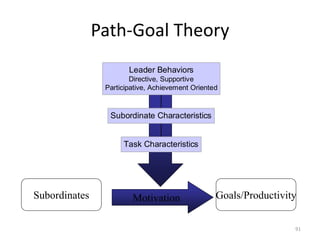
Path-Goal Theory
91
Task Characteristics
Subordinate Characteristics
Leader Behaviors
Directive, Supportive
Participative, Achievement Oriented
Subordinates Goals/ProductivityMotivation
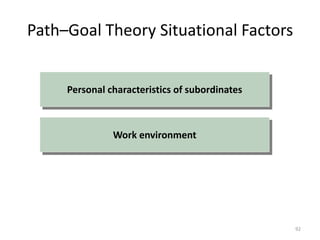
Path–Goal Theory Situational Factors
92
Personal characteristics of subordinates
Work environment
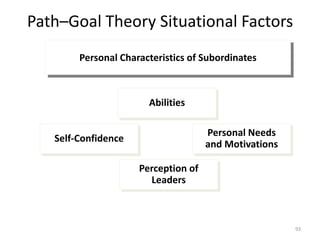
Path–Goal Theory Situational Factors
93
Personal Characteristics of Subordinates
Abilities
Self-Confidence
Personal Needs
and Motivations
Perception of
Leaders
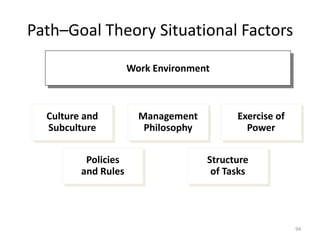
Path–Goal Theory Situational Factors
94
Work Environment
Exercise of
Power
Culture and
Subculture
Policies
and Rules
Structure
of Tasks
Management
Philosophy
Path Goal Theory: Strengths/Weakness
Strength
• It specifies four conceptually distinct varieties of leadership
• Explains how task and subordinate characteristics affect the
impact of leadership
• Informs leaders how to choose an appropriate leadership style.
• Integrates the motivation principles into a theory of leadership.
• Provides a practical model
Weakness
• It is very complex.
• It has received only partial support from the many empirical
research studies that have been conducted to test its validity.
• It fails to explain the relationship between leadership behavior
and worker motivation.
• This approach treats leadership as a one-way event-the leader
affects the subordinate.
95
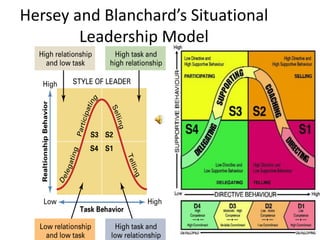
The Situational Leadership Theory developed
by Hershey and Blanchard:
• Is there an optimum way for leaders to adjust their behavior with
different followers and thereby increase their likelihood of
success?
• If so, then what factors should the leader base his behavior on?
Four Level of Readiness
• Style 1- High task and low relationship. The “telling” style is
directive.
• Style 2- High task and high relationship. The “selling” style is also
directive, but in a more persuasive, guiding, manner.
• Style3- High relationship and low task. In the “participating”
leadership style there is less direction and more collaboration
between leader and group members.
• Style 4- Low relationship and low task. In the “delegating” style,
the leader delegates and is kept informed of progress
Hersey and Blanchard’s Situational
Leadership Model
Evaluation of the Theory:
• Best used with new hires
• Can be valuable in training and development
• Competent people require the least specific
direction
• Gives false impression that all situations are clear-
cut
• Popular because of its commonsense approach
but not a lot of empirical research to support its
validity
• Situational Leadership is a useful way to get
leaders to think about how leadership
effectiveness may depend somewhat on being
flexible with different subordinates, not on acting
the same way toward them all.
JOB ENRICHMENT
• A job design technique that is a variation on the concept of job
enlargement.
• Job enrichment adds new sources of job satisfaction by increasing
the level of responsibility of the employee.
• While job enlargement is considered a horizontal restructuring
method, job enrichment is a vertical restructuring method by virtue
of giving the employee additional authority, autonomy, and control
over the way the job is accomplished. Also called job enhancement
or vertical job expansion.
To make jobs which
Have a greater variety.
Requires higher level of knowledge and skills.
Give workers more autonomy.
Give workers more responsibility.
Give workers opportunities for personal growth, and
A meaningful work experience
Compiled by Dr.M.Balasubramanian
JOB EVALUATION
• An assessment of the relative worth of various jobs on
the basis of a consistent set of job and personal factors,
such as qualifications and skills required.
• The objective of job evaluation is to determine which
jobs should get more pay than others. Several methods
such as job ranking, job grading, and factor comparison
are employed in job evaluation. Research indicates,
however, that each method is nearly as accurate and
reliable as the other in ranking and pricing different
jobs. Job evaluation forms the basis for wage and
salary negotiations.
Compiled by Dr.M.Balasubramanian
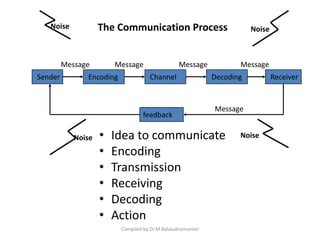
The Communication Process
• Idea to communicate
• Encoding
• Transmission
• Receiving
• Decoding
• Action
Compiled by Dr.M.Balasubramanian
Sender Encoding Channel Decoding Receiver
Message Message Message Message
feedback
Noise Noise
Noise Noise
Message
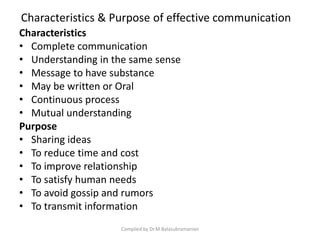
Characteristics & Purpose of effective communication
Characteristics
• Complete communication
• Understanding in the same sense
• Message to have substance
• May be written or Oral
• Continuous process
• Mutual understanding
Purpose
• Sharing ideas
• To reduce time and cost
• To improve relationship
• To satisfy human needs
• To avoid gossip and rumors
• To transmit information
Compiled by Dr.M.Balasubramanian
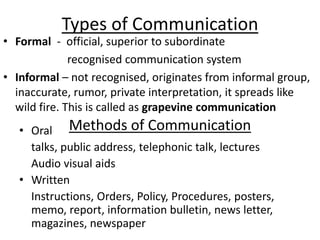
Types of Communication
• Formal - official, superior to subordinate
recognised communication system
• Informal – not recognised, originates from informal group,
inaccurate, rumor, private interpretation, it spreads like
wild fire. This is called as grapevine communication
• Oral
talks, public address, telephonic talk, lectures
Audio visual aids
• Written
Instructions, Orders, Policy, Procedures, posters,
memo, report, information bulletin, news letter,
magazines, newspaper
Methods of Communication
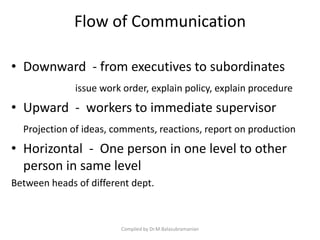
Flow of Communication
• Downward - from executives to subordinates
issue work order, explain policy, explain procedure
• Upward - workers to immediate supervisor
Projection of ideas, comments, reactions, report on production
• Horizontal - One person in one level to other
person in same level
Between heads of different dept.
Compiled by Dr.M.Balasubramanian
Barriers to Communication
• Physical
Distance, Lack of time, Noise, In different divisions,
environmental (temp, humidity)
• Psychological
Differences in position, absence of mind, fear, status,
bias
• Semantics
Faculty expressions and listening
Eg: Rama and seetha saw the pet animals when they
were playing in the park.
Confusion whether animals were playing or rama and
seetha
Compiled by Dr.M.Balasubramanian
Methods to overcome Barriers
• Use feedback
• Simplify language
• Listen actively
• Constrain emotions
• Watch nonverbal clues
• Information thro proper channel
• Adequate communication facility
• Known language
Compiled by Dr.M.Balasubramanian
Qualities of an effective control system
• Control is the process of monitoring
activities to ensure that they are being
accomplished as planned and correcting
any significant deviations.
Unit 5 : Controlling
• Accuracy
• Timeliness
• Economy
• Flexibility
• Acceptability
• Integrity
• Strategic placement
• Corrective action
• Emphasis on the
exception
1. Accuracy: Accurate information is essential for effective managerial decisions. Inaccurate controls
would divert management efforts and energies on problems that do not exist or have a low
priority and would fail to alert managers to serious problems that do require attention.
2. Timeliness: If information about problems does not reach management in a timely manner, then
such information may become useless and damage may occur.
3. Flexibility: Technological changes occur very fast. A rigid control system would not be suitable for
a changing environment. An effective control system is one that can be updated quickly as the
need arises.
4. Acceptability: A control system that is difficult to understand can cause unnecessary mistakes and
frustration to workers. Employees must agree that such controls are necessary and will not have
any negative effects on their efforts to achieve their personal as well as organizational goals.
5. Integration: When the controls are consistent with corporate values and culture, they work in
harmony with organizational policies and hence are easier to enforce. These controls become an
integrated part of the organizational environment and thus become effective.
6. Economic feasibility:
The cost of a control system must be balanced against its benefits. The system must be
economically feasible and reasonable to operate.
7. Strategic placement:
Effective controls should be placed and emphasized at such critical and strategic control points
where failures cannot be tolerated and where time and money costs of failures are greatest.
8. Corrective action:
An effective control system not only checks for and identifies deviation but also is programmed
to suggest solutions to correct such a deviation.
9. Emphasis on exception:
Only important deviations are brought to the attention of management, In other words,
management does not have to bother with activities that are running smoothly. This will ensure
that managerial attention is directed towards error and not towards conformity.
• Market control emphasizes the use of external
market mechanisms such as price competition
and market share.
• Bureaucratic control emphasizes authority and
relies on administrative rules, regulations,
procedures, and policies.
• Clan control designs control systems in which
employee behaviors are regulated by the shared
values, norms, traditions, rituals, beliefs, and
other aspects of the organization’s culture.
Compiled by Dr.M.Balasubramanian
Control approaches
What is the control process? Controlling
– The process of measuring performance and taking action to ensure
desired results.
– Has a positive and necessary role in the management process.
– Ensures that the right things happen, in the right way, at the right
time.
– Organizational learning and after-action review.
 Steps in the control process:
Step 1 — Establish objectives and standards.
Step 2 — Measure actual performance.
Step 3 — Compare results with objectives and standards.
Step 4 — Take corrective action as needed.
Compiled by Dr.M.Balasubramanian
Control process
 Step 1 — establishing objectives and standards
– Output standards
• Measure performance results in terms of quantity, quality, cost, or time.
– Input standards
• Measure effort in terms of amount of work expended in task performance.
 Step 2 — measuring actual performance
– Goal is accurate measurement of actual performance results
and/or performance efforts.
– Must identify significant differences between actual results and
original plan.
– Effective control requires measurement.
Compiled by Dr.M.Balasubramanian
Control process contd..
 Step 3 — comparing results with objectives & standards
– Need for action reflects the difference between desired
performance and actual performance
– Comparison methods:
• Historical comparison, Relative comparison & Engg. Comparison
 Step 4 — taking corrective action
– Taking action when a discrepancy exists between desired
and actual performance.
– Management by exception
• Giving attention to situations showing the greatest need for action.
• Types of exceptions
Problem situation (below standard)
Opportunity situation (above standard)
Compiled by Dr.M.Balasubramanian
CLASSIFICATION OF CONTROLS
Managers have two broad options with respect to control.
• They can rely on people to exercise self-control (internal)
over their own behavior.
• Alternatively, managers can take direct action (external) to
control the behavior of others.
• Internal Controls
The potential for self-control is enhanced when capable
people have clear performance objectives and proper
resource support.
• External Controls
Performance appraisal systems, compensation and benefit
systems, employee discipline systems, and management-by-
objectives
Compiled by Dr.M.Balasubramanian
TYPES OF CONTROLS
 Feedforward controls …
– Employed before a work activity begins.
– Ensures that:
1. Objectives are clear 2. Proper directions are established. 3. Right resources
are available.
Focuses on quality of resources.
 Concurrent controls …
– Focus on what happens during work process.
– Monitor ongoing operations to make sure they are being done according to
plan.
– Can reduce waste in unacceptable finished products or services.
 Feedback controls …
– Take place after work is completed.
– Focus on quality of end results.
– Provide useful information for improving future operations.
Compiled by Dr.M.Balasubramanian
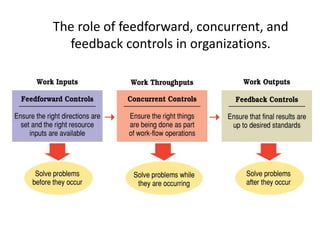
The role of feedforward, concurrent, and
feedback controls in organizations.
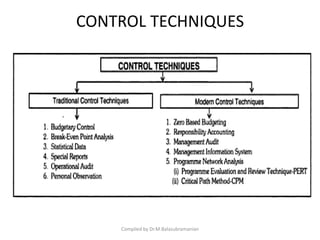
CONTROL TECHNIQUES
Compiled by Dr.M.Balasubramanian
TRADITIONAL CONTROL TECHNIQUES
• Statistical Data
Statistical analysis involves collecting and scrutinizing every data sample in a set of
items from which samples can be drawn. A sample, in statistics, is a representative
selection drawn from a total population. Information is presented in the form of tables,
graphs, charts etc., it facilitates comparison of performance with the standards laid and with
previous years’ performance.
• Break even point analysis
A break-even analysis is an analysis to determine the point at which revenue received
equals the costs associated with receiving the revenue. Break-even analysis calculates
what is known as a margin of safety, the amount that revenues exceed the BEP
Operational Audit
Operational auditing, in its broadest sense, is the regular and independent appraisal,
by a staff of internal auditors, of the accounting, financial, and other operations of a
business
• Personal Observation
Manager collect first hand information about the performance of the employees. It
also creates psychological pressure on the employees to improve their performance as
they are aware that they are being observed personally by the manager. However, this
technique is not to be effectively used in all kinds of jobs as it is very time consuming.
• Budgetary Control
Budgetary control refers to how well managers utilize budgets to monitor and control
costs and operations in a given accounting period.
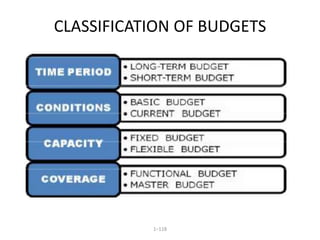
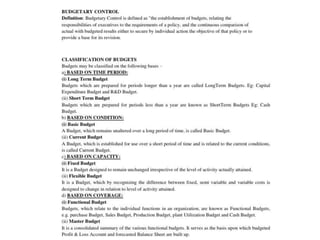
CLASSIFICATION OF BUDGETS
1–118
Types of Budget
• Revenue and Expense budget
The most common budgets spell out plans for revenues and operating expenses in rupee terms. The
most basic of revenue budget is the sales budget which is a formal and detailed expression of the
sales forecast. The revenue from sales of products or services furnishes the principal income to pay
operating expenses and yield profits.
• Time, Space, Material and Product budget
Many budgets are better expressed in quantities rather than in monetary terms. e.g.direct-labor-
hours, machine-hours, units of materials, square feet allocated, and units produced
• Capital Expenditure budget
Capital expenditure budgets outline specifically capital expenditures for plant,machinery,
equipment, inventories, and other items
• Cash Budget
The cash budget is simply a forecast of cash receipts and disbursements against which actual cash
"experience" is measured
• Variable Budget
The variable budget is based on an analysis of expense items to determine how individual costs
should vary with volume of output. Some costs do not vary with volume, particularly in so short a
period as 1 month, 6months, or a year. Among these are depreciation, property taxes and
insurance.
• Zero Based Budget
By starting the budget of each package from base zero, budgeters calculate costs afresh for each
budget period; thus they avoid the common tendency in budgeting of looking only at changes from
a previous period
MODERN TECHNIQUES
(a) Return on Investment.
(b) Ratio Analysis.
(c) Responsibility Accounting.
(d) Management Audit.
(e) PERT and CPM.
(f) Management Information System.
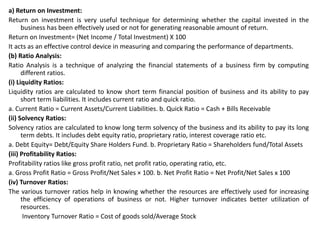
a) Return on Investment:
Return on investment is very useful technique for determining whether the capital invested in the
business has been effectively used or not for generating reasonable amount of return.
Return on Investment= (Net Income / Total Investment) X 100
It acts as an effective control device in measuring and comparing the performance of departments.
(b) Ratio Analysis:
Ratio Analysis is a technique of analyzing the financial statements of a business firm by computing
different ratios.
(i) Liquidity Ratios:
Liquidity ratios are calculated to know short term financial position of business and its ability to pay
short term liabilities. It includes current ratio and quick ratio.
a. Current Ratio = Current Assets/Current Liabilities. b. Quick Ratio = Cash + Bills Receivable
(ii) Solvency Ratios:
Solvency ratios are calculated to know long term solvency of the business and its ability to pay its long
term debts. It includes debt equity ratio, proprietary ratio, interest coverage ratio etc.
a. Debt Equity= Debt/Equity Share Holders Fund. b. Proprietary Ratio = Shareholders fund/Total Assets
(iii) Profitability Ratios:
Profitability ratios like gross profit ratio, net profit ratio, operating ratio, etc.
a. Gross Profit Ratio = Gross Profit/Net Sales × 100. b. Net Profit Ratio = Net Profit/Net Sales x 100
(iv) Turnover Ratios:
The various turnover ratios help in knowing whether the resources are effectively used for increasing
the efficiency of operations of business or not. Higher turnover indicates better utilization of
resources.
Inventory Turnover Ratio = Cost of goods sold/Average Stock
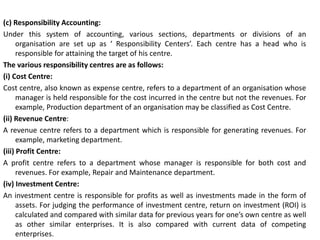
(c) Responsibility Accounting:
Under this system of accounting, various sections, departments or divisions of an
organisation are set up as ‘ Responsibility Centers’. Each centre has a head who is
responsible for attaining the target of his centre.
The various responsibility centres are as follows:
(i) Cost Centre:
Cost centre, also known as expense centre, refers to a department of an organisation whose
manager is held responsible for the cost incurred in the centre but not the revenues. For
example, Production department of an organisation may be classified as Cost Centre.
(ii) Revenue Centre:
A revenue centre refers to a department which is responsible for generating revenues. For
example, marketing department.
(iii) Profit Centre:
A profit centre refers to a department whose manager is responsible for both cost and
revenues. For example, Repair and Maintenance department.
(iv) Investment Centre:
An investment centre is responsible for profits as well as investments made in the form of
assets. For judging the performance of investment centre, return on investment (ROI) is
calculated and compared with similar data for previous years for one’s own centre as well
as other similar enterprises. It is also compared with current data of competing
enterprises.
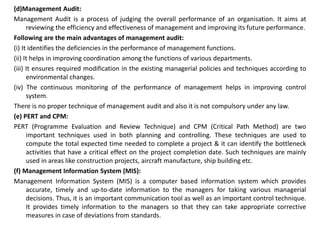
(d)Management Audit:
Management Audit is a process of judging the overall performance of an organisation. It aims at
reviewing the efficiency and effectiveness of management and improving its future performance.
Following are the main advantages of management audit:
(i) It identifies the deficiencies in the performance of management functions.
(ii) It helps in improving coordination among the functions of various departments.
(iii) It ensures required modification in the existing managerial policies and techniques according to
environmental changes.
(iv) The continuous monitoring of the performance of management helps in improving control
system.
There is no proper technique of management audit and also it is not compulsory under any law.
(e) PERT and CPM:
PERT (Programme Evaluation and Review Technique) and CPM (Critical Path Method) are two
important techniques used in both planning and controlling. These techniques are used to
compute the total expected time needed to complete a project & it can identify the bottleneck
activities that have a critical effect on the project completion date. Such techniques are mainly
used in areas like construction projects, aircraft manufacture, ship building etc.
(f) Management Information System (MIS):
Management Information System (MIS) is a computer based information system which provides
accurate, timely and up-to-date information to the managers for taking various managerial
decisions. Thus, it is an important communication tool as well as an important control technique.
It provides timely information to the managers so that they can take appropriate corrective
measures in case of deviations from standards.
PERT/CPM
S.NO PERT CPM
1. The term PERT means Programme
evaluation and review technique
CPM means critical path
method
2 PERT is a probabilistic model CPM is a deterministic model
3 PERT model deals with uncertainty CPM model deals with
certainty
4 Time taken to complete the project
is highly uncertain
Time taken to complete the
project is certain
5 There are three types of time
estimates .They are pessimistic ,
optimistic and most likely time .
te=[ tp+4tm+to/6]
There is only one time assigned
.
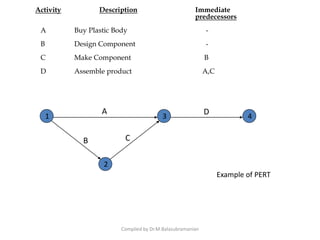
Activity Description Immediate
predecessors
A Buy Plastic Body -
B Design Component -
C Make Component B
D Assemble product A,C
1 3 4
2
A
B C
D
Compiled by Dr.M.Balasubramanian
Example of PERT
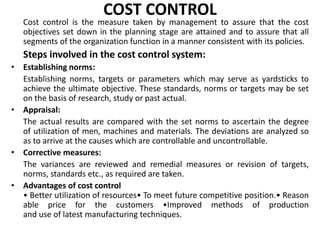
COST CONTROL
Cost control is the measure taken by management to assure that the cost
objectives set down in the planning stage are attained and to assure that all
segments of the organization function in a manner consistent with its policies.
Steps involved in the cost control system:
• Establishing norms:
Establishing norms, targets or parameters which may serve as yardsticks to
achieve the ultimate objective. These standards, norms or targets may be set
on the basis of research, study or past actual.
• Appraisal:
The actual results are compared with the set norms to ascertain the degree
of utilization of men, machines and materials. The deviations are analyzed so
as to arrive at the causes which are controllable and uncontrollable.
• Corrective measures:
The variances are reviewed and remedial measures or revision of targets,
norms, standards etc., as required are taken.
• Advantages of cost control
• Better utilization of resources• To meet future competitive position.• Reason
able price for the customers •Improved methods of production
and use of latest manufacturing techniques.
PRODUCTIVITY
• Productivity refers to the ratio between the
output from production processes to its input.
Productivity may be conceived of as a
measure of the technical or engineering
efficiency of production. As such quantitative
measures of input, and sometimes output, are
emphasized
Compiled by Dr.M.Balasubramanian
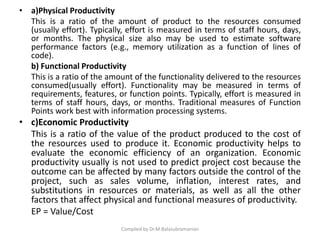
• a)Physical Productivity
This is a ratio of the amount of product to the resources consumed
(usually effort). Typically, effort is measured in terms of staff hours, days,
or months. The physical size also may be used to estimate software
performance factors (e.g., memory utilization as a function of lines of
code).
b) Functional Productivity
This is a ratio of the amount of the functionality delivered to the resources
consumed(usually effort). Functionality may be measured in terms of
requirements, features, or function points. Typically, effort is measured in
terms of staff hours, days, or months. Traditional measures of Function
Points work best with information processing systems.
• c)Economic Productivity
This is a ratio of the value of the product produced to the cost of
the resources used to produce it. Economic productivity helps to
evaluate the economic efficiency of an organization. Economic
productivity usually is not used to predict project cost because the
outcome can be affected by many factors outside the control of the
project, such as sales volume, inflation, interest rates, and
substitutions in resources or materials, as well as all the other
factors that affect physical and functional measures of productivity.
EP = Value/Cost
Compiled by Dr.M.Balasubramanian
FACTORS AFFECTING PRODUCTIVITY
• National Productivity
Human Resources (basic education, training, good
working condition, pay scale, etc)
Technology and capital investment (R&D, attractive tax
reduction and ease of policy to attract investment)
Government regulation
• Manufacturing Industry
Product design
Equipment & machinery
Skill & effectiveness of workers
Energy
Type of production
Compiled by Dr.M.Balasubramanian
Productivity Improvement Tools• JIT (Just-In-Time)
reduce lead times
minimise inventory
reduce the defect rate to zero and
Accomplish all of the above at minimum cost
• KANBAN
Kanban is a visual process and project management
tool first developed in Japan by Toyota.
Kanban is a way to visualize your work and limit the
amount of work in progress at any one time.
Kanban is a Japanese word that simply translates to
“signal.”
kanban card work system allows teams to
communicate and collaborate on what work needs to
be done and when.
Kanban has three core principles:
• Start with what you know - Don't try to reinvent the
wheel right away. Visualize what you have now.
• Pursue incremental, evolutionary change - Once you
can see the current state of your work, visualize how
to improve it.
• Respect the current process, roles, responsibilities &
titles - Don't make drastic, sweeping changes without
getting buy-in from the rest of your team. Kanban is a
collaborative process.
•5 S
The five S’s stand for five Japanese words;
Seiri (proper arrangement)
Seiton (orderliness)
seiso(cleanliness)
seiketsu(standardising)
Shitsuke (discipline)
KAIZEN
Define the area for improvement.
Analyse and select the
appropriate problem.
Identify its causes.
Plan counter measures.
Implement countermeasures.
Confirm the result.
Standardize.
PURCHASE CONTROL
• Purchase control is an element of material
control. Material procurement is known as the
purchase function. The functional responsibility
of purchasing is that of the purchase manager or
the purchaser. Purchasing is an important
function of materials management because in
purchase of materials, a substantial portion of the
company's finance is committed which affects
cash flow position of the company. Success of a
business is to a large extent influenced by the
efficiency of its purchase organization.
Compiled by Dr.M.Balasubramanian
The advantages derived from a good and adequate system of the purchase control are
as follows
• a)Continuous availability of materials:
It ensures the continuous flow of materials. So production work may not be held up for
want of materials. A manufacturer can complete schedule of production in time.
• b) Purchasing of right quantity:
Purchase of right quantity of materials avoids locking up of working capital. It minimizes
risk of surplus and obsolete stores. It means there should not be possibility of
overstocking and understocking.
c) Purchasing of right quality:
Purchase of materials of proper quality and specification avoids waste of materials and
loss in production. Effective purchase control prevents wastes and losses of materials
right from the purchase till their consumptions. It enables the management to reduce
cost of production.
d) Economy in purchasing:
The purchasing of materials is a highly specialized function. By purchasing materials at
reasonable prices, the efficient purchaser is able to make a valuable contribution to the
success of a business.
• e) Works as information centre:
It serves as a function centre on the materials knowledge relating to prices, sources of
supply, specifications, mode of delivery, etc. By providing continuous information to the
management it is possible to prepare planning for production.
• f) Development of business relationship:
Purchasing of materials from the best market and from reliable suppliers develops
business relationships. The result is that there may be smooth supply of materials in
time and so it avoid disputes and financial losses
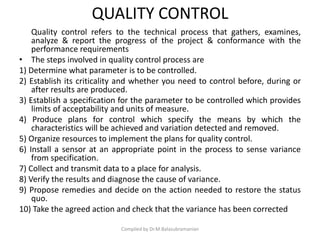
QUALITY CONTROL
Quality control refers to the technical process that gathers, examines,
analyze & report the progress of the project & conformance with the
performance requirements
• The steps involved in quality control process are
1) Determine what parameter is to be controlled.
2) Establish its criticality and whether you need to control before, during or
after results are produced.
3) Establish a specification for the parameter to be controlled which provides
limits of acceptability and units of measure.
4) Produce plans for control which specify the means by which the
characteristics will be achieved and variation detected and removed.
5) Organize resources to implement the plans for quality control.
6) Install a sensor at an appropriate point in the process to sense variance
from specification.
7) Collect and transmit data to a place for analysis.
8) Verify the results and diagnose the cause of variance.
9) Propose remedies and decide on the action needed to restore the status
quo.
10) Take the agreed action and check that the variance has been corrected
Compiled by Dr.M.Balasubramanian
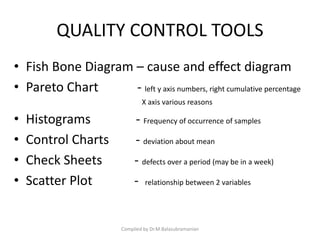
QUALITY CONTROL TOOLS
• Fish Bone Diagram – cause and effect diagram
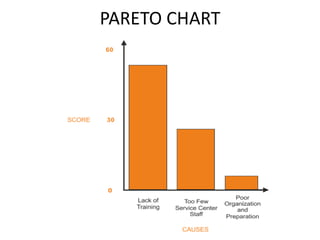
• Pareto Chart - left y axis numbers, right cumulative percentage
X axis various reasons
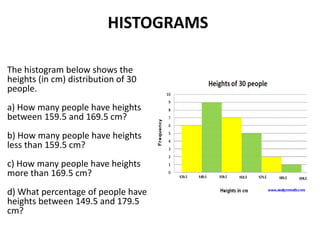
• Histograms - Frequency of occurrence of samples
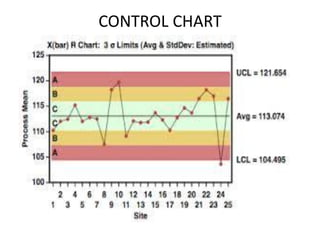
• Control Charts - deviation about mean
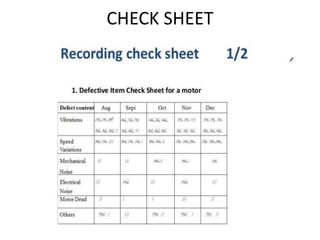
• Check Sheets - defects over a period (may be in a week)
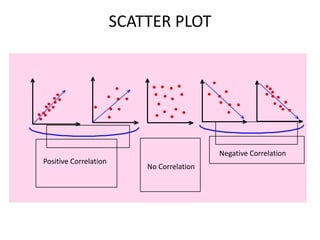
• Scatter Plot - relationship between 2 variables
Compiled by Dr.M.Balasubramanian
SCATTER PLOT
Positive Correlation
Negative Correlation
No Correlation
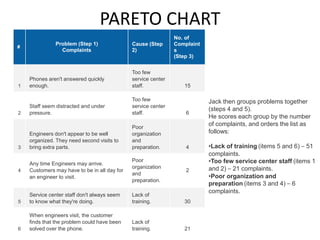
PARETO CHART
#
Problem (Step 1)
Complaints
Cause (Step
2)
No. of
Complaint
s
(Step 3)
1
Phones aren't answered quickly
enough.
Too few
service center
staff. 15
2
Staff seem distracted and under
pressure.
Too few
service center
staff. 6
3
Engineers don't appear to be well
organized. They need second visits to
bring extra parts.
Poor
organization
and
preparation. 4
4
Any time Engineers may arrive.
Customers may have to be in all day for
an engineer to visit.
Poor
organization
and
preparation.
2
5
Service center staff don't always seem
to know what they're doing.
Lack of
training. 30
6
When engineers visit, the customer
finds that the problem could have been
solved over the phone.
Lack of
training. 21
Jack then groups problems together
(steps 4 and 5).
He scores each group by the number
of complaints, and orders the list as
follows:
•Lack of training (items 5 and 6) – 51
complaints.
•Too few service center staff (items 1
and 2) – 21 complaints.
•Poor organization and
preparation (items 3 and 4) – 6
complaints.
PARETO CHART
HISTOGRAMS
The histogram below shows the
heights (in cm) distribution of 30
people.
a) How many people have heights
between 159.5 and 169.5 cm?
b) How many people have heights
less than 159.5 cm?
c) How many people have heights
more than 169.5 cm?
d) What percentage of people have
heights between 149.5 and 179.5
cm?
CONTROL CHART
CHECK SHEET
INFORMATION TECHNOLOGY IN CONTROLLING
• Management Information System (MIS) provides the
communication link that makes controlling possible.
• MIS is defined as a formal system of gathering, integrating,
comparing, analyzing and dispersing information internally
and externally to the enterprise in a timely, effectively and
efficient manner.
• Electronic equipment permits fast and economical processing
of large data without confusions and make them readily
available for decision making.
• The applications of computer are found in material
requirement planning, computer aided manufacturing,
project costing, inventory control and purchasing.
Compiled by Dr.M.Balasubramanian
Role of Management Information System
• Helps in Decision making: - Management Information System (MIS) plays a
significant Role in Decision making Process of any Organization. Because in Any
organization decision is made on the basis of relevant Information and relevant
information can only be Retrieving from the MIS.
• Helps in Coordination among the Department: - Management information
System is also helping in establishing a sound Relationship among the people
between department to department through proper exchanging of
Information’s.
• Helps in Finding out Problems: - We know that MIS provides relevant
information about the every aspect of activities. Hence, If any mistake is made
by the management then Management Information Systems (MIS) helps in
Finding out the Solution of that Problem.
• Helps in Comparison of Business Performance: - MIS stores all Past Data and
information in its Database. That is why management information system is
very useful to compare Business organization Performance. With the help of
Management information system (MIS) Organization can analyze their
Performance whatever they did last year or Previous Years and whatever
performance in this year and also measures organization Development and
Growth.
Compiled by Dr.M.Balasubramanian
CAUSES OF NEGATIVE DEVIATIONS IN THE
PROCESS OF CONTROLLING
• Uncertainty
• Lack of knowledge, experience, or judgment
Compiled by Dr.M.Balasubramanian
Direct control: the procedure that traces the causes of
an unsatisfactory result back to the persons responsible
for it and get them to correct their practices.
Preventive control: the procedure that traces the
causes of an unsatisfactory result back to managers’
management skill and knowledge.
TWO GENERAL APPROACHES TO NEGATIVE
DEVIATIONS
PREVENTIVE CONTROL
• The basic philosophy of preventive control
system is that the best way to correct
deviations is not to let these take place at all.
• The basic tool of the system is to develop
better managers, who can manage problems
from a wider and intelligent perspective.
Highly qualified managers will make fewer
mistakes, thus reducing the need for direct
control
Compiled by Dr.M.Balasubramanian
ASSUMTIONS UNDER DIRECT AND PREVENTIVE
CONTROL
Direct
• All performance can be measured
• Personal responsibility exists
• Time expenditure is warranted
• Mistakes can be discovered in time
• Person responsible will take corrective steps
Preventive
• Qualified managers make a minimum of errors
• The management fundamentals can be used to
measure performance
• Application of management fundamentals can be
evaluated
Compiled by Dr.M.Balasubramanian
147
Advantages of Preventive Control
• Greater accuracy is achieved in assigning personal
responsibility.
• Preventive control encourages self-control and make
corrective action more effective.
• Preventive control may lighten the managerial
burden caused by direct controls.
• Employees may be motivated to improve themselves
continuously.
POPULAR TECHNIQUES OF DIRECT CONTROL
• Budget summaries and report
Budget summary is a resume of all individual
budgets. It reflects company in terms of profit,
cost, sales volume, etc.
• Profit and loss control
Income expenditure statement, at times may
be for each and every division
• Return on investment (ROI)
Ratio of earning to investment of capital of a
company
Why do People do Reports for Controlling?
• The controls team is established to manipulate the
delivery of the project’s products outputs.
• Controlling reports allow the control team to compare and
contrast information, analyze and interpret data, make
inferences and conclusions, and make rational decisions.
• Control teams also make reports to present the team’s
achievements, plans, and problems on a regular basis.
Achievements can be a source of inspiration and
motivation to the team members who feel frustration
when they do not meet their goals. The team’s
accomplishments can also boost the control team’s
momentum. Problems are also presented in the
controlling report for the team to know the existing and
potential threats the group is facing and is going to face.
Compiled by Dr.M.Balasubramanian
How do Teams usually do Reports for Controlling?
• Reports for controlling provide vital data on the activities,
performance, status, and progress of the team and the project.
• The controlling report should be factual, complete, accurate, and
updated. This is to ensure that the team and its members always
get the newest information within a specific time frame. Also,
reports allow control teams to formulate plans, establish
strategies, implement actions, and evaluate outcomes.
• The report can indicate essential information on the team’s issues,
plans, and achievements. With this information, the team will be
able to discuss its future goals while solving and preventing actual
and potential issues. Moreover, the team members will be able to
inspire and motivate their teammates with the team’s
achievements that are included in the controlling report.
• Quantitative data on the controlling report may also be presented
using tables, graphs, charts, and diagrams. This is to facilitate
faster appreciation and comprehension of data, unlike a plain
narrative output. These tools in presenting data can be effective in
showing the link between the past, present and the future report.
Compiled by Dr.M.Balasubramanian
Typical questions/metrics/topics that are usually covered
in a Report for Controlling
• What are the available resources to the team?
• What are the actual threats that you see? How are you going to solve
them?
• What are the potential problems that you foresee? How are you going to
prevent them?
• Do you have other concerns or issues?
• What are your achievements for today?
• What short and long term goals do you have in order to meet the
company’s objectives?
• What strategies and actions will you implement to meet the plans?
• Were the strategies and actions previously implemented successful?
• What are your strong and weak points when it comes to managing the
team?
• Do you see any open opportunities for improving your management skills?
• What are the feedbacks of your subordinates on how you handle them?
• What is the trend in your performance? What is its implication to your
future performance?
Compiled by Dr.M.Balasubramanian
Advantages & Best Practices of doing Reporting
for Controlling
• Communication is the primary benefit of a control report. It
connects the members of the team with the reports and updates
on their status, progress, and performance.
• The control report also connects teams, which has members from
various locales and time zones. Aside from updates, the team
members can also communicate urgent information to the team,
along with new and changed information.
• Control reports help the team in its business plan. The reports have
assessment clues, which help the team formulate concrete plans,
develop efficient strategies, implement effective actions, and
evaluate outcomes
• The team’s momentum is set to be boosted by the achievements
listed in the control report.
• Problem identification is another advantage of reports for
controlling. Team members will be able to spot existing and
potential threats to the team, allowing them to discuss the possible
ways to solve actual problems and prevent potential problems.
Compiled by Dr.M.Balasubramanian
Disadvantages & Pitfalls of doing Reporting
for Controlling
• Control reports has to indicate essential pieces of information,
such as problems, achievements, and plans. Also, information
like strategies, actions, weakness, strengths, opportunities and
threats can be also included in the report. This can be time-
consuming as team members have their regular tasks and
duties.
• Online control reports are easy sent and distributed to the
members and leaders of the team. However, these online
reports have one issue – reliance to a stable internet
connection.
• Some teams only focus on the present or current updates on
the project, which means that the past and future aspects of
the business can be neglected. This may compromise the
team’s performance as the present performance of the team is
linked and comparable to its past and future performance.
Failure to include past data may lose the team’s baseline data
while not including the future aspect may lose the team’s
preparedness to threats.Compiled by Dr.M.Balasubramanian
STEPS IN OPERATIONS MANAGEMENT
• Planning to plan
• Performing a values scan
• Mission formulation
• Strategic business Modeling
• Performance audit and gap analysis
• Integrating action plans
• Contingency plans
• Strategy implementation
Compiled by Dr.M.Balasubramanian
END….
Compiled by Dr.M.Balasubramanian

Directing as a function of Management

  • 1.
    MG 6851 PRINCIPLESOF MANAGEMENT UNIT 4 DIRECTING AS A FUNCTION OF MANAGEMENT Compiled by Dr.M.Balasubramanian
  • 2.
    FOUNDATION OF INDIVIDUALAND GROUP BEHAVIOUR Compiled by Dr.M.Balasubramanian
  • 3.
    INDIVIDUAL BEHAVIOUR Study of •Personality - Appearance Biological factors like hereidity, Brain and physical features Cultural and Social Factors • Attitudes • Learning and Behaviour Modification • Perception Compiled by Dr.M.Balasubramanian An individual’s personality is the combination of the psychological traits that characterize that person. Literally dozens of traits are attributed to an individual’s behavior. Researchers attempted to focus specifically on which traits would identify sources of one’s personality. Two of these efforts have been widely recognized— the Myers-Briggs Type Indicator and the Big Five-model of personality.
  • 4.
  • 6.
  • 7.
  • 8.
  • 9.
    • MARS modelof individual behavior is a model that seeks to elaborate individual behavior as a result of internal and external factors or influences combined together. The name itself is an acronym for individual Motivation, Abilities, Role Perception and Situational Factors. Motivation can be described as internal forces that impact the direction, intensity, and endurance of a person’s voluntary choice of behavior. It consists • Direction − focused by goals., Intensity − bulk of effort allocated. • Persistence − amount of time taken for the effort to be exerted. Ability • Ability is the natural tendency and learned capabilities needed to complete a task successfully. It has four different parts namely − • Aptitudes − natural talent that helps people learn more efficiently and perform effectively. • Learned capabilities − accomplished skills and knowledge. • Competencies − abilities, individual values, personality traits • Person-job fit − there are three ways to match people with jobs Role Perceptions • Understanding the tasks and importance to be performed. Situational Factors - They are the environmental conditions like given time bound, team members, budget, and work facilities that limits or facilitates behavior
  • 10.
    Leon Festinger, inthe late 1950s, proposed the theory of cognitive dissonance. This theory sought to explain the relationship between attitudes and behavior. Dissonance in this case means inconsistency. Cognitive dissonance refers to any incompatibility that an individual might perceive between attitudes or between his or her behavior and attitudes. Festinger argued that any form of inconsistency is uncomfortable and that individuals will attempt to reduce the dissonance and the discomfort. Festinger proposed that the desire to reduce dissonance is determined by the importance of the elements creating the dissonance. Cognitive dissonance theory is founded on the assumption that individuals seek consistency between their expectations and their reality. Because of this, people engage in a process called dissonance reduction to bring their cognitions and actions in line with one another. This creation of uniformity allows for a lessening of psychological tension and distress. Dissonance is felt when people are confronted with information that is inconsistent with their beliefs. If the dissonance is not reduced by changing one's belief, the dissonance can result in restoring consonance through misperception, rejection or refutation of the information, seeking support from others who share the beliefs and attempting to persuade others. What Is Cognitive Dissonance Theory
  • 11.
    11 Style of Decision MakingJudging (J) Perceiving (P) Preference for Decision Making Thinking (T) Feeling (F) Type of Social Interaction Introvert (I) Extrovert (E) Preference for Gathering Data Intuitive (N) Sensing (S) Myers-Briggs Type Indicator (MBTI) psychological traits that we use to classify a person
  • 12.
    Extraversion and Introversion- If you prefer to direct your energy to deal with people, things, situations, or "the outer world", then your preference is for Extraversion. If you prefer to direct your energy to deal with ideas, information, explanations or beliefs, or "the inner world", then your preference is for Introversion. Sensing and Intuition - If you prefer to deal with facts, what you know, to have clarity, or to describe what you see, then your preference is for Sensing. If you prefer to deal with ideas, look into the unknown, to generate new possibilities or to anticipate what isn't obvious, then your preference is for Intuition. The letter N is used for intuition because I has already been allocated to Introversion. Thinking and Feeling - If you prefer to decide on the basis of objective logic, using an analytic approach, then your preference is for Thinking. If you prefer to decide using values - i.e. on the basis of what or who you believe is important - then your preference is for Feeling. Judgment and Perception - If you prefer your life to be planned, stable and organised then your preference is for Judging. If you prefer to go with the flow, to maintain flexibility and respond to things as they arise, then your preference is for Perception. ESTJ strengths ESTJs drive themselves to reach their goal, organising people and resources in order to achieve it. They have an extensive network of contacts and are willing to make tough decisions when necessary. They tend to value competence highly
  • 13.
  • 14.
    The Big FiveModel of Personality Extroversion A personality dimension that describes the degree to which someone is sociable, talkative, and assertive. Agreeableness A personality dimension that describes the degree to which someone is good-natured, cooperative, and trusting. Conscientiousness A personality dimension that describes the degree to which someone is responsible, dependable, persistent, and achievement oriented. Emotional stability A personality dimension that describes the degree to which someone is calm, enthusiastic, and secure (positive) or tense, nervous, depressed, and insecure (negative). Openness to experience A personality dimension that describes the degree to which someone is imaginative, artistically sensitive, and intellectual.
  • 15.
    15 Holland’s Personality-Job FitTheory Type Personality Occupations Realistic Investigative Social Conventional Enterprising Artistic Shy, Stable, Practical Analytical, Independent Sociable, Cooperative Practical, Efficient Ambitious, Energetic Imaginative, Idealistic Mechanic, Farmer, Assembly-Line Worker Biologist, Economist, Mathematician Social Worker, Teacher, Counselor Accountant, Manager Bank Teller Lawyer, Salesperson Painter, Writer, Musician
  • 16.
    16 InformalFormal What Is aGroup? Formally Established Work Assignments Specific Tasks Occur Naturally Friendships Common Interests
  • 17.
  • 18.
  • 19.
    8-19 Four Types ofGroups Formal Groups • Command – determined by the organization chart • Task – working together to complete a job task Informal Groups • Interest – affiliate to attain a specific objective of shared interest • Friendship – members have one or more common characteristics
  • 20.
    8-20 The Five-Stage Model ofGroup Development 1 • Forming: • Uncertainty about purpose, structure, and leadership 2 • Storming: • Intragroup conflict as members resist constraints 3 • Norming: • Group is cohesive with strong group identity 4 • Performing: • Group fully functional and working toward goals 5 • Adjourning: • For temporary groups: breaking up
  • 21.
    8-21 Group Properties • Roles •Norms • Status • Size • Cohesiveness
  • 22.
    8-22 Group Property 1:Roles The set of expected behavior patterns that are attributed to occupying a given position in a social unit • Role Identity – role’s associated attitudes and behaviors • Role Perception – our view of how we’re supposed to act in a given situation • Role Expectations – how others believe you should act in a given situation • Role Conflict – conflict experienced when multiple roles are incompatible
  • 23.
    8-23 Group Property 2:Norms Acceptable standards of behavior within a group that are shared by the group’s members • Powerful means of influencing behavior • Performance Norms Group Property 3: Status A socially defined position or rank given to groups or group members by others • Determined by: – The power a person wields over others – A person’s ability to contribute to a group’s goals – An individual’s personal characteristics
  • 24.
    8-24 Group Property 4:Size • Smaller groups are faster at completing tasks – members perform better • Large groups are consistently better at problem solving • Social Loafing - tendency to expend less effort working in a group than as an individual
  • 25.
    8-25 Social Loafing Causes: • Equitytheory – unequal distribution of work • Dispersion of responsibility – clouds the relationship between individual inputs and group output Prevention: • Set group goals • Increase inter-group competition • Engage in peer evaluation • Distribute group rewards based on members’ individual contributions
  • 26.
    8-26 Group Property 5:Cohesiveness The degree to which members of the group are attracted to each other and motivated to stay in the group • Performance-related norms are the moderating variable for productivity and cohesiveness • High cohesiveness with high norms gives higher productivity
  • 27.
    8-27 Encouraging Cohesiveness 1. Makethe group smaller 2. Encourage agreement with group goals 3. Increase the time spent together 4. Increase the status and perceived difficulty of group membership 5. Stimulate competition with other groups 6. Give rewards to the group rather than to individual members 7. Physically isolate the group
  • 28.
    28 Strong Increase in Productivity ModerateIncrease in Productivity No Significant Effect on Productivity Decrease in Productivity Cohesiveness AlignmentofGroupandOrg.Goals High Low Cohesiveness-Productivity Relationship High Low
  • 29.
    Compiled by Dr.M.Balasubramanian •Creativity means the ability to combine ideas in a unique way or to make unusual associations between ideas. • Innovation is the process of taking a creative idea and turning into a useful product, service, or method of operation. • Structural variables • Cultural variables • Human resource variables Three Sets of Variables to Simulate Innovation
  • 30.
    Motivation • Motivation isthe willingness to exert high levels of effort to reach organizational goals, conditioned by the effort’s ability to satisfy some individual need. • Need is some internal state that makes certain outcomes appear attractive. Compiled by Dr.M.Balasubramanian • Primary Motives • General Motives • Secondary Motives Types of Motives Performance=Ability x Motivation
  • 31.
    Primary Motives • Hunger,Thirst, Clothing, Sleep, Shelter General Motives • Motives which can not be termed primary or secondary. Ex: Curiosity, Affection • Primary needs try to reduce the tension or stimulation whereas the general need induces the individual to enhance the amount of stimulation. Secondary Motives Learned drives become secondary motives which Includes Curiosity & Manipulation. Ex: Need for status, affiliation, Power, etc Compiled by Dr.M.Balasubramanian
  • 32.
  • 33.
    The Motivation Process Compiledby Dr.M.Balasubramanian Unsatisfied need Tension Drives Search behavior Satisfied need Reduction of tension
  • 34.
    Strategies for Motivating subordinates 1.Reward risk taking instead of risk avoiding 2. Reward creativity instead of mindless conformity 3. Reward smart work instead of busy work 4. Reward simplification instead of needless complication 5. Reward quietly effective behaviour instead of squeaking joints 6. Reward working together instead of working against
  • 35.
    Remember important wordsas a Motivator  Six important words - “ I admit I made a mistake”  Five important words - ” You did a good job”  Four important words - “ What is your opinion?”  Three important words - “Let’s work together.”  Two most important words - “ Thank you”  Single most important word is ”WE”.
  • 36.
    MAJOR THEORIES OFMOTIVATION I. Need Approaches: - Maslow’s Hierarchy of Needs - Alderfer’s ERG Theory - Herzberg’s Two Factor Theory - McClelland’s Learned Needs Theory - Gregor X and Y theory II. Cognitive Approaches: - Expectancy Theory (VIE or VRoom Theory and Porter theory) - Equity Theory/ Social Comparison (Adam Theory) - Goal Setting Theory (Locke Theory) III. REINFORCEMENT THEORY : How Rewards & Reinforcements Sustain Motivation Over Time Carrot and Stick Theory :
  • 37.
    Maslow’s Hierarchy ofNeeds Theory Works on the assumption that the behaviour of individuals at a particular moment is usually determined by their strongest need. Five needs:  1. Physiological : Basic needs of hunger, thirst and shelter.  2. Safety: security and protection from physical and emotional harm  3. Social: affection, belongingness, acceptance and friendship  4. Esteem: Need for both self esteem(self respect, autonomy and achievement) and external esteem (status, recognition and attention)  5.Self-actualization the drive to become what one is capable of becoming: includes growth, achieving one’s potential, self fulfillment.
  • 38.
    Alderfer’s ERG Theory NeedGrowth Needs Need Progression Regression Relatedness Needs Existence Needs ERG theory groups human needs into three broad categories: Existence, Relatedness, and Growth. Existence needs include a person’s physiological and physically related safety needs, such as the need for food, shelter, and safe working conditions. Relatedness needs include a person’s need to interact with other people, receive public recognition, and feel secure around people (i.e., interpersonal safety). Growth needs consist of a person’s self-esteem through personal achievement as well as the concept of self-actualization. ERG theory states that an employee’s behavior is motivated simultaneously by more than one need level. Thus, you might try to satisfy your growth needs (such as by completing an assignment exceptionally well) even though your relatedness needs aren’t completely satisfied.
  • 39.
    McClelland’s Achievement-Power-Affiliation Theory • Assumptionthat through life experiences, people develop various needs. – The three needs include: • (1) The need for achievement – the desire to do something better than it has been done before. • (2) The need for power – the desire to control, influence, or be responsible for other people. • (3) The need for affiliation – the desire to maintain close and friendly personal relationships. • People have all of these needs to some extent. • The relative strength of the needs influences the motivation of a person.
  • 40.
    A manager whoview employees from a Theory X perspective believes: • Employees inherently dislike work and, whenever possible, will attempt to avoid it. • Because employees dislike work, they must be coerced, controlled, or threatened with punishment to achieve desired goals. • Employees will shirk responsibilities and seek formal direction whenever possible. • Most works place security above all other factors associated with work and will display little ambition. THEORY X Theory X offered by McGregor assumes that employees dislike work, are lazy, seek to avoid responsibility, and must be coerced to perform. It is a negative view about people.
  • 41.
    A manager whoview employees from a Theory Y perspective believes: • Employees can view work as being as natural as rest or play • Men and women will exercise self-direction and self- control if they are committed to the objectives • The average person can learn to accept, even seek, responsibility • The ability to make good decisions widely dispersed throughout the population and is not necessarily the sole province of managers. THEORY Y Theory Y assumes that employees are creative, seek responsibility, and can exercise self-direction. It is a positive view about people.
  • 42.
    Achievement Recognition Work itself Responsibility Advancement Growth Supervision Company policy Relationshipwith supervisor Working conditions Salary Relationship with peers Personal life Relationship with subordinates Status Security Motivators (Intrinsic Factors) Hygiene factors (Extrinsic Factors) Extremely Satisfied Explains dissatisfaction level Neutral Extremely Dissatisfied Explains satisfaction level Herzberg’ Motivation-hygiene Theory This should be present This should be taken care
  • 43.
    Motivational Factors Factors thatdeal with job content and lead to job satisfaction Growth This includes actual learning of new skills, with greater possibility of advancement within the current occupational specialty as well as personal growth. Work Itself The actual content of the job and its positive or negative effect upon the employee whether the job is Characterized as interesting or boring, varied or routine, creative , excessively easy or excessively difficult. Feeling of satisfaction or achievement Responsibility Responsibility refers to the employee’s control over his or her own job or being given the responsibility for the work of others. Achievement Personal satisfaction of completing a job, solving problems, and seeing the results of one’s efforts. Advancement The actual change in upward status in the company. Recognition This is the recognition by others for a job well done or personal accomplishment.
  • 44.
    Hygiene Factors Factors thatdeal with job context and lead to job dissatisfaction Company Policies & Administration The feelings about the adequacy or inadequacy of company and management. This includes poor communications, lack of delegated authority, policies, procedures, and rules. Supervision The competency or technical ability of the supervisor. This includes the supervisors willingness to teach or delegate authority, fairness, and job knowledge. Interpersonal Relations The relationships between the worker and his or her superiors, subordinates, and peers. Status Factors that involve some indication of status: private office, important sounding title, secretary, company car, and other “perks.” Changes in status would be considered under advancement Working Conditions Factors such as physical environment of the job: amount of work, facilities for performing work, light, tools, temperature, space, ventilation, and appearance of work place. Job Security The employee’s job tenure and/or the company’s stability or instability. Salary This includes all forms of compensation and focuses on wage or salary increases.
  • 45.
    EQUITY THEORY • Whencolleagues compare that Mr.X is paid more than me, but does not work like me. • I get less pay than Mr.Y, but this place cannot operate without me. • People try to compare their efforts to their compensation and loose motivation Compiled by Dr.M.Balasubramanian Adams' Equity Theory calls for a fair balance to be struck between an employee's inputs (hard work, skill level, tolerance, enthusiasm, and so on) and an employee's outputs (salary, benefits, intangibles such as recognition,and so on).
  • 46.
    Equity Theory Relationship Compiledby Dr.M.Balasubramanian Perceived ratio comparison Employee’s assessment InputsB OutcomesB InputsA OutcomesA  InputsB OutcomesB InputsA OutcomesA  InputsB OutcomesB InputsA OutcomesA  Inequity (underrewarded) Equity Inequity(overrewarded) *Person A is the employee, and Person B is a relevant other or referent.
  • 47.
    Expectancy Theory (VIETheory) – Vroom,1964 Expectancy theory claims that people will be motivated to exert effort on the job when they believe that doing so will help them achieve the things they want Components of motivation: – Expectancy: The belief that one’s effort will affect performance – Instrumentality: The belief that one’s performance will be rewarded – Valence: The perceived value of the expected rewards
  • 48.
  • 49.
    GOAL SETTING PROCESS Example: we will increase the production by 2 units per employee per hour from next month • Identify the need or purpose of the goal • Meet the employees, discuss the need for goal setting • Action plan (SMART ) • Ensure facilities available • Meet at the end of the time frame to get the reports Compiled by Dr.M.Balasubramanian
  • 50.
    Example of GoalSetting • Specific : A goal is to generate 3 types of financial statement namely cash flow, budget vs actual and income • Measurable : Should be able to assess whether the three types of statements were generated or not • Achievable : The goal would be irrelevant, if the person had no access to the financial information • Relevant : The goal would not be useful, if the organization has no plan to make decision based on financial statement • Timely : The statement should be generated by a certain dead line. Ex: Before board meeting Compiled by Dr.M.Balasubramanian
  • 51.
    Goal-Setting Theory (Locke,1968) • Locke's research showed that there was a relationship between how difficult and specific a goal was and people's performance of a task. He found that specific and difficult goals led to better task performance than vague or easy goals. Five Principles of Goal Setting Goals must have: • Clarity. • Challenge. • Commitment. • Feedback. • Task complexity. 51
  • 52.
    Reinforcement Theory ofMotivation • Behavior that leads toward rewards tends to be repeated • Behavior that tends to lead toward no rewards or toward punishment tends to be avoided • There are four types of Operant Conditioning: Positive Reinforcement, Negative Reinforcement, Punishment, and Extinction. Both Positive and Negative Reinforcement strengthen behavior while both Punishment and Extinction weaken behavior. • Positive reinforcement—rewards on exhibiting the correct behavior. • Negative Reinforcement or Avoidance Learning withholding something unpleasant when a desired behavior is engaged in (e.g., an annoying alarm is avoided when a machine is used properly) Or, engaging in some behavior avoids an unpleasant outcome (e.g., arrive on time and the boss does not shout). • Extinction - Weakening a behavior. This is the process of getting no goodies when do a behavior. So if person does extra effort, but gets no thanks for it, they stop doing it. • Punishment - Weakening a behavior. This is the process of getting a punishment as a consequence of a behavior.
  • 55.
  • 56.
    Contemporary Issues inMotivation • What is the key to motivating a diverse workforce? • Should employees be paid for performance or time on the job? • How can managers motivate minimum-wage employees? • What’s different in motivating professional and technical employees? • How can flexible work options influence motivation?(compressed workweek, flextime work, job sharing, telecommuting ) Compiled by Dr.M.Balasubramanian
  • 57.
    Definitions • Robert Kreitner: “leadershipis a social influence process in which the leader seeks the voluntary participation of subordinates in an effort to reach organizational objectives.” • Stephen P. Robbins : “Leadership is the ability to influence a group towards achievements of goals.” Compiled by Dr.M.Balasubramanian Leadership
  • 58.
    Leadership Vs Management •Both of them are inter- related • Leadership is a component of management • Management includes planning, organizing, leading and controlling functions for achieving goals. • Leadership involves influencing people in achieving the goals set by the management . • Management uses formal authority in making people work • Leadership involves creating influence by the use of personal traits in motivating and inspiring people to give better performance. Compiled by Dr.M.Balasubramanian
  • 59.
    Function of Leadership Directing,Supervising, Mediating, Motivating Directing • Sharing organizational mission, vision and objective • Guiding and leading people • Divide jobs • Give instructions • Assign responsibilities Compiled by Dr.M.Balasubramanian
  • 60.
    Function of Leadership Supervising • Watching, coaching and examining the subordinates • Ensuring the execution of orders in time • Helps to improve the performance Motivating • Creating willingness to work • Making others work to achieve organization’s objectives as a means to satisfy their needs • Motivate by giving challenging jobs, healthy environment, sense of belongingness etc Mediating • Negotiating between two conflicting parties • Act as a mediator to resolve the conflict • Solve problem
  • 61.
    Leadership Styles • Autocratic(Authoritarian) • Bureaucratic • Democratic • Coercive • Transactional • Transformational • Laissez-Faire
  • 62.
    Autocratic (Authoritarian) • Managerretains power (classical approach) • Manager is decision-making authority • Manager does not consult employees for input • Subordinates expected to obey orders without explanations • Motivation provided through structured rewards and punishments
  • 63.
    When to useAutocratic • New, untrained employees • Employees are motivated • Employees do not respond to any other leadership style • High-volume production needs • Limited time for decision making • Manager’s power is challenged by an employee
  • 64.
    Autocratic Style ADVANTAGES • Quickdecision making • Maintain discipline DISADVANTAGES • Negative motivation • Lack development of subordinates • One way communication • Not preferred by subordinates Compiled by Dr.M.Balasubramanian
  • 65.
    Bureaucratic • Manager manages“by the book¨ • Everything must be done according to procedure or policy • If it isn’t covered by the book, the manager refers to the next level above him or her • Police officer more than leader
  • 66.
    When to use Bureaucratic •Performing routine tasks • Need for standards/procedures • Use of dangerous or delicate equipment • Safety or security training being conducted • Tasks that require handling cash
  • 67.
    Democratic • Often referredto as participative style • Keeps employees informed • Shares decision making & problem solving responsibilities • Gathers information from staff members before making decisions • Help employees evaluate their own performance • Allows employees to establish goals • Encourages employees to grow on the job and be promoted • Recognizes and encourages achievement • Can produce high quality and high quantity work for long periods of time
  • 68.
    When to use Democratic •To keep employees informed • To encourage employees to share in decision-making and problem-solving • To provide opportunities for employees to develop a high sense of personal growth and job satisfaction • Complex problems that require a lots of input • To encourage team building and participation.
  • 69.
    Democratic style ADVANTAGES • Developmentof subordinates • Better decision making with the views of subordinates • Increase employee satisfaction • Subordinates become responsible • Two way communication DISADVANTAGES • Time consuming for decision making • Leader may be misinterpreted as incompetent and inefficient • Leaders may try to avoid responsibility • May cause indiscipline Compiled by Dr.M.Balasubramanian
  • 70.
    Coercive • Power froma person’s authority to punish • Most obvious types of power a leader has. • Good leaders use coercive power only as a last resort: – In today’s sophisticated and complex workplace, excessive use of coercive power unleashes unpredictable and destabilizing forces which can ultimately undermine the leader using it. • To meet very short term goals • When left with no other choice • In times of crisis When to use Coercive
  • 71.
    Transactional • Motivate followersby appealing to their own self-interest • Motivate by the exchange process. – EX: business owners exchange status and wages for the work effort of the employee. • Focuses on the accomplishment of tasks & good worker relationships in exchange for desirable rewards. • Encourage leader to adapt their style and behavior to meet expectations of followers When to use it • Leader wants to be in control • When there are approaching deadlines that must be met • Relationship is short term
  • 72.
    Transformational • Charismatic andvisionary • Inspire followers to transcend their self-interest for the organization • Appeal to followers' ideals and values • Inspire followers to think about problems in new or different ways • Common strategies used to influence followers include vision and framing Research indicates that transformational leadership is more strongly correlated with lower turnover rates, higher productivity, and higher employee satisfaction.
  • 73.
    • When leaderswant members to be an active part of the organization and have ownership to it • When leaders are building a sense of purpose • When the organization has a long term plan • When people need to be motivated When to use Transformational
  • 74.
    Laissez-Faire • Also knownas the “hands-off¨ style • Little or no direction • Gives followers as much freedom as possible • All authority or power is given to the followers • Followers must determine goals, make decisions, and resolve problems on their own. When to use it • Employees are highly skilled, experienced, and educated • Employees have pride in their work and the drive to do it successfully on their own • Outside experts, such as staff specialists or consultants are being used • Employees are trustworthy and experienced
  • 75.
    Laissez-Faire or Freerein Style • ADVANTAGES • High level of motivation as group runs on its own • High development of employees • Higher job satisfaction • DISADVANTAGES • No proper direction provided (lack focus) • Lack of prompt decision making • People avoids responsibility • Problem of coordination is created Compiled by Dr.M.Balasubramanian
  • 76.
    Qualities of Leadership •Vision and Foresight • Intelligence • Sense of responsibility • Trustworthy • Emotional maturity • Technical knowledge • Organizing ability • Motivation and communication skill • Ability of judgment • Human relation expert Compiled by Dr.M.Balasubramanian
  • 77.
    LEADER VS MANAGER BasisManager Leader Origin A person becomes a manager by virtue of his position. A person becomes a leader on basis of his personal qualities. Formal Rights Manager has got formal rights Rights are not available to a leader. Followers The subordinates are the followers of managers. The group of employees whom the leaders leads are his followers. Functions A manager performs all five functions of management. Leader influences people to work willingly for group objectives. Necessity A manager is very essential to a concern. A leader is required to create cordial relation between person working in and for organization. Stability It is more stable. Leadership is temporary. Mutual Relationship All managers are leaders. All leaders are not managers. Accountability Manager is accountable for self and subordinates behaviour, performance. Leaders have no well defined accountability. Concern A manager’s concern is organizational goals. A leader’s concern is group goals and member’s satisfaction. Followers People follow manager by virtue of job description. People follow them on voluntary basis. Role Continues in office till he performs his duties satisfactorily in congruence with A leader can maintain his position only through
  • 78.
    LEADERSHIP THEORIES • Traittheories • Behavioral theories • Situational/contingency theories – Fiedler's Contingency Model – Path-Goal Theory – Situational Theory 78
  • 79.
    Traits That DifferentiateLeaders From non-leaders • Drive • Desire to lead • Honesty and integrity • Self-confidence • Intelligence • Job-relevant knowledge • Decision making • Communication Compiled by Dr.M.Balasubramanian Identifies characteristics that causes effective leadership. Leaders are born
  • 80.
    Behavioural Theory ofLeadership • This theory considers the observable actions and reactions of leaders and followers in a given situation. Behavioral theories focus on how leaders behave and assume that leaders can be made, rather than born and successful leadership is based on definable, learnable behavior. Behavioral theories of leadership are classified based on specific behaviors of a leader. • Autocratic leadership, Democratic leadership, Laissez fair leadership, etc • OHIO State Studies – Consideration and Initiating Structure • MICHIGAN State Studies – People oriented and Task Oriented
  • 81.
  • 82.
    Blake/Mouton LeadershipGrid High Low 9 8 7 6 5 4 3 2 1 1 23 4 5 6 7 8 9 Concern for Production HighLow ConcernforPeople 1,1 Impoverished Management He/she has neither a high regard for creating systems for getting the job done, nor for creating a work environment that is satisfying and motivating. The result is disorganization, dissatisfaction and disharmony. 1,9 Country Club Management Most concerned about the needs and feelings of members of team. These people operate under the assumption that as long as team members are happy and secure then they will work hard. But result is a work environment that is very relaxed and fun but where production suffers. 9,1 Authority ( Produce or Perish) People in this category believe employee needs are always secondary to the need for efficient and productive workplaces. This type of leader is very autocratic, has strict work rules, policies, & procedures, and views punishment as the most effective means to motivate employees. 9,9 Team Management Employees understand the organizations purpose & needs. When employees are committed to organization’s success, their needs and production needs coincide. This creates a team environment, which leads to high satisfaction and motivation and, as a result, high production. 5,5 Middle of the Road Management Balance of the two concerns, and it may appear to be an ideal compromise. When you compromise, you necessarily give away a bit of each concern, so that neither production nor people needs are fully met. Leaders who use this style settle for average performance.
  • 83.
    Fiedler's Contingency Theoryof Leadership • Leader Effectiveness = f (leader style, situation favorability) – Group performance is a result of interaction of two factors. • Leadership style • Situational favorableness 83 • Leadership Style – This is the consistent system of interactions that takes place between a leader and work group. – An individual's leadership style depends upon his or her personality and is, thus, fixed
  • 84.
    Least Preferred Coworker(LPC) • The least-preferred coworker (LPC) scale classifies leadership styles. – Describe the one person with whom he or she worked the least well with. – From a scale of 1 through 8, describe this person on a series of bipolar scales: Unfriendly 1 2 3 4 5 6 7 8 Friendly Uncooperative 1 2 3 4 5 6 7 8 Cooperative Hostile 1 2 3 4 5 6 7 8 Supportive Guarded 1 2 3 4 5 6 7 8 Open 84
  • 85.
    Selection of LeadershipStyles 85 Relationship oriented: A high LPC score suggests that the leader has a human relations orientation Task oriented: A low LPC score indicates a task orientation. Fiedler's logic: Individuals who rate their least preferred coworker in a favorable light, derive satisfaction out of interpersonal relationship; those who rate the coworker unfavorably get satisfaction out of successful task performance
  • 86.
    Situation Favorability 86 1. Leader-memberrelations: The degree to which the employees accept the leader 2. Task structure: The degree to which the subordinates jobs are described in detail 3. Position power: The amount of formal authority the leader possesses by virtue of his or her position in the organization. Situation Favorability The degree a situation enables a leader to exert influence over a group The focus is on three key situational factors
  • 87.
  • 88.
    Determining the effectiveleadership Style • For instance, imagine that you've just started working at a new company, replacing a much-loved leader who recently retired. You're leading a team who views you with distrust (so your Leader-Member Relations are poor). The task you're all doing together is well defined (structured), and your position of power is high because you're the boss, and you're able to offer reward or punishment to the group. • The most effective leader in this situation would be high LPC – that is, a leader who can focus on building relationships first. • Or, imagine that you're leading a team who likes and respects you (so your Leader-Member relations are good). The project you're working on together is highly creative (unstructured) and your position of power is high since, again, you're in a management position of strength. In this situation a task- focused leadership style would be most effective. Compiled by Dr.M.Balasubramanian
  • 89.
    Contingency theory: Strengths& Weakness Strength • Supported by a lot of empirical research • Looks at the impact of the situation on leaders • It is predictive • People need not be effective in all situations • Way to assess leader style that could be useful to an organization Weakness • Doubt whether the LPC is a true measure of leadership style • It is cumbersome to use • Doesn't explain what to do when there is a mismatch between style and situation • Other situational variables, like training and experience, have an impact in a leader's effectiveness 89
  • 90.
    House & Mitchell’sPath–Goal Theory 90 Leaders can influence subordinates’ motivation by: 1. Teaching employees competencies needed 2. Tailoring rewards to meet employees’ needs 3. Acting to support subordinates’ efforts Assumptions 1. A leader’s behavior is acceptable and satisfying to subordinates to the extent that they view it as either an immediate source of satisfaction or future satisfaction. 2. A leader’s behavior will increase subordinates’ efforts if it links satisfaction of their needs to effective performance and supports their efforts to achieve goals.
  • 91.
    Path-Goal Theory 91 Task Characteristics SubordinateCharacteristics Leader Behaviors Directive, Supportive Participative, Achievement Oriented Subordinates Goals/ProductivityMotivation
  • 92.
    Path–Goal Theory SituationalFactors 92 Personal characteristics of subordinates Work environment
  • 93.
    Path–Goal Theory SituationalFactors 93 Personal Characteristics of Subordinates Abilities Self-Confidence Personal Needs and Motivations Perception of Leaders
  • 94.
    Path–Goal Theory SituationalFactors 94 Work Environment Exercise of Power Culture and Subculture Policies and Rules Structure of Tasks Management Philosophy
  • 95.
    Path Goal Theory:Strengths/Weakness Strength • It specifies four conceptually distinct varieties of leadership • Explains how task and subordinate characteristics affect the impact of leadership • Informs leaders how to choose an appropriate leadership style. • Integrates the motivation principles into a theory of leadership. • Provides a practical model Weakness • It is very complex. • It has received only partial support from the many empirical research studies that have been conducted to test its validity. • It fails to explain the relationship between leadership behavior and worker motivation. • This approach treats leadership as a one-way event-the leader affects the subordinate. 95
  • 96.
    The Situational LeadershipTheory developed by Hershey and Blanchard: • Is there an optimum way for leaders to adjust their behavior with different followers and thereby increase their likelihood of success? • If so, then what factors should the leader base his behavior on? Four Level of Readiness • Style 1- High task and low relationship. The “telling” style is directive. • Style 2- High task and high relationship. The “selling” style is also directive, but in a more persuasive, guiding, manner. • Style3- High relationship and low task. In the “participating” leadership style there is less direction and more collaboration between leader and group members. • Style 4- Low relationship and low task. In the “delegating” style, the leader delegates and is kept informed of progress
  • 97.
    Hersey and Blanchard’sSituational Leadership Model
  • 98.
    Evaluation of theTheory: • Best used with new hires • Can be valuable in training and development • Competent people require the least specific direction • Gives false impression that all situations are clear- cut • Popular because of its commonsense approach but not a lot of empirical research to support its validity • Situational Leadership is a useful way to get leaders to think about how leadership effectiveness may depend somewhat on being flexible with different subordinates, not on acting the same way toward them all.
  • 99.
    JOB ENRICHMENT • Ajob design technique that is a variation on the concept of job enlargement. • Job enrichment adds new sources of job satisfaction by increasing the level of responsibility of the employee. • While job enlargement is considered a horizontal restructuring method, job enrichment is a vertical restructuring method by virtue of giving the employee additional authority, autonomy, and control over the way the job is accomplished. Also called job enhancement or vertical job expansion. To make jobs which Have a greater variety. Requires higher level of knowledge and skills. Give workers more autonomy. Give workers more responsibility. Give workers opportunities for personal growth, and A meaningful work experience Compiled by Dr.M.Balasubramanian
  • 100.
    JOB EVALUATION • Anassessment of the relative worth of various jobs on the basis of a consistent set of job and personal factors, such as qualifications and skills required. • The objective of job evaluation is to determine which jobs should get more pay than others. Several methods such as job ranking, job grading, and factor comparison are employed in job evaluation. Research indicates, however, that each method is nearly as accurate and reliable as the other in ranking and pricing different jobs. Job evaluation forms the basis for wage and salary negotiations. Compiled by Dr.M.Balasubramanian
  • 101.
    The Communication Process •Idea to communicate • Encoding • Transmission • Receiving • Decoding • Action Compiled by Dr.M.Balasubramanian Sender Encoding Channel Decoding Receiver Message Message Message Message feedback Noise Noise Noise Noise Message
  • 102.
    Characteristics & Purposeof effective communication Characteristics • Complete communication • Understanding in the same sense • Message to have substance • May be written or Oral • Continuous process • Mutual understanding Purpose • Sharing ideas • To reduce time and cost • To improve relationship • To satisfy human needs • To avoid gossip and rumors • To transmit information Compiled by Dr.M.Balasubramanian
  • 103.
    Types of Communication •Formal - official, superior to subordinate recognised communication system • Informal – not recognised, originates from informal group, inaccurate, rumor, private interpretation, it spreads like wild fire. This is called as grapevine communication • Oral talks, public address, telephonic talk, lectures Audio visual aids • Written Instructions, Orders, Policy, Procedures, posters, memo, report, information bulletin, news letter, magazines, newspaper Methods of Communication
  • 104.
    Flow of Communication •Downward - from executives to subordinates issue work order, explain policy, explain procedure • Upward - workers to immediate supervisor Projection of ideas, comments, reactions, report on production • Horizontal - One person in one level to other person in same level Between heads of different dept. Compiled by Dr.M.Balasubramanian
  • 105.
    Barriers to Communication •Physical Distance, Lack of time, Noise, In different divisions, environmental (temp, humidity) • Psychological Differences in position, absence of mind, fear, status, bias • Semantics Faculty expressions and listening Eg: Rama and seetha saw the pet animals when they were playing in the park. Confusion whether animals were playing or rama and seetha Compiled by Dr.M.Balasubramanian
  • 106.
    Methods to overcomeBarriers • Use feedback • Simplify language • Listen actively • Constrain emotions • Watch nonverbal clues • Information thro proper channel • Adequate communication facility • Known language Compiled by Dr.M.Balasubramanian
  • 107.
    Qualities of aneffective control system • Control is the process of monitoring activities to ensure that they are being accomplished as planned and correcting any significant deviations. Unit 5 : Controlling • Accuracy • Timeliness • Economy • Flexibility • Acceptability • Integrity • Strategic placement • Corrective action • Emphasis on the exception
  • 108.
    1. Accuracy: Accurateinformation is essential for effective managerial decisions. Inaccurate controls would divert management efforts and energies on problems that do not exist or have a low priority and would fail to alert managers to serious problems that do require attention. 2. Timeliness: If information about problems does not reach management in a timely manner, then such information may become useless and damage may occur. 3. Flexibility: Technological changes occur very fast. A rigid control system would not be suitable for a changing environment. An effective control system is one that can be updated quickly as the need arises. 4. Acceptability: A control system that is difficult to understand can cause unnecessary mistakes and frustration to workers. Employees must agree that such controls are necessary and will not have any negative effects on their efforts to achieve their personal as well as organizational goals. 5. Integration: When the controls are consistent with corporate values and culture, they work in harmony with organizational policies and hence are easier to enforce. These controls become an integrated part of the organizational environment and thus become effective. 6. Economic feasibility: The cost of a control system must be balanced against its benefits. The system must be economically feasible and reasonable to operate. 7. Strategic placement: Effective controls should be placed and emphasized at such critical and strategic control points where failures cannot be tolerated and where time and money costs of failures are greatest. 8. Corrective action: An effective control system not only checks for and identifies deviation but also is programmed to suggest solutions to correct such a deviation. 9. Emphasis on exception: Only important deviations are brought to the attention of management, In other words, management does not have to bother with activities that are running smoothly. This will ensure that managerial attention is directed towards error and not towards conformity.
  • 109.
    • Market controlemphasizes the use of external market mechanisms such as price competition and market share. • Bureaucratic control emphasizes authority and relies on administrative rules, regulations, procedures, and policies. • Clan control designs control systems in which employee behaviors are regulated by the shared values, norms, traditions, rituals, beliefs, and other aspects of the organization’s culture. Compiled by Dr.M.Balasubramanian Control approaches
  • 110.
    What is thecontrol process? Controlling – The process of measuring performance and taking action to ensure desired results. – Has a positive and necessary role in the management process. – Ensures that the right things happen, in the right way, at the right time. – Organizational learning and after-action review.  Steps in the control process: Step 1 — Establish objectives and standards. Step 2 — Measure actual performance. Step 3 — Compare results with objectives and standards. Step 4 — Take corrective action as needed. Compiled by Dr.M.Balasubramanian
  • 111.
    Control process  Step1 — establishing objectives and standards – Output standards • Measure performance results in terms of quantity, quality, cost, or time. – Input standards • Measure effort in terms of amount of work expended in task performance.  Step 2 — measuring actual performance – Goal is accurate measurement of actual performance results and/or performance efforts. – Must identify significant differences between actual results and original plan. – Effective control requires measurement. Compiled by Dr.M.Balasubramanian
  • 112.
    Control process contd.. Step 3 — comparing results with objectives & standards – Need for action reflects the difference between desired performance and actual performance – Comparison methods: • Historical comparison, Relative comparison & Engg. Comparison  Step 4 — taking corrective action – Taking action when a discrepancy exists between desired and actual performance. – Management by exception • Giving attention to situations showing the greatest need for action. • Types of exceptions Problem situation (below standard) Opportunity situation (above standard) Compiled by Dr.M.Balasubramanian
  • 113.
    CLASSIFICATION OF CONTROLS Managershave two broad options with respect to control. • They can rely on people to exercise self-control (internal) over their own behavior. • Alternatively, managers can take direct action (external) to control the behavior of others. • Internal Controls The potential for self-control is enhanced when capable people have clear performance objectives and proper resource support. • External Controls Performance appraisal systems, compensation and benefit systems, employee discipline systems, and management-by- objectives Compiled by Dr.M.Balasubramanian
  • 114.
    TYPES OF CONTROLS Feedforward controls … – Employed before a work activity begins. – Ensures that: 1. Objectives are clear 2. Proper directions are established. 3. Right resources are available. Focuses on quality of resources.  Concurrent controls … – Focus on what happens during work process. – Monitor ongoing operations to make sure they are being done according to plan. – Can reduce waste in unacceptable finished products or services.  Feedback controls … – Take place after work is completed. – Focus on quality of end results. – Provide useful information for improving future operations. Compiled by Dr.M.Balasubramanian
  • 115.
    The role offeedforward, concurrent, and feedback controls in organizations.
  • 116.
    CONTROL TECHNIQUES Compiled byDr.M.Balasubramanian
  • 117.
    TRADITIONAL CONTROL TECHNIQUES •Statistical Data Statistical analysis involves collecting and scrutinizing every data sample in a set of items from which samples can be drawn. A sample, in statistics, is a representative selection drawn from a total population. Information is presented in the form of tables, graphs, charts etc., it facilitates comparison of performance with the standards laid and with previous years’ performance. • Break even point analysis A break-even analysis is an analysis to determine the point at which revenue received equals the costs associated with receiving the revenue. Break-even analysis calculates what is known as a margin of safety, the amount that revenues exceed the BEP Operational Audit Operational auditing, in its broadest sense, is the regular and independent appraisal, by a staff of internal auditors, of the accounting, financial, and other operations of a business • Personal Observation Manager collect first hand information about the performance of the employees. It also creates psychological pressure on the employees to improve their performance as they are aware that they are being observed personally by the manager. However, this technique is not to be effectively used in all kinds of jobs as it is very time consuming. • Budgetary Control Budgetary control refers to how well managers utilize budgets to monitor and control costs and operations in a given accounting period.
  • 118.
  • 120.
    Types of Budget •Revenue and Expense budget The most common budgets spell out plans for revenues and operating expenses in rupee terms. The most basic of revenue budget is the sales budget which is a formal and detailed expression of the sales forecast. The revenue from sales of products or services furnishes the principal income to pay operating expenses and yield profits. • Time, Space, Material and Product budget Many budgets are better expressed in quantities rather than in monetary terms. e.g.direct-labor- hours, machine-hours, units of materials, square feet allocated, and units produced • Capital Expenditure budget Capital expenditure budgets outline specifically capital expenditures for plant,machinery, equipment, inventories, and other items • Cash Budget The cash budget is simply a forecast of cash receipts and disbursements against which actual cash "experience" is measured • Variable Budget The variable budget is based on an analysis of expense items to determine how individual costs should vary with volume of output. Some costs do not vary with volume, particularly in so short a period as 1 month, 6months, or a year. Among these are depreciation, property taxes and insurance. • Zero Based Budget By starting the budget of each package from base zero, budgeters calculate costs afresh for each budget period; thus they avoid the common tendency in budgeting of looking only at changes from a previous period
  • 121.
    MODERN TECHNIQUES (a) Returnon Investment. (b) Ratio Analysis. (c) Responsibility Accounting. (d) Management Audit. (e) PERT and CPM. (f) Management Information System.
  • 122.
    a) Return onInvestment: Return on investment is very useful technique for determining whether the capital invested in the business has been effectively used or not for generating reasonable amount of return. Return on Investment= (Net Income / Total Investment) X 100 It acts as an effective control device in measuring and comparing the performance of departments. (b) Ratio Analysis: Ratio Analysis is a technique of analyzing the financial statements of a business firm by computing different ratios. (i) Liquidity Ratios: Liquidity ratios are calculated to know short term financial position of business and its ability to pay short term liabilities. It includes current ratio and quick ratio. a. Current Ratio = Current Assets/Current Liabilities. b. Quick Ratio = Cash + Bills Receivable (ii) Solvency Ratios: Solvency ratios are calculated to know long term solvency of the business and its ability to pay its long term debts. It includes debt equity ratio, proprietary ratio, interest coverage ratio etc. a. Debt Equity= Debt/Equity Share Holders Fund. b. Proprietary Ratio = Shareholders fund/Total Assets (iii) Profitability Ratios: Profitability ratios like gross profit ratio, net profit ratio, operating ratio, etc. a. Gross Profit Ratio = Gross Profit/Net Sales × 100. b. Net Profit Ratio = Net Profit/Net Sales x 100 (iv) Turnover Ratios: The various turnover ratios help in knowing whether the resources are effectively used for increasing the efficiency of operations of business or not. Higher turnover indicates better utilization of resources. Inventory Turnover Ratio = Cost of goods sold/Average Stock
  • 123.
    (c) Responsibility Accounting: Underthis system of accounting, various sections, departments or divisions of an organisation are set up as ‘ Responsibility Centers’. Each centre has a head who is responsible for attaining the target of his centre. The various responsibility centres are as follows: (i) Cost Centre: Cost centre, also known as expense centre, refers to a department of an organisation whose manager is held responsible for the cost incurred in the centre but not the revenues. For example, Production department of an organisation may be classified as Cost Centre. (ii) Revenue Centre: A revenue centre refers to a department which is responsible for generating revenues. For example, marketing department. (iii) Profit Centre: A profit centre refers to a department whose manager is responsible for both cost and revenues. For example, Repair and Maintenance department. (iv) Investment Centre: An investment centre is responsible for profits as well as investments made in the form of assets. For judging the performance of investment centre, return on investment (ROI) is calculated and compared with similar data for previous years for one’s own centre as well as other similar enterprises. It is also compared with current data of competing enterprises.
  • 124.
    (d)Management Audit: Management Auditis a process of judging the overall performance of an organisation. It aims at reviewing the efficiency and effectiveness of management and improving its future performance. Following are the main advantages of management audit: (i) It identifies the deficiencies in the performance of management functions. (ii) It helps in improving coordination among the functions of various departments. (iii) It ensures required modification in the existing managerial policies and techniques according to environmental changes. (iv) The continuous monitoring of the performance of management helps in improving control system. There is no proper technique of management audit and also it is not compulsory under any law. (e) PERT and CPM: PERT (Programme Evaluation and Review Technique) and CPM (Critical Path Method) are two important techniques used in both planning and controlling. These techniques are used to compute the total expected time needed to complete a project & it can identify the bottleneck activities that have a critical effect on the project completion date. Such techniques are mainly used in areas like construction projects, aircraft manufacture, ship building etc. (f) Management Information System (MIS): Management Information System (MIS) is a computer based information system which provides accurate, timely and up-to-date information to the managers for taking various managerial decisions. Thus, it is an important communication tool as well as an important control technique. It provides timely information to the managers so that they can take appropriate corrective measures in case of deviations from standards.
  • 125.
    PERT/CPM S.NO PERT CPM 1.The term PERT means Programme evaluation and review technique CPM means critical path method 2 PERT is a probabilistic model CPM is a deterministic model 3 PERT model deals with uncertainty CPM model deals with certainty 4 Time taken to complete the project is highly uncertain Time taken to complete the project is certain 5 There are three types of time estimates .They are pessimistic , optimistic and most likely time . te=[ tp+4tm+to/6] There is only one time assigned .
  • 126.
    Activity Description Immediate predecessors ABuy Plastic Body - B Design Component - C Make Component B D Assemble product A,C 1 3 4 2 A B C D Compiled by Dr.M.Balasubramanian Example of PERT
  • 127.
    COST CONTROL Cost controlis the measure taken by management to assure that the cost objectives set down in the planning stage are attained and to assure that all segments of the organization function in a manner consistent with its policies. Steps involved in the cost control system: • Establishing norms: Establishing norms, targets or parameters which may serve as yardsticks to achieve the ultimate objective. These standards, norms or targets may be set on the basis of research, study or past actual. • Appraisal: The actual results are compared with the set norms to ascertain the degree of utilization of men, machines and materials. The deviations are analyzed so as to arrive at the causes which are controllable and uncontrollable. • Corrective measures: The variances are reviewed and remedial measures or revision of targets, norms, standards etc., as required are taken. • Advantages of cost control • Better utilization of resources• To meet future competitive position.• Reason able price for the customers •Improved methods of production and use of latest manufacturing techniques.
  • 128.
    PRODUCTIVITY • Productivity refersto the ratio between the output from production processes to its input. Productivity may be conceived of as a measure of the technical or engineering efficiency of production. As such quantitative measures of input, and sometimes output, are emphasized Compiled by Dr.M.Balasubramanian
  • 129.
    • a)Physical Productivity Thisis a ratio of the amount of product to the resources consumed (usually effort). Typically, effort is measured in terms of staff hours, days, or months. The physical size also may be used to estimate software performance factors (e.g., memory utilization as a function of lines of code). b) Functional Productivity This is a ratio of the amount of the functionality delivered to the resources consumed(usually effort). Functionality may be measured in terms of requirements, features, or function points. Typically, effort is measured in terms of staff hours, days, or months. Traditional measures of Function Points work best with information processing systems. • c)Economic Productivity This is a ratio of the value of the product produced to the cost of the resources used to produce it. Economic productivity helps to evaluate the economic efficiency of an organization. Economic productivity usually is not used to predict project cost because the outcome can be affected by many factors outside the control of the project, such as sales volume, inflation, interest rates, and substitutions in resources or materials, as well as all the other factors that affect physical and functional measures of productivity. EP = Value/Cost Compiled by Dr.M.Balasubramanian
  • 130.
    FACTORS AFFECTING PRODUCTIVITY •National Productivity Human Resources (basic education, training, good working condition, pay scale, etc) Technology and capital investment (R&D, attractive tax reduction and ease of policy to attract investment) Government regulation • Manufacturing Industry Product design Equipment & machinery Skill & effectiveness of workers Energy Type of production Compiled by Dr.M.Balasubramanian
  • 131.
    Productivity Improvement Tools•JIT (Just-In-Time) reduce lead times minimise inventory reduce the defect rate to zero and Accomplish all of the above at minimum cost • KANBAN Kanban is a visual process and project management tool first developed in Japan by Toyota. Kanban is a way to visualize your work and limit the amount of work in progress at any one time. Kanban is a Japanese word that simply translates to “signal.” kanban card work system allows teams to communicate and collaborate on what work needs to be done and when. Kanban has three core principles: • Start with what you know - Don't try to reinvent the wheel right away. Visualize what you have now. • Pursue incremental, evolutionary change - Once you can see the current state of your work, visualize how to improve it. • Respect the current process, roles, responsibilities & titles - Don't make drastic, sweeping changes without getting buy-in from the rest of your team. Kanban is a collaborative process. •5 S The five S’s stand for five Japanese words; Seiri (proper arrangement) Seiton (orderliness) seiso(cleanliness) seiketsu(standardising) Shitsuke (discipline) KAIZEN Define the area for improvement. Analyse and select the appropriate problem. Identify its causes. Plan counter measures. Implement countermeasures. Confirm the result. Standardize.
  • 132.
    PURCHASE CONTROL • Purchasecontrol is an element of material control. Material procurement is known as the purchase function. The functional responsibility of purchasing is that of the purchase manager or the purchaser. Purchasing is an important function of materials management because in purchase of materials, a substantial portion of the company's finance is committed which affects cash flow position of the company. Success of a business is to a large extent influenced by the efficiency of its purchase organization. Compiled by Dr.M.Balasubramanian
  • 133.
    The advantages derivedfrom a good and adequate system of the purchase control are as follows • a)Continuous availability of materials: It ensures the continuous flow of materials. So production work may not be held up for want of materials. A manufacturer can complete schedule of production in time. • b) Purchasing of right quantity: Purchase of right quantity of materials avoids locking up of working capital. It minimizes risk of surplus and obsolete stores. It means there should not be possibility of overstocking and understocking. c) Purchasing of right quality: Purchase of materials of proper quality and specification avoids waste of materials and loss in production. Effective purchase control prevents wastes and losses of materials right from the purchase till their consumptions. It enables the management to reduce cost of production. d) Economy in purchasing: The purchasing of materials is a highly specialized function. By purchasing materials at reasonable prices, the efficient purchaser is able to make a valuable contribution to the success of a business. • e) Works as information centre: It serves as a function centre on the materials knowledge relating to prices, sources of supply, specifications, mode of delivery, etc. By providing continuous information to the management it is possible to prepare planning for production. • f) Development of business relationship: Purchasing of materials from the best market and from reliable suppliers develops business relationships. The result is that there may be smooth supply of materials in time and so it avoid disputes and financial losses
  • 134.
    QUALITY CONTROL Quality controlrefers to the technical process that gathers, examines, analyze & report the progress of the project & conformance with the performance requirements • The steps involved in quality control process are 1) Determine what parameter is to be controlled. 2) Establish its criticality and whether you need to control before, during or after results are produced. 3) Establish a specification for the parameter to be controlled which provides limits of acceptability and units of measure. 4) Produce plans for control which specify the means by which the characteristics will be achieved and variation detected and removed. 5) Organize resources to implement the plans for quality control. 6) Install a sensor at an appropriate point in the process to sense variance from specification. 7) Collect and transmit data to a place for analysis. 8) Verify the results and diagnose the cause of variance. 9) Propose remedies and decide on the action needed to restore the status quo. 10) Take the agreed action and check that the variance has been corrected Compiled by Dr.M.Balasubramanian
  • 135.
    QUALITY CONTROL TOOLS •Fish Bone Diagram – cause and effect diagram • Pareto Chart - left y axis numbers, right cumulative percentage X axis various reasons • Histograms - Frequency of occurrence of samples • Control Charts - deviation about mean • Check Sheets - defects over a period (may be in a week) • Scatter Plot - relationship between 2 variables Compiled by Dr.M.Balasubramanian
  • 136.
  • 137.
    PARETO CHART # Problem (Step1) Complaints Cause (Step 2) No. of Complaint s (Step 3) 1 Phones aren't answered quickly enough. Too few service center staff. 15 2 Staff seem distracted and under pressure. Too few service center staff. 6 3 Engineers don't appear to be well organized. They need second visits to bring extra parts. Poor organization and preparation. 4 4 Any time Engineers may arrive. Customers may have to be in all day for an engineer to visit. Poor organization and preparation. 2 5 Service center staff don't always seem to know what they're doing. Lack of training. 30 6 When engineers visit, the customer finds that the problem could have been solved over the phone. Lack of training. 21 Jack then groups problems together (steps 4 and 5). He scores each group by the number of complaints, and orders the list as follows: •Lack of training (items 5 and 6) – 51 complaints. •Too few service center staff (items 1 and 2) – 21 complaints. •Poor organization and preparation (items 3 and 4) – 6 complaints.
  • 138.
  • 139.
    HISTOGRAMS The histogram belowshows the heights (in cm) distribution of 30 people. a) How many people have heights between 159.5 and 169.5 cm? b) How many people have heights less than 159.5 cm? c) How many people have heights more than 169.5 cm? d) What percentage of people have heights between 149.5 and 179.5 cm?
  • 140.
  • 141.
  • 142.
    INFORMATION TECHNOLOGY INCONTROLLING • Management Information System (MIS) provides the communication link that makes controlling possible. • MIS is defined as a formal system of gathering, integrating, comparing, analyzing and dispersing information internally and externally to the enterprise in a timely, effectively and efficient manner. • Electronic equipment permits fast and economical processing of large data without confusions and make them readily available for decision making. • The applications of computer are found in material requirement planning, computer aided manufacturing, project costing, inventory control and purchasing. Compiled by Dr.M.Balasubramanian
  • 143.
    Role of ManagementInformation System • Helps in Decision making: - Management Information System (MIS) plays a significant Role in Decision making Process of any Organization. Because in Any organization decision is made on the basis of relevant Information and relevant information can only be Retrieving from the MIS. • Helps in Coordination among the Department: - Management information System is also helping in establishing a sound Relationship among the people between department to department through proper exchanging of Information’s. • Helps in Finding out Problems: - We know that MIS provides relevant information about the every aspect of activities. Hence, If any mistake is made by the management then Management Information Systems (MIS) helps in Finding out the Solution of that Problem. • Helps in Comparison of Business Performance: - MIS stores all Past Data and information in its Database. That is why management information system is very useful to compare Business organization Performance. With the help of Management information system (MIS) Organization can analyze their Performance whatever they did last year or Previous Years and whatever performance in this year and also measures organization Development and Growth. Compiled by Dr.M.Balasubramanian
  • 144.
    CAUSES OF NEGATIVEDEVIATIONS IN THE PROCESS OF CONTROLLING • Uncertainty • Lack of knowledge, experience, or judgment Compiled by Dr.M.Balasubramanian Direct control: the procedure that traces the causes of an unsatisfactory result back to the persons responsible for it and get them to correct their practices. Preventive control: the procedure that traces the causes of an unsatisfactory result back to managers’ management skill and knowledge. TWO GENERAL APPROACHES TO NEGATIVE DEVIATIONS
  • 145.
    PREVENTIVE CONTROL • Thebasic philosophy of preventive control system is that the best way to correct deviations is not to let these take place at all. • The basic tool of the system is to develop better managers, who can manage problems from a wider and intelligent perspective. Highly qualified managers will make fewer mistakes, thus reducing the need for direct control Compiled by Dr.M.Balasubramanian
  • 146.
    ASSUMTIONS UNDER DIRECTAND PREVENTIVE CONTROL Direct • All performance can be measured • Personal responsibility exists • Time expenditure is warranted • Mistakes can be discovered in time • Person responsible will take corrective steps Preventive • Qualified managers make a minimum of errors • The management fundamentals can be used to measure performance • Application of management fundamentals can be evaluated Compiled by Dr.M.Balasubramanian
  • 147.
    147 Advantages of PreventiveControl • Greater accuracy is achieved in assigning personal responsibility. • Preventive control encourages self-control and make corrective action more effective. • Preventive control may lighten the managerial burden caused by direct controls. • Employees may be motivated to improve themselves continuously.
  • 148.
    POPULAR TECHNIQUES OFDIRECT CONTROL • Budget summaries and report Budget summary is a resume of all individual budgets. It reflects company in terms of profit, cost, sales volume, etc. • Profit and loss control Income expenditure statement, at times may be for each and every division • Return on investment (ROI) Ratio of earning to investment of capital of a company
  • 149.
    Why do Peopledo Reports for Controlling? • The controls team is established to manipulate the delivery of the project’s products outputs. • Controlling reports allow the control team to compare and contrast information, analyze and interpret data, make inferences and conclusions, and make rational decisions. • Control teams also make reports to present the team’s achievements, plans, and problems on a regular basis. Achievements can be a source of inspiration and motivation to the team members who feel frustration when they do not meet their goals. The team’s accomplishments can also boost the control team’s momentum. Problems are also presented in the controlling report for the team to know the existing and potential threats the group is facing and is going to face. Compiled by Dr.M.Balasubramanian
  • 150.
    How do Teamsusually do Reports for Controlling? • Reports for controlling provide vital data on the activities, performance, status, and progress of the team and the project. • The controlling report should be factual, complete, accurate, and updated. This is to ensure that the team and its members always get the newest information within a specific time frame. Also, reports allow control teams to formulate plans, establish strategies, implement actions, and evaluate outcomes. • The report can indicate essential information on the team’s issues, plans, and achievements. With this information, the team will be able to discuss its future goals while solving and preventing actual and potential issues. Moreover, the team members will be able to inspire and motivate their teammates with the team’s achievements that are included in the controlling report. • Quantitative data on the controlling report may also be presented using tables, graphs, charts, and diagrams. This is to facilitate faster appreciation and comprehension of data, unlike a plain narrative output. These tools in presenting data can be effective in showing the link between the past, present and the future report. Compiled by Dr.M.Balasubramanian
  • 151.
    Typical questions/metrics/topics thatare usually covered in a Report for Controlling • What are the available resources to the team? • What are the actual threats that you see? How are you going to solve them? • What are the potential problems that you foresee? How are you going to prevent them? • Do you have other concerns or issues? • What are your achievements for today? • What short and long term goals do you have in order to meet the company’s objectives? • What strategies and actions will you implement to meet the plans? • Were the strategies and actions previously implemented successful? • What are your strong and weak points when it comes to managing the team? • Do you see any open opportunities for improving your management skills? • What are the feedbacks of your subordinates on how you handle them? • What is the trend in your performance? What is its implication to your future performance? Compiled by Dr.M.Balasubramanian
  • 152.
    Advantages & BestPractices of doing Reporting for Controlling • Communication is the primary benefit of a control report. It connects the members of the team with the reports and updates on their status, progress, and performance. • The control report also connects teams, which has members from various locales and time zones. Aside from updates, the team members can also communicate urgent information to the team, along with new and changed information. • Control reports help the team in its business plan. The reports have assessment clues, which help the team formulate concrete plans, develop efficient strategies, implement effective actions, and evaluate outcomes • The team’s momentum is set to be boosted by the achievements listed in the control report. • Problem identification is another advantage of reports for controlling. Team members will be able to spot existing and potential threats to the team, allowing them to discuss the possible ways to solve actual problems and prevent potential problems. Compiled by Dr.M.Balasubramanian
  • 153.
    Disadvantages & Pitfallsof doing Reporting for Controlling • Control reports has to indicate essential pieces of information, such as problems, achievements, and plans. Also, information like strategies, actions, weakness, strengths, opportunities and threats can be also included in the report. This can be time- consuming as team members have their regular tasks and duties. • Online control reports are easy sent and distributed to the members and leaders of the team. However, these online reports have one issue – reliance to a stable internet connection. • Some teams only focus on the present or current updates on the project, which means that the past and future aspects of the business can be neglected. This may compromise the team’s performance as the present performance of the team is linked and comparable to its past and future performance. Failure to include past data may lose the team’s baseline data while not including the future aspect may lose the team’s preparedness to threats.Compiled by Dr.M.Balasubramanian
  • 154.
    STEPS IN OPERATIONSMANAGEMENT • Planning to plan • Performing a values scan • Mission formulation • Strategic business Modeling • Performance audit and gap analysis • Integrating action plans • Contingency plans • Strategy implementation Compiled by Dr.M.Balasubramanian
  • 155.