©2015 Cengage Learning. All Rights Reserved. May not be scanned, copied or duplicated, or posted to a publicly accessible website, in whole or in part. 6e
©2015 Cengage Learning. All Rights Reserved. May not be scanned, copied or duplicated, or posted to a publicly accessible website, in whole or in part.
Chapter 4
The Leader as
an Individual
©2015 Cengage Learning. All Rights Reserved. May not be scanned, copied or duplicated, or posted to a publicly accessible website, in whole or in part.
Learning Objectives (23may)
• Understand the importance of self-
awareness and recognize one’s blind spots
• Identify major personality dimensions and
understand how personality influences
leadership and relationships within
organizations
2
©2015 Cengage Learning. All Rights Reserved. May not be scanned, copied or duplicated, or posted to a publicly accessible website, in whole or in part.
Learning Objectives
• Clarify instrumental and end values, and
recognize how values guide thoughts and
behavior
• Define attitudes and explain their
relationship to leader’s behavior
• Explain attributions and recognize how
perception affects the leader-follower
relationship
3
©2015 Cengage Learning. All Rights Reserved. May not be scanned, copied or duplicated, or posted to a publicly accessible website, in whole or in part.
Learning Objectives
• Recognize individual differences in
cognitive style and broaden one’s own
thinking style to expand leadership
potential
• Understand how to lead and work with
people with varied personality traits
4
©2015 Cengage Learning. All Rights Reserved. May not be scanned, copied or duplicated, or posted to a publicly accessible website, in whole or in part.
Self-Awareness
• Being conscious of the internal aspects of
one’s nature
– Personality traits
– Emotions
– Values
– Attitudes and perceptions
– Appreciating how your patterns affect other
people
5
©2015 Cengage Learning. All Rights Reserved. May not be scanned, copied or duplicated, or posted to a publicly accessible website, in whole or in part.
Big Five Personality
Dimensions
• Extroversion: Degree to which a person is
outgoing, sociable, talkative, and
comfortable meeting and talking to new
people
– Characteristic of dominance
• High degree of dominance could even be
detrimental to effective leadership
6
©2015 Cengage Learning. All Rights Reserved. May not be scanned, copied or duplicated, or posted to a publicly accessible website, in whole or in part.
Big Five Personality
Dimensions
• Agreeableness: Degree to which a person
is able to get along with others
– Being good-natured, cooperative, forgiving,
compassionate, understanding, and
trusting
• Conscientiousness: Degree to which a
person is responsible, dependable,
persistent, and achievement-oriented
– Focus on a few goals
7
©2015 Cengage Learning. All Rights Reserved. May not be scanned, copied or duplicated, or posted to a publicly accessible website, in whole or in part.
Big Five Personality
Dimensions
• Emotional stability: Degree to which a
person is well-adjusted, calm, and secure
– Emotionally stable leader can:
• Handle stress and criticism well, and does not
take mistakes or failures personally
• Develop positive relationships
• Improve relationships
– Leaders with a low degree of emotional
stability can become tense, anxious, or
depressed
8
©2015 Cengage Learning. All Rights Reserved. May not be scanned, copied or duplicated, or posted to a publicly accessible website, in whole or in part.
Big Five Personality
Dimensions
• Openness to experience: Degree to which
a person has a broad range of interests
and is imaginative, creative, and willing to
consider new ideas
– Important as leadership is about change.
Source: The Big Five Personality Traits
(youtube).
9
©2015 Cengage Learning. All Rights Reserved. May not be scanned, copied or duplicated, or posted to a publicly accessible website, in whole or in part.
Differences in Behavior Between
Internals and Externals (30/5
kaamatan, 6june-raya, 13june..)
Internals
• More self-motivated
• Better in control of their
own behavior
• Participate more in social
and political activities
• Actively seek information
• Better able to handle
complex information and
problem solving
Externals
• Have structured, directed
work situations
• Better able to handle work
that requires compliance
and conformity
10
©2015 Cengage Learning. All Rights Reserved. May not be scanned, copied or duplicated, or posted to a publicly accessible website, in whole or in part.
Theory X and Theory Y
• Assumption that people are basically lazy and
not motivated to work and that they have a
natural tendency to avoid responsibility
Theory X
• Assumption that people do not inherently
dislike work and will commit themselves
willingly to work that they care about
Theory Y
11
©2015 Cengage Learning. All Rights Reserved. May not be scanned, copied or duplicated, or posted to a publicly accessible website, in whole or in part.
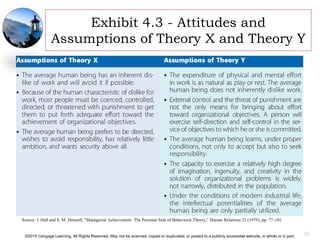
Exhibit 4.3 - Attitudes and
Assumptions of Theory X and Theory Y
12
Source: J. Hall and S. M. Donnell, “Managerial Achievement: The Personal Side of Behavioral Theory,” Human Relations 32 (1979), pp. 77–101
©2015 Cengage Learning. All Rights Reserved. May not be scanned, copied or duplicated, or posted to a publicly accessible website, in whole or in part.
Social Perception
• Making sense out of the environment by
selecting, organizing, and interpreting
information
– Values and attitudes affect perceptions, and
vice versa
13
©2015 Cengage Learning. All Rights Reserved. May not be scanned, copied or duplicated, or posted to a publicly accessible website, in whole or in part.
Perpetual Distortions
• Errors in judgment that arise from
inaccuracies in the perceptual process
– Stereotyping: Assigning an individual to a
group and attributing generalizations about
the group to the individual
• Hinders from knowing people who are
stereotyped
– Halo effect: Overall impression of a person
or situation based on one characteristic
• Blinds the perceiver to other characteristics
14
©2015 Cengage Learning. All Rights Reserved. May not be scanned, copied or duplicated, or posted to a publicly accessible website, in whole or in part.
Perpetual Distortions
– Projection: Tendency to see one’s own
personal traits in others
– Perceptual defense: Protecting oneself by
disregarding ideas, situations, or people
that are unpleasant
15
©2015 Cengage Learning. All Rights Reserved. May not be scanned, copied or duplicated, or posted to a publicly accessible website, in whole or in part.
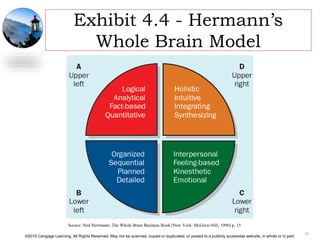
Exhibit 4.4 - Hermann’s
Whole Brain Model
16
Source: Ned Herrmann, The Whole Brain Business Book (New York: McGraw-Hill, 1996) p. 15
©2015 Cengage Learning. All Rights Reserved. May not be scanned, copied or duplicated, or posted to a publicly accessible website, in whole or in part.
Myers-Briggs Type Indicator
(MBTI)™
• Measures how individuals differ in
gathering and evaluating information for
solving problems and making decisions
• Uses different pairs of attributes to classify
people in 1 of 16 different personality types
– Introversion versus extroversion
– Sensing versus intuition
– Thinking versus feeling
– Judging versus perceiving
17
©2015 Cengage Learning. All Rights Reserved. May not be scanned, copied or duplicated, or posted to a publicly accessible website, in whole or in part.
Working with Different
Personality Types
• Leaders can work effectively by:
– Understanding one’s own personality and
how they react to others
– Treating everyone with respect
– Acknowledging each person’s strengths
– Striving for understanding
– Remembering that everyone wants to fit in
18

Topic 7 c4 leader as individual

  • 1.
    ©2015 Cengage Learning.All Rights Reserved. May not be scanned, copied or duplicated, or posted to a publicly accessible website, in whole or in part. 6e ©2015 Cengage Learning. All Rights Reserved. May not be scanned, copied or duplicated, or posted to a publicly accessible website, in whole or in part. Chapter 4 The Leader as an Individual
  • 2.
    ©2015 Cengage Learning.All Rights Reserved. May not be scanned, copied or duplicated, or posted to a publicly accessible website, in whole or in part. Learning Objectives (23may) • Understand the importance of self- awareness and recognize one’s blind spots • Identify major personality dimensions and understand how personality influences leadership and relationships within organizations 2
  • 3.
    ©2015 Cengage Learning.All Rights Reserved. May not be scanned, copied or duplicated, or posted to a publicly accessible website, in whole or in part. Learning Objectives • Clarify instrumental and end values, and recognize how values guide thoughts and behavior • Define attitudes and explain their relationship to leader’s behavior • Explain attributions and recognize how perception affects the leader-follower relationship 3
  • 4.
    ©2015 Cengage Learning.All Rights Reserved. May not be scanned, copied or duplicated, or posted to a publicly accessible website, in whole or in part. Learning Objectives • Recognize individual differences in cognitive style and broaden one’s own thinking style to expand leadership potential • Understand how to lead and work with people with varied personality traits 4
  • 5.
    ©2015 Cengage Learning.All Rights Reserved. May not be scanned, copied or duplicated, or posted to a publicly accessible website, in whole or in part. Self-Awareness • Being conscious of the internal aspects of one’s nature – Personality traits – Emotions – Values – Attitudes and perceptions – Appreciating how your patterns affect other people 5
  • 6.
    ©2015 Cengage Learning.All Rights Reserved. May not be scanned, copied or duplicated, or posted to a publicly accessible website, in whole or in part. Big Five Personality Dimensions • Extroversion: Degree to which a person is outgoing, sociable, talkative, and comfortable meeting and talking to new people – Characteristic of dominance • High degree of dominance could even be detrimental to effective leadership 6
  • 7.
    ©2015 Cengage Learning.All Rights Reserved. May not be scanned, copied or duplicated, or posted to a publicly accessible website, in whole or in part. Big Five Personality Dimensions • Agreeableness: Degree to which a person is able to get along with others – Being good-natured, cooperative, forgiving, compassionate, understanding, and trusting • Conscientiousness: Degree to which a person is responsible, dependable, persistent, and achievement-oriented – Focus on a few goals 7
  • 8.
    ©2015 Cengage Learning.All Rights Reserved. May not be scanned, copied or duplicated, or posted to a publicly accessible website, in whole or in part. Big Five Personality Dimensions • Emotional stability: Degree to which a person is well-adjusted, calm, and secure – Emotionally stable leader can: • Handle stress and criticism well, and does not take mistakes or failures personally • Develop positive relationships • Improve relationships – Leaders with a low degree of emotional stability can become tense, anxious, or depressed 8
  • 9.
    ©2015 Cengage Learning.All Rights Reserved. May not be scanned, copied or duplicated, or posted to a publicly accessible website, in whole or in part. Big Five Personality Dimensions • Openness to experience: Degree to which a person has a broad range of interests and is imaginative, creative, and willing to consider new ideas – Important as leadership is about change. Source: The Big Five Personality Traits (youtube). 9
  • 10.
    ©2015 Cengage Learning.All Rights Reserved. May not be scanned, copied or duplicated, or posted to a publicly accessible website, in whole or in part. Differences in Behavior Between Internals and Externals (30/5 kaamatan, 6june-raya, 13june..) Internals • More self-motivated • Better in control of their own behavior • Participate more in social and political activities • Actively seek information • Better able to handle complex information and problem solving Externals • Have structured, directed work situations • Better able to handle work that requires compliance and conformity 10
  • 11.
    ©2015 Cengage Learning.All Rights Reserved. May not be scanned, copied or duplicated, or posted to a publicly accessible website, in whole or in part. Theory X and Theory Y • Assumption that people are basically lazy and not motivated to work and that they have a natural tendency to avoid responsibility Theory X • Assumption that people do not inherently dislike work and will commit themselves willingly to work that they care about Theory Y 11
  • 12.
    ©2015 Cengage Learning.All Rights Reserved. May not be scanned, copied or duplicated, or posted to a publicly accessible website, in whole or in part. Exhibit 4.3 - Attitudes and Assumptions of Theory X and Theory Y 12 Source: J. Hall and S. M. Donnell, “Managerial Achievement: The Personal Side of Behavioral Theory,” Human Relations 32 (1979), pp. 77–101
  • 13.
    ©2015 Cengage Learning.All Rights Reserved. May not be scanned, copied or duplicated, or posted to a publicly accessible website, in whole or in part. Social Perception • Making sense out of the environment by selecting, organizing, and interpreting information – Values and attitudes affect perceptions, and vice versa 13
  • 14.
    ©2015 Cengage Learning.All Rights Reserved. May not be scanned, copied or duplicated, or posted to a publicly accessible website, in whole or in part. Perpetual Distortions • Errors in judgment that arise from inaccuracies in the perceptual process – Stereotyping: Assigning an individual to a group and attributing generalizations about the group to the individual • Hinders from knowing people who are stereotyped – Halo effect: Overall impression of a person or situation based on one characteristic • Blinds the perceiver to other characteristics 14
  • 15.
    ©2015 Cengage Learning.All Rights Reserved. May not be scanned, copied or duplicated, or posted to a publicly accessible website, in whole or in part. Perpetual Distortions – Projection: Tendency to see one’s own personal traits in others – Perceptual defense: Protecting oneself by disregarding ideas, situations, or people that are unpleasant 15
  • 16.
    ©2015 Cengage Learning.All Rights Reserved. May not be scanned, copied or duplicated, or posted to a publicly accessible website, in whole or in part. Exhibit 4.4 - Hermann’s Whole Brain Model 16 Source: Ned Herrmann, The Whole Brain Business Book (New York: McGraw-Hill, 1996) p. 15
  • 17.
    ©2015 Cengage Learning.All Rights Reserved. May not be scanned, copied or duplicated, or posted to a publicly accessible website, in whole or in part. Myers-Briggs Type Indicator (MBTI)™ • Measures how individuals differ in gathering and evaluating information for solving problems and making decisions • Uses different pairs of attributes to classify people in 1 of 16 different personality types – Introversion versus extroversion – Sensing versus intuition – Thinking versus feeling – Judging versus perceiving 17
  • 18.
    ©2015 Cengage Learning.All Rights Reserved. May not be scanned, copied or duplicated, or posted to a publicly accessible website, in whole or in part. Working with Different Personality Types • Leaders can work effectively by: – Understanding one’s own personality and how they react to others – Treating everyone with respect – Acknowledging each person’s strengths – Striving for understanding – Remembering that everyone wants to fit in 18