
AB Rajar
Associate Professor
Community Medicine
Muhammad Medical College.
1
CONTENTS.
 Hygiene and Elements.
 Personal hygiene – Definition.
 Care of:
• Hair.
• Skin and Face.
• Teeth.
• Ears.
• Hands.
• Nails and cuticles.
• Feet
2
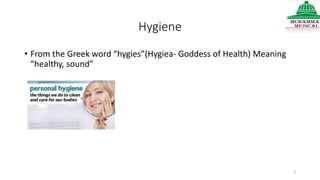
Hygiene
• From the Greek word “hygies”(Hygiea- Goddess of Health) Meaning
“healthy, sound”
3
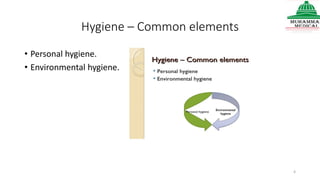
Hygiene – Common elements
• Personal hygiene.
• Environmental hygiene.
4
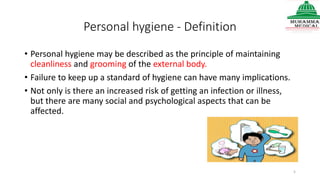
Personal hygiene - Definition
• Personal hygiene may be described as the principle of maintaining
cleanliness and grooming of the external body.
• Failure to keep up a standard of hygiene can have many implications.
• Not only is there an increased risk of getting an infection or illness,
but there are many social and psychological aspects that can be
affected.
5
What is Personal Hygiene?
 Regular Routine of Personal Care Washing and Grooming of:
• Hair.
• Face and Skin.
• Teeth.
• Ears.
• Hands.
• Nails.
• Feet
6
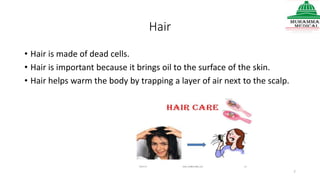
Hair
• Hair is made of dead cells.
• Hair is important because it brings oil to the surface of the skin.
• Hair helps warm the body by trapping a layer of air next to the scalp.
7
Hair Care Tips
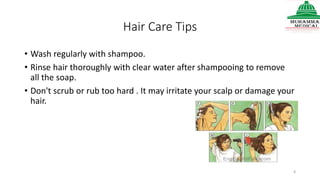
• Wash regularly with shampoo.
• Rinse hair thoroughly with clear water after shampooing to remove
all the soap.
• Don't scrub or rub too hard . It may irritate your scalp or damage your
hair.
8
Hair Care Tips
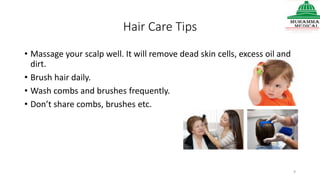
• Massage your scalp well. It will remove dead skin cells, excess oil and
dirt.
• Brush hair daily.
• Wash combs and brushes frequently.
• Don’t share combs, brushes etc.
9
Why Brush Your Hair?
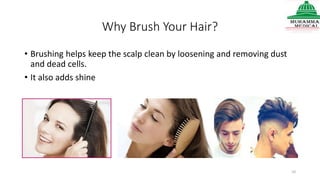
• Brushing helps keep the scalp clean by loosening and removing dust
and dead cells.
• It also adds shine
10
Hair & Scalp problems
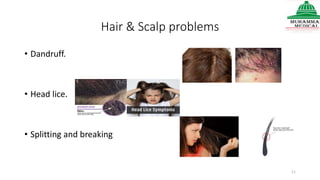
• Dandruff.
• Head lice.
• Splitting and breaking
11
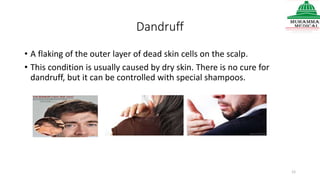
Dandruff
• A flaking of the outer layer of dead skin cells on the scalp.
• This condition is usually caused by dry skin. There is no cure for
dandruff, but it can be controlled with special shampoos.
12
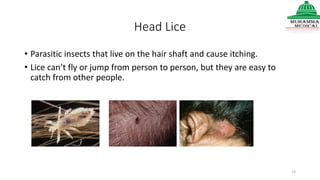
Head Lice
• Parasitic insects that live on the hair shaft and cause itching.
• Lice can’t fly or jump from person to person, but they are easy to
catch from other people.
13
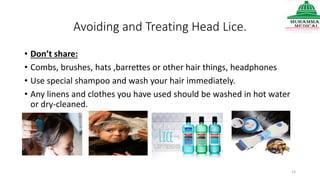
Avoiding and Treating Head Lice.
• Don’t share:
• Combs, brushes, hats ,barrettes or other hair things, headphones
• Use special shampoo and wash your hair immediately.
• Any linens and clothes you have used should be washed in hot water
or dry-cleaned.
14
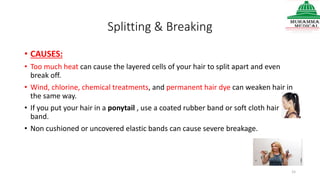
Splitting & Breaking
• CAUSES:
• Too much heat can cause the layered cells of your hair to split apart and even
break off.
• Wind, chlorine, chemical treatments, and permanent hair dye can weaken hair in
the same way.
• If you put your hair in a ponytail , use a coated rubber band or soft cloth hair
band.
• Non cushioned or uncovered elastic bands can cause severe breakage.
15
Skin
• The human skin is the outer covering of the body.
 FUNCTIONS OF SKIN.
• Protection.
• Vitamin D formation.
• Temperature control.
• Sensation.
• Water resistance.
• Control of evaporation.
• Excretion.
• Absorption
16
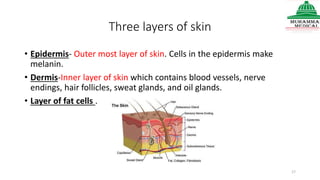
Three layers of skin
• Epidermis- Outer most layer of skin. Cells in the epidermis make
melanin.
• Dermis-Inner layer of skin which contains blood vessels, nerve
endings, hair follicles, sweat glands, and oil glands.
• Layer of fat cells .
17
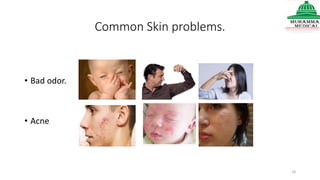
Common Skin problems.
• Bad odor.
• Acne
18
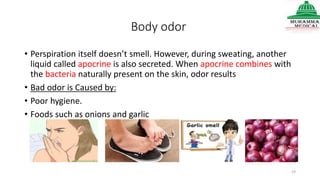
Body odor
• Perspiration itself doesn’t smell. However, during sweating, another
liquid called apocrine is also secreted. When apocrine combines with
the bacteria naturally present on the skin, odor results
• Bad odor is Caused by:
• Poor hygiene.
• Foods such as onions and garlic
19
Acne
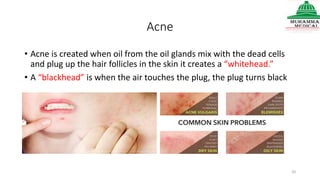
• Acne is created when oil from the oil glands mix with the dead cells
and plug up the hair follicles in the skin it creates a “whitehead.”
• A “blackhead” is when the air touches the plug, the plug turns black
20
What makes acne worse?
• Oil-based makeup, suntan oil, hair jells and spray.
• For girls, menstruation.
• For Boys it may get worse because they have more skin oil.
• Squeezing or picking at blemishes.
• Hard scrubbing of the skin
21
Skin Care Tips.
• Daily baths or showers using soap and scrubbing the entire body with
a washcloth. Do not need to scrub violently.
• The use antiperspirants decreases perspiration and cover odor with
manly smell.
• Wash the face two times a day with a mild soap or gentle cleanser. It
is best to
• Use lotions only if needed, and use ones that are oil-free and water-
based.
• Try to stay out of the sun, and use a sunscreen every day during
summer and winter.
22
Skin Care Tips.
• Bathe or shower regularly using soap Do not scrub violently.
• If possible, bathe or shower after exercise – especially after sweating.
• Use antiperspirants decreases perspiration and cover odor with a
manly smell.
• Wear clean clothes.
• Reduce stress levels which irritates the skin.
• Maintain a healthy diet
23
Skin Care Tips
• Wash your face 2 times a day.
• Avoid washing too often, as the skin will become irritated and dry
out.
• Keep oily hair away from your skin.
• Avoid touching acne except when washing.
• Don’t squeeze or pick the pimples.
• Try to avoid touching the face.
• Keep hands clean by washing them often.
24
Protect yourself from the sun
• Wear sunscreen and reapply it every hour.
• Wear a hat, T-shirt, and sunglasses.
• Drink plenty of fluids.
• Protect yourself from UV Rays
25
Teeth
• Healthy teeth and gums enable you to:
• Chew food thoroughly.
• Speak clearly.
• Give shape and structure to your mouth
26
Structure of teeth.
• Enamel (top): The hard material on the outer surface of the tooth.
• Dentin (middle): Below the enamel – the bonelike material that
surrounds the sensitive inner parts of the tooth.
• Pulp (inside):Tissue that contains nerve endings and blood vessels.
27
Dental problems
• Dental problems are caused by the activity of certain types of oral
bacteria Other causes:
• Tongue not cleaned
• Food stuck in teeth
• Sinus problems
• Stomach problems
28
Dental Problems
• Halitosis. or chronic bad breath.
• Tooth decay.
• Plaque.
• Tartar. calculus, forms below and above the gum line.
• Periodontal Disease
29
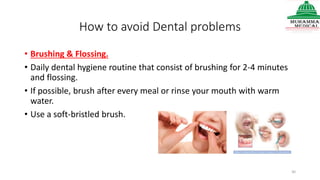
How to avoid Dental problems
• Brushing & Flossing.
• Daily dental hygiene routine that consist of brushing for 2-4 minutes
and flossing.
• If possible, brush after every meal or rinse your mouth with warm
water.
• Use a soft-bristled brush.
30
How to avoid Dental problems
• Brushing & Flossing.
• Replace your toothbrush every 2-3 months or after an illness.
• Use toothpaste that contains fluoride.
• Flossing removes food trapped between your teeth and gum lines
that rinsing and brushing miss.
31
Dental care
• Eat at least 5 servings of fruits and vegetables each day.
• Include foods that contain calcium, such as milk and yogurt.
• Limit intake of sugar.
• See a dentist every 6 months
32
Ears
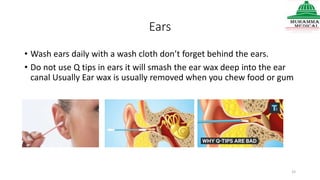
• Wash ears daily with a wash cloth don’t forget behind the ears.
• Do not use Q tips in ears it will smash the ear wax deep into the ear
canal Usually Ear wax is usually removed when you chew food or gum
33
HAND HYGIENE
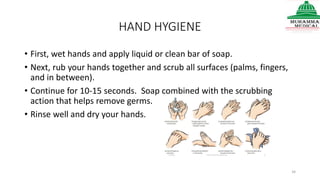
• First, wet hands and apply liquid or clean bar of soap.
• Next, rub your hands together and scrub all surfaces (palms, fingers,
and in between).
• Continue for 10-15 seconds. Soap combined with the scrubbing
action that helps remove germs.
• Rinse well and dry your hands.
34
Nails and cuticles
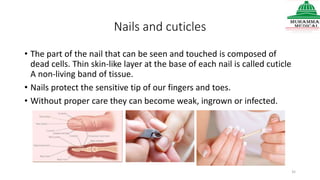
• The part of the nail that can be seen and touched is composed of
dead cells. Thin skin-like layer at the base of each nail is called cuticle
A non-living band of tissue.
• Nails protect the sensitive tip of our fingers and toes.
• Without proper care they can become weak, ingrown or infected.
35
Nail Care
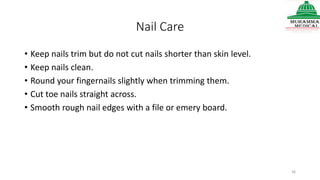
• Keep nails trim but do not cut nails shorter than skin level.
• Keep nails clean.
• Round your fingernails slightly when trimming them.
• Cut toe nails straight across.
• Smooth rough nail edges with a file or emery board.
36
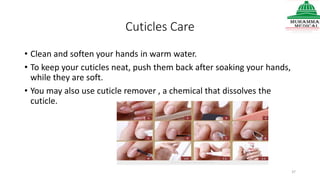
Cuticles Care
• Clean and soften your hands in warm water.
• To keep your cuticles neat, push them back after soaking your hands,
while they are soft.
• You may also use cuticle remover , a chemical that dissolves the
cuticle.
37
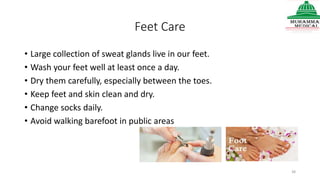
Feet Care
• Large collection of sweat glands live in our feet.
• Wash your feet well at least once a day.
• Dry them carefully, especially between the toes.
• Keep feet and skin clean and dry.
• Change socks daily.
• Avoid walking barefoot in public areas
38
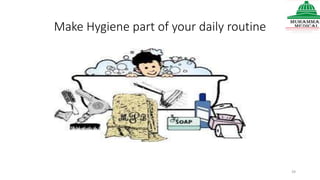
Make Hygiene part of your daily routine
39
40

Personal Hygiene

  • 1.
    AB Rajar Associate Professor CommunityMedicine Muhammad Medical College. 1
  • 2.
    CONTENTS.  Hygiene andElements.  Personal hygiene – Definition.  Care of: • Hair. • Skin and Face. • Teeth. • Ears. • Hands. • Nails and cuticles. • Feet 2
  • 3.
    Hygiene • From theGreek word “hygies”(Hygiea- Goddess of Health) Meaning “healthy, sound” 3
  • 4.
    Hygiene – Commonelements • Personal hygiene. • Environmental hygiene. 4
  • 5.
    Personal hygiene -Definition • Personal hygiene may be described as the principle of maintaining cleanliness and grooming of the external body. • Failure to keep up a standard of hygiene can have many implications. • Not only is there an increased risk of getting an infection or illness, but there are many social and psychological aspects that can be affected. 5
  • 6.
    What is PersonalHygiene?  Regular Routine of Personal Care Washing and Grooming of: • Hair. • Face and Skin. • Teeth. • Ears. • Hands. • Nails. • Feet 6
  • 7.
    Hair • Hair ismade of dead cells. • Hair is important because it brings oil to the surface of the skin. • Hair helps warm the body by trapping a layer of air next to the scalp. 7
  • 8.
    Hair Care Tips •Wash regularly with shampoo. • Rinse hair thoroughly with clear water after shampooing to remove all the soap. • Don't scrub or rub too hard . It may irritate your scalp or damage your hair. 8
  • 9.
    Hair Care Tips •Massage your scalp well. It will remove dead skin cells, excess oil and dirt. • Brush hair daily. • Wash combs and brushes frequently. • Don’t share combs, brushes etc. 9
  • 10.
    Why Brush YourHair? • Brushing helps keep the scalp clean by loosening and removing dust and dead cells. • It also adds shine 10
  • 11.
    Hair & Scalpproblems • Dandruff. • Head lice. • Splitting and breaking 11
  • 12.
    Dandruff • A flakingof the outer layer of dead skin cells on the scalp. • This condition is usually caused by dry skin. There is no cure for dandruff, but it can be controlled with special shampoos. 12
  • 13.
    Head Lice • Parasiticinsects that live on the hair shaft and cause itching. • Lice can’t fly or jump from person to person, but they are easy to catch from other people. 13
  • 14.
    Avoiding and TreatingHead Lice. • Don’t share: • Combs, brushes, hats ,barrettes or other hair things, headphones • Use special shampoo and wash your hair immediately. • Any linens and clothes you have used should be washed in hot water or dry-cleaned. 14
  • 15.
    Splitting & Breaking •CAUSES: • Too much heat can cause the layered cells of your hair to split apart and even break off. • Wind, chlorine, chemical treatments, and permanent hair dye can weaken hair in the same way. • If you put your hair in a ponytail , use a coated rubber band or soft cloth hair band. • Non cushioned or uncovered elastic bands can cause severe breakage. 15
  • 16.
    Skin • The humanskin is the outer covering of the body.  FUNCTIONS OF SKIN. • Protection. • Vitamin D formation. • Temperature control. • Sensation. • Water resistance. • Control of evaporation. • Excretion. • Absorption 16
  • 17.
    Three layers ofskin • Epidermis- Outer most layer of skin. Cells in the epidermis make melanin. • Dermis-Inner layer of skin which contains blood vessels, nerve endings, hair follicles, sweat glands, and oil glands. • Layer of fat cells . 17
  • 18.
    Common Skin problems. •Bad odor. • Acne 18
  • 19.
    Body odor • Perspirationitself doesn’t smell. However, during sweating, another liquid called apocrine is also secreted. When apocrine combines with the bacteria naturally present on the skin, odor results • Bad odor is Caused by: • Poor hygiene. • Foods such as onions and garlic 19
  • 20.
    Acne • Acne iscreated when oil from the oil glands mix with the dead cells and plug up the hair follicles in the skin it creates a “whitehead.” • A “blackhead” is when the air touches the plug, the plug turns black 20
  • 21.
    What makes acneworse? • Oil-based makeup, suntan oil, hair jells and spray. • For girls, menstruation. • For Boys it may get worse because they have more skin oil. • Squeezing or picking at blemishes. • Hard scrubbing of the skin 21
  • 22.
    Skin Care Tips. •Daily baths or showers using soap and scrubbing the entire body with a washcloth. Do not need to scrub violently. • The use antiperspirants decreases perspiration and cover odor with manly smell. • Wash the face two times a day with a mild soap or gentle cleanser. It is best to • Use lotions only if needed, and use ones that are oil-free and water- based. • Try to stay out of the sun, and use a sunscreen every day during summer and winter. 22
  • 23.
    Skin Care Tips. •Bathe or shower regularly using soap Do not scrub violently. • If possible, bathe or shower after exercise – especially after sweating. • Use antiperspirants decreases perspiration and cover odor with a manly smell. • Wear clean clothes. • Reduce stress levels which irritates the skin. • Maintain a healthy diet 23
  • 24.
    Skin Care Tips •Wash your face 2 times a day. • Avoid washing too often, as the skin will become irritated and dry out. • Keep oily hair away from your skin. • Avoid touching acne except when washing. • Don’t squeeze or pick the pimples. • Try to avoid touching the face. • Keep hands clean by washing them often. 24
  • 25.
    Protect yourself fromthe sun • Wear sunscreen and reapply it every hour. • Wear a hat, T-shirt, and sunglasses. • Drink plenty of fluids. • Protect yourself from UV Rays 25
  • 26.
    Teeth • Healthy teethand gums enable you to: • Chew food thoroughly. • Speak clearly. • Give shape and structure to your mouth 26
  • 27.
    Structure of teeth. •Enamel (top): The hard material on the outer surface of the tooth. • Dentin (middle): Below the enamel – the bonelike material that surrounds the sensitive inner parts of the tooth. • Pulp (inside):Tissue that contains nerve endings and blood vessels. 27
  • 28.
    Dental problems • Dentalproblems are caused by the activity of certain types of oral bacteria Other causes: • Tongue not cleaned • Food stuck in teeth • Sinus problems • Stomach problems 28
  • 29.
    Dental Problems • Halitosis.or chronic bad breath. • Tooth decay. • Plaque. • Tartar. calculus, forms below and above the gum line. • Periodontal Disease 29
  • 30.
    How to avoidDental problems • Brushing & Flossing. • Daily dental hygiene routine that consist of brushing for 2-4 minutes and flossing. • If possible, brush after every meal or rinse your mouth with warm water. • Use a soft-bristled brush. 30
  • 31.
    How to avoidDental problems • Brushing & Flossing. • Replace your toothbrush every 2-3 months or after an illness. • Use toothpaste that contains fluoride. • Flossing removes food trapped between your teeth and gum lines that rinsing and brushing miss. 31
  • 32.
    Dental care • Eatat least 5 servings of fruits and vegetables each day. • Include foods that contain calcium, such as milk and yogurt. • Limit intake of sugar. • See a dentist every 6 months 32
  • 33.
    Ears • Wash earsdaily with a wash cloth don’t forget behind the ears. • Do not use Q tips in ears it will smash the ear wax deep into the ear canal Usually Ear wax is usually removed when you chew food or gum 33
  • 34.
    HAND HYGIENE • First,wet hands and apply liquid or clean bar of soap. • Next, rub your hands together and scrub all surfaces (palms, fingers, and in between). • Continue for 10-15 seconds. Soap combined with the scrubbing action that helps remove germs. • Rinse well and dry your hands. 34
  • 35.
    Nails and cuticles •The part of the nail that can be seen and touched is composed of dead cells. Thin skin-like layer at the base of each nail is called cuticle A non-living band of tissue. • Nails protect the sensitive tip of our fingers and toes. • Without proper care they can become weak, ingrown or infected. 35
  • 36.
    Nail Care • Keepnails trim but do not cut nails shorter than skin level. • Keep nails clean. • Round your fingernails slightly when trimming them. • Cut toe nails straight across. • Smooth rough nail edges with a file or emery board. 36
  • 37.
    Cuticles Care • Cleanand soften your hands in warm water. • To keep your cuticles neat, push them back after soaking your hands, while they are soft. • You may also use cuticle remover , a chemical that dissolves the cuticle. 37
  • 38.
    Feet Care • Largecollection of sweat glands live in our feet. • Wash your feet well at least once a day. • Dry them carefully, especially between the toes. • Keep feet and skin clean and dry. • Change socks daily. • Avoid walking barefoot in public areas 38
  • 39.
    Make Hygiene partof your daily routine 39
  • 40.