Personal Hygiene
Personal Hygiene
Mrs.Puvaneswari Ramesh
Assoc. Professor
NHCON
Contents
Contents
 Hygiene and Elements
 Personal hygiene – Definition
 Care of
 Hair
 Skin and Face
 Teeth
 Ears
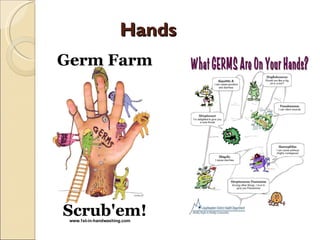
 Hands
 Nails and cuticles
 Feet
Hygiene
Hygiene
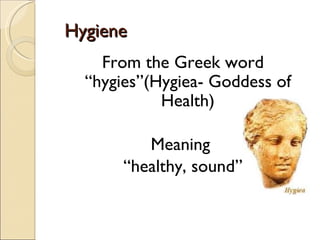
From the Greek word
“hygies”(Hygiea- Goddess of
Health)
Meaning
“healthy, sound”
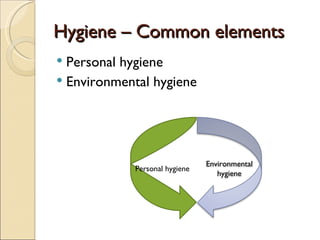
Hygiene – Common elements
 Personal hygiene
 Environmental hygiene
Personal hygiene
Environmental
hygiene
Personal hygiene - Definition
 Personal hygiene may be described as the
principle of maintaining cleanliness and
grooming of the external body.
Failure to keep up a standard
of hygiene can have many implications.
Not only is there an increased risk of
getting an infection or illness, but there
are many social and psychological aspects
that can be affected.
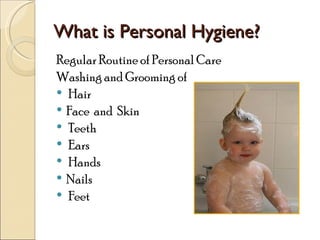
What is Personal Hygiene?
Regular Routine of Personal Care
Washing and Grooming of
 Hair
 Face and Skin
 Teeth
 Ears
 Hands
 Nails
 Feet
Hair
Hair
Hair is made of dead cells.
Hair is important because it brings oil to
the surface of the skin.
Hair helps warm the body by trapping a
layer of air next to the scalp.
Hair Care Tips
Hair Care Tips
• Wash regularly with shampoo. Rinse hair
thoroughly with clear water after
shampooing to remove all the soap
• Don't scrub or rub too hard . It may
irritate your scalp or damage your hair.
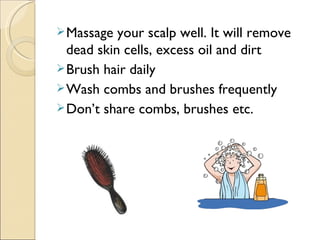
Massage your scalp well. It will remove
dead skin cells, excess oil and dirt
Brush hair daily
Wash combs and brushes frequently
Don’t share combs, brushes etc.
Why Brush Your Hair?
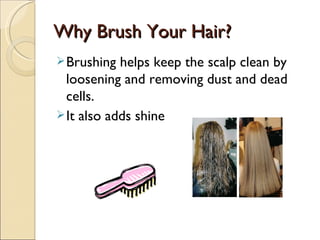
Brushing helps keep the scalp clean by
loosening and removing dust and dead
cells.
It also adds shine
Hair & Scalp problems
Dandruff
Head lice
Splitting and breaking
Dandruff
Dandruff
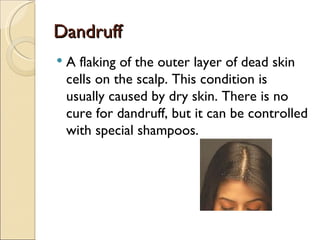
 A flaking of the outer layer of dead skin
cells on the scalp. This condition is
usually caused by dry skin. There is no
cure for dandruff, but it can be controlled
with special shampoos.
Head Lice
Head Lice
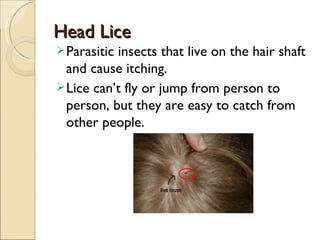
Parasitic insects that live on the hair shaft
and cause itching.
Lice can’t fly or jump from person to
person, but they are easy to catch from
other people.
Avoiding and Treating Head Lice
Don’t share:
Combs, brushes, hats ,barrettes or other
hair things, headphones
Use special shampoo and wash your hair
immediately.
Any linens and clothes you have used
should be washed in hot water or
dry-cleaned.
Splitting & Breaking
Too much heat can cause the layered cells
of your hair to split apart and even break off.
Wind, chlorine, chemical treatments, and
permanent hair dye can weaken hair in the
same way.
If you put your hair in a ponytail , use a
coated rubber band or soft cloth hair band.
Noncushioned or uncovered elastic bands
can cause severe breakage.
Skin
Skin
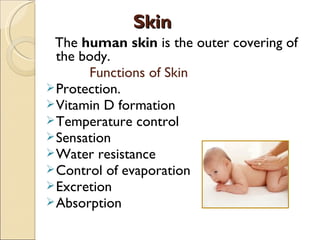
The human skin is the outer covering of
the body.
Functions of Skin
Protection.
Vitamin D formation
Temperature control
Sensation
Water resistance
Control of evaporation
Excretion
Absorption
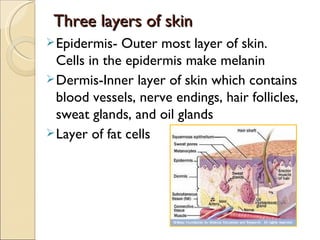
Three layers of skin
Epidermis- Outer most layer of skin.
Cells in the epidermis make melanin
Dermis-Inner layer of skin which contains
blood vessels, nerve endings, hair follicles,
sweat glands, and oil glands
Layer of fat cells
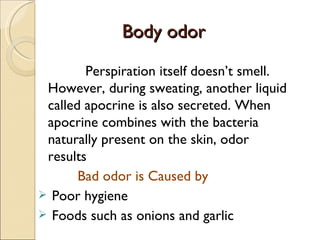
Common Skin problems
 Bad odor
 Acne
Body odor
Body odor
Perspiration itself doesn’t smell.
However, during sweating, another liquid
called apocrine is also secreted. When
apocrine combines with the bacteria
naturally present on the skin, odor
results
Bad odor is Caused by
 Poor hygiene
 Foods such as onions and garlic
Acne
Acne
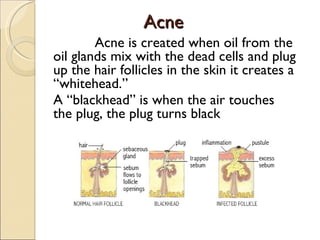
Acne is created when oil from the
oil glands mix with the dead cells and plug
up the hair follicles in the skin it creates a
“whitehead.”
A “blackhead” is when the air touches
the plug, the plug turns black
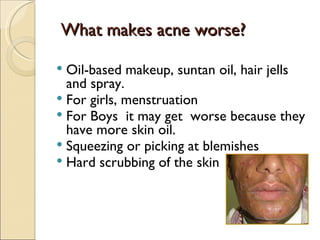
What makes acne worse?
 Oil-based makeup, suntan oil, hair jells
and spray.
 For girls, menstruation
 For Boys it may get worse because they
have more skin oil.
 Squeezing or picking at blemishes
 Hard scrubbing of the skin
 Daily baths or showers using soap and scrubbing the entire body with a
washcloth Do not need to scrub violently.
 The use antiperspirants decreases perspiration and cover odor with a
manly smell
 Wash the face two times a day with a mild soap or gentle cleanser. It is best to
 Use lotions only if needed, and use ones that are oil-free and water-based.
  
   Try to stay out of the sun, and use a sunscreen every day during summer and
winter.
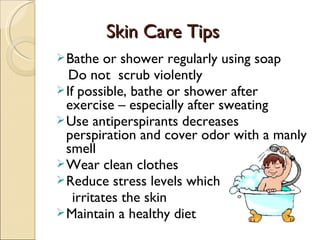
Skin Care Tips
Skin Care Tips
Bathe or shower regularly using soap
Do not scrub violently
If possible, bathe or shower after
exercise – especially after sweating
Use antiperspirants decreases
perspiration and cover odor with a manly
smell
Wear clean clothes
Reduce stress levels which
irritates the skin
Maintain a healthy diet
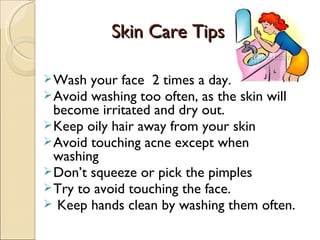
Skin Care Tips
Skin Care Tips
Wash your face 2 times a day.
Avoid washing too often, as the skin will
become irritated and dry out.
Keep oily hair away from your skin
Avoid touching acne except when
washing
Don’t squeeze or pick the pimples
Try to avoid touching the face.
 Keep hands clean by washing them often.
Protect yourself from the sun
Wear sunscreen and reapply it every
hour.
Wear a hat, T-shirt, and sunglasses.
Drink plenty of fluids.
Protect yourself from UV Rays
Teeth
Teeth
Healthy teeth and gums enable
you to:
Chew food thoroughly
Speak clearly
Give shape and structure to your mouth
Structure of teeth
Structure of teeth
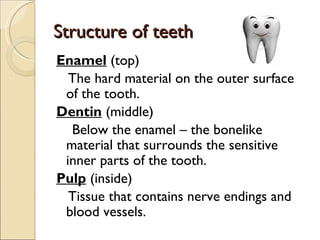
Enamel (top)
The hard material on the outer surface
of the tooth.
Dentin (middle)
Below the enamel – the bonelike
material that surrounds the sensitive
inner parts of the tooth.
Pulp (inside)
Tissue that contains nerve endings and
blood vessels.
Dental problems
Dental problems
Dental problems are caused by the
activity of certain types of oral bacteria
Other causes:
Tongue not cleaned
Food stuck in teeth
Sinus problems
Stomach problems
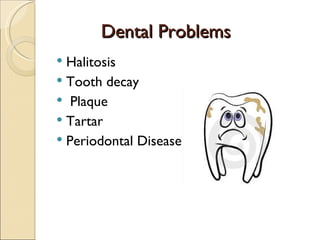
Dental Problems
Dental Problems
 Halitosis
 Tooth decay
 Plaque
 Tartar
 Periodontal Disease
How to avoid Dental problems-
Brushing & Flossing
Brushing & Flossing
Daily dental hygiene routine that consist
of brushing for 2-4 minutes and flossing
I f possible, brush after every meal or
rinse your mouth with warm water.
Use a soft-bristled brush.
Brushing & Flossing
Brushing & Flossing
Replace your toothbrush every 2-3
months or after an illness.
Use toothpaste that contains fluoride.
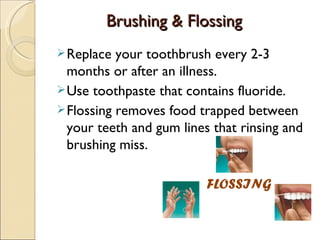
Flossing removes food trapped between
your teeth and gum lines that rinsing and
brushing miss.
FLOSSING
Dental care
Dental care
Eat at least 5 servings of fruits and
vegetables each day.
Include foods that contain calcium, such
as milk and yogurt.
Limit intake of sugar.
See a dentist every 6 months
Ears
Ears
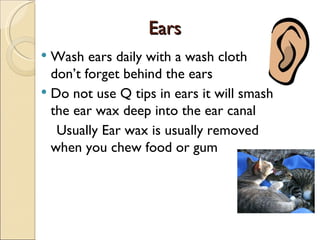
 Wash ears daily with a wash cloth
don’t forget behind the ears
 Do not use Q tips in ears it will smash
the ear wax deep into the ear canal
Usually Ear wax is usually removed
when you chew food or gum
Hands
Hands
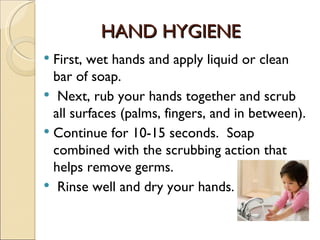
HAND HYGIENE
HAND HYGIENE
 First, wet hands and apply liquid or clean
bar of soap. 
 Next, rub your hands together and scrub
all surfaces (palms, fingers, and in between).
 Continue for 10-15 seconds.  Soap
combined with the scrubbing action that
helps remove germs.
 Rinse well and dry your hands.
Nails and cuticles
Nails and cuticles
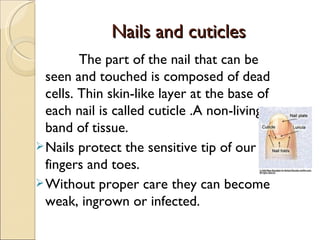
The part of the nail that can be
seen and touched is composed of dead
cells. Thin skin-like layer at the base of
each nail is called cuticle .A non-living
band of tissue.
Nails protect the sensitive tip of our
fingers and toes.
Without proper care they can become
weak, ingrown or infected.
Nail Care
Nail Care
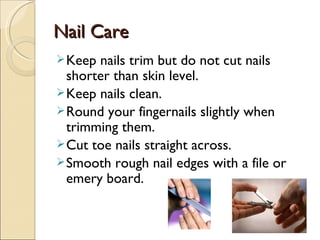
Keep nails trim but do not cut nails
shorter than skin level.
Keep nails clean.
Round your fingernails slightly when
trimming them.
Cut toe nails straight across.
Smooth rough nail edges with a file or
emery board.
Cuticles Care
Cuticles Care
Clean and soften your hands in warm
water.
To keep your cuticles neat, push them
back after soaking your hands, while they
are soft.
You may also use cuticle remover , a
chemical that dissolves the cuticle
Feet Care
Feet Care
Large collection of sweat glands live in
our feet
Wash your feet well at least once a day.
Dry them carefully, especially between
the toes.
Keep feet and skin clean and dry
Change socks daily
Avoid walking barefoot in public areas
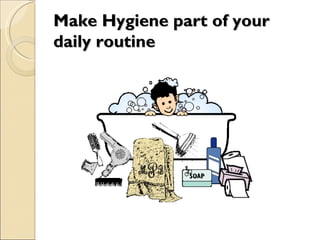
Make Hygiene part of your
daily routine
daily routine
Personalhygiene 120531235008-phpapp01 (2)

Personalhygiene 120531235008-phpapp01 (2)

  • 1.
  • 2.
    Contents Contents  Hygiene andElements  Personal hygiene – Definition  Care of  Hair  Skin and Face  Teeth  Ears  Hands  Nails and cuticles  Feet
  • 3.
    Hygiene Hygiene From the Greekword “hygies”(Hygiea- Goddess of Health) Meaning “healthy, sound”
  • 4.
    Hygiene – Commonelements Hygiene – Common elements  Personal hygiene  Environmental hygiene Personal hygiene Environmental hygiene
  • 5.
    Personal hygiene -Definition Personal hygiene - Definition  Personal hygiene may be described as the principle of maintaining cleanliness and grooming of the external body. Failure to keep up a standard of hygiene can have many implications. Not only is there an increased risk of getting an infection or illness, but there are many social and psychological aspects that can be affected.
  • 6.
    What is PersonalHygiene? What is Personal Hygiene? Regular Routine of Personal Care Washing and Grooming of  Hair  Face and Skin  Teeth  Ears  Hands  Nails  Feet
  • 7.
    Hair Hair Hair is madeof dead cells. Hair is important because it brings oil to the surface of the skin. Hair helps warm the body by trapping a layer of air next to the scalp.
  • 8.
    Hair Care Tips HairCare Tips • Wash regularly with shampoo. Rinse hair thoroughly with clear water after shampooing to remove all the soap • Don't scrub or rub too hard . It may irritate your scalp or damage your hair.
  • 9.
    Massage your scalpwell. It will remove dead skin cells, excess oil and dirt Brush hair daily Wash combs and brushes frequently Don’t share combs, brushes etc.
  • 10.
    Why Brush YourHair? Why Brush Your Hair? Brushing helps keep the scalp clean by loosening and removing dust and dead cells. It also adds shine
  • 11.
    Hair & Scalpproblems Hair & Scalp problems Dandruff Head lice Splitting and breaking
  • 12.
    Dandruff Dandruff  A flakingof the outer layer of dead skin cells on the scalp. This condition is usually caused by dry skin. There is no cure for dandruff, but it can be controlled with special shampoos.
  • 13.
    Head Lice Head Lice Parasiticinsects that live on the hair shaft and cause itching. Lice can’t fly or jump from person to person, but they are easy to catch from other people.
  • 14.
    Avoiding and TreatingHead Lice Avoiding and Treating Head Lice Don’t share: Combs, brushes, hats ,barrettes or other hair things, headphones Use special shampoo and wash your hair immediately. Any linens and clothes you have used should be washed in hot water or dry-cleaned.
  • 15.
    Splitting & Breaking Splitting& Breaking Too much heat can cause the layered cells of your hair to split apart and even break off. Wind, chlorine, chemical treatments, and permanent hair dye can weaken hair in the same way. If you put your hair in a ponytail , use a coated rubber band or soft cloth hair band. Noncushioned or uncovered elastic bands can cause severe breakage.
  • 16.
    Skin Skin The human skinis the outer covering of the body. Functions of Skin Protection. Vitamin D formation Temperature control Sensation Water resistance Control of evaporation Excretion Absorption
  • 17.
    Three layers ofskin Three layers of skin Epidermis- Outer most layer of skin. Cells in the epidermis make melanin Dermis-Inner layer of skin which contains blood vessels, nerve endings, hair follicles, sweat glands, and oil glands Layer of fat cells
  • 18.
    Common Skin problems CommonSkin problems  Bad odor  Acne
  • 19.
    Body odor Body odor Perspirationitself doesn’t smell. However, during sweating, another liquid called apocrine is also secreted. When apocrine combines with the bacteria naturally present on the skin, odor results Bad odor is Caused by  Poor hygiene  Foods such as onions and garlic
  • 20.
    Acne Acne Acne is createdwhen oil from the oil glands mix with the dead cells and plug up the hair follicles in the skin it creates a “whitehead.” A “blackhead” is when the air touches the plug, the plug turns black
  • 21.
    What makes acneworse? What makes acne worse?  Oil-based makeup, suntan oil, hair jells and spray.  For girls, menstruation  For Boys it may get worse because they have more skin oil.  Squeezing or picking at blemishes  Hard scrubbing of the skin
  • 22.
     Daily bathsor showers using soap and scrubbing the entire body with a washcloth Do not need to scrub violently.  The use antiperspirants decreases perspiration and cover odor with a manly smell  Wash the face two times a day with a mild soap or gentle cleanser. It is best to  Use lotions only if needed, and use ones that are oil-free and water-based.       Try to stay out of the sun, and use a sunscreen every day during summer and winter.
  • 23.
    Skin Care Tips SkinCare Tips Bathe or shower regularly using soap Do not scrub violently If possible, bathe or shower after exercise – especially after sweating Use antiperspirants decreases perspiration and cover odor with a manly smell Wear clean clothes Reduce stress levels which irritates the skin Maintain a healthy diet
  • 24.
    Skin Care Tips SkinCare Tips Wash your face 2 times a day. Avoid washing too often, as the skin will become irritated and dry out. Keep oily hair away from your skin Avoid touching acne except when washing Don’t squeeze or pick the pimples Try to avoid touching the face.  Keep hands clean by washing them often.
  • 25.
    Protect yourself fromthe sun Protect yourself from the sun Wear sunscreen and reapply it every hour. Wear a hat, T-shirt, and sunglasses. Drink plenty of fluids. Protect yourself from UV Rays
  • 26.
    Teeth Teeth Healthy teeth andgums enable you to: Chew food thoroughly Speak clearly Give shape and structure to your mouth
  • 27.
    Structure of teeth Structureof teeth Enamel (top) The hard material on the outer surface of the tooth. Dentin (middle) Below the enamel – the bonelike material that surrounds the sensitive inner parts of the tooth. Pulp (inside) Tissue that contains nerve endings and blood vessels.
  • 28.
    Dental problems Dental problems Dentalproblems are caused by the activity of certain types of oral bacteria Other causes: Tongue not cleaned Food stuck in teeth Sinus problems Stomach problems
  • 29.
    Dental Problems Dental Problems Halitosis  Tooth decay  Plaque  Tartar  Periodontal Disease
  • 30.
    How to avoidDental problems- How to avoid Dental problems- Brushing & Flossing Brushing & Flossing Daily dental hygiene routine that consist of brushing for 2-4 minutes and flossing I f possible, brush after every meal or rinse your mouth with warm water. Use a soft-bristled brush.
  • 31.
    Brushing & Flossing Brushing& Flossing Replace your toothbrush every 2-3 months or after an illness. Use toothpaste that contains fluoride. Flossing removes food trapped between your teeth and gum lines that rinsing and brushing miss. FLOSSING
  • 32.
    Dental care Dental care Eatat least 5 servings of fruits and vegetables each day. Include foods that contain calcium, such as milk and yogurt. Limit intake of sugar. See a dentist every 6 months
  • 33.
    Ears Ears  Wash earsdaily with a wash cloth don’t forget behind the ears  Do not use Q tips in ears it will smash the ear wax deep into the ear canal Usually Ear wax is usually removed when you chew food or gum
  • 34.
  • 35.
    HAND HYGIENE HAND HYGIENE First, wet hands and apply liquid or clean bar of soap.   Next, rub your hands together and scrub all surfaces (palms, fingers, and in between).  Continue for 10-15 seconds.  Soap combined with the scrubbing action that helps remove germs.  Rinse well and dry your hands.
  • 36.
    Nails and cuticles Nailsand cuticles The part of the nail that can be seen and touched is composed of dead cells. Thin skin-like layer at the base of each nail is called cuticle .A non-living band of tissue. Nails protect the sensitive tip of our fingers and toes. Without proper care they can become weak, ingrown or infected.
  • 37.
    Nail Care Nail Care Keepnails trim but do not cut nails shorter than skin level. Keep nails clean. Round your fingernails slightly when trimming them. Cut toe nails straight across. Smooth rough nail edges with a file or emery board.
  • 38.
    Cuticles Care Cuticles Care Cleanand soften your hands in warm water. To keep your cuticles neat, push them back after soaking your hands, while they are soft. You may also use cuticle remover , a chemical that dissolves the cuticle
  • 39.
    Feet Care Feet Care Largecollection of sweat glands live in our feet Wash your feet well at least once a day. Dry them carefully, especially between the toes. Keep feet and skin clean and dry Change socks daily Avoid walking barefoot in public areas
  • 40.
    Make Hygiene partof your Make Hygiene part of your daily routine daily routine