BY
SUMAN SHAIKH
DPT 3rd YEAR (BATCH 2015-19)
COP, JPMC
• Definition
• Uses
• Parts of goniometer
• Degree of freedom
• End feel
• Procedure of goniometry
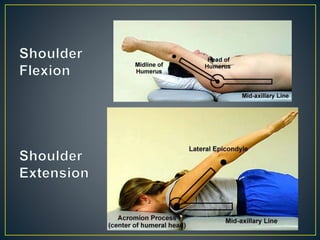
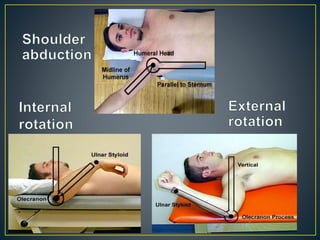
• Active ROMs for shoulder and
elbow
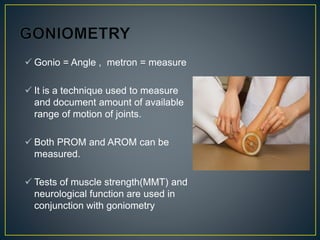
 Gonio = Angle , metron = measure
 It is a technique used to measure
and document amount of available
range of motion of joints.
 Both PROM and AROM can be
measured.
 Tests of muscle strength(MMT) and
neurological function are used in
conjunction with goniometry
To identify abnormal conditions related to
muscles, tendons and joints. Such as:
1. Contractures
2. Decreased ROM due to disuse or injury
Developing treatment goals
For evaluating progress/lack of progress in
rehabilitation treatment.
Finding effectiveness of specific therapeutic
technique, medication or surgical
procedure.
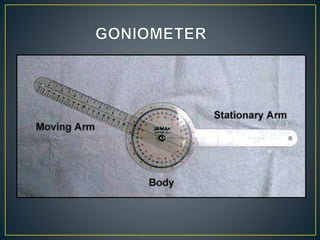
A standard (universal) goniometer
Consists of :
1. Stationary arm: It is part of body, cannot
move independently
2. Moving arm: Attached to fulcrum in the
center of body
3. Body: A full circle on which 0o to 360o
• degrees are drawn.
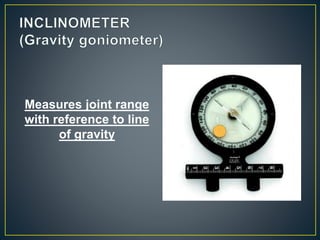
Measures joint range
with reference to line
of gravity
Joints are described in relation to number
of planes that they can move in.
Uniaxial : movement in only one plane
 e.g. elbow joint, knee joint
Biaxial : movement in 2 planes
 e.g. wrist joint
Multiaxial : movement in 3 planes
 e.g. shoulder joint
The feeling of a structure being a barrier
for further motion at the end of joint range
is called END FEEL.
The types of structures limiting ROM have
their own characteristic end feel.
These are of 2 types
1. Normal
2. abnormal
1. Ask the patient to acquire recommended testing
position.
2. Place the join in zero position (neutral position)
3. Stabilize the proximal joint component.
4. Before using goniometer, ask patient to move distal
joint component to complete range, until end feel is
determined.
5. Now palpate bony landmark
6. Align the goniometer
7. Read and record the measurement.
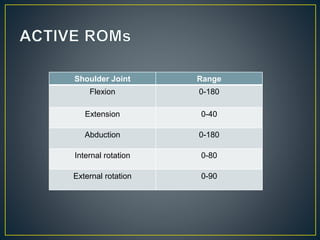
Shoulder Joint Range
Flexion 0-180
Extension 0-40
Abduction 0-180
Internal rotation 0-80
External rotation 0-90
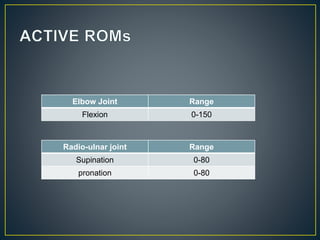
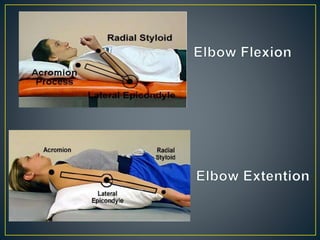
Elbow Joint Range
Flexion 0-150
Radio-ulnar joint Range
Supination 0-80
pronation 0-80
-----THANK YOU-----
ANY QUESTIONS ??

Goniometry

  • 1.
    BY SUMAN SHAIKH DPT 3rdYEAR (BATCH 2015-19) COP, JPMC
  • 2.
    • Definition • Uses •Parts of goniometer • Degree of freedom • End feel • Procedure of goniometry • Active ROMs for shoulder and elbow
  • 3.
     Gonio =Angle , metron = measure  It is a technique used to measure and document amount of available range of motion of joints.  Both PROM and AROM can be measured.  Tests of muscle strength(MMT) and neurological function are used in conjunction with goniometry
  • 4.
    To identify abnormalconditions related to muscles, tendons and joints. Such as: 1. Contractures 2. Decreased ROM due to disuse or injury Developing treatment goals For evaluating progress/lack of progress in rehabilitation treatment. Finding effectiveness of specific therapeutic technique, medication or surgical procedure.
  • 5.
    A standard (universal)goniometer Consists of : 1. Stationary arm: It is part of body, cannot move independently 2. Moving arm: Attached to fulcrum in the center of body 3. Body: A full circle on which 0o to 360o • degrees are drawn.
  • 7.
    Measures joint range withreference to line of gravity
  • 8.
    Joints are describedin relation to number of planes that they can move in. Uniaxial : movement in only one plane  e.g. elbow joint, knee joint Biaxial : movement in 2 planes  e.g. wrist joint Multiaxial : movement in 3 planes  e.g. shoulder joint
  • 9.
    The feeling ofa structure being a barrier for further motion at the end of joint range is called END FEEL. The types of structures limiting ROM have their own characteristic end feel. These are of 2 types 1. Normal 2. abnormal
  • 10.
    1. Ask thepatient to acquire recommended testing position. 2. Place the join in zero position (neutral position) 3. Stabilize the proximal joint component. 4. Before using goniometer, ask patient to move distal joint component to complete range, until end feel is determined. 5. Now palpate bony landmark 6. Align the goniometer 7. Read and record the measurement.
  • 11.
    Shoulder Joint Range Flexion0-180 Extension 0-40 Abduction 0-180 Internal rotation 0-80 External rotation 0-90
  • 14.
    Elbow Joint Range Flexion0-150 Radio-ulnar joint Range Supination 0-80 pronation 0-80
  • 17.