Peroxisome
A Membrane-Bound Organelle
Introduction
Peroxisomes are oxidative organelles. Frequently, molecular
oxygen serves as a co-substrate, from which hydrogen
peroxide (H2O2) is then formed.
Peroxisomes owe their name to hydrogen peroxide
generating and scavenging activities. They perform key
roles in lipid metabolism and the conversion of reactive
oxygen species.
Peroxisomes are involved in the catabolism of very long
chain fatty acids, branched chain fatty acids, bile acid
intermediates (in the liver), D-amino acids, and polyamines,
the reduction of reactive oxygen species –
specifically hydrogen peroxide – and the biosynthesis
of plasmalogens, i.e., ether phospholipids critical for the
normal function of mammalian brains and lungs.
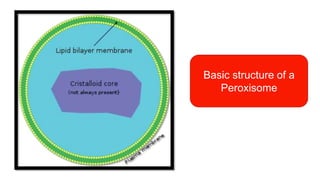
Basic structure of a
Peroxisome
History
Peroxisomes (microbodies) were first described by a Swedish
doctoral student, J. Rhodin in 1954. They were identified as
organelles by the Belgian cytologist Christian de Duve in
1967. De Duve and co-workers discovered that peroxisomes
contain several oxidases involved in the production of
hydrogen peroxide (H2O2) as well as catalase involved in the
decomposition of H2O2 to oxygen and water.
Due to their role in peroxide metabolism, De Duve named them
“peroxisomes”, replacing the formerly used morphological term
“microbodies”. Later, it was described that firefly luciferase is
targeted to peroxisomes in mammalian cells, allowing the
discovery of the import targeting signal for peroxisomes, and
triggering many advances in the peroxisome biogenesis field.
Structural Design
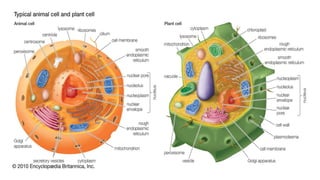
Peroxisomes are small (0.1–1 µm diameter) subcellular compartments (organelles)
with a fine, granular matrix and surrounded by a single biomembrane which are
located in the cytoplasm of a cell. Compartmentalization creates an optimized
environment to promote various metabolic reactions within peroxisomes required to
sustain cellular functions and viability of the organism.
The number, size and protein composition of peroxisomes are variable and depend on
cell type and environmental conditions. For example, in baker's yeast (S. cerevisiae),
it has been observed that, with good glucose supply, only a few, small peroxisomes
are present. In contrast, when the yeasts were supplied with long-chain fatty acids as
sole carbon source up to 20 to 25 large peroxisomes can be formed.
Metabolic
Functions
A major function of the peroxisome is the breakdown of very long chain fatty
acids through beta oxidation. In animal cells, the long fatty acids are converted
to medium chain fatty acids, which are subsequently shuttled
to mitochondria where they eventually are broken down to carbon dioxide and
water. In yeast and plant cells, this process is carried out exclusively in
peroxisomes.
The first reactions in the formation of plasmalogen in animal cells also occur in
peroxisomes. Plasmalogen is the most abundant phospholipid in myelin.
Deficiency of plasmalogens causes profound abnormalities in the myelination
of nerve cells, which is one reason why many peroxisomal disorders affect the
nervous system. Peroxisomes also play a role in the production of bile acids
important for the absorption of fats and fat-soluble vitamins, such as vitamins A
and K. Skin disorders are features of genetic disorders affecting peroxisome
function as a result.
The specific metabolic pathways that occur exclusively in mammalian
peroxisomes are:
 α-oxidation of phytanic acid
 β-oxidation of very-long-chain and polyunsaturated fatty acids
 biosynthesis of plasmalogens
 conjugation of cholic acid as part of bile acid synthesis
Peroxisome
Assembly
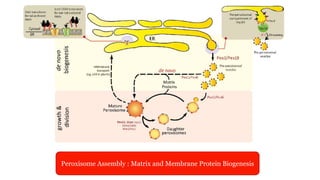
Peroxisomes can be derived from the smooth endoplasmic reticulum under
certain experimental conditions and replicate by membrane growth and
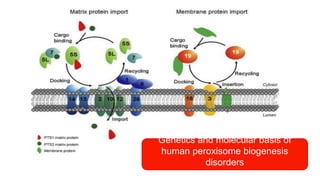
division out of pre-existing organelles. Peroxisome matrix proteins are
translated in the cytoplasm prior to import. Specific amino acid sequences
(PTS or peroxisomal targeting signal) at the C-terminus (PTS1) or N-
terminus (PTS2) of peroxisomal matrix proteins signals them to be imported
into the organelle by a targeting factor. There are currently 36 known
proteins involved in peroxisome biogenesis and maintenance,
called peroxins, which participate in the process of peroxisome assembly in
different organisms. In mammalian cells there are 13 characterized peroxins.
In contrast to protein import into the endoplasmic reticulum (ER) or
mitochondria, proteins do not need to be unfolded to be imported into the
peroxisome lumen. The matrix protein import receptors, the
peroxins PEX5 and PEX7, accompany their cargoes (containing a PTS1 or
a PTS2 amino acid sequence, respectively) all the way to the peroxisome
where they release the cargo into the peroxisomal matrix and then return
to the cytosol – a step named recycling. A special way of peroxisomal
protein targeting is called piggy backing. Proteins that are transported by
this unique method do not have a canonical PTS, but rather bind on a PTS
protein to be transported as a complex.
Peroxisome Assembly : Matrix and Membrane Protein Biogenesis
Peroxisome
Interaction and
Communicatio
n
The diverse functions of peroxisomes require dynamic interactions and
cooperation with many organelles involved in cellular lipid metabolism
such as the endoplasmic reticulum (ER), mitochondria, lipid droplets,
and lysosomes.
Peroxisomes interact with mitochondria in several metabolic pathways,
including β-oxidation of fatty acids and the metabolism of reactive
oxygen species. Both organelles are in close contact with the
endoplasmic reticulum (ER) and share several proteins, including
organelle fission factors.
Peroxisomes also interact with the endoplasmic reticulum (ER) and
cooperate in the synthesis of ether lipids (plasmalogens) which are
important for nerve cells (see above). In filamentous fungi, peroxisomes
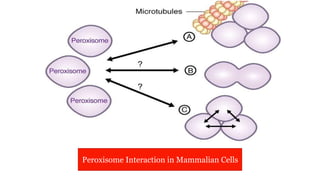
move on microtubules by 'hitchhiking,' a process involving contact with
rapidly moving early endosomes.
Physical contact between organelles is often mediated by membrane
contact sites, where membranes of two organelles are physically
tethered to enable rapid transfer of small molecules, enable organelle
communication and are crucial for coordination of cellular functions and
hence human health. Alterations of membrane contacts have been
observed in various diseases.
Peroxisome Interaction in Mammalian Cells
Genes
 PEX genes encode the protein machinery ("peroxins")
required for proper peroxisome assembly, as described
above. Membrane assembly and maintenance requires
three of these (peroxins 3, 16, and 19) and may occur
without the import of the matrix (lumen) enzymes.
Proliferation of the organelle is regulated by Pex11p.
 Genes that encode peroxin proteins
include: PEX1, PEX2 (PXMP3), PEX3, PEX5, PEX6, PEX
7,PEX9, PEX10, PEX11A, PEX11B, PEX11G, PEX12, PE
X13, PEX14, PEX16, PEX19, PEX26, PEX28, PEX30,
and PEX31. Between organisms, PEX numbering and
function can differ.
Genetics and molecular basis of
human peroxisome biogenesis
disorders
Evolutionary
Origins
The protein content of peroxisomes varies across species or
organism, but the presence of proteins common to many species
has been used to suggest an endosymbiotic origin; that is,
peroxisomes evolved from bacteria that invaded larger cells as
parasites, and very gradually evolved a symbiotic relationship.
However, this view has been challenged by recent discoveries. For
example, peroxisome-less mutants can restore peroxisomes upon
introduction of the wild-type gene.
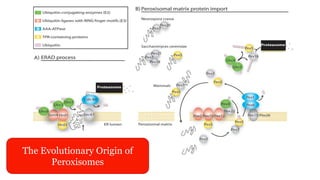
Two independent evolutionary analyses of the
peroxisomal proteome found homologies between the peroxisomal
import machinery and the ERAD pathway in the endoplasmic
reticulum, along with a number of metabolic enzymes that were
likely recruited from the mitochondria.
Recently, it has been suggested that the peroxisome may have had
an actinobacterial origin; however, this is controversial.
The Evolutionary Origin of
Peroxisomes
ThankYou
A Power Point Presentation by Sayyed Anamta Irfan, BSc. Bioscience 1st
Semester, Under the guidance of Dr. Sushma Verma.

Peroxisome.pptx

  • 1.
  • 2.
    Introduction Peroxisomes are oxidativeorganelles. Frequently, molecular oxygen serves as a co-substrate, from which hydrogen peroxide (H2O2) is then formed. Peroxisomes owe their name to hydrogen peroxide generating and scavenging activities. They perform key roles in lipid metabolism and the conversion of reactive oxygen species. Peroxisomes are involved in the catabolism of very long chain fatty acids, branched chain fatty acids, bile acid intermediates (in the liver), D-amino acids, and polyamines, the reduction of reactive oxygen species – specifically hydrogen peroxide – and the biosynthesis of plasmalogens, i.e., ether phospholipids critical for the normal function of mammalian brains and lungs.
  • 3.
    Basic structure ofa Peroxisome
  • 4.
    History Peroxisomes (microbodies) werefirst described by a Swedish doctoral student, J. Rhodin in 1954. They were identified as organelles by the Belgian cytologist Christian de Duve in 1967. De Duve and co-workers discovered that peroxisomes contain several oxidases involved in the production of hydrogen peroxide (H2O2) as well as catalase involved in the decomposition of H2O2 to oxygen and water. Due to their role in peroxide metabolism, De Duve named them “peroxisomes”, replacing the formerly used morphological term “microbodies”. Later, it was described that firefly luciferase is targeted to peroxisomes in mammalian cells, allowing the discovery of the import targeting signal for peroxisomes, and triggering many advances in the peroxisome biogenesis field.
  • 5.
    Structural Design Peroxisomes aresmall (0.1–1 µm diameter) subcellular compartments (organelles) with a fine, granular matrix and surrounded by a single biomembrane which are located in the cytoplasm of a cell. Compartmentalization creates an optimized environment to promote various metabolic reactions within peroxisomes required to sustain cellular functions and viability of the organism. The number, size and protein composition of peroxisomes are variable and depend on cell type and environmental conditions. For example, in baker's yeast (S. cerevisiae), it has been observed that, with good glucose supply, only a few, small peroxisomes are present. In contrast, when the yeasts were supplied with long-chain fatty acids as sole carbon source up to 20 to 25 large peroxisomes can be formed.
  • 7.
    Metabolic Functions A major functionof the peroxisome is the breakdown of very long chain fatty acids through beta oxidation. In animal cells, the long fatty acids are converted to medium chain fatty acids, which are subsequently shuttled to mitochondria where they eventually are broken down to carbon dioxide and water. In yeast and plant cells, this process is carried out exclusively in peroxisomes. The first reactions in the formation of plasmalogen in animal cells also occur in peroxisomes. Plasmalogen is the most abundant phospholipid in myelin. Deficiency of plasmalogens causes profound abnormalities in the myelination of nerve cells, which is one reason why many peroxisomal disorders affect the nervous system. Peroxisomes also play a role in the production of bile acids important for the absorption of fats and fat-soluble vitamins, such as vitamins A and K. Skin disorders are features of genetic disorders affecting peroxisome function as a result. The specific metabolic pathways that occur exclusively in mammalian peroxisomes are:  α-oxidation of phytanic acid  β-oxidation of very-long-chain and polyunsaturated fatty acids  biosynthesis of plasmalogens  conjugation of cholic acid as part of bile acid synthesis
  • 8.
    Peroxisome Assembly Peroxisomes can bederived from the smooth endoplasmic reticulum under certain experimental conditions and replicate by membrane growth and division out of pre-existing organelles. Peroxisome matrix proteins are translated in the cytoplasm prior to import. Specific amino acid sequences (PTS or peroxisomal targeting signal) at the C-terminus (PTS1) or N- terminus (PTS2) of peroxisomal matrix proteins signals them to be imported into the organelle by a targeting factor. There are currently 36 known proteins involved in peroxisome biogenesis and maintenance, called peroxins, which participate in the process of peroxisome assembly in different organisms. In mammalian cells there are 13 characterized peroxins. In contrast to protein import into the endoplasmic reticulum (ER) or mitochondria, proteins do not need to be unfolded to be imported into the peroxisome lumen. The matrix protein import receptors, the peroxins PEX5 and PEX7, accompany their cargoes (containing a PTS1 or a PTS2 amino acid sequence, respectively) all the way to the peroxisome where they release the cargo into the peroxisomal matrix and then return to the cytosol – a step named recycling. A special way of peroxisomal protein targeting is called piggy backing. Proteins that are transported by this unique method do not have a canonical PTS, but rather bind on a PTS protein to be transported as a complex.
  • 9.
    Peroxisome Assembly :Matrix and Membrane Protein Biogenesis
  • 10.
    Peroxisome Interaction and Communicatio n The diversefunctions of peroxisomes require dynamic interactions and cooperation with many organelles involved in cellular lipid metabolism such as the endoplasmic reticulum (ER), mitochondria, lipid droplets, and lysosomes. Peroxisomes interact with mitochondria in several metabolic pathways, including β-oxidation of fatty acids and the metabolism of reactive oxygen species. Both organelles are in close contact with the endoplasmic reticulum (ER) and share several proteins, including organelle fission factors. Peroxisomes also interact with the endoplasmic reticulum (ER) and cooperate in the synthesis of ether lipids (plasmalogens) which are important for nerve cells (see above). In filamentous fungi, peroxisomes move on microtubules by 'hitchhiking,' a process involving contact with rapidly moving early endosomes. Physical contact between organelles is often mediated by membrane contact sites, where membranes of two organelles are physically tethered to enable rapid transfer of small molecules, enable organelle communication and are crucial for coordination of cellular functions and hence human health. Alterations of membrane contacts have been observed in various diseases.
  • 11.
  • 12.
    Genes  PEX genesencode the protein machinery ("peroxins") required for proper peroxisome assembly, as described above. Membrane assembly and maintenance requires three of these (peroxins 3, 16, and 19) and may occur without the import of the matrix (lumen) enzymes. Proliferation of the organelle is regulated by Pex11p.  Genes that encode peroxin proteins include: PEX1, PEX2 (PXMP3), PEX3, PEX5, PEX6, PEX 7,PEX9, PEX10, PEX11A, PEX11B, PEX11G, PEX12, PE X13, PEX14, PEX16, PEX19, PEX26, PEX28, PEX30, and PEX31. Between organisms, PEX numbering and function can differ.
  • 13.
    Genetics and molecularbasis of human peroxisome biogenesis disorders
  • 14.
    Evolutionary Origins The protein contentof peroxisomes varies across species or organism, but the presence of proteins common to many species has been used to suggest an endosymbiotic origin; that is, peroxisomes evolved from bacteria that invaded larger cells as parasites, and very gradually evolved a symbiotic relationship. However, this view has been challenged by recent discoveries. For example, peroxisome-less mutants can restore peroxisomes upon introduction of the wild-type gene. Two independent evolutionary analyses of the peroxisomal proteome found homologies between the peroxisomal import machinery and the ERAD pathway in the endoplasmic reticulum, along with a number of metabolic enzymes that were likely recruited from the mitochondria. Recently, it has been suggested that the peroxisome may have had an actinobacterial origin; however, this is controversial.
  • 15.
  • 16.
    ThankYou A Power PointPresentation by Sayyed Anamta Irfan, BSc. Bioscience 1st Semester, Under the guidance of Dr. Sushma Verma.