Basic Concepts of
Periodic Table
By
Asst. Prof. Vikas Chandra Sharma
SSMV- BHILAI
Periodic Table :
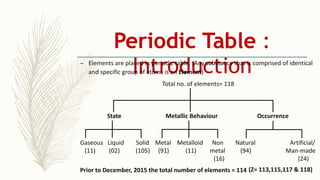
Introduction– Elements are placed in periodic table. (Any substance that is comprised of identical
and specific group of atoms is an Element)
Total no. of elements= 118
State Metallic Behaviour Occurrence
Gaseous Liquid Solid Metal Metalloid Non Natural Artificial/
(11) (02) (105) (91) (11) metal (94) Man-made
(16) (24)
Prior to December, 2015 the total number of elements = 114 (Z= 113,115,117 & 118)
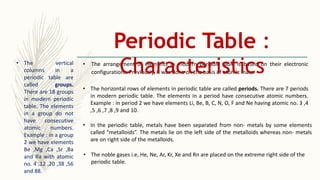
• The arrangement of elements in modern periodic table is based on their electronic
configurations. Previously, it was done on the basis of atomic mass.
Periodic Table :
Characteristics
• In the periodic table, metals have been separated from non- metals by some elements
called “metalloids”. The metals lie on the left side of the metalloids whereas non- metals
are on right side of the metalloids.
• The horizontal rows of elements in periodic table are called periods. There are 7 periods
in modern periodic table. The elements in a period have consecutive atomic numbers.
Example : in period 2 we have elements Li, Be, B, C, N, O, F and Ne having atomic no. 3 ,4
,5 ,6 ,7 ,8 ,9 and 10.
• The vertical
columns in a
periodic table are
called groups.
There are 18 groups
in modern periodic
table. The elements
in a group do not
have consecutive
atomic numbers.
Example : in a group
2 we have elements
Be ,Mg ,Ca ,Sr ,Ba
and Ra with atomic
no. 4 ,12 ,20 ,38 ,56
and 88.
• The noble gases i.e, He, Ne, Ar, Kr, Xe and Rn are placed on the extreme right side of the
periodic table.
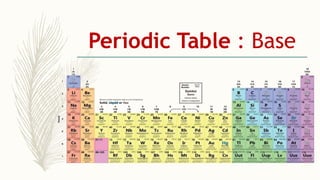
Periodic Table : Base
Periodic Table :
Development
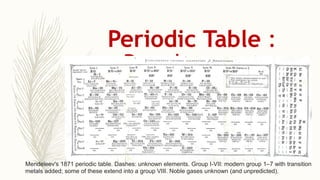
Mendeleev's 1871 periodic table. Dashes: unknown elements. Group I-VII: modern group 1–7 with transition
metals added; some of these extend into a group VIII. Noble gases unknown (and unpredicted).
Periodic Table :
Development
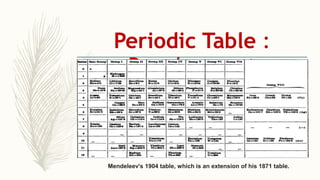
Mendeleev's 1904 table, which is an extension of his 1871 table.
Periodic Table :
Development
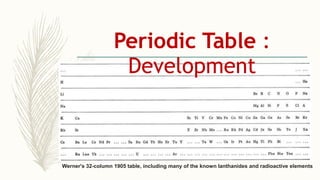
Werner's 32-column 1905 table, including many of the known lanthanides and radioactive elements
Periodic Table : Basic
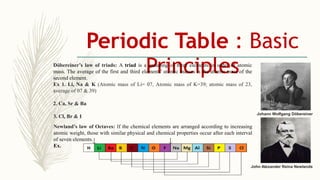
PrinciplesDöbereiner’s law of triads: A triad is a grouping of three elements in order of atomic
mass. The average of the first and third elements' atomic masses is the atomic mass of the
second element.
Ex 1. Li, Na & K (Atomic mass of Li= 07, Atomic mass of K=39; atomic mass of 23,
average of 07 & 39)
2. Ca, Sr & Ba
3. Cl, Br & I
Johann Wolfgang Döbereiner
John Alexander Reina Newlands
Newland’s law of Octaves: If the chemical elements are arranged according to increasing
atomic weight, those with similar physical and chemical properties occur after each interval
of seven elements.
Ex.
Periodic Table :
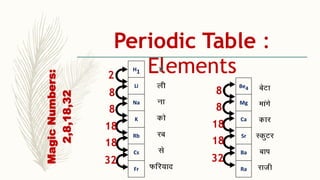
ElementsH1
Li
Na
K
Rb
Cs
Fr
Be4
Mg
Ca
Sr
Ba
Ra
2
8
8
18
18
32
8
8
18
18
32
MagicNumbers:
2,8,18,32
Periodic Table :
Elements
……..continued
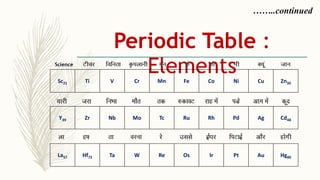
La57 Hf72 Ta W Re Os Ir Pt Au Hg80
Sc21 Ti V Cr Mn Fe Co Ni Cu Zn30
Y39 Zr Nb Mo Tc Ru Rh Pd Ag Cd48
Periodic Table :
Elements
……..continued
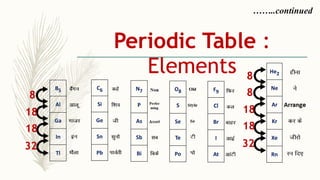
He2
Ne
Ar
Kr
Xe
Rn
8
8
18
18
32
B5
Al
Ga
In
Tl
C6
Si
Ge
Sn
Pb
N7
P
As
Sb
Bi
O8
S
Se
Te
Po
F9
Cl
Br
I
At
8
18
18
32
Periodic Table :
Positioning of Elements
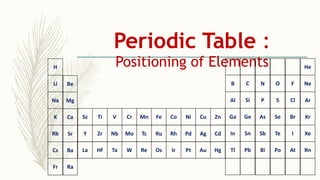
La Hf Ta W Re Os Ir Pt Au Hg
H
Li
Na
K
Rb
Cs
Fr
B
Al
Ga
In
Tl
C
Si
Ge
Sn
Pb
N
P
As
Sb
Bi
O
S
Se
Te
Po
F
Cl
Br
I
At
He
Ne
Ar
Kr
Xe
Rn
Sc Ti V Cr Mn Fe Co Ni Cu Zn
Y Zr Nb Mo Tc Ru Rh Pd Ag Cd
Be
Mg
Ca
Sr
Ba
Ra
“Enjoy your studies”

Basic concepts of modern periodic table

  • 1.
    Basic Concepts of PeriodicTable By Asst. Prof. Vikas Chandra Sharma SSMV- BHILAI
  • 2.
    Periodic Table : Introduction–Elements are placed in periodic table. (Any substance that is comprised of identical and specific group of atoms is an Element) Total no. of elements= 118 State Metallic Behaviour Occurrence Gaseous Liquid Solid Metal Metalloid Non Natural Artificial/ (11) (02) (105) (91) (11) metal (94) Man-made (16) (24) Prior to December, 2015 the total number of elements = 114 (Z= 113,115,117 & 118)
  • 3.
    • The arrangementof elements in modern periodic table is based on their electronic configurations. Previously, it was done on the basis of atomic mass. Periodic Table : Characteristics • In the periodic table, metals have been separated from non- metals by some elements called “metalloids”. The metals lie on the left side of the metalloids whereas non- metals are on right side of the metalloids. • The horizontal rows of elements in periodic table are called periods. There are 7 periods in modern periodic table. The elements in a period have consecutive atomic numbers. Example : in period 2 we have elements Li, Be, B, C, N, O, F and Ne having atomic no. 3 ,4 ,5 ,6 ,7 ,8 ,9 and 10. • The vertical columns in a periodic table are called groups. There are 18 groups in modern periodic table. The elements in a group do not have consecutive atomic numbers. Example : in a group 2 we have elements Be ,Mg ,Ca ,Sr ,Ba and Ra with atomic no. 4 ,12 ,20 ,38 ,56 and 88. • The noble gases i.e, He, Ne, Ar, Kr, Xe and Rn are placed on the extreme right side of the periodic table.
  • 4.
  • 5.
    Periodic Table : Development Mendeleev's1871 periodic table. Dashes: unknown elements. Group I-VII: modern group 1–7 with transition metals added; some of these extend into a group VIII. Noble gases unknown (and unpredicted).
  • 6.
    Periodic Table : Development Mendeleev's1904 table, which is an extension of his 1871 table.
  • 7.
    Periodic Table : Development Werner's32-column 1905 table, including many of the known lanthanides and radioactive elements
  • 8.
    Periodic Table :Basic PrinciplesDöbereiner’s law of triads: A triad is a grouping of three elements in order of atomic mass. The average of the first and third elements' atomic masses is the atomic mass of the second element. Ex 1. Li, Na & K (Atomic mass of Li= 07, Atomic mass of K=39; atomic mass of 23, average of 07 & 39) 2. Ca, Sr & Ba 3. Cl, Br & I Johann Wolfgang Döbereiner John Alexander Reina Newlands Newland’s law of Octaves: If the chemical elements are arranged according to increasing atomic weight, those with similar physical and chemical properties occur after each interval of seven elements. Ex.
  • 9.
  • 10.
    Periodic Table : Elements ……..continued La57Hf72 Ta W Re Os Ir Pt Au Hg80 Sc21 Ti V Cr Mn Fe Co Ni Cu Zn30 Y39 Zr Nb Mo Tc Ru Rh Pd Ag Cd48
  • 11.
  • 12.
    Periodic Table : Positioningof Elements La Hf Ta W Re Os Ir Pt Au Hg H Li Na K Rb Cs Fr B Al Ga In Tl C Si Ge Sn Pb N P As Sb Bi O S Se Te Po F Cl Br I At He Ne Ar Kr Xe Rn Sc Ti V Cr Mn Fe Co Ni Cu Zn Y Zr Nb Mo Tc Ru Rh Pd Ag Cd Be Mg Ca Sr Ba Ra
  • 13.