SCIENCE & TECHNOLOGY 
STD:-SSC(MAHRASHTRA BOARD) 
 NAME:-ASHOK GANGADHAR JADHAV
1.SCHOOL OF ELEMENTS 
MAIN POINTS 
1.1 Dobereiner’s Traids 
1.2 Newland’s Octaves 
1.3 Mendeleev’s Periodic Table 
1.4 Modern Periodic Table
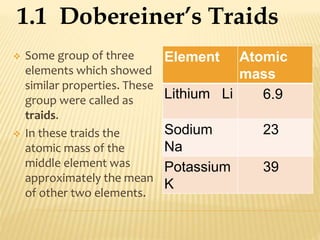
1.1 Dobereiner’s Traids 
 Some group of three 
elements which showed 
similar properties. These 
group were called as 
traids. 
 In these traids the 
atomic mass of the 
middle element was 
approximately the mean 
of other two elements. 
Element Atomic 
mass 
Lithium Li 6.9 
Sodium 
Na 
23 
Potassium 
K 
39
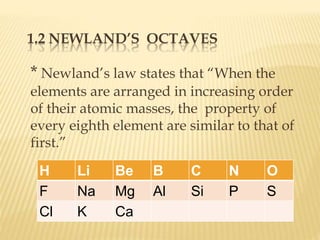
1.2 NEWLAND’S OCTAVES 
* Newland’s law states that “When the 
elements are arranged in increasing order 
of their atomic masses, the property of 
every eighth element are similar to that of 
first.” 
H Li Be B C N O 
F Na Mg Al Si P S 
Cl K Ca
1.3 MENDELEEV’S PERIODIC TABLE 
 Mendeleev believed that atomic mass of element was 
the fundamental property in classifying elements. 
 His law is known as Mendeleev’s Periodic law: 
The 
physical and chemical properties of elements are a 
periodic function of their atomic mass. 
 The tabular arrangement of the elements are based 
on the Mendeleev’s Periodic law is called as 
Mendeleev’s Periodic Table.
Main Features Of Mendeleev’s Periodic Table 
 The horizontal rows in the periodic table are 
called periods. There are seven periods. 
These are numbered from 1 to 7. 
 Properties of elements in particular period 
show regular gradation from left to right. 
 Vertical columns in the periodic table are 
called groups. There are eight groups 
numbered from I to VIII. Groups I to VIII are 
further divided into A and B subgroups.
Merits Of Mendeleev’s Periodic Table 
 Mendeleev was the first who 
successfully to classified all known 
elements. 
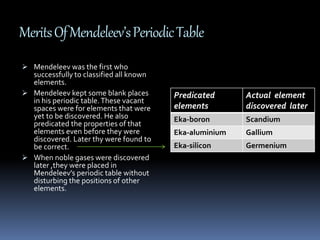
 Mendeleev kept some blank places 
in his periodic table. These vacant 
spaces were for elements that were 
yet to be discovered. He also 
predicated the properties of that 
elements even before they were 
discovered. Later thy were found to 
be correct. 
 When noble gases were discovered 
later ,they were placed in 
Mendeleev’s periodic table without 
disturbing the positions of other 
elements. 
Predicated 
elements 
Actual element 
discovered later 
Eka-boron Scandium 
Eka-aluminium Gallium 
Eka-silicon Germenium
Demerits of Mendeleev’s Periodic Table 
 Hydrogen resembles alkali as well as halogens. Therefore 
no fixed position could be given to hydrogen in the periodic 
table. 
 Isotopes of same elements have different atomic masses; 
therefore each one of them should be given a different 
position. On the other hand isotopes are chemically similar, 
they had to be given a same position. 
 At a certain places, element have higher atomic mass has 
been placed before an element have lower atomic mass. 
For example, cobalt (Co = 58.93) is placed before nickel 
( Ni = 58.71) 
 Some elements placed in same subgroup had different 
properties. e.g. Manganese (Mn) is placed with halogens 
which is totally differ in the properties.
1.4 MODERN PERIODIC TABLE 
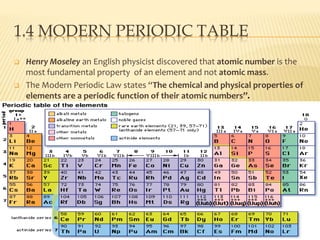
 Henry Moseley an English physicist discovered that atomic number is the 
most fundamental property of an element and not atomic mass. 
 The Modern Periodic Law states “The chemical and physical properties of 
elements are a periodic function of their atomic numbers”.

School of elements

  • 1.
    SCIENCE & TECHNOLOGY STD:-SSC(MAHRASHTRA BOARD)  NAME:-ASHOK GANGADHAR JADHAV
  • 2.
    1.SCHOOL OF ELEMENTS MAIN POINTS 1.1 Dobereiner’s Traids 1.2 Newland’s Octaves 1.3 Mendeleev’s Periodic Table 1.4 Modern Periodic Table
  • 3.
    1.1 Dobereiner’s Traids  Some group of three elements which showed similar properties. These group were called as traids.  In these traids the atomic mass of the middle element was approximately the mean of other two elements. Element Atomic mass Lithium Li 6.9 Sodium Na 23 Potassium K 39
  • 4.
    1.2 NEWLAND’S OCTAVES * Newland’s law states that “When the elements are arranged in increasing order of their atomic masses, the property of every eighth element are similar to that of first.” H Li Be B C N O F Na Mg Al Si P S Cl K Ca
  • 5.
    1.3 MENDELEEV’S PERIODICTABLE  Mendeleev believed that atomic mass of element was the fundamental property in classifying elements.  His law is known as Mendeleev’s Periodic law: The physical and chemical properties of elements are a periodic function of their atomic mass.  The tabular arrangement of the elements are based on the Mendeleev’s Periodic law is called as Mendeleev’s Periodic Table.
  • 6.
    Main Features OfMendeleev’s Periodic Table  The horizontal rows in the periodic table are called periods. There are seven periods. These are numbered from 1 to 7.  Properties of elements in particular period show regular gradation from left to right.  Vertical columns in the periodic table are called groups. There are eight groups numbered from I to VIII. Groups I to VIII are further divided into A and B subgroups.
  • 7.
    Merits Of Mendeleev’sPeriodic Table  Mendeleev was the first who successfully to classified all known elements.  Mendeleev kept some blank places in his periodic table. These vacant spaces were for elements that were yet to be discovered. He also predicated the properties of that elements even before they were discovered. Later thy were found to be correct.  When noble gases were discovered later ,they were placed in Mendeleev’s periodic table without disturbing the positions of other elements. Predicated elements Actual element discovered later Eka-boron Scandium Eka-aluminium Gallium Eka-silicon Germenium
  • 8.
    Demerits of Mendeleev’sPeriodic Table  Hydrogen resembles alkali as well as halogens. Therefore no fixed position could be given to hydrogen in the periodic table.  Isotopes of same elements have different atomic masses; therefore each one of them should be given a different position. On the other hand isotopes are chemically similar, they had to be given a same position.  At a certain places, element have higher atomic mass has been placed before an element have lower atomic mass. For example, cobalt (Co = 58.93) is placed before nickel ( Ni = 58.71)  Some elements placed in same subgroup had different properties. e.g. Manganese (Mn) is placed with halogens which is totally differ in the properties.
  • 9.
    1.4 MODERN PERIODICTABLE  Henry Moseley an English physicist discovered that atomic number is the most fundamental property of an element and not atomic mass.  The Modern Periodic Law states “The chemical and physical properties of elements are a periodic function of their atomic numbers”.