Pythagoras
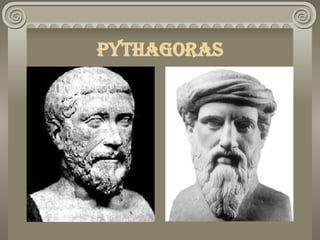
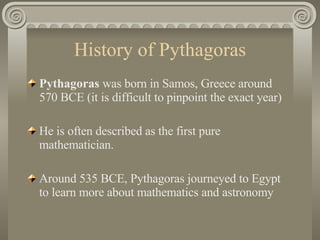
History of Pythagoras Pythagoras  was born in Samos, Greece around 570 BCE (it is difficult to pinpoint the exact year) He is often described as the first pure mathematician. Around 535 BCE, Pythagoras journeyed to Egypt to learn more about mathematics and astronomy
History of Pythagoras (cont.)  Pythagoras founded a philosophical and religious school/society in Croton (now spelled Crotone, in southern Italy) His followers were commonly referred to as Pythagoreans. The members of the inner circle of the society were called the “mathematikoi” The members of the society followed a strict code which held them to being vegetarians and have no personal possessions
History of Pythagoras (cont.)  There is not much evidence of Pythagoras and his society’s work because they were so secretive and kept no records One major belief was that all things in nature and all relations could be reduced to number relations
Pythagoras and Music Pythagoras made important developments in music and astronomy Observing that plucked strings of different lengths gave off different tones, he came up with the musical scale still used today. Was an accomplished musician at playing the lyre
Pythagoras and Math Pythagoras made many contributions to the world of math including: Studies with even/odd numbers Studies involving Perfect and Prime Numbers Irrational Numbers Various theorems/ideas about triangles, parallel lines, circles, etc. Of course THE PYTHAGOREAN THEOREM
The Theorem: The square of the hypotenuse of a right triangle is equal to the sum of the squares of the other 2 sides (legs) a 2  + b 2  = c 2 But what does it mean???
Pythagorean Theorem
It’s Uses Determine side length of triangles Height, distance of objects The Distance Formula Range finding
Real World Uses Architecture, Engineering, Surveying CAD (Computer Aided Drafting) Military Applications Cartography (Map-Making/Directions)
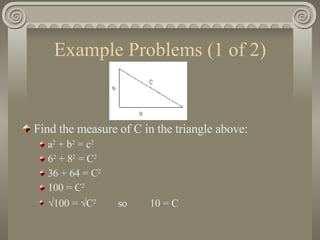
Example Problems (1 of 2) Find the measure of C in the triangle above: a 2  + b 2  = c 2 6 2  + 8 2  = C 2 36 + 64 = C 2 100 = C 2  100 =   C 2 so  10 = C
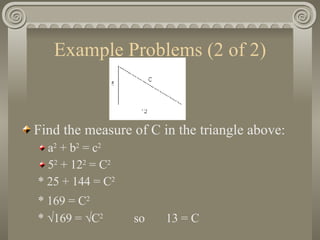
Example Problems (2 of 2) Find the measure of C in the triangle above: a 2  + b 2  = c 2 5 2  + 12 2  = C 2 * 25 + 144 = C 2 * 169 = C 2 *   169 =   C 2 so  13 = C

Pythagoras And The Pythagorean Theorem

  • 1.
  • 2.
    History of PythagorasPythagoras was born in Samos, Greece around 570 BCE (it is difficult to pinpoint the exact year) He is often described as the first pure mathematician. Around 535 BCE, Pythagoras journeyed to Egypt to learn more about mathematics and astronomy
  • 3.
    History of Pythagoras(cont.) Pythagoras founded a philosophical and religious school/society in Croton (now spelled Crotone, in southern Italy) His followers were commonly referred to as Pythagoreans. The members of the inner circle of the society were called the “mathematikoi” The members of the society followed a strict code which held them to being vegetarians and have no personal possessions
  • 4.
    History of Pythagoras(cont.) There is not much evidence of Pythagoras and his society’s work because they were so secretive and kept no records One major belief was that all things in nature and all relations could be reduced to number relations
  • 5.
    Pythagoras and MusicPythagoras made important developments in music and astronomy Observing that plucked strings of different lengths gave off different tones, he came up with the musical scale still used today. Was an accomplished musician at playing the lyre
  • 6.
    Pythagoras and MathPythagoras made many contributions to the world of math including: Studies with even/odd numbers Studies involving Perfect and Prime Numbers Irrational Numbers Various theorems/ideas about triangles, parallel lines, circles, etc. Of course THE PYTHAGOREAN THEOREM
  • 7.
    The Theorem: Thesquare of the hypotenuse of a right triangle is equal to the sum of the squares of the other 2 sides (legs) a 2 + b 2 = c 2 But what does it mean???
  • 8.
  • 9.
    It’s Uses Determineside length of triangles Height, distance of objects The Distance Formula Range finding
  • 10.
    Real World UsesArchitecture, Engineering, Surveying CAD (Computer Aided Drafting) Military Applications Cartography (Map-Making/Directions)
  • 11.
    Example Problems (1of 2) Find the measure of C in the triangle above: a 2 + b 2 = c 2 6 2 + 8 2 = C 2 36 + 64 = C 2 100 = C 2  100 =  C 2 so 10 = C
  • 12.
    Example Problems (2of 2) Find the measure of C in the triangle above: a 2 + b 2 = c 2 5 2 + 12 2 = C 2 * 25 + 144 = C 2 * 169 = C 2 *  169 =  C 2 so 13 = C