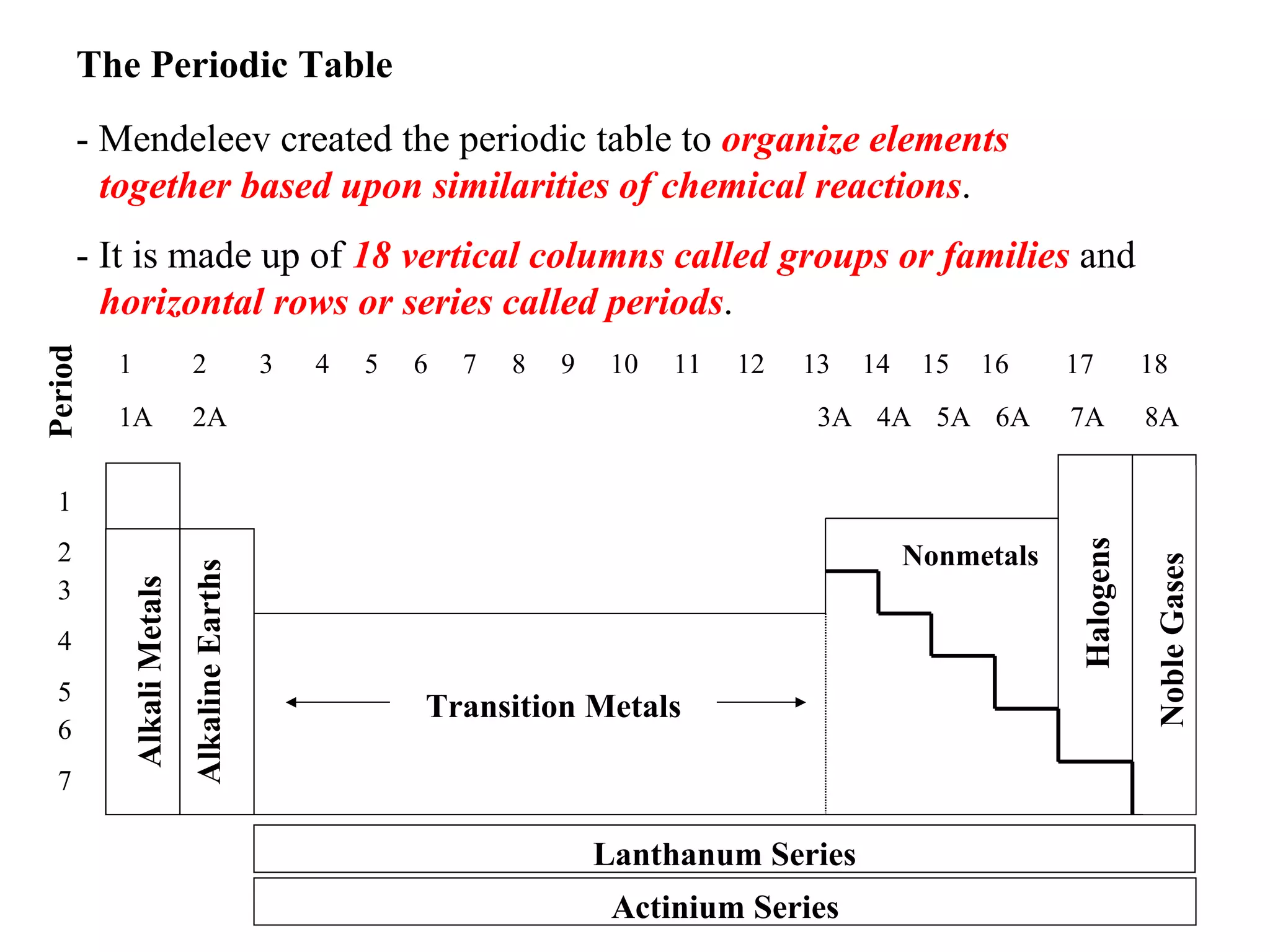
The Periodic Table   - Mendeleev created the periodic table to  organize elements together based upon similarities of chemical reactions .   - It is made up of  18   vertical columns called groups or families  and  horizontal rows or series called periods .   Period Alkali Metals Alkaline Earths Nonmetals Halogens Noble Gases Lanthanum Series Actinium Series 1 2 18 17 16 15 14 13 3  4  5  6  7  8  9  10  11  12 1A 2A 3A 4A 5A 6A 7A 8A 1 2 3 4 5 6 7 Transition Metals
Characteristics of Metals   - Shiny or  lustrous   - Good  conductors  of  heat and electricity   - Flexible: can be  bent or shaped into wire  ( ductile ) or  rolled into sheets  ( malleable )   - All are  solids  at room temperature (exception:  mercury , which is a  liquid )   - All have a  silver colour , except for gold and copper   Examples:  copper   ( Cu (s) ),   magnesium   ( Mg (s) )
Characteristics of Nonmetals   - Solids may be  dull in appearance  or may have a  glassy  luster   -  Poor conductors  of heat and electricity   -  Varied examples  of solids, liquids and gases   - Colours  vary   Examples: oxygen   ( O 2(g) ), sulfur   ( S 8(s) ), bromine   ( Br 2(l) )   Characteristics of Metalloids   - Have properties of  both metals and nonmetals   -  Semiconductors : conduct in some conditions but not others   -  All  are solids   Examples: carbon   ( C (s) ), boron   ( B (s) ), silicon  ( Si (s) )
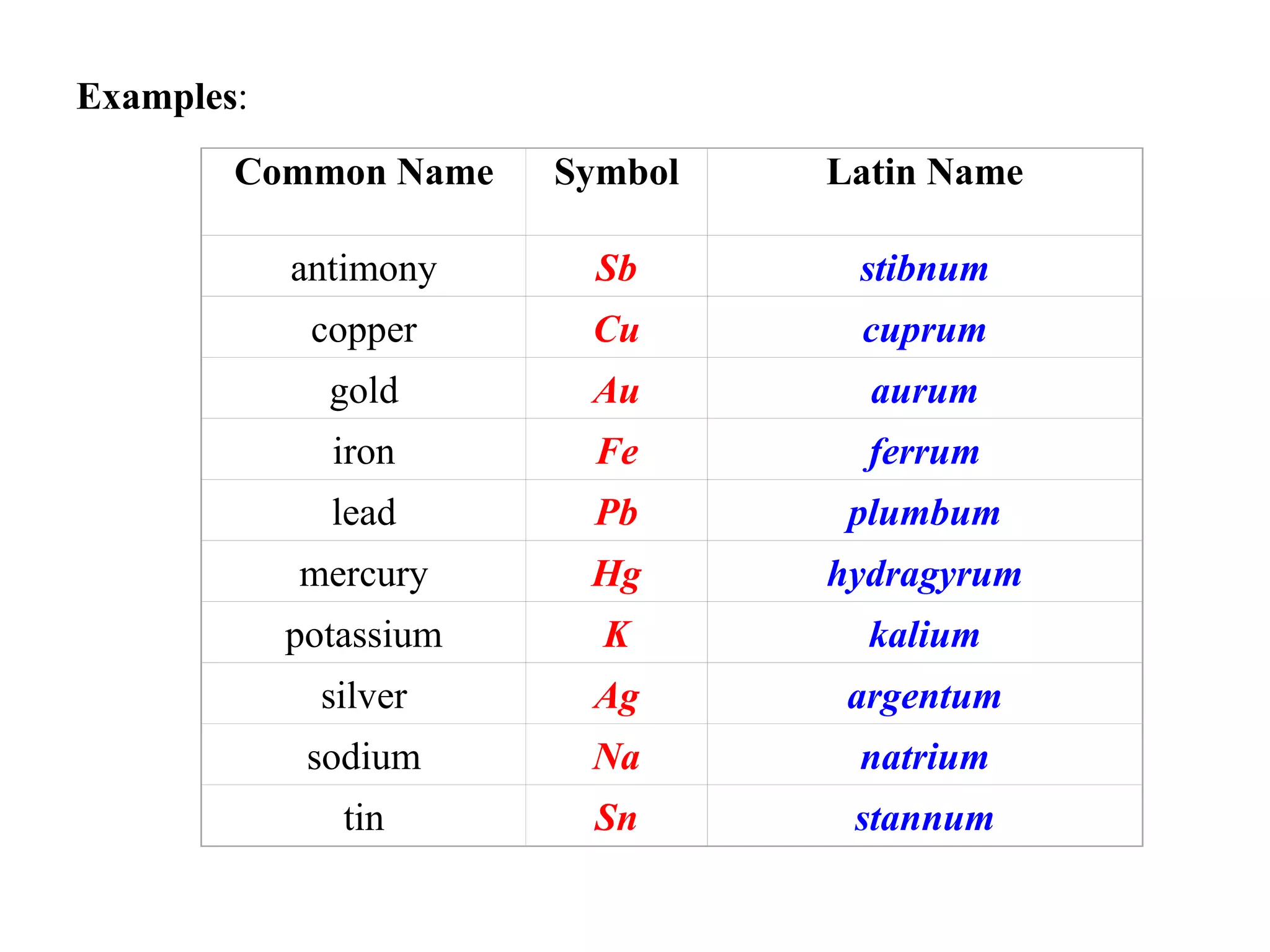
Characteristics of Noble Gases   -  All  are gases   -  Least reactive  of all elements   -  Do not conduct   electricity   Examples :  helium  ( He (g) ),  neon  ( Ne (g) )   - Each element has an abbreviation. Some elements use only  one character  such as carbon (C) or potassium (P).  - Each element has an abbreviation. Some elements use only  one character  such as carbon (C) or potassium (K). Others use  two characters , the  first  being  capitalized  and the  second , being  lower case , such as calcium (Ca).   - Some symbols are obvious but some have historic origins.
Examples :   Common Name Symbol Latin Name antimony Sb stibnum copper Cu cuprum gold Au aurum iron Fe ferrum lead Pb plumbum mercury Hg hydragyrum potassium K kalium silver Ag argentum sodium Na natrium tin Sn stannum

C20 Unit 1 4 The Periodic Table

  • 1.
    The Periodic Table - Mendeleev created the periodic table to organize elements together based upon similarities of chemical reactions . - It is made up of 18 vertical columns called groups or families and horizontal rows or series called periods . Period Alkali Metals Alkaline Earths Nonmetals Halogens Noble Gases Lanthanum Series Actinium Series 1 2 18 17 16 15 14 13 3 4 5 6 7 8 9 10 11 12 1A 2A 3A 4A 5A 6A 7A 8A 1 2 3 4 5 6 7 Transition Metals
  • 2.
    Characteristics of Metals - Shiny or lustrous - Good conductors of heat and electricity - Flexible: can be bent or shaped into wire ( ductile ) or rolled into sheets ( malleable ) - All are solids at room temperature (exception: mercury , which is a liquid ) - All have a silver colour , except for gold and copper Examples: copper ( Cu (s) ), magnesium ( Mg (s) )
  • 3.
    Characteristics of Nonmetals - Solids may be dull in appearance or may have a glassy luster - Poor conductors of heat and electricity - Varied examples of solids, liquids and gases - Colours vary Examples: oxygen ( O 2(g) ), sulfur ( S 8(s) ), bromine   ( Br 2(l) ) Characteristics of Metalloids - Have properties of both metals and nonmetals - Semiconductors : conduct in some conditions but not others - All are solids Examples: carbon ( C (s) ), boron ( B (s) ), silicon ( Si (s) )
  • 4.
    Characteristics of NobleGases - All are gases - Least reactive of all elements - Do not conduct electricity Examples : helium ( He (g) ), neon ( Ne (g) ) - Each element has an abbreviation. Some elements use only one character such as carbon (C) or potassium (P). - Each element has an abbreviation. Some elements use only one character such as carbon (C) or potassium (K). Others use two characters , the first being capitalized and the second , being lower case , such as calcium (Ca). - Some symbols are obvious but some have historic origins.
  • 5.
    Examples : Common Name Symbol Latin Name antimony Sb stibnum copper Cu cuprum gold Au aurum iron Fe ferrum lead Pb plumbum mercury Hg hydragyrum potassium K kalium silver Ag argentum sodium Na natrium tin Sn stannum