PERICARDIAL DISEASES
DR VAROON R2 MEDICINE F UNIT
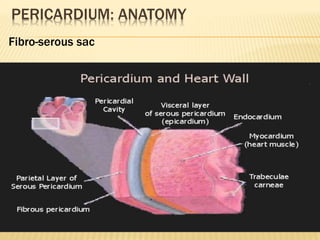
PERICARDIUM: ANATOMY
Fibro-serous sac
FUNCTION OF THE PERICARDIUM
1. Stabilization of the heart within the thoracic cavity -
ligamentous attachments -- limiting the heart’s motion.
2. Protection of the heart from mechanical trauma and
infection from adjoining structures.
3. The pericardial fluid functions as a lubricant and
decreases friction of cardiac surface during systole
and diastole.
4. Prevention of excessive dilation of heart especially
during sudden rise in intra-cardiac volume
PERICARDIAL DISEASES
PERICARDITIS
PERICARDIAL EFFUSION
AND CARDIAC
TAMPONADE
OTHERS : PERICARDIAL
CYSTS, TUMORS
PERICARDITIS
DEFINITION
CLASSIFICATION
BASED ON
1. DURATION
2. ETIOLOGY
DURATION
1. ACUTE PERICARDITIS - < 6 WEEKS
 FIBRINOUS
 EFFUSIVE (SEROUS OR SANGUINEOUS)
2. SUBACUTE – 6 WEEKS TO 6 MONTHS
 EFFUSIVE – CONSTRICTIVE
 CONSTRICTIVE
3. CHRONIC - > 6 MONTHS
 CONSTRICTIVE
 EFFUSIVE
 ADHESIVE ( NON CONSTRCTIVE)
ETIOLOGIES OF PERICARDITIS
I. INFECTIVE
1. VIRAL - Coxsackie A and B, Influenza, adenovirus,
HIV
2. BACTERIAL - Staphylococcus, pneumococcus,
TB, etc.
3. FUNGAL - Candida
4. PARASITIC - Amoeba, candida, etc.
II. AUTOIMMUNE DISORDERS
1. Systemic lupus erythematosus (SLE)
2. Drug-Induced lupus (e.g. Hydralazine,
Procainamide)
3. Rheumatoid Arthritis
4. Post Cardiac Injury Syndromes
III. NEOPLASM
1. Primary mesothelioma
2. Secondary, metastatic
3. Direct extension from adjoining tumor
(lung, bronchus, breast etc)
IV. RADIATION PERICARDITIS
V. RENAL FAILURE (uremia)
VI. TRAUMATIC CARDIAC INJURY
1. Penetrating - stab wound, bullet
wound
2. Blunt non-penetrating - automobile
steering wheel accident
VII. IDIOPATHIC
ACUTE PERICARDITIS
Four simple criteria for diagnosis
1. Chest pain
2. Pericardial rub
3. ECG findings
4. Pericardial effusion
CHEST PAIN
 Site : substernal, retrosternal or left precodial
 Radiating to trapezius ridge
 Relieved : sitting and leaning
 Aggravated : supine and inspiration
 Associated symptoms: dyspnea, cough,
hiccoughs
Differentiation from MI and Pleuritis
PERICARDIAL RUB
 Audible in 85%
 Site : left lower sternal border – leaning –
end of expiration
 Character : high pitch ( rasping, scratching,
grating, walking on crunchy snow or dry
leaves)
 3 Components corresponding to ventricular
systole , early diastolic filling and atrial
contraction
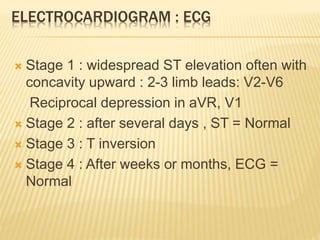
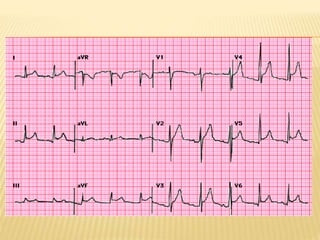
ELECTROCARDIOGRAM : ECG
 Stage 1 : widespread ST elevation often with
concavity upward : 2-3 limb leads: V2-V6
Reciprocal depression in aVR, V1
 Stage 2 : after several days , ST = Normal
 Stage 3 : T inversion
 Stage 4 : After weeks or months, ECG =
Normal
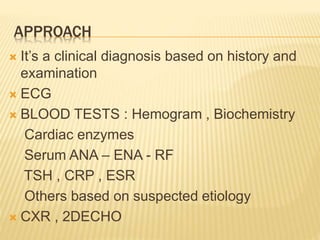
APPROACH
 It’s a clinical diagnosis based on history and
examination
 ECG
 BLOOD TESTS : Hemogram , Biochemistry
Cardiac enzymes
Serum ANA – ENA - RF
TSH , CRP , ESR
Others based on suspected etiology
 CXR , 2DECHO
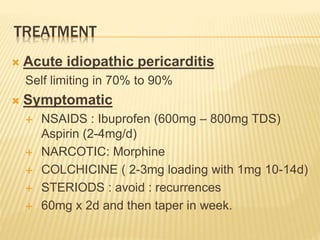
TREATMENT
 Acute idiopathic pericarditis
Self limiting in 70% to 90%
 Symptomatic
 NSAIDS : Ibuprofen (600mg – 800mg TDS)
Aspirin (2-4mg/d)
 NARCOTIC: Morphine
 COLCHICINE ( 2-3mg loading with 1mg 10-14d)
 STERIODS : avoid : recurrences
 60mg x 2d and then taper in week.
RELAPSING AND RECURRENT PERICARDITIS
 15% - 30%
 Initial relapse : 2 weeks NSAIDS/colchicine
 Recurrent pericardial pain :
Steriods : longer duration : low dose – 0.2 –
0.5 mg mg/kg
 Hyperimmune Globulin : CMV(4ml/kg on
0,4,8d f/b 2ml/kg on 12, 16) , Adeno, Parvo
 Interferon alpha 2.5 M IU/M2 3/week :
Coxsackie B
COMPLICATIONS
PERICARDIAL EFFUSION
CARDIAC TAMPONADE
CONSTRICTION
PERICARDIAL EFFUSION
Normal 15-50 ml of fluid
ETIOLOGY
1. Inflammation : infection, immunologic process.
2. Trauma : bleeding in pericardial space.
3. Noninfectious :
a. increase in pulmonary hydrostatic pressure e.g.
congestive heart failure.
b. increase in capillary permeability e.g.
hypothyroidism
c. decrease in plasma oncotic pressure e.g.
cirrhosis.
4. Decreased drainage : obstruction of thoracic
duct : malignancy or damage during surgery.
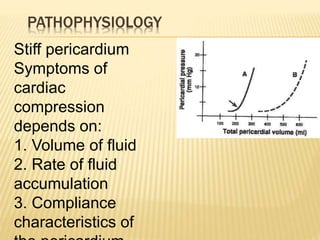
PATHOPHYSIOLOGY
Stiff pericardium
Symptoms of
cardiac
compression
depends on:
1. Volume of fluid
2. Rate of fluid
accumulation
3. Compliance
characteristics of
CLINICAL FEATURES
Small effusions do not produce hemodynamic
abnormalities.
Large effusions
Hemodynamic Instability
Compression of adjoining structures
dysphagia (compression of esophagus)
hoarseness (recurrent laryngeal nerve
compression)
hiccups (diaphragmatic stimulation)
dyspnea (pleural inflammation/effusion)
Chest pain, pressure, discomfort
Light-headedness, syncope
Palpitations
CARDIAC TAMPONADE
 Definition : fluid sufficient to cause
obstruction to inflow of blood in ventricles
 Minimum 200ml
 Directly proportional to thickness of
ventricular myocardium
 Inversely thickness of parietal pericardium
 Three common causes : neoplastic ,
idiopathic, pericardial effusion secondary to
renal failure
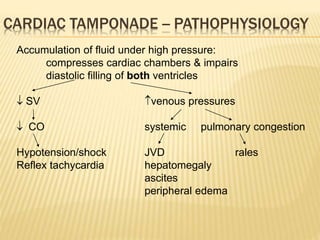
CARDIAC TAMPONADE -- PATHOPHYSIOLOGY
Accumulation of fluid under high pressure:
compresses cardiac chambers & impairs
diastolic filling of both ventricles
 SV venous pressures
 CO systemic pulmonary congestion
Hypotension/shock JVD rales
Reflex tachycardia hepatomegaly
ascites
peripheral edema
TAMPONADE
Acute: (trauma, LV rupture)
Profound hypotension
Confusion/Agitation
Slow/Progressive large effusion (weeks)
Fatigue (CO)
Dyspnea
Orthopnea
Hepatic engorgement
EXAMINATION AND FINDINGS
BECK’S TRIAD
 HYPOTENSION
 SOFT OR ABSENT HEART SOUNDS
 JUGULAR VENOUS DISTENSION WITH
PROMINENT X DESCENT BUT AN ABSENT
Y DESCENT
PULSUS PARADOXUS
Inspiration: negative intrathoracic pressure is
transmitted to the pericardial space
 IPP
 blood return to the right ventricle
 jugular venous and right atrial pressures
 right ventricular volume  interventricular
septum shifts towards the left ventricle
 left ventricular volume
 LV stroke volume
  blood pressure (<10mmHg is normal) during
inspiration
GENERAL EXAMINATION
TACHYCARDIA
HEPATOJUGULAR REFLUX
TACHYPNEA
WEAKENED PERIPHERAL
PULSES, EDEMA, AND CYANOSIS
RAISED JVP
SYSTEMIC EXAMINATION
 MUFFLED HEART SOUNDS
 PERICARDIAL RUB
 TUBULAR BREATH SOUNDS : LEFT
AXILLA OR LEF BASE : BRONCHIAL
COMPRESSION
 EWART SIGN: DULLNESS TO
PERCUSSION BENEATH THE ANGLE OF
LEFT SCAPULA and INCREASED
FREMITUS
 HEPATOSPLENOMEGALY
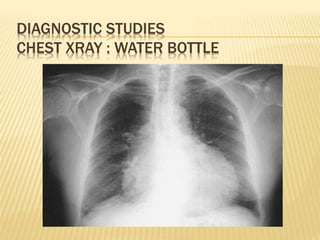
DIAGNOSTIC STUDIES
CHEST XRAY : WATER BOTTLE
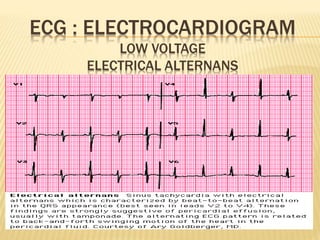
ECG : ELECTROCARDIOGRAM
LOW VOLTAGE
ELECTRICAL ALTERNANS
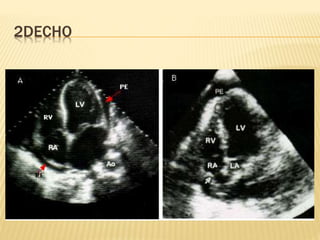
2DECHO
RIGHT HEART CATHETERIZATION
Catheterization Findings:
Elevated RA and RV diastolic pressures
Equalized diastolic pressures
Blunted “y” descent in RA tracing
y descent: early diastolic filling (atrial emptying)
 BP and Pulsus paradoxus
Pericardial pressure = RA pressure
TREATMENT
Surgical procedures
 Pericardiectomy
 Pericardiocentesis
 Pericardial window placement
 Pericardiotomy.
PERICARDIOCENTESIS
 Pericardiocentesis is the aspiration of fluid
from the pericardial space that surrounds the
heart.
CONTRAINDICATIONS
Absolute contraindications
 In the hemodynamically unstable patient, no
absolute contraindications
Relative contraindications
 Uncorrected bleeding disorder
 Traumatic cardiac tamponade. Some authors
argue that traumatic cardiac tamponade
should be treated by emergent thoracotomy.
POSITION
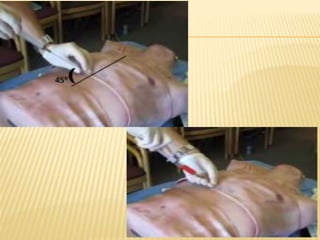
 Position the patient in a semirecumbent
position at a 30- to 45-degree angle. This
position brings the heart closer to the anterior
chest wall.
 The supine position is an acceptable
alternative.
APPROACH
Anatomic
landmarks :
xiphoid process,
5th and 6th ribs
The subxiphoid
and the left
sternocostal
margin are the
most commonly
used sites (black
Complications
 Dysrhythmias
 Coronary artery puncture or aneurysm
 Left internal mammary artery puncture or
aneurysm
 Hemothorax
 Pneumothorax
 Pneumopericardium
 Hepatic injury
 False-negative aspiration – Clotted blood in the
pericardium
 False-positive aspiration – Intracardiac aspiration
PERICARDIECTOMY
 Pericardiectomy is the most effective
surgical procedure for managing large
effusions, because it has the lowest
associated risk of recurrent effusions.
This procedure is used for constrictive
pericarditis, effusive pericarditis, or
recurrent pericarditis with multiple
attacks, steroid dependence, and/or
intolerance to other medical
management.
PERICARDIAL WINDOW
 Pericardial window placement is used for
effusive pericarditis therapy. In critically ill
patients, a balloon catheter may be used to
create a pericardial window, in which only 9
cm2 or less of pericardium is resected.
PERICARDIOTOMY
 Consider subxiphoid pericardiotomy for large
effusions that do not resolve. This procedure
may be performed under local anesthesia
and has a lower risk of complications than
pericardiectomy.
TREATMENT FOR SPECIFIC
CAUSES OF PERICARDITIS
 Infectious pericarditis
 Bacterial pericarditis : appropriate
antibiotics for at least 4 weeks and
drainage of pericardial fluid.
 Fungal infection : fluconazole,
ketoconazole, itraconazole, amphotericin
B, liposomal amphotericin B, or
amphotericin B lipid complex
Corticosteroids and NSAIDs can be used
to support the antifungal drug treatment.
 Intrapericardial fibrinolysis : thick, loculated
fluid, but open surgical drainage is preferred.
Occasionally, patients require partial to total
pericardiectomy.
 Tubercular infection : AKT
 Use of adjunctive prednisolone in patients
with acquired immunodeficiency syndrome
(AIDS) may reduce mortality in this
population.
METABOLIC PERICARDITIS
 RENAL FAILURE associated uremic
pericarditis : HEMODIALYSIS
 Hemodialysis : hypotension, which may
be dangerous in the setting of
tamponade.
In addition, some physicians advocate
heparin-free hemodialysis to reduce the
risk of intrapericardial hemorrhage.
 Peritoneal dialysis may compromise
respiratory function because of the effect of
intraperitoneal fluid on the diaphragm.
 In dialysis-associated pericarditis, an
increased intensity of dialysis for 10-14 days
is recommended.
Correct hypophosphatemia and hypokalemia
 Cardiovascular pericarditis
 Pericarditis does not contraindicate
thrombolytic or anticoagulant therapy for an
acute MI.
 However, anticoagulation should be
discontinued if pericardial effusion develops
or effusion size increases. Treatment is with
aspirin.
 In Dressler syndrome, anticoagulant therapy
should be stopped because of the risk of
hemorrhagic pericarditis. Treatment is with
NSAIDs.
CONSTRICTIVE PERICARDITIS
Late complication of pericardial disease
Fibrous scar formation
Fusion of pericardial layers
Calcification further stiffens pericardium
Etiologies:
any cause of pericarditis
idiopathic
post-surgery
mc : tuberculosis
radiation
neoplasm
PATHOPHYSIOLOGY
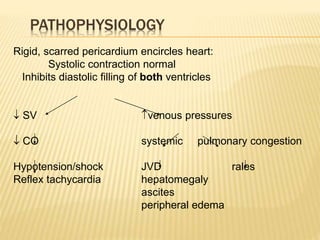
Rigid, scarred pericardium encircles heart:
Systolic contraction normal
Inhibits diastolic filling of both ventricles
 SV venous pressures
 CO systemic pulmonary congestion
Hypotension/shock JVD rales
Reflex tachycardia hepatomegaly
ascites
peripheral edema
PHYSICAL EXAMINATION
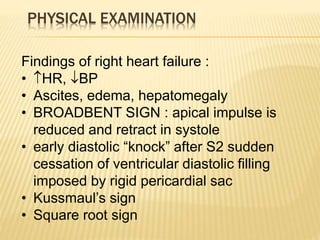
Findings of right heart failure :
• HR, BP
• Ascites, edema, hepatomegaly
• BROADBENT SIGN : apical impulse is
reduced and retract in systole
• early diastolic “knock” after S2 sudden
cessation of ventricular diastolic filling
imposed by rigid pericardial sac
• Kussmaul’s sign
• Square root sign
DIAGNOSIS
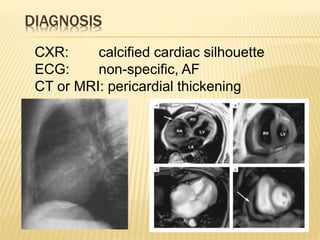
CXR: calcified cardiac silhouette
ECG: non-specific, AF
CT or MRI: pericardial thickening
2D ECHO
 Pericardial thickening
 Dilatation of IVC and hepatic veins
 Sharp halt in ventricular filling in early
diastole
 Flattening of left ventricular posterior wall
 Atrial enlargement
TREATMENT
PERICARDIAL
RESECTION
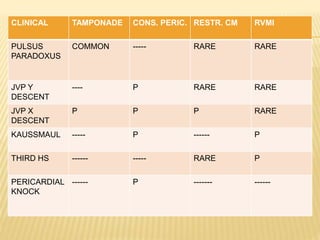
CLINICAL TAMPONADE CONS. PERIC. RESTR. CM RVMI
PULSUS
PARADOXUS
COMMON ----- RARE RARE
JVP Y
DESCENT
---- P RARE RARE
JVP X
DESCENT
P P P RARE
KAUSSMAUL ----- P ------ P
THIRD HS ------ ----- RARE P
PERICARDIAL
KNOCK
------ P ------- ------
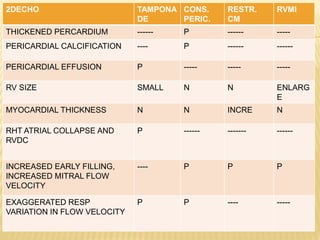
2DECHO TAMPONA
DE
CONS.
PERIC.
RESTR.
CM
RVMI
THICKENED PERCARDIUM ------ P ------ -----
PERICARDIAL CALCIFICATION ---- P ------ ------
PERICARDIAL EFFUSION P ----- ----- -----
RV SIZE SMALL N N ENLARG
E
MYOCARDIAL THICKNESS N N INCRE N
RHT ATRIAL COLLAPSE AND
RVDC
P ------ ------- ------
INCREASED EARLY FILLING,
INCREASED MITRAL FLOW
VELOCITY
---- P P P
EXAGGERATED RESP
VARIATION IN FLOW VELOCITY
P P ---- -----
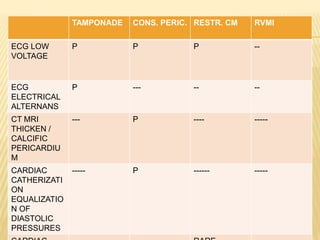
TAMPONADE CONS. PERIC. RESTR. CM RVMI
ECG LOW
VOLTAGE
P P P --
ECG
ELECTRICAL
ALTERNANS
P --- -- --
CT MRI
THICKEN /
CALCIFIC
PERICARDIU
M
--- P ---- -----
CARDIAC
CATHERIZATI
ON
EQUALIZATIO
N OF
DIASTOLIC
PRESSURES
----- P ------ -----
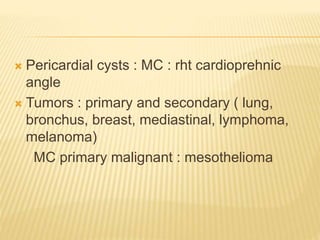
 Pericardial cysts : MC : rht cardioprehnic
angle
 Tumors : primary and secondary ( lung,
bronchus, breast, mediastinal, lymphoma,
melanoma)
MC primary malignant : mesothelioma
Pericardial diseases

Pericardial diseases

  • 1.
  • 2.
  • 3.
    FUNCTION OF THEPERICARDIUM 1. Stabilization of the heart within the thoracic cavity - ligamentous attachments -- limiting the heart’s motion. 2. Protection of the heart from mechanical trauma and infection from adjoining structures. 3. The pericardial fluid functions as a lubricant and decreases friction of cardiac surface during systole and diastole. 4. Prevention of excessive dilation of heart especially during sudden rise in intra-cardiac volume
  • 4.
    PERICARDIAL DISEASES PERICARDITIS PERICARDIAL EFFUSION ANDCARDIAC TAMPONADE OTHERS : PERICARDIAL CYSTS, TUMORS
  • 5.
  • 6.
    DURATION 1. ACUTE PERICARDITIS- < 6 WEEKS  FIBRINOUS  EFFUSIVE (SEROUS OR SANGUINEOUS) 2. SUBACUTE – 6 WEEKS TO 6 MONTHS  EFFUSIVE – CONSTRICTIVE  CONSTRICTIVE 3. CHRONIC - > 6 MONTHS  CONSTRICTIVE  EFFUSIVE  ADHESIVE ( NON CONSTRCTIVE)
  • 7.
    ETIOLOGIES OF PERICARDITIS I.INFECTIVE 1. VIRAL - Coxsackie A and B, Influenza, adenovirus, HIV 2. BACTERIAL - Staphylococcus, pneumococcus, TB, etc. 3. FUNGAL - Candida 4. PARASITIC - Amoeba, candida, etc. II. AUTOIMMUNE DISORDERS 1. Systemic lupus erythematosus (SLE) 2. Drug-Induced lupus (e.g. Hydralazine, Procainamide) 3. Rheumatoid Arthritis 4. Post Cardiac Injury Syndromes
  • 8.
    III. NEOPLASM 1. Primarymesothelioma 2. Secondary, metastatic 3. Direct extension from adjoining tumor (lung, bronchus, breast etc) IV. RADIATION PERICARDITIS V. RENAL FAILURE (uremia) VI. TRAUMATIC CARDIAC INJURY 1. Penetrating - stab wound, bullet wound 2. Blunt non-penetrating - automobile steering wheel accident VII. IDIOPATHIC
  • 9.
    ACUTE PERICARDITIS Four simplecriteria for diagnosis 1. Chest pain 2. Pericardial rub 3. ECG findings 4. Pericardial effusion
  • 10.
    CHEST PAIN  Site: substernal, retrosternal or left precodial  Radiating to trapezius ridge  Relieved : sitting and leaning  Aggravated : supine and inspiration  Associated symptoms: dyspnea, cough, hiccoughs Differentiation from MI and Pleuritis
  • 11.
    PERICARDIAL RUB  Audiblein 85%  Site : left lower sternal border – leaning – end of expiration  Character : high pitch ( rasping, scratching, grating, walking on crunchy snow or dry leaves)  3 Components corresponding to ventricular systole , early diastolic filling and atrial contraction
  • 12.
    ELECTROCARDIOGRAM : ECG Stage 1 : widespread ST elevation often with concavity upward : 2-3 limb leads: V2-V6 Reciprocal depression in aVR, V1  Stage 2 : after several days , ST = Normal  Stage 3 : T inversion  Stage 4 : After weeks or months, ECG = Normal
  • 14.
    APPROACH  It’s aclinical diagnosis based on history and examination  ECG  BLOOD TESTS : Hemogram , Biochemistry Cardiac enzymes Serum ANA – ENA - RF TSH , CRP , ESR Others based on suspected etiology  CXR , 2DECHO
  • 15.
    TREATMENT  Acute idiopathicpericarditis Self limiting in 70% to 90%  Symptomatic  NSAIDS : Ibuprofen (600mg – 800mg TDS) Aspirin (2-4mg/d)  NARCOTIC: Morphine  COLCHICINE ( 2-3mg loading with 1mg 10-14d)  STERIODS : avoid : recurrences  60mg x 2d and then taper in week.
  • 16.
    RELAPSING AND RECURRENTPERICARDITIS  15% - 30%  Initial relapse : 2 weeks NSAIDS/colchicine  Recurrent pericardial pain : Steriods : longer duration : low dose – 0.2 – 0.5 mg mg/kg  Hyperimmune Globulin : CMV(4ml/kg on 0,4,8d f/b 2ml/kg on 12, 16) , Adeno, Parvo  Interferon alpha 2.5 M IU/M2 3/week : Coxsackie B
  • 17.
  • 18.
    PERICARDIAL EFFUSION Normal 15-50ml of fluid ETIOLOGY 1. Inflammation : infection, immunologic process. 2. Trauma : bleeding in pericardial space. 3. Noninfectious : a. increase in pulmonary hydrostatic pressure e.g. congestive heart failure. b. increase in capillary permeability e.g. hypothyroidism c. decrease in plasma oncotic pressure e.g. cirrhosis. 4. Decreased drainage : obstruction of thoracic duct : malignancy or damage during surgery.
  • 19.
    PATHOPHYSIOLOGY Stiff pericardium Symptoms of cardiac compression dependson: 1. Volume of fluid 2. Rate of fluid accumulation 3. Compliance characteristics of
  • 20.
    CLINICAL FEATURES Small effusionsdo not produce hemodynamic abnormalities. Large effusions Hemodynamic Instability Compression of adjoining structures dysphagia (compression of esophagus) hoarseness (recurrent laryngeal nerve compression) hiccups (diaphragmatic stimulation) dyspnea (pleural inflammation/effusion) Chest pain, pressure, discomfort Light-headedness, syncope Palpitations
  • 21.
    CARDIAC TAMPONADE  Definition: fluid sufficient to cause obstruction to inflow of blood in ventricles  Minimum 200ml  Directly proportional to thickness of ventricular myocardium  Inversely thickness of parietal pericardium  Three common causes : neoplastic , idiopathic, pericardial effusion secondary to renal failure
  • 22.
    CARDIAC TAMPONADE --PATHOPHYSIOLOGY Accumulation of fluid under high pressure: compresses cardiac chambers & impairs diastolic filling of both ventricles  SV venous pressures  CO systemic pulmonary congestion Hypotension/shock JVD rales Reflex tachycardia hepatomegaly ascites peripheral edema
  • 23.
    TAMPONADE Acute: (trauma, LVrupture) Profound hypotension Confusion/Agitation Slow/Progressive large effusion (weeks) Fatigue (CO) Dyspnea Orthopnea Hepatic engorgement
  • 24.
    EXAMINATION AND FINDINGS BECK’STRIAD  HYPOTENSION  SOFT OR ABSENT HEART SOUNDS  JUGULAR VENOUS DISTENSION WITH PROMINENT X DESCENT BUT AN ABSENT Y DESCENT
  • 25.
    PULSUS PARADOXUS Inspiration: negativeintrathoracic pressure is transmitted to the pericardial space  IPP  blood return to the right ventricle  jugular venous and right atrial pressures  right ventricular volume  interventricular septum shifts towards the left ventricle  left ventricular volume  LV stroke volume   blood pressure (<10mmHg is normal) during inspiration
  • 26.
  • 27.
    SYSTEMIC EXAMINATION  MUFFLEDHEART SOUNDS  PERICARDIAL RUB  TUBULAR BREATH SOUNDS : LEFT AXILLA OR LEF BASE : BRONCHIAL COMPRESSION  EWART SIGN: DULLNESS TO PERCUSSION BENEATH THE ANGLE OF LEFT SCAPULA and INCREASED FREMITUS  HEPATOSPLENOMEGALY
  • 28.
  • 29.
    ECG : ELECTROCARDIOGRAM LOWVOLTAGE ELECTRICAL ALTERNANS
  • 30.
  • 31.
    RIGHT HEART CATHETERIZATION CatheterizationFindings: Elevated RA and RV diastolic pressures Equalized diastolic pressures Blunted “y” descent in RA tracing y descent: early diastolic filling (atrial emptying)  BP and Pulsus paradoxus Pericardial pressure = RA pressure
  • 32.
    TREATMENT Surgical procedures  Pericardiectomy Pericardiocentesis  Pericardial window placement  Pericardiotomy.
  • 33.
    PERICARDIOCENTESIS  Pericardiocentesis isthe aspiration of fluid from the pericardial space that surrounds the heart.
  • 34.
    CONTRAINDICATIONS Absolute contraindications  Inthe hemodynamically unstable patient, no absolute contraindications Relative contraindications  Uncorrected bleeding disorder  Traumatic cardiac tamponade. Some authors argue that traumatic cardiac tamponade should be treated by emergent thoracotomy.
  • 35.
    POSITION  Position thepatient in a semirecumbent position at a 30- to 45-degree angle. This position brings the heart closer to the anterior chest wall.  The supine position is an acceptable alternative.
  • 36.
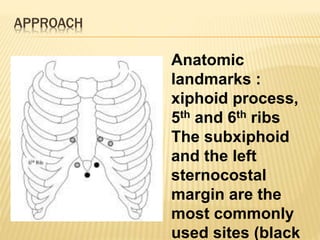
    APPROACH Anatomic landmarks : xiphoid process, 5thand 6th ribs The subxiphoid and the left sternocostal margin are the most commonly used sites (black
  • 38.
    Complications  Dysrhythmias  Coronaryartery puncture or aneurysm  Left internal mammary artery puncture or aneurysm  Hemothorax  Pneumothorax  Pneumopericardium  Hepatic injury  False-negative aspiration – Clotted blood in the pericardium  False-positive aspiration – Intracardiac aspiration
  • 39.
    PERICARDIECTOMY  Pericardiectomy isthe most effective surgical procedure for managing large effusions, because it has the lowest associated risk of recurrent effusions. This procedure is used for constrictive pericarditis, effusive pericarditis, or recurrent pericarditis with multiple attacks, steroid dependence, and/or intolerance to other medical management.
  • 40.
    PERICARDIAL WINDOW  Pericardialwindow placement is used for effusive pericarditis therapy. In critically ill patients, a balloon catheter may be used to create a pericardial window, in which only 9 cm2 or less of pericardium is resected.
  • 41.
    PERICARDIOTOMY  Consider subxiphoidpericardiotomy for large effusions that do not resolve. This procedure may be performed under local anesthesia and has a lower risk of complications than pericardiectomy.
  • 42.
  • 43.
     Infectious pericarditis Bacterial pericarditis : appropriate antibiotics for at least 4 weeks and drainage of pericardial fluid.  Fungal infection : fluconazole, ketoconazole, itraconazole, amphotericin B, liposomal amphotericin B, or amphotericin B lipid complex Corticosteroids and NSAIDs can be used to support the antifungal drug treatment.
  • 44.
     Intrapericardial fibrinolysis: thick, loculated fluid, but open surgical drainage is preferred. Occasionally, patients require partial to total pericardiectomy.  Tubercular infection : AKT  Use of adjunctive prednisolone in patients with acquired immunodeficiency syndrome (AIDS) may reduce mortality in this population.
  • 45.
    METABOLIC PERICARDITIS  RENALFAILURE associated uremic pericarditis : HEMODIALYSIS  Hemodialysis : hypotension, which may be dangerous in the setting of tamponade. In addition, some physicians advocate heparin-free hemodialysis to reduce the risk of intrapericardial hemorrhage.
  • 46.
     Peritoneal dialysismay compromise respiratory function because of the effect of intraperitoneal fluid on the diaphragm.  In dialysis-associated pericarditis, an increased intensity of dialysis for 10-14 days is recommended. Correct hypophosphatemia and hypokalemia
  • 47.
     Cardiovascular pericarditis Pericarditis does not contraindicate thrombolytic or anticoagulant therapy for an acute MI.  However, anticoagulation should be discontinued if pericardial effusion develops or effusion size increases. Treatment is with aspirin.  In Dressler syndrome, anticoagulant therapy should be stopped because of the risk of hemorrhagic pericarditis. Treatment is with NSAIDs.
  • 48.
    CONSTRICTIVE PERICARDITIS Late complicationof pericardial disease Fibrous scar formation Fusion of pericardial layers Calcification further stiffens pericardium Etiologies: any cause of pericarditis idiopathic post-surgery mc : tuberculosis radiation neoplasm
  • 49.
    PATHOPHYSIOLOGY Rigid, scarred pericardiumencircles heart: Systolic contraction normal Inhibits diastolic filling of both ventricles  SV venous pressures  CO systemic pulmonary congestion Hypotension/shock JVD rales Reflex tachycardia hepatomegaly ascites peripheral edema
  • 50.
    PHYSICAL EXAMINATION Findings ofright heart failure : • HR, BP • Ascites, edema, hepatomegaly • BROADBENT SIGN : apical impulse is reduced and retract in systole • early diastolic “knock” after S2 sudden cessation of ventricular diastolic filling imposed by rigid pericardial sac • Kussmaul’s sign • Square root sign
  • 51.
    DIAGNOSIS CXR: calcified cardiacsilhouette ECG: non-specific, AF CT or MRI: pericardial thickening
  • 52.
    2D ECHO  Pericardialthickening  Dilatation of IVC and hepatic veins  Sharp halt in ventricular filling in early diastole  Flattening of left ventricular posterior wall  Atrial enlargement
  • 53.
  • 54.
    CLINICAL TAMPONADE CONS.PERIC. RESTR. CM RVMI PULSUS PARADOXUS COMMON ----- RARE RARE JVP Y DESCENT ---- P RARE RARE JVP X DESCENT P P P RARE KAUSSMAUL ----- P ------ P THIRD HS ------ ----- RARE P PERICARDIAL KNOCK ------ P ------- ------
  • 55.
    2DECHO TAMPONA DE CONS. PERIC. RESTR. CM RVMI THICKENED PERCARDIUM------ P ------ ----- PERICARDIAL CALCIFICATION ---- P ------ ------ PERICARDIAL EFFUSION P ----- ----- ----- RV SIZE SMALL N N ENLARG E MYOCARDIAL THICKNESS N N INCRE N RHT ATRIAL COLLAPSE AND RVDC P ------ ------- ------ INCREASED EARLY FILLING, INCREASED MITRAL FLOW VELOCITY ---- P P P EXAGGERATED RESP VARIATION IN FLOW VELOCITY P P ---- -----
  • 56.
    TAMPONADE CONS. PERIC.RESTR. CM RVMI ECG LOW VOLTAGE P P P -- ECG ELECTRICAL ALTERNANS P --- -- -- CT MRI THICKEN / CALCIFIC PERICARDIU M --- P ---- ----- CARDIAC CATHERIZATI ON EQUALIZATIO N OF DIASTOLIC PRESSURES ----- P ------ -----
  • 57.
     Pericardial cysts: MC : rht cardioprehnic angle  Tumors : primary and secondary ( lung, bronchus, breast, mediastinal, lymphoma, melanoma) MC primary malignant : mesothelioma