Project: Ghana Emergency Medicine Collaborative
Document Title: Case Presentation- Pericarditis
Author(s): Kwaku Nyame
License: Unless otherwise noted, this material is made available under the
terms of the Creative Commons Attribution Share Alike-3.0 License:
http://creativecommons.org/licenses/by-sa/3.0/
We have reviewed this material in accordance with U.S. Copyright Law and have tried to maximize your
ability to use, share, and adapt it. These lectures have been modified in the process of making a publicly
shareable version. The citation key on the following slide provides information about how you may share and
adapt this material.
Copyright holders of content included in this material should contact open.michigan@umich.edu with any
questions, corrections, or clarification regarding the use of content.
For more information about how to cite these materials visit http://open.umich.edu/privacy-and-terms-use.
Any medical information in this material is intended to inform and educate and is not a tool for self-diagnosis
or a replacement for medical evaluation, advice, diagnosis or treatment by a healthcare professional. Please
speak to your physician if you have questions about your medical condition.
Viewer discretion is advised: Some medical content is graphic and may not be suitable for all viewers.
1
Attribution Key
for more information see: http://open.umich.edu/wiki/AttributionPolicy
Use + Share + Adapt
Make Your Own Assessment
Creative Commons – Attribution License
Creative Commons – Attribution Share Alike License
Creative Commons – Attribution Noncommercial License
Creative Commons – Attribution Noncommercial Share Alike License
GNU – Free Documentation License
Creative Commons – Zero Waiver
Public Domain – Ineligible: Works that are ineligible for copyright protection in the U.S. (17 USC § 102(b)) *laws in
your jurisdiction may differ
Public Domain – Expired: Works that are no longer protected due to an expired copyright term.
Public Domain – Government: Works that are produced by the U.S. Government. (17 USC §
105)
Public Domain – Self Dedicated: Works that a copyright holder has dedicated to the public domain.
Fair Use: Use of works that is determined to be Fair consistent with the U.S. Copyright Act. (17 USC § 107) *laws in your
jurisdiction may differ
Our determination DOES NOT mean that all uses of this 3rd-party content are Fair Uses and we DO NOT guarantee that
your use of the content is Fair.
To use this content you should do your own independent analysis to determine whether or not your use will be Fair.
{ Content the copyright holder, author, or law permits you to use, share and adapt. }
{ Content Open.Michigan believes can be used, shared, and adapted because it is ineligible for copyright. }
{ Content Open.Michigan has used under a Fair Use determination. }
2
Case Presentation - Pericarditis
Kwaku Nyame
3
History
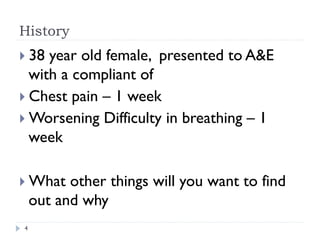
} 38 year old female, presented to A&E
with a compliant of
} Chest pain – 1 week
} Worsening Difficulty in breathing – 1
week
} What other things will you want to find
out and why
4
History
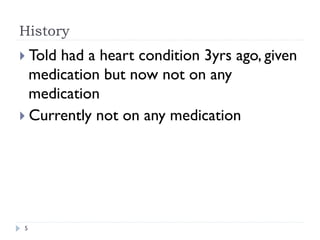
} Told had a heart condition 3yrs ago, given
medication but now not on any
medication
} Currently not on any medication
5
Physical Exams
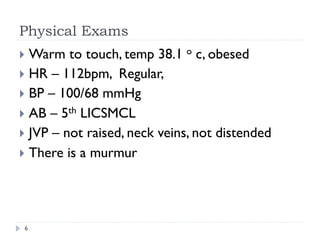
}  Warm to touch, temp 38.1 o c, obesed
}  HR – 112bpm, Regular,
}  BP – 100/68 mmHg
}  AB – 5th LICSMCL
}  JVP – not raised, neck veins, not distended
}  There is a murmur
6
Physical Exam ctd
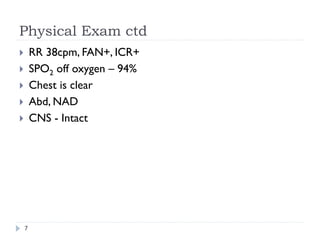
}  RR 38cpm, FAN+, ICR+
}  SPO2 off oxygen – 94%
}  Chest is clear
}  Abd, NAD
}  CNS - Intact
7
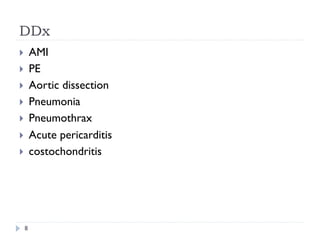
DDx
}  AMI
}  PE
}  Aortic dissection
}  Pneumonia
}  Pneumothrax
}  Acute pericarditis
}  costochondritis
8
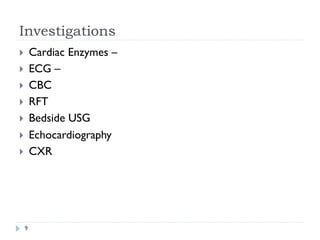
Investigations
}  Cardiac Enzymes –
}  ECG –
}  CBC
}  RFT
}  Bedside USG
}  Echocardiography
}  CXR
9
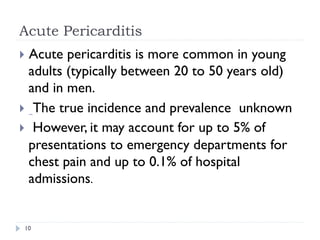
Acute Pericarditis
}  Acute pericarditis is more common in young
adults (typically between 20 to 50 years old)
and in men.
}   The true incidence and prevalence unknown
}  However, it may account for up to 5% of
presentations to emergency departments for
chest pain and up to 0.1% of hospital
admissions.
10
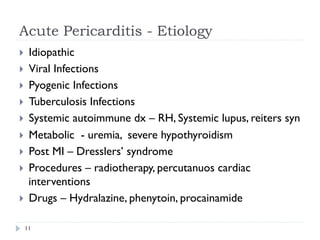
Acute Pericarditis - Etiology
}  Idiopathic
}  Viral Infections
}  Pyogenic Infections
}  Tuberculosis Infections
}  Systemic autoimmune dx – RH, Systemic lupus, reiters syn
}  Metabolic - uremia, severe hypothyroidism
}  Post MI – Dresslers’ syndrome
}  Procedures – radiotherapy, percutanuos cardiac
interventions
}  Drugs – Hydralazine, phenytoin, procainamide
11
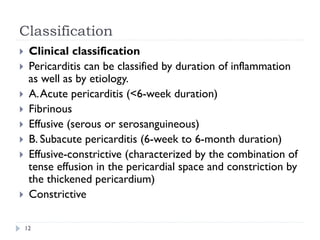
Classification
}  Clinical classification
}  Pericarditis can be classified by duration of inflammation
as well as by etiology.
}  A.Acute pericarditis (<6-week duration)
}  Fibrinous
}  Effusive (serous or serosanguineous)
}  B. Subacute pericarditis (6-week to 6-month duration)
}  Effusive-constrictive (characterized by the combination of
tense effusion in the pericardial space and constriction by
the thickened pericardium)
}  Constrictive
12
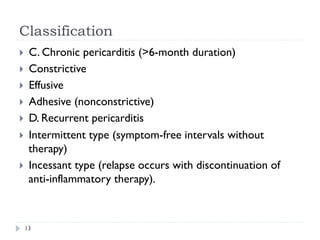
Classification
}  C. Chronic pericarditis (>6-month duration)
}  Constrictive
}  Effusive
}  Adhesive (nonconstrictive)
}  D. Recurrent pericarditis
}  Intermittent type (symptom-free intervals without
therapy)
}  Incessant type (relapse occurs with discontinuation of
anti-inflammatory therapy).
13
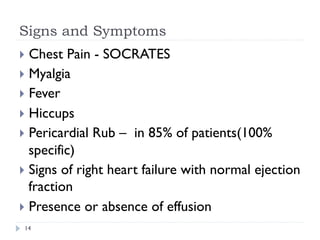
Signs and Symptoms
}  Chest Pain - SOCRATES
}  Myalgia
}  Fever
}  Hiccups
}  Pericardial Rub – in 85% of patients(100%
specific)
}  Signs of right heart failure with normal ejection
fraction
}  Presence or absence of effusion
14
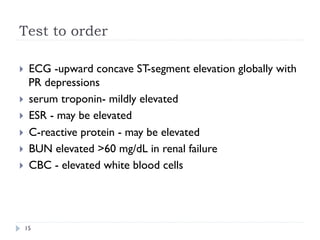
Test to order
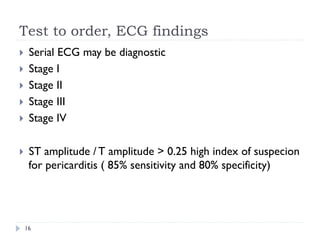
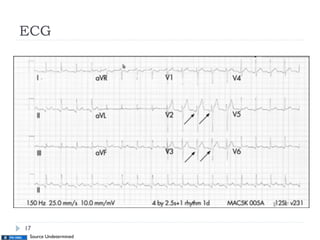
}  ECG -upward concave ST-segment elevation globally with
PR depressions
}  serum troponin- mildly elevated
}  ESR - may be elevated
}  C-reactive protein - may be elevated
}  BUN elevated >60 mg/dL in renal failure
}  CBC - elevated white blood cells
15
Test to order, ECG findings
}  Serial ECG may be diagnostic
}  Stage I
}  Stage II
}  Stage III
}  Stage IV
}  ST amplitude / T amplitude > 0.25 high index of suspecion
for pericarditis ( 85% sensitivity and 80% specificity)
16
ECG
Source Undetermined
17
Test to order
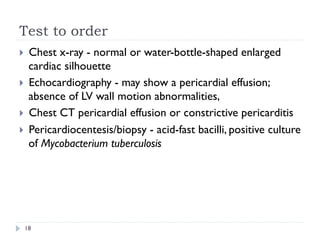
}  Chest x-ray - normal or water-bottle-shaped enlarged
cardiac silhouette
}  Echocardiography - may show a pericardial effusion;
absence of LV wall motion abnormalities,
}  Chest CT pericardial effusion or constrictive pericarditis
}  Pericardiocentesis/biopsy - acid-fast bacilli, positive culture
of Mycobacterium tuberculosis
18
Treatment
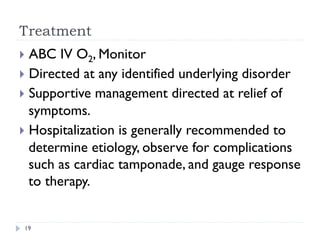
}  ABC IV O2, Monitor
}  Directed at any identified underlying disorder
}  Supportive management directed at relief of
symptoms.
}  Hospitalization is generally recommended to
determine etiology, observe for complications
such as cardiac tamponade, and gauge response
to therapy.
19
Treatment
}  NSAIDs, Ibuprofen preferred, Aspirin
preferred for post MI pericarditis for 4 weeks
}  PPIs
}  Limit exercise till chest pain resolves
}  If after 2 wks, pain persist, add colchicine for 3
month
}  If pain still persist, add systemic steroids
}  Recurrent non-purulent disease, consider
azathioprine
20
Complications- Pericadial Effusion
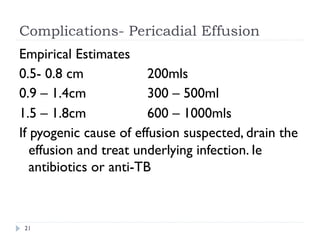
Empirical Estimates
0.5- 0.8 cm 200mls
0.9 – 1.4cm 300 – 500ml
1.5 – 1.8cm 600 – 1000mls
If pyogenic cause of effusion suspected, drain the
effusion and treat underlying infection. Ie
antibiotics or anti-TB
21
Complications – Constrictive Pericarditis
}  Similar to Right sided heart failure, restrictive
cardiomyopathy
}  Signs – elevated JVP with rapid y deecnt, kussmaul sign,
pericardial knock, ascitis, dependent edema and
hepatomegaly
}  ECG – low voltage, inverted t wave, no classic finding
}  Radiograph - pericardial thickening + calcicication
}  Rx - Pericardioectomy
22
Complications- Cardiac Tamponade
}  Dyspnea, profound exertional intolerance with symptoms
of underlying cause
}  Exam – Tachycardia, low systolic BP with narrow pulse
pressure, Distended neck viens with absent y decent,
Pulsus paradoxus , distant or soft heart sounds, right
upper quadrant abd pain
}  CXR – may be normal, an epicardial fat-pad sign (15%)
}  ECG – low voltages, electric alternans
}  ECHO – diagnostic tool of choice
}  Rx- Iv fluids, Pericardiocentesis with insertion of pigtail
catheter , Rx of underlying cause
23
Ref
}  Emergency Medicine,A comprehensive Study Guide
}  Principles of Medicine in Africa
}  www.online.epocrates.com
24

GEMC: Case Presentation- Pericarditis: Resident Training

  • 1.
    Project: Ghana EmergencyMedicine Collaborative Document Title: Case Presentation- Pericarditis Author(s): Kwaku Nyame License: Unless otherwise noted, this material is made available under the terms of the Creative Commons Attribution Share Alike-3.0 License: http://creativecommons.org/licenses/by-sa/3.0/ We have reviewed this material in accordance with U.S. Copyright Law and have tried to maximize your ability to use, share, and adapt it. These lectures have been modified in the process of making a publicly shareable version. The citation key on the following slide provides information about how you may share and adapt this material. Copyright holders of content included in this material should contact open.michigan@umich.edu with any questions, corrections, or clarification regarding the use of content. For more information about how to cite these materials visit http://open.umich.edu/privacy-and-terms-use. Any medical information in this material is intended to inform and educate and is not a tool for self-diagnosis or a replacement for medical evaluation, advice, diagnosis or treatment by a healthcare professional. Please speak to your physician if you have questions about your medical condition. Viewer discretion is advised: Some medical content is graphic and may not be suitable for all viewers. 1
  • 2.
    Attribution Key for moreinformation see: http://open.umich.edu/wiki/AttributionPolicy Use + Share + Adapt Make Your Own Assessment Creative Commons – Attribution License Creative Commons – Attribution Share Alike License Creative Commons – Attribution Noncommercial License Creative Commons – Attribution Noncommercial Share Alike License GNU – Free Documentation License Creative Commons – Zero Waiver Public Domain – Ineligible: Works that are ineligible for copyright protection in the U.S. (17 USC § 102(b)) *laws in your jurisdiction may differ Public Domain – Expired: Works that are no longer protected due to an expired copyright term. Public Domain – Government: Works that are produced by the U.S. Government. (17 USC § 105) Public Domain – Self Dedicated: Works that a copyright holder has dedicated to the public domain. Fair Use: Use of works that is determined to be Fair consistent with the U.S. Copyright Act. (17 USC § 107) *laws in your jurisdiction may differ Our determination DOES NOT mean that all uses of this 3rd-party content are Fair Uses and we DO NOT guarantee that your use of the content is Fair. To use this content you should do your own independent analysis to determine whether or not your use will be Fair. { Content the copyright holder, author, or law permits you to use, share and adapt. } { Content Open.Michigan believes can be used, shared, and adapted because it is ineligible for copyright. } { Content Open.Michigan has used under a Fair Use determination. } 2
  • 3.
    Case Presentation -Pericarditis Kwaku Nyame 3
  • 4.
    History } 38 year oldfemale, presented to A&E with a compliant of } Chest pain – 1 week } Worsening Difficulty in breathing – 1 week } What other things will you want to find out and why 4
  • 5.
    History } Told had aheart condition 3yrs ago, given medication but now not on any medication } Currently not on any medication 5
  • 6.
    Physical Exams }  Warmto touch, temp 38.1 o c, obesed }  HR – 112bpm, Regular, }  BP – 100/68 mmHg }  AB – 5th LICSMCL }  JVP – not raised, neck veins, not distended }  There is a murmur 6
  • 7.
    Physical Exam ctd } RR 38cpm, FAN+, ICR+ }  SPO2 off oxygen – 94% }  Chest is clear }  Abd, NAD }  CNS - Intact 7
  • 8.
    DDx }  AMI }  PE } Aortic dissection }  Pneumonia }  Pneumothrax }  Acute pericarditis }  costochondritis 8
  • 9.
    Investigations }  Cardiac Enzymes– }  ECG – }  CBC }  RFT }  Bedside USG }  Echocardiography }  CXR 9
  • 10.
    Acute Pericarditis }  Acutepericarditis is more common in young adults (typically between 20 to 50 years old) and in men. }   The true incidence and prevalence unknown }  However, it may account for up to 5% of presentations to emergency departments for chest pain and up to 0.1% of hospital admissions. 10
  • 11.
    Acute Pericarditis -Etiology }  Idiopathic }  Viral Infections }  Pyogenic Infections }  Tuberculosis Infections }  Systemic autoimmune dx – RH, Systemic lupus, reiters syn }  Metabolic - uremia, severe hypothyroidism }  Post MI – Dresslers’ syndrome }  Procedures – radiotherapy, percutanuos cardiac interventions }  Drugs – Hydralazine, phenytoin, procainamide 11
  • 12.
    Classification }  Clinical classification } Pericarditis can be classified by duration of inflammation as well as by etiology. }  A.Acute pericarditis (<6-week duration) }  Fibrinous }  Effusive (serous or serosanguineous) }  B. Subacute pericarditis (6-week to 6-month duration) }  Effusive-constrictive (characterized by the combination of tense effusion in the pericardial space and constriction by the thickened pericardium) }  Constrictive 12
  • 13.
    Classification }  C. Chronicpericarditis (>6-month duration) }  Constrictive }  Effusive }  Adhesive (nonconstrictive) }  D. Recurrent pericarditis }  Intermittent type (symptom-free intervals without therapy) }  Incessant type (relapse occurs with discontinuation of anti-inflammatory therapy). 13
  • 14.
    Signs and Symptoms } Chest Pain - SOCRATES }  Myalgia }  Fever }  Hiccups }  Pericardial Rub – in 85% of patients(100% specific) }  Signs of right heart failure with normal ejection fraction }  Presence or absence of effusion 14
  • 15.
    Test to order } ECG -upward concave ST-segment elevation globally with PR depressions }  serum troponin- mildly elevated }  ESR - may be elevated }  C-reactive protein - may be elevated }  BUN elevated >60 mg/dL in renal failure }  CBC - elevated white blood cells 15
  • 16.
    Test to order,ECG findings }  Serial ECG may be diagnostic }  Stage I }  Stage II }  Stage III }  Stage IV }  ST amplitude / T amplitude > 0.25 high index of suspecion for pericarditis ( 85% sensitivity and 80% specificity) 16
  • 17.
  • 18.
    Test to order } Chest x-ray - normal or water-bottle-shaped enlarged cardiac silhouette }  Echocardiography - may show a pericardial effusion; absence of LV wall motion abnormalities, }  Chest CT pericardial effusion or constrictive pericarditis }  Pericardiocentesis/biopsy - acid-fast bacilli, positive culture of Mycobacterium tuberculosis 18
  • 19.
    Treatment }  ABC IVO2, Monitor }  Directed at any identified underlying disorder }  Supportive management directed at relief of symptoms. }  Hospitalization is generally recommended to determine etiology, observe for complications such as cardiac tamponade, and gauge response to therapy. 19
  • 20.
    Treatment }  NSAIDs, Ibuprofenpreferred, Aspirin preferred for post MI pericarditis for 4 weeks }  PPIs }  Limit exercise till chest pain resolves }  If after 2 wks, pain persist, add colchicine for 3 month }  If pain still persist, add systemic steroids }  Recurrent non-purulent disease, consider azathioprine 20
  • 21.
    Complications- Pericadial Effusion EmpiricalEstimates 0.5- 0.8 cm 200mls 0.9 – 1.4cm 300 – 500ml 1.5 – 1.8cm 600 – 1000mls If pyogenic cause of effusion suspected, drain the effusion and treat underlying infection. Ie antibiotics or anti-TB 21
  • 22.
    Complications – ConstrictivePericarditis }  Similar to Right sided heart failure, restrictive cardiomyopathy }  Signs – elevated JVP with rapid y deecnt, kussmaul sign, pericardial knock, ascitis, dependent edema and hepatomegaly }  ECG – low voltage, inverted t wave, no classic finding }  Radiograph - pericardial thickening + calcicication }  Rx - Pericardioectomy 22
  • 23.
    Complications- Cardiac Tamponade } Dyspnea, profound exertional intolerance with symptoms of underlying cause }  Exam – Tachycardia, low systolic BP with narrow pulse pressure, Distended neck viens with absent y decent, Pulsus paradoxus , distant or soft heart sounds, right upper quadrant abd pain }  CXR – may be normal, an epicardial fat-pad sign (15%) }  ECG – low voltages, electric alternans }  ECHO – diagnostic tool of choice }  Rx- Iv fluids, Pericardiocentesis with insertion of pigtail catheter , Rx of underlying cause 23
  • 24.
    Ref }  Emergency Medicine,Acomprehensive Study Guide }  Principles of Medicine in Africa }  www.online.epocrates.com 24