Chapter Five
Market structure
•In this chapter we will discuss about the
two major types of market structures:
Perfectly competitive market
Pure monopoly market
2.
Market, Marketing andMarket structure
Market
• In the ordinary sense, the word market refers to a physical
place where commodities are bought and sold.
• In economics, however, the term market does not
necessarily refer to a particular place, but to the
mechanism or arrangement by which buyers and sellers of
a commodity are able to contact each other for having
economic exchange and by which they are able to strike
deals about price and the quantity to be bought and sold.
• In simple words, we may define market as a structure in
which the buyers and sellers of a commodity remain in
contact.
3.
Conti…
Marketing
Marketing: is theprocess of exchanging goods and services
between buyers and sellers.
Market structure:
The term market structure can be defined in reference to the
manner in which a market is organized.
This can be done on the basis of the relative number and size of
firms in an industry and degree of collusion in the industry.
It is not only just about the number of firms and their relative sizes
but also there are other characteristics which are very important
such as, the level and forms of competition, extent of product
differentiation, and ease of entry into and exit from the market.
4.
Perfectly competitive market
Perfect competition is a market structure characterized by a
complete absence of rivalry among the individual firms.
Assumptions of perfectly competitive market
Large number of sellers and buyers
Homogeneous product
Perfect mobility of factors of production
Free entry and exit
Perfect knowledge about market conditions
No government interference
Short run equilibriumof the firm
The main objective of a firm is profit maximization. If the firm has to
incur a loss, it aims to minimize the loss.
Profit is the difference between total revenue and total cost.
Total Revenue (TR): it is the total amount of money a firm receives
from a given quantity of its product sold.
It is obtained by multiplying the unit price of the commodity and the
quantity of that product sold. TR=P X Q, where P = price of the
product and Q = quantity of the product sold
Average revenue (AR):- it is the revenue per unit of item sold.
It is calculated by dividing the total revenue by the amount of the
product sold.
Marginal Revenue: it is the additional amount of money/ revenue the
firm receives by selling one more unit of the product.
In other words, it is the change in total revenue resulting from the sale
of an extra unit of the product.
7.
Conti….
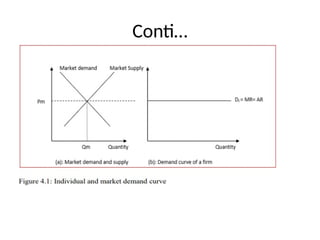
o In aperfectly competitive market, a firm‘s average revenue,
marginal revenue and price of the product are equal, i.e. AR
= MR = P =Df
o Because, the purely competitive firm is a price taker, it will
maximize its economic profit only by adjusting its output.
Equilibrium of a competitive firm
There are two ways to determine the level of output at
which a competitive firm will realize maximum profit or
minimum loss.
1. Total Approach
2. Marginal Approach
8.
Conti….
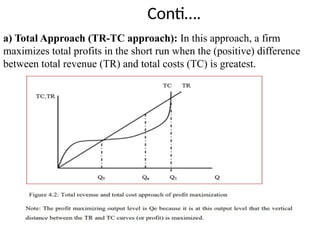
a) Total Approach(TR-TC approach): In this approach, a firm
maximizes total profits in the short run when the (positive) difference
between total revenue (TR) and total costs (TC) is greatest.
9.
Conti…
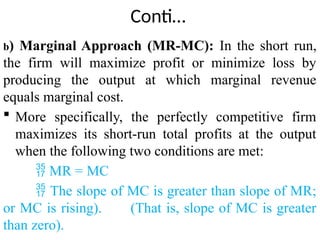
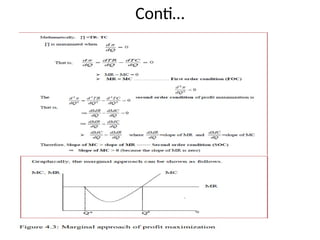
b) Marginal Approach(MR-MC): In the short run,
the firm will maximize profit or minimize loss by
producing the output at which marginal revenue
equals marginal cost.
More specifically, the perfectly competitive firm
maximizes its short-run total profits at the output
when the following two conditions are met:
MR = MC
The slope of MC is greater than slope of MR;
or MC is rising). (That is, slope of MC is greater
than zero).
Conti….
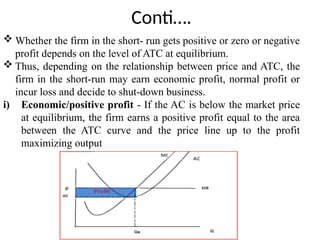
Whether thefirm in the short- run gets positive or zero or negative
profit depends on the level of ATC at equilibrium.
Thus, depending on the relationship between price and ATC, the
firm in the short-run may earn economic profit, normal profit or
incur loss and decide to shut-down business.
i) Economic/positive profit - If the AC is below the market price
at equilibrium, the firm earns a positive profit equal to the area
between the ATC curve and the price line up to the profit
maximizing output
12.
Conti…
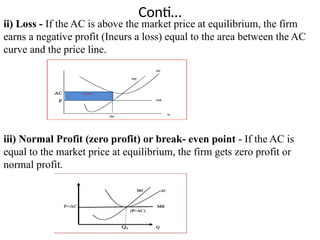
ii) Loss -If the AC is above the market price at equilibrium, the firm
earns a negative profit (Incurs a loss) equal to the area between the AC
curve and the price line.
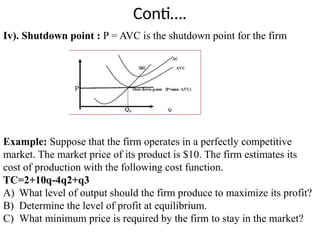
iii) Normal Profit (zero profit) or break- even point - If the AC is
equal to the market price at equilibrium, the firm gets zero profit or
normal profit.
13.
Conti….
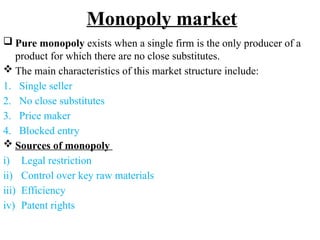
Iv). Shutdown point: P = AVC is the shutdown point for the firm
Example: Suppose that the firm operates in a perfectly competitive
market. The market price of its product is $10. The firm estimates its
cost of production with the following cost function.
TC=2+10q-4q2+q3
A) What level of output should the firm produce to maximize its profit?
B) Determine the level of profit at equilibrium.
C) What minimum price is required by the firm to stay in the market?
14.
Monopoly market
Puremonopoly exists when a single firm is the only producer of a
product for which there are no close substitutes.
The main characteristics of this market structure include:
1. Single seller
2. No close substitutes
3. Price maker
4. Blocked entry
Sources of monopoly
i) Legal restriction
ii) Control over key raw materials
iii) Efficiency
iv) Patent rights