The Model of Perfect Competition
Perfect Competition - An IdealFirms are primarily distinguished from each other by the degree of competition they face:Perfect CompetitionMonopolistic CompetitionMonopolyOligopolyProfit maximization.The Model of Perfect Competition.Allocative and Productive efficiencies.Long-run costs and adjustments
Profit Maximizing RuleNo matter what kind of firm we are talking about, they will max. profit when:Marginal Revenue = Marginal Cost              (MR)                         (MC)If MR > MC, you are foregoing profit.If MR < MC, you are foregoing profit.
Perfect CompetitionAll goods are identical.--One cannot be (usefully) distinguished from another.Many buyers and sellers.--No one can affect price through their actions.There are no barriers to entry/exit.--Firms cannot earn economic profit in the long run.Buyers & sellers have perfect information.--A single price will prevail in the market.
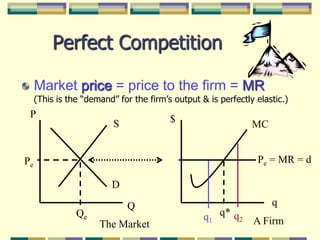
P$SMCPe = MR = dPeDqQq*Qeq2q1A FirmThe MarketPerfect CompetitionMarket price = price to the firm = MR(This is the “demand” for the firm’s output & is perfectly elastic.)
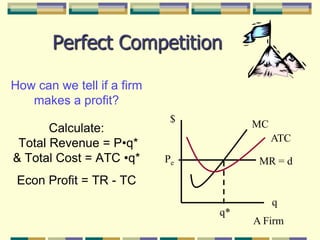
$MCATCPeMR = dqq*A FirmPerfect CompetitionHow can we tell if a firm makes a profit?Calculate: Total Revenue = P•q*& Total Cost = ATC •q*Econ Profit = TR - TC
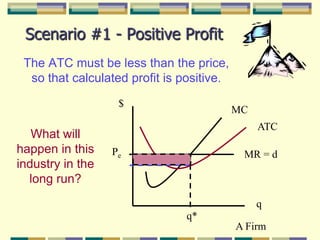
$MCATCPeMR = dqq*A FirmScenario #1 - Positive ProfitThe ATC must be less than the price, so that calculated profit is positive.What will happen in this industry in the long run?
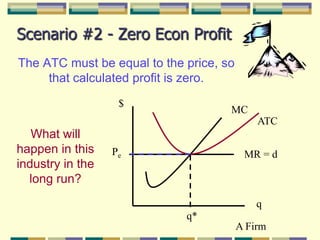
$MCATCPeMR = dqq*Scenario #2 - Zero Econ ProfitThe ATC must be equal to the price, so that calculated profit is zero.What will happen in this industry in the long run?A Firm
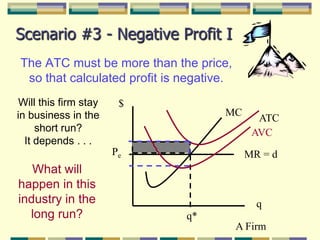
$MCATCAVCPeMR = dqq*A FirmScenario #3 - Negative Profit IThe ATC must be more than the price, so that calculated profit is negative.Will this firm stay in business in the short run?It depends . . .What will happen in this industry in the long run?
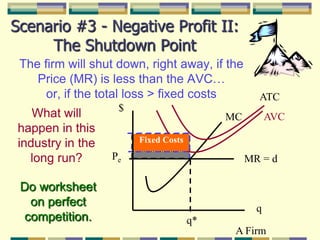
ATC$AVCMCPeMR = dqq*A FirmScenario #3 - Negative Profit II:The Shutdown PointThe firm will shut down, right away, if the Price (MR) is less than the AVC…or, if the total loss > fixed costsWhat will happen in this industry in the long run?Fixed CostsDo worksheet on perfect competition.
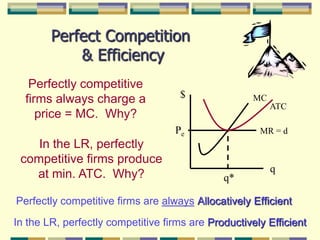
Perfect Competition & EfficiencyAllocative Efficiency (What to produce?)occurs when Price = Marginal CostWhy ?Productive Efficiency (How to produce?)occurs where output level is at the minimum ATCWhy ?
$MCATCPeMR = dqq*Perfect Competition & EfficiencyPerfectly competitive firms always charge a price = MC.  Why?In the LR, perfectly competitive firms produce at min. ATC.  Why?Perfectly competitive firms are alwaysAllocatively EfficientIn the LR, perfectly competitive firms are Productively Efficient
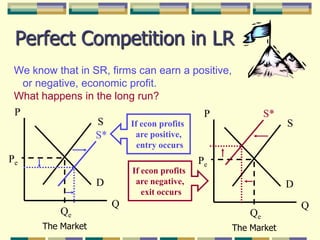
S*PPIf econ profits are positive, entry occursSSS*PePeIf econ profits are negative, exit occursDDQQQeQeThe MarketThe MarketPerfect Competition in LRWe know that in SR, firms can earn a positive,   or negative, economic profit.  What happens in the long run?
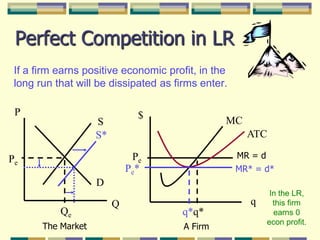
PSS*PePe*MR* = d*DQq*QeThe MarketPerfect Competition in LRIf a firm earns positive economic profit, in the long run that will be dissipated as firms enter.$MCATCMR = dPeIn the LR, this firm earns 0 econ profit.qq*A Firm
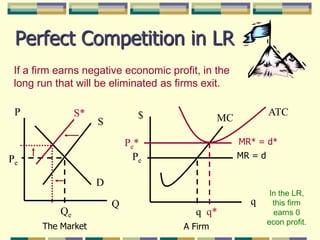
S*PSMR* = d*Pe*PeDQq*QeThe MarketPerfect Competition in LRIf a firm earns negative economic profit, in the long run that will be eliminated as firms exit.ATC$MCMR = dPeIn the LR, this firm earns 0 econ profit.qqA Firm
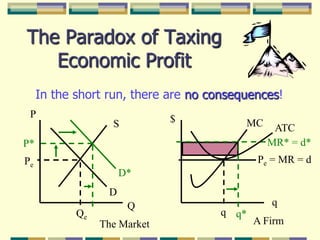
The Paradox of Taxing Economic ProfitIn the short run, there are no consequences!P$MCSATCMR* = d*P*Pe = MR = dPeD*DqQqQeq*A FirmThe Market

The Model Of Perfect Competition

  • 1.
    The Model ofPerfect Competition
  • 2.
    Perfect Competition -An IdealFirms are primarily distinguished from each other by the degree of competition they face:Perfect CompetitionMonopolistic CompetitionMonopolyOligopolyProfit maximization.The Model of Perfect Competition.Allocative and Productive efficiencies.Long-run costs and adjustments
  • 3.
    Profit Maximizing RuleNomatter what kind of firm we are talking about, they will max. profit when:Marginal Revenue = Marginal Cost (MR) (MC)If MR > MC, you are foregoing profit.If MR < MC, you are foregoing profit.
  • 4.
    Perfect CompetitionAll goodsare identical.--One cannot be (usefully) distinguished from another.Many buyers and sellers.--No one can affect price through their actions.There are no barriers to entry/exit.--Firms cannot earn economic profit in the long run.Buyers & sellers have perfect information.--A single price will prevail in the market.
  • 5.
    P$SMCPe = MR= dPeDqQq*Qeq2q1A FirmThe MarketPerfect CompetitionMarket price = price to the firm = MR(This is the “demand” for the firm’s output & is perfectly elastic.)
  • 6.
    $MCATCPeMR = dqq*AFirmPerfect CompetitionHow can we tell if a firm makes a profit?Calculate: Total Revenue = P•q*& Total Cost = ATC •q*Econ Profit = TR - TC
  • 7.
    $MCATCPeMR = dqq*AFirmScenario #1 - Positive ProfitThe ATC must be less than the price, so that calculated profit is positive.What will happen in this industry in the long run?
  • 8.
    $MCATCPeMR = dqq*Scenario#2 - Zero Econ ProfitThe ATC must be equal to the price, so that calculated profit is zero.What will happen in this industry in the long run?A Firm
  • 9.
    $MCATCAVCPeMR = dqq*AFirmScenario #3 - Negative Profit IThe ATC must be more than the price, so that calculated profit is negative.Will this firm stay in business in the short run?It depends . . .What will happen in this industry in the long run?
  • 10.
    ATC$AVCMCPeMR = dqq*AFirmScenario #3 - Negative Profit II:The Shutdown PointThe firm will shut down, right away, if the Price (MR) is less than the AVC…or, if the total loss > fixed costsWhat will happen in this industry in the long run?Fixed CostsDo worksheet on perfect competition.
  • 11.
    Perfect Competition &EfficiencyAllocative Efficiency (What to produce?)occurs when Price = Marginal CostWhy ?Productive Efficiency (How to produce?)occurs where output level is at the minimum ATCWhy ?
  • 12.
    $MCATCPeMR = dqq*PerfectCompetition & EfficiencyPerfectly competitive firms always charge a price = MC. Why?In the LR, perfectly competitive firms produce at min. ATC. Why?Perfectly competitive firms are alwaysAllocatively EfficientIn the LR, perfectly competitive firms are Productively Efficient
  • 13.
    S*PPIf econ profitsare positive, entry occursSSS*PePeIf econ profits are negative, exit occursDDQQQeQeThe MarketThe MarketPerfect Competition in LRWe know that in SR, firms can earn a positive, or negative, economic profit. What happens in the long run?
  • 14.
    PSS*PePe*MR* = d*DQq*QeTheMarketPerfect Competition in LRIf a firm earns positive economic profit, in the long run that will be dissipated as firms enter.$MCATCMR = dPeIn the LR, this firm earns 0 econ profit.qq*A Firm
  • 15.
    S*PSMR* = d*Pe*PeDQq*QeTheMarketPerfect Competition in LRIf a firm earns negative economic profit, in the long run that will be eliminated as firms exit.ATC$MCMR = dPeIn the LR, this firm earns 0 econ profit.qqA Firm
  • 16.
    The Paradox ofTaxing Economic ProfitIn the short run, there are no consequences!P$MCSATCMR* = d*P*Pe = MR = dPeD*DqQqQeq*A FirmThe Market