

MEANING
Perception means
understanding or thinking
about a particular thing
with a particular point of
view.
Nature of Perception
Mental process
Activation process
Unique interpretation
Wider than sensation
Affected by many factors
Provides check on
behavior
SENSATION
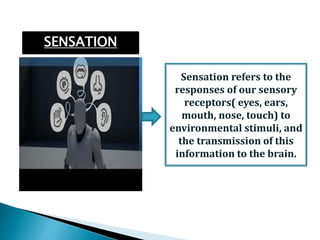
Sensation refers to the
responses of our sensory
receptors( eyes, ears,
mouth, nose, touch) to
environmental stimuli, and
the transmission of this
information to the brain.
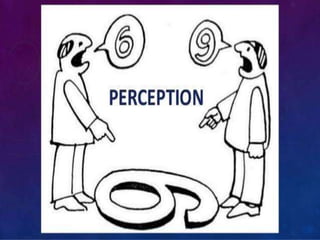
PERCEPTION
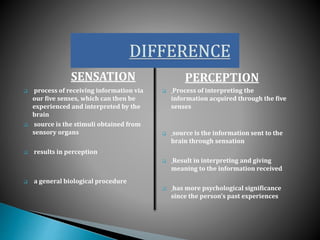
 Process of interpreting the
information acquired through the five
senses
 source is the information sent to the
brain through sensation
 Result in interpreting and giving
meaning to the information received
 has more psychological significance
since the person’s past experiences
SENSATION
 process of receiving information via
our five senses, which can then be
experienced and interpreted by the
brain
 source is the stimuli obtained from
sensory organs
 results in perception
 a general biological procedure
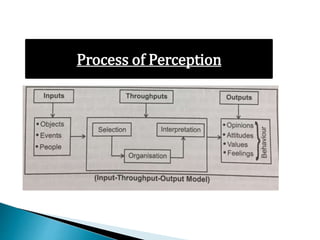
Process of Perception
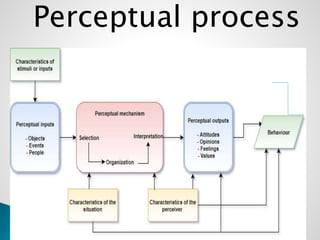
Perceptual process
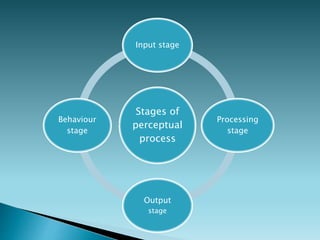
Stages of
perceptual
process
Input stage
Processing
stage
Output
stage
Behaviour
stage
Perceptual selection
Though people are exposed to several stimuli, they tend
to select only a few at a given point of time, this is
perceptual selectivity in perception which stimuli get
selected depends on two major factors:
1)Consumers pervious experience as it affects their
expectations.
2) Their motives at that time for one’s needs, desire &
interest.
1) Nature of stimulus.
2)One’s expectations.
3)Motives at the time.
Factors affecting the
selection of stimuli:
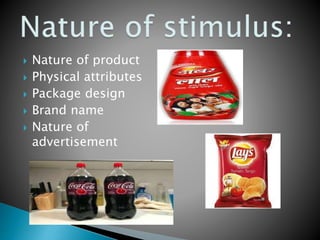
 Nature of product
 Physical attributes
 Package design
 Brand name
 Nature of
advertisement
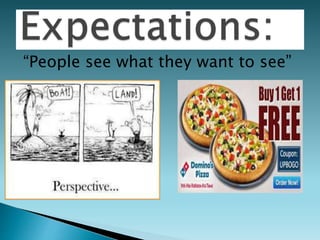
“People see what they want to see”
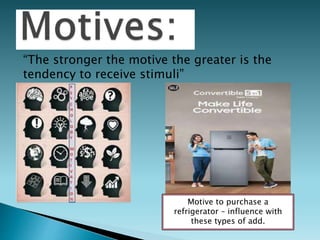
“The stronger the motive the greater is the
tendency to receive stimuli”
Motive to purchase a
refrigerator – influence with
these types of add.
•People do not experience all the stimuli selected by
them as separate and discrete sensations.
• They rather, organise this stimuli into groups and
perceive them as a unified whole.
•This method of perceptual organisation enables
individuals to view life in a simplified manner.
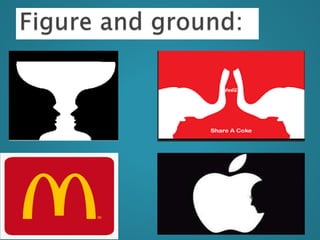
1)
Figure
and
ground
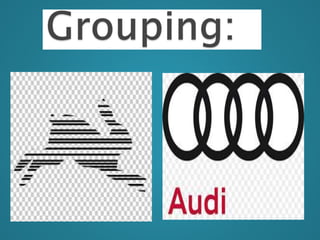
2)
grouping
3)
closure
Internal factors:
• Needs & desires.
• Personality
• experience
External factors:
• size
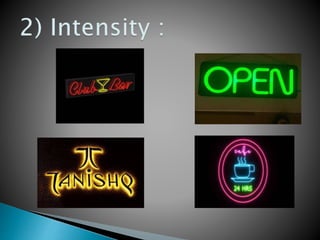
• Intensity
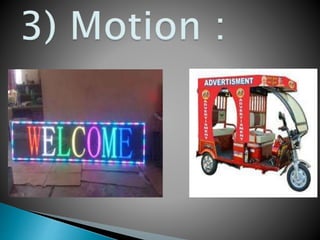
• Motion
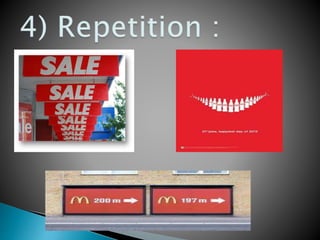
• Repetition
• Status
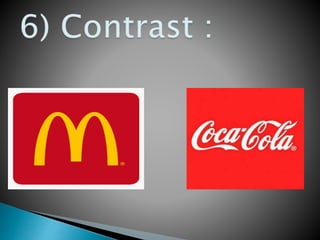
• contrast
1)Needs & desire: Need - need a dress for
wedding.
Desire: desire to purchase.
2)personality: suits light colors
3) experience: because of prior comments
with family , friends etc.
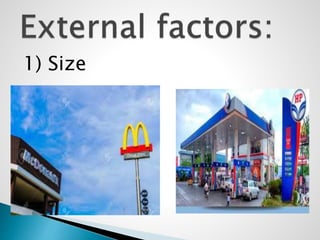
1) Size
•People have the tendency to interpret the
meaning of what they have selectively perceived
and organised on their basis of their own
assumptions about the stimuli.
• It is based on their previous experience stimuli
generally highly ambiguous.
•In that case an individual interprete them in
such a way as to serve to fulfill his needs,
wants, wishes, interests and so on.
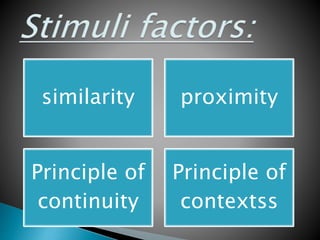
similarity proximity
Principle of
continuity
Principle of
contextss
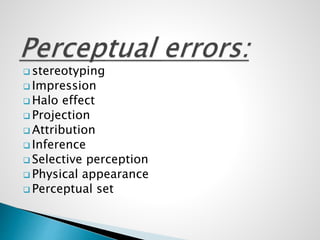
 stereotyping
 Impression
 Halo effect
 Projection
 Attribution
 Inference
 Selective perception
 Physical appearance
 Perceptual set
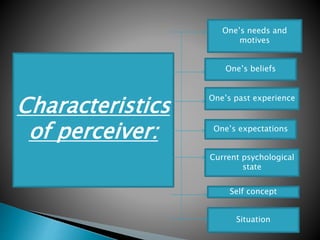
Characteristics
of perceiver:
One’s needs and
motives
One’s beliefs
One’s expectations
Current psychological
state
Self concept
Situation
One’s past experience

Perception and Consumer Behaviour

  • 2.
    MEANING Perception means understanding orthinking about a particular thing with a particular point of view.
  • 3.
    Nature of Perception Mentalprocess Activation process Unique interpretation Wider than sensation Affected by many factors Provides check on behavior
  • 4.
    SENSATION Sensation refers tothe responses of our sensory receptors( eyes, ears, mouth, nose, touch) to environmental stimuli, and the transmission of this information to the brain.
  • 5.
    PERCEPTION  Process ofinterpreting the information acquired through the five senses  source is the information sent to the brain through sensation  Result in interpreting and giving meaning to the information received  has more psychological significance since the person’s past experiences SENSATION  process of receiving information via our five senses, which can then be experienced and interpreted by the brain  source is the stimuli obtained from sensory organs  results in perception  a general biological procedure
  • 6.
  • 7.
  • 8.
  • 9.
    Perceptual selection Though peopleare exposed to several stimuli, they tend to select only a few at a given point of time, this is perceptual selectivity in perception which stimuli get selected depends on two major factors: 1)Consumers pervious experience as it affects their expectations. 2) Their motives at that time for one’s needs, desire & interest.
  • 10.
    1) Nature ofstimulus. 2)One’s expectations. 3)Motives at the time. Factors affecting the selection of stimuli:
  • 11.
     Nature ofproduct  Physical attributes  Package design  Brand name  Nature of advertisement
  • 12.
    “People see whatthey want to see”
  • 13.
    “The stronger themotive the greater is the tendency to receive stimuli” Motive to purchase a refrigerator – influence with these types of add.
  • 14.
    •People do notexperience all the stimuli selected by them as separate and discrete sensations. • They rather, organise this stimuli into groups and perceive them as a unified whole. •This method of perceptual organisation enables individuals to view life in a simplified manner.
  • 15.
  • 19.
    Internal factors: • Needs& desires. • Personality • experience External factors: • size • Intensity • Motion • Repetition • Status • contrast
  • 20.
    1)Needs & desire:Need - need a dress for wedding. Desire: desire to purchase. 2)personality: suits light colors 3) experience: because of prior comments with family , friends etc.
  • 21.
  • 27.
    •People have thetendency to interpret the meaning of what they have selectively perceived and organised on their basis of their own assumptions about the stimuli. • It is based on their previous experience stimuli generally highly ambiguous. •In that case an individual interprete them in such a way as to serve to fulfill his needs, wants, wishes, interests and so on.
  • 28.
  • 29.
     stereotyping  Impression Halo effect  Projection  Attribution  Inference  Selective perception  Physical appearance  Perceptual set
  • 30.
    Characteristics of perceiver: One’s needsand motives One’s beliefs One’s expectations Current psychological state Self concept Situation One’s past experience