PERCEPTION

1
 Perception refers to the way we try to understand the world around
us. We gather information through our five sense organs, but
perception adds meaning to these sensory inputs.
 Perception is the process by which we organize and interpret our
sensory impressions in order to give meaning to the environment.
Here, a situation may be the same but the interpretation of that
situation by two individuals may be immensely different.
 Perception is the set of processes by which an individual becomes
aware of and interprets information about the environment.

2
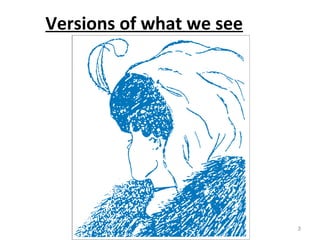
Versions of what we see

Figure 11.2

3
What is Perceptual Process
• The Process by which people select, organize, interpret,
retrieve and respond to information.
• The first process of perception is selection & attention
• The process of perceptual selection is based on internal
factors & external factors
i) Internal – relating to the state of the individual
ii) External – the environment

4
THE PERCEPTUAL PROCESS

•
•
•
•
•
•

PROCESS OF RECEIVING STIMULI 
PROCESS OF SELECTING STIMULI
PROCESS OR ORGANIZING STIMULI 
PROCESS OF INTERPRETING 
PROCESS OF CHECKING
PROCESS OF REACTING 

5
Fctors:govern the selection of
stimulus)External factors Influencing
Selection
• Intensity – Adv, Strikes(generally, stimuli which are high in
intensity are perceived more readily than those of low
intensity)
• Size
• Contrast – differ from familiar
• Movement
• Repetition
• Familiarity
• Novelty
6
Internal factors Influencing Selection
•
•
•
•
•

Psychological need
Background
Experience
Personality
Self-acceptance

7
Process of Organizing Stimuli
Grouping:
• Similarity – stimuli which are similar are put together.
• Proximity – objects or persons closer put together
• Closure – Triangle
• Figure – ground – tendency to keep something in focus and
the others in the background
• Perceptual Constancy – tendency to stabilize perceptions

8
Factors that attribute to the Process of
Interpreting
• Perceptual set – Previously held beliefs
• Stereo Typing(generally favorable or unfavorable
opinion a person holds for a particular group of
person)
• Halo Effect(opinion or attitude towards a single
person)positive & negative halo effect.
• Perceptual defense
• (contextual factors)
• Interpersonal context
• Other person’s background
9
Process of checking
• Comparing your perceptions with other
people’s

10
Process of reacting
•
Impression formation – judgment
Action may be covert or overt
Covert action: the formation of opinion
Overt action: is a definite action in response to the perception.
Limitations
1. Generalizations
2. Surroundings
3. Situational limitation – cannot show behaviors critical for
impression formation
4. Preconceived Notions

11
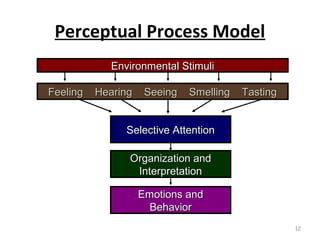
Perceptual Process Model
Environmental Stimuli
Feeling

Hearing

Seeing

Smelling

Tasting

Selective Attention
Organization and
Interpretation
Emotions and
Behavior
12
13
• The perceptions and judgments regarding a person’s actions are
often significantly influenced by the assumptions we make about the
person’s internal state.
• Attribution theory refers to the ways in which we judge people
differently, depending on what meaning we attribute to a given
behaviour.
• Whenever we observe the behaviour of an individual, we attempt to
determine whether it was internally or externally caused.
• Attributions are found to strongly affect various functions in an
organization, e.g. the process of employee performance evaluations,
nature of supervision or guidance or the general attitude towards the
organization in general.

14
•
•

There are often some errors or biases in our judgment about others.
When we make judgment about other people’s behaviour, we tend to
underestimate the influence of external factors and overestimate the influence of
internal or personal factors. This is called fundamental
attribution error.

•

Another noticeable tendency, called self-serving bias, refers to the inclination for
individuals to attribute their own successes to internal factors while putting the
blame for failures on external factors.

15

Perception

  • 1.
  • 2.
     Perception refersto the way we try to understand the world around us. We gather information through our five sense organs, but perception adds meaning to these sensory inputs.  Perception is the process by which we organize and interpret our sensory impressions in order to give meaning to the environment. Here, a situation may be the same but the interpretation of that situation by two individuals may be immensely different.  Perception is the set of processes by which an individual becomes aware of and interprets information about the environment. 2
  • 3.
    Versions of whatwe see Figure 11.2 3
  • 4.
    What is PerceptualProcess • The Process by which people select, organize, interpret, retrieve and respond to information. • The first process of perception is selection & attention • The process of perceptual selection is based on internal factors & external factors i) Internal – relating to the state of the individual ii) External – the environment 4
  • 5.
    THE PERCEPTUAL PROCESS • • • • • • PROCESSOF RECEIVING STIMULI  PROCESS OF SELECTING STIMULI PROCESS OR ORGANIZING STIMULI  PROCESS OF INTERPRETING  PROCESS OF CHECKING PROCESS OF REACTING  5
  • 6.
    Fctors:govern the selectionof stimulus)External factors Influencing Selection • Intensity – Adv, Strikes(generally, stimuli which are high in intensity are perceived more readily than those of low intensity) • Size • Contrast – differ from familiar • Movement • Repetition • Familiarity • Novelty 6
  • 7.
    Internal factors InfluencingSelection • • • • • Psychological need Background Experience Personality Self-acceptance 7
  • 8.
    Process of OrganizingStimuli Grouping: • Similarity – stimuli which are similar are put together. • Proximity – objects or persons closer put together • Closure – Triangle • Figure – ground – tendency to keep something in focus and the others in the background • Perceptual Constancy – tendency to stabilize perceptions 8
  • 9.
    Factors that attributeto the Process of Interpreting • Perceptual set – Previously held beliefs • Stereo Typing(generally favorable or unfavorable opinion a person holds for a particular group of person) • Halo Effect(opinion or attitude towards a single person)positive & negative halo effect. • Perceptual defense • (contextual factors) • Interpersonal context • Other person’s background 9
  • 10.
    Process of checking •Comparing your perceptions with other people’s 10
  • 11.
    Process of reacting • Impressionformation – judgment Action may be covert or overt Covert action: the formation of opinion Overt action: is a definite action in response to the perception. Limitations 1. Generalizations 2. Surroundings 3. Situational limitation – cannot show behaviors critical for impression formation 4. Preconceived Notions 11
  • 12.
    Perceptual Process Model EnvironmentalStimuli Feeling Hearing Seeing Smelling Tasting Selective Attention Organization and Interpretation Emotions and Behavior 12
  • 13.
  • 14.
    • The perceptionsand judgments regarding a person’s actions are often significantly influenced by the assumptions we make about the person’s internal state. • Attribution theory refers to the ways in which we judge people differently, depending on what meaning we attribute to a given behaviour. • Whenever we observe the behaviour of an individual, we attempt to determine whether it was internally or externally caused. • Attributions are found to strongly affect various functions in an organization, e.g. the process of employee performance evaluations, nature of supervision or guidance or the general attitude towards the organization in general. 14
  • 15.
    • • There are oftensome errors or biases in our judgment about others. When we make judgment about other people’s behaviour, we tend to underestimate the influence of external factors and overestimate the influence of internal or personal factors. This is called fundamental attribution error. • Another noticeable tendency, called self-serving bias, refers to the inclination for individuals to attribute their own successes to internal factors while putting the blame for failures on external factors. 15

Editor's Notes

  • #5 Perceptual information is gathered from : Sight, hearing, touch, taste and Smell.
  • #7 Selective attention is the ability, often exercised unconsciously, to choose from the stream of sensory data to concentrate on particular elements and to ignore others