Learning and
motivation
Meaning and definition of learning
Learning in psychology is the process by which
a “relatively lasting change in potential behavior
occurs because of practice or experience”.
Learning is the process of acquiring
modifications in existing knowledge, skills,
habits or tendencies through experience
practice, or exercise.
According to Gates and others
Learning is the modification of behavior through
experiences.
According to Henry P. Smith
Learning is the acquisition of new behavior or
strengthening or weakening of old behavior as a result
of experience
According to crow and crow
Learning is the acquisition of habits, knowledge, and
attitudes. It involves news ways of doing good things,
and it operates in an individual’s attempt to overcome
obstacles or to adjust to new situations.
According to Skinner
Learning is the process of progressive behavior
adaption.
According to Munn
To learn is to modify behavior and experience
According to M.L. Bigge
Learning may be considered as a change in insights,
behavior, perception, motivation or a combination of
these.
Nature of learning
•Learning is the adaptation or
adjustment.
•Learning is improvement
•Learning is organizing experience
•Learning brings behavioral changes
•Learning is active
•Learning is goal directed
•Learning is universal and continuous
Characteristics of learning
According to W.R McLaw learning has the
following characteristics
•Learning is a continuous modification of
behavior which continuous throughout life.
•Learning is a pervasive. It reaches into all
aspects of human life.
• Learning involves the whole person socially,
emotionally and intellectually.
•Learning is often a change in the organization of
behavior.
•Learning is development. Time is one of its
dimensions.
•Learning is responsive to incentives.
In most cases positive incentives such as
rewards are more effective than negative
incentives such as punishments.
•Learning is always concerned with goals.
•Interest and learning are positively related.
•Learning depends on maturation and
motivation.
Factors affecting
learning
• intellectual factors
• learning factors
• physical factors
• mental factors
• emotional and social factors
•Teacher’s personality
• environmental factors
•Intellectual factors
•It refers to individual mental level.
•Success in school is generally related to level of the
intellect.
•Pupils with low intelligence often encounter
serious difficultly in mastering school work.
•Thus, the native capacity of individual is of prime
importance in determining the effectiveness of the
learning process.
•Learning factors
•Factors owing to lack of mastery of what has been
taught, faulty methods of work or study and
narrowing of experimental background may affect
the learning process of any pupil.
•Physical factors
•Factors such as health, physical development,
nutrition, visual and physical defects and glandular
abnormality.
•The health of the learner will likely affect his ability
to learn and his power to concentrate.
•Mental factors
•Attitudes comes under this
•Attitudes are made up of organic and kinesthetic
elements.
•They play a larger role in the mental organization
and general behavior of the individual.
•Emotional and social factors
•Personal factors such as instincts and emotions,
•Social factors such as cooperation and rivalry are
directly related to a complex psychology of
motivation.
•It is the recognized fact that the various responses
of the individual to various kinds of stimuli are
determined by a wide variety of tendencies.
•Some of these innate tendencies are constructive
and others are harmful.
•For some reason people may developed a dislike for
some subject because he may fail to see its value, or
may lack foundation.
•Teacher’s personality
•The teacher is an individual personality is an
important element in the learning environment or the
failures and success of the learner.
•The supreme value of the teacher is not in the
regular performance of routine duties, but in his
power to lead and to inspire his pupils through the
influence of his moral personality.
•Pupils love a happy, sympathetic, enthusiastic and
cheerful leader. Effective teaching and learning are the
result of love of pupils, sympathy for their interest,
tolerance and a definite capacity for understanding.
•Environmental factor
•One of the factors that affect the efficiency of
learning is the condition in which learning takes
place.
•This includes the class rooms, textbooks,
equipment, school supplies and other materials.
•It is difficult to do a good job of teaching in a poor
type of building and without adequate equipment
and instructional materials.
Domains of learning
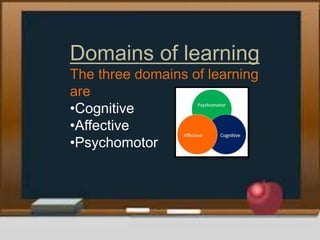
The three domains of learning
are
•Cognitive
•Affective
•Psychomotor
1. Cognitive domain
The cognitive domain aims to develop
the mental skills and the acquisition of
knowledge of the individual.
It includes,
Knowledge; comprehension;
application; analysis; synthesis and
evaluation.
Knowledge includes the ability of the learner to recall data
or information.
This is followed with comprehension which assesses the
ability of the learner to understand the meaning of what is
known.
This is the case where the student able to explain the
existing theory in his or her own words.
This is followed by application which shows the ability of
the student to use abstract knowledge in a new situation.
The analysis category aims to differentiate facts and
opinions.
The synthesis category shows the ability to integrate
different elements or concepts in order to form a sound
pattern or structure to help establish a new meaning.
The category of evaluation shows the ability to come up
with the judgments about the importance of concepts.
2. Affective domain
It includes the feelings, emotions and attitudes of
the individual.
The categories of affective domains include
receiving phenomenon; responding to
phenomenon; valuing; organization and
characterization.
The sub domain of receiving phenomenon creates
the awareness of the feelings and emotions as well
as the ability to utilize the selective attention.
(Listening attentively to the lessons in the class
rooms)
The next sub domain of responding to the
phenomenon involves active participation of the
learner in class during group discussion.
Valuing involves the ability to see the worth of
something and express it.
This includes the ability of a learner to share their
views and ideas about various issues raised in
class.
The ability of the student to prioritize a value over
another and create a unique value system is
known as organization.
This can be assessed with the needs to value
one’s academic work against the social
relationships.
The sub domain of the characterization explains
the ability to internalize values and let them
control the behavior of the individual.
In the view of this student considers the
academic work highly important as it plays an
important role in deciding the career path chosen
rather than what may be available.
3. The psychomotor domain
It includes utilizing motor skills and ability to
coordinate them.
The sub domains of psychomotor include
perception; set; guided response; mechanism;
complex overt response; adaptation; and
origination.
•Perception involves the ability to apply
sensory information to motor activity.
•For instance, a student practices a series
of exercises in a text book with the aim of
scoring higher marks during exams.
•Set, as a sub domain, involves the
readiness to act upon a series of
challenges to overcome them.
•In relation to guided responses, it includes
the ability to imitate a displayed behavior or
utilize a trial and error method to resolve a
situation.
The sub domain of mechanism includes the ability to
convert learned responses into habitual actions with
proficiency and confidence.
Students are able to solve exam questions after they have
confidently been able to answer some past questions.
Complex overt responses explain the ability to skillfully
perform complex patterns of actions.
Adaptability is an integral part of the domain which
exhibits the ability to modify learned skills to meet special
events.
An instance is when a student who has learnt various
underlying theories is able to invent or make a working
model using every day materials.
Origination also involves creating new movement patterns
for the specific situation.
Transfer of learning
The essence of learning is that a previously learnt
fact should be linked with a present experience.
This is because human beings must be dynamic and
that the prior experience will make them to develop
the new skills and knowledge. The influence that past
experience has on the succeeding experience is
called transfer of learning.
According to Cormier And Hagman, (1987)
Transfer of learning as the application of skills and
knowledge learned in one context being applied in
another context.
Types of transfer of learning
•Positive transfer: this is a situation where by
previously learned facts or information aids in the
understanding of a new task, it also helps the
learners to learn the new task effectively.
•Negative transfer: this is the type of learning in
which prior experience impact negatively on the new
one. In this case, the understanding of past skills
inhibits the mastering of new ones.
•Zero transfer: this type of learning reveal no link
between the previously learnt task and recent one.
Educational implications of
theories of learning
Thorndike – Trial and error theory
John Watson – Behaviorism
Skinner – operant conditioning
Kohler - insight learning
1. Thorndike – Trial and error
theory
Ordinarily trial and error theory is connected with
motor learning.
•But It has also has some implications for abstract
thinking.
•Some of the school subjects that require abstract
thinking like science and Math, are affected by this
process.
•The pupil has to make number of unsuccessful
attempts before he arrives at the desired result.
•He /she should, therefore, be trained to make
attempts over and over again, and without feeling
bored.
2. John Watson –
Behaviorism
Behaviorism is the theory of learning which states
all behaviors are learned through interaction with
the environment through the process called
conditioning.
In term of its general principles, behaviorism
suggests that in classroom instruction, learning
tasks should be broken down into small,
discrete individual behaviors to be developed
into good habits.
The teacher provides the necessary stimulus
by presenting a model of the pattern and giving
prompts. The learners then responded by
repeating after the teacher or making
appropriate substitutions based on teacher’s
prompts.
The teacher then provides reinforcement,
“rewarding” correct responses by affirming or
praising them, and “punishing” wrong
responses by correcting them.
When she is sure that the students are
able to produce the pattern correctly, she
then gives student further practices in the
pattern to ensure that they master it and can
produce it not only accurately, but also
automatically.
3. Skinner – operant
conditioning
•Successive approximation
The theory suggests the great potentiality of the
shaping procedures for behavior modification.
Operant conditioning can be used for shaping
behavior of children by appropriate use of
reinforcement or rewards.
Successive approximation is a process which
means that complicated behavior patterns are
learned gradually through successive steps which
are rewarding for the learner.
•Eliminating negative behavior through
extinction
When a learned response is repeated without
reinforcement, the strength of the tendency to
perform that response undergoes a
progressive decrease.
Extinction procedures can be successfully
used by the classroom teacher in eliminating
negative behavior of students.
•Reinforcement
Operant conditioning has valuable implications for
reinforcement techniques in classrooms.
The school can use the principles of operant
conditioning to eliminate the element of fear from
school atmosphere by using positive reinforcement.
The technique simply involves providing the reward
for positive behavior.
The reward can be a high grade, a pen, a smile, a
verbal compliment.
4. Kohler - insight learning
An individual has insight into a learning
situation to the extent that he is able to
understand the situation as a whole.
A solution to a problem is an example of
insight that results from integration of all the
mental processes. All the higher learning
takes place by this method.
When a theft case is reported, the police comes to
the place of occurrence, collects data, observe the
whole situation, workout in his mind all the clues to
catch hold the thief and finally acts upon the solution.
Complex problem require higher learning and
solutions are only by application of insight.
All new ideas and concepts, inventions and
discoveries are the result of insightful learning.
Teaching and learning of mathematics and science
demand higher intellectual exercises.
References
Johnparankimalil.wordpress.com
Chaterjee S.K. (2000) advanced educational
psychology books & allied pvt.ltd.Delhi.
Chauhan…. Mangal S.K(1999)essentials of
educational psychology
www.preservearticles.com
www.psychologydiscussion.net
jovelyn.wordpress.com
www.yourarticlelibrary.com
Isme.ac.uk

educational psychology

  • 1.
  • 2.
    Meaning and definitionof learning Learning in psychology is the process by which a “relatively lasting change in potential behavior occurs because of practice or experience”. Learning is the process of acquiring modifications in existing knowledge, skills, habits or tendencies through experience practice, or exercise.
  • 3.
    According to Gatesand others Learning is the modification of behavior through experiences. According to Henry P. Smith Learning is the acquisition of new behavior or strengthening or weakening of old behavior as a result of experience According to crow and crow Learning is the acquisition of habits, knowledge, and attitudes. It involves news ways of doing good things, and it operates in an individual’s attempt to overcome obstacles or to adjust to new situations.
  • 4.
    According to Skinner Learningis the process of progressive behavior adaption. According to Munn To learn is to modify behavior and experience According to M.L. Bigge Learning may be considered as a change in insights, behavior, perception, motivation or a combination of these.
  • 5.
    Nature of learning •Learningis the adaptation or adjustment. •Learning is improvement •Learning is organizing experience •Learning brings behavioral changes •Learning is active •Learning is goal directed •Learning is universal and continuous
  • 6.
    Characteristics of learning Accordingto W.R McLaw learning has the following characteristics •Learning is a continuous modification of behavior which continuous throughout life. •Learning is a pervasive. It reaches into all aspects of human life. • Learning involves the whole person socially, emotionally and intellectually. •Learning is often a change in the organization of behavior.
  • 7.
    •Learning is development.Time is one of its dimensions. •Learning is responsive to incentives. In most cases positive incentives such as rewards are more effective than negative incentives such as punishments. •Learning is always concerned with goals. •Interest and learning are positively related. •Learning depends on maturation and motivation.
  • 8.
    Factors affecting learning • intellectualfactors • learning factors • physical factors • mental factors • emotional and social factors •Teacher’s personality • environmental factors
  • 9.
    •Intellectual factors •It refersto individual mental level. •Success in school is generally related to level of the intellect. •Pupils with low intelligence often encounter serious difficultly in mastering school work. •Thus, the native capacity of individual is of prime importance in determining the effectiveness of the learning process. •Learning factors •Factors owing to lack of mastery of what has been taught, faulty methods of work or study and narrowing of experimental background may affect the learning process of any pupil.
  • 10.
    •Physical factors •Factors suchas health, physical development, nutrition, visual and physical defects and glandular abnormality. •The health of the learner will likely affect his ability to learn and his power to concentrate. •Mental factors •Attitudes comes under this •Attitudes are made up of organic and kinesthetic elements. •They play a larger role in the mental organization and general behavior of the individual.
  • 11.
    •Emotional and socialfactors •Personal factors such as instincts and emotions, •Social factors such as cooperation and rivalry are directly related to a complex psychology of motivation. •It is the recognized fact that the various responses of the individual to various kinds of stimuli are determined by a wide variety of tendencies. •Some of these innate tendencies are constructive and others are harmful. •For some reason people may developed a dislike for some subject because he may fail to see its value, or may lack foundation.
  • 12.
    •Teacher’s personality •The teacheris an individual personality is an important element in the learning environment or the failures and success of the learner. •The supreme value of the teacher is not in the regular performance of routine duties, but in his power to lead and to inspire his pupils through the influence of his moral personality. •Pupils love a happy, sympathetic, enthusiastic and cheerful leader. Effective teaching and learning are the result of love of pupils, sympathy for their interest, tolerance and a definite capacity for understanding.
  • 13.
    •Environmental factor •One ofthe factors that affect the efficiency of learning is the condition in which learning takes place. •This includes the class rooms, textbooks, equipment, school supplies and other materials. •It is difficult to do a good job of teaching in a poor type of building and without adequate equipment and instructional materials.
  • 14.
    Domains of learning Thethree domains of learning are •Cognitive •Affective •Psychomotor
  • 15.
    1. Cognitive domain Thecognitive domain aims to develop the mental skills and the acquisition of knowledge of the individual. It includes, Knowledge; comprehension; application; analysis; synthesis and evaluation.
  • 16.
    Knowledge includes theability of the learner to recall data or information. This is followed with comprehension which assesses the ability of the learner to understand the meaning of what is known. This is the case where the student able to explain the existing theory in his or her own words. This is followed by application which shows the ability of the student to use abstract knowledge in a new situation. The analysis category aims to differentiate facts and opinions. The synthesis category shows the ability to integrate different elements or concepts in order to form a sound pattern or structure to help establish a new meaning. The category of evaluation shows the ability to come up with the judgments about the importance of concepts.
  • 17.
    2. Affective domain Itincludes the feelings, emotions and attitudes of the individual. The categories of affective domains include receiving phenomenon; responding to phenomenon; valuing; organization and characterization.
  • 18.
    The sub domainof receiving phenomenon creates the awareness of the feelings and emotions as well as the ability to utilize the selective attention. (Listening attentively to the lessons in the class rooms) The next sub domain of responding to the phenomenon involves active participation of the learner in class during group discussion. Valuing involves the ability to see the worth of something and express it. This includes the ability of a learner to share their views and ideas about various issues raised in class.
  • 19.
    The ability ofthe student to prioritize a value over another and create a unique value system is known as organization. This can be assessed with the needs to value one’s academic work against the social relationships. The sub domain of the characterization explains the ability to internalize values and let them control the behavior of the individual. In the view of this student considers the academic work highly important as it plays an important role in deciding the career path chosen rather than what may be available.
  • 20.
    3. The psychomotordomain It includes utilizing motor skills and ability to coordinate them. The sub domains of psychomotor include perception; set; guided response; mechanism; complex overt response; adaptation; and origination.
  • 21.
    •Perception involves theability to apply sensory information to motor activity. •For instance, a student practices a series of exercises in a text book with the aim of scoring higher marks during exams. •Set, as a sub domain, involves the readiness to act upon a series of challenges to overcome them. •In relation to guided responses, it includes the ability to imitate a displayed behavior or utilize a trial and error method to resolve a situation.
  • 22.
    The sub domainof mechanism includes the ability to convert learned responses into habitual actions with proficiency and confidence. Students are able to solve exam questions after they have confidently been able to answer some past questions. Complex overt responses explain the ability to skillfully perform complex patterns of actions. Adaptability is an integral part of the domain which exhibits the ability to modify learned skills to meet special events. An instance is when a student who has learnt various underlying theories is able to invent or make a working model using every day materials. Origination also involves creating new movement patterns for the specific situation.
  • 23.
    Transfer of learning Theessence of learning is that a previously learnt fact should be linked with a present experience. This is because human beings must be dynamic and that the prior experience will make them to develop the new skills and knowledge. The influence that past experience has on the succeeding experience is called transfer of learning. According to Cormier And Hagman, (1987) Transfer of learning as the application of skills and knowledge learned in one context being applied in another context.
  • 24.
    Types of transferof learning •Positive transfer: this is a situation where by previously learned facts or information aids in the understanding of a new task, it also helps the learners to learn the new task effectively. •Negative transfer: this is the type of learning in which prior experience impact negatively on the new one. In this case, the understanding of past skills inhibits the mastering of new ones. •Zero transfer: this type of learning reveal no link between the previously learnt task and recent one.
  • 25.
  • 26.
    Thorndike – Trialand error theory John Watson – Behaviorism Skinner – operant conditioning Kohler - insight learning
  • 27.
    1. Thorndike –Trial and error theory Ordinarily trial and error theory is connected with motor learning. •But It has also has some implications for abstract thinking. •Some of the school subjects that require abstract thinking like science and Math, are affected by this process. •The pupil has to make number of unsuccessful attempts before he arrives at the desired result. •He /she should, therefore, be trained to make attempts over and over again, and without feeling bored.
  • 28.
    2. John Watson– Behaviorism Behaviorism is the theory of learning which states all behaviors are learned through interaction with the environment through the process called conditioning.
  • 29.
    In term ofits general principles, behaviorism suggests that in classroom instruction, learning tasks should be broken down into small, discrete individual behaviors to be developed into good habits. The teacher provides the necessary stimulus by presenting a model of the pattern and giving prompts. The learners then responded by repeating after the teacher or making appropriate substitutions based on teacher’s prompts.
  • 30.
    The teacher thenprovides reinforcement, “rewarding” correct responses by affirming or praising them, and “punishing” wrong responses by correcting them. When she is sure that the students are able to produce the pattern correctly, she then gives student further practices in the pattern to ensure that they master it and can produce it not only accurately, but also automatically.
  • 31.
    3. Skinner –operant conditioning •Successive approximation The theory suggests the great potentiality of the shaping procedures for behavior modification. Operant conditioning can be used for shaping behavior of children by appropriate use of reinforcement or rewards. Successive approximation is a process which means that complicated behavior patterns are learned gradually through successive steps which are rewarding for the learner.
  • 32.
    •Eliminating negative behaviorthrough extinction When a learned response is repeated without reinforcement, the strength of the tendency to perform that response undergoes a progressive decrease. Extinction procedures can be successfully used by the classroom teacher in eliminating negative behavior of students.
  • 33.
    •Reinforcement Operant conditioning hasvaluable implications for reinforcement techniques in classrooms. The school can use the principles of operant conditioning to eliminate the element of fear from school atmosphere by using positive reinforcement. The technique simply involves providing the reward for positive behavior. The reward can be a high grade, a pen, a smile, a verbal compliment.
  • 34.
    4. Kohler -insight learning An individual has insight into a learning situation to the extent that he is able to understand the situation as a whole. A solution to a problem is an example of insight that results from integration of all the mental processes. All the higher learning takes place by this method.
  • 35.
    When a theftcase is reported, the police comes to the place of occurrence, collects data, observe the whole situation, workout in his mind all the clues to catch hold the thief and finally acts upon the solution. Complex problem require higher learning and solutions are only by application of insight. All new ideas and concepts, inventions and discoveries are the result of insightful learning. Teaching and learning of mathematics and science demand higher intellectual exercises.
  • 36.
    References Johnparankimalil.wordpress.com Chaterjee S.K. (2000)advanced educational psychology books & allied pvt.ltd.Delhi. Chauhan…. Mangal S.K(1999)essentials of educational psychology www.preservearticles.com www.psychologydiscussion.net jovelyn.wordpress.com www.yourarticlelibrary.com Isme.ac.uk