Phimosis And Circumcision
Dept of Urology
Govt Royapettah Hospital and Kilpauk Medical College
Chennai
1
Moderators:
Professors:
• Prof. Dr. G. Sivasankar, M.S., M.Ch.,
• Prof. Dr. A. Senthilvel, M.S., M.Ch.,
Asst Professors:
• Dr. J. Sivabalan, M.S., M.Ch.,
• Dr. R. Bhargavi, M.S., M.Ch.,
• Dr. S. Raju, M.S., M.Ch.,
• Dr. K. Muthurathinam, M.S., M.Ch.,
• Dr. D. Tamilselvan, M.S., M.Ch.,
• Dr. K. Senthilkumar, M.S., M.Ch.
Dept of Urology, GRH
and KMC, Chennai.
2
PHIMOSIS
• Phimosis is defined as the inability of the
prepuce (foreskin) to be retracted behind the
glans penis in uncircumcised males.
• Depending on the situation, this condition may
be considered either physiologic or pathologic.
• Physiologic, or congenital, phimosis is a normal
condition of the newborn male.
3
Dept of Urology, GRH
and KMC, Chennai.
• The entity of pathologic, or true, phimosis is far
less common and can affect children or adults.
• This is associated with cicatricial scarring of the
prepuce that is often white in appearance.
• Phimosis may occur after circumcision if
redundant inner prepuce slides back over the
glans, with subsequent cicatricial scarring and
contraction
4
Dept of Urology, GRH
and KMC, Chennai.
Epidemiology
• Nearly all males are born with physiologic phimosis.
• Data have shown that the foreskin is retractable in
90% of boys by age 3 years.
• Only 1% of boys have physiologic phimosis that
persists until age 17 years.
• Thus, most healthy adult men should not have
phimosis; the presence of the disorder in an adult
male should raise the suspicion of balanitis
(infection of the foreskin), balanoposthitis (infection
of glans and foreskin), diabetes, [29] or malignancy.
5
Dept of Urology, GRH
and KMC, Chennai.
Embryology
• Developmentally, during the third month of intrauterine
life (65 mm fetus), a fold of skin develops at the base of
the glans penis.
• This fold of skin grows distally from the glans penis and
eventually becomes the prepuce.
• The dorsal aspect of the fold grows more rapidly than the
ventral aspect, initially only the dorsum of the glans
penis is covered by this fold.
• As the glanular urethra fuses in the midline, it carries
the ventral prepuce along with it. This ventral fusion of
the prepuce is marked by the frenulum.
• Preputial formation is usually complete by the fifth
month of intrauterine life (100 mm fetus).
6
Dept of Urology, GRH
and KMC, Chennai.
• The inner surface of the prepuce and epithelium of
the glans, are both stratified squamous epithelium
in type, and both fuses together.
• Later, presumably under the influence of androgens,
the squamous cells begin to keratinize and arrange
themselves in whorls. The whorled cells then
disintegrate so that clefts appear between the
prepuce and the glans.
• These clefts eventually propagate and separate the
inner preputial epithelium and the epithelium of the
glans from each other. This process of separation is
usually incomplete at birth and continues through
childhood and sometimes to adult life.
7
Dept of Urology, GRH
and KMC, Chennai.
Relevant Anatomy
• The penis is composed of paired corpora
cavernosa, the crura of which are attached to the
pubic arch, and the corpus spongiosum .
• The proximal portion of the corpus spongiosum
is referred to as the bulb of the penis, and the
glans represents the distal expansion.
• The urethra traverses the corpus spongiosum to
exit at the meatus.
• The cavernosal bodies produce the male
erection when they are engorged with blood.
8
Dept of Urology, GRH
and KMC, Chennai.
• The fascial layers of the penis are continuous
with the fascial layers of the perineum and lower
abdomen. Dartos fascia represents the
superficial penile fascia.
• Deep to this lies the Buck fascia, which covers
the tunica albuginea of the penile bodies.
Proximally, the Buck fascia is in continuity with
the suspensory ligament of the penis, which
attaches to the symphysis pubis.
9
Dept of Urology, GRH
and KMC, Chennai.
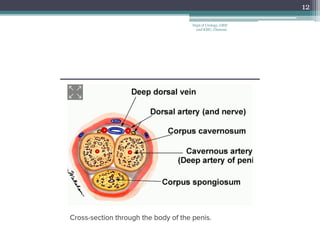
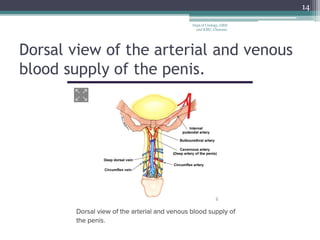
• The penis is supplied by a superficial system of arteries
that arise from the external pudendal arteries and
a deep system of arteries that stem from the internal
pudendal arteries .
• The superficial blood supply lies in the superficial penile
fascia and supplies the penile skin and prepuce.
• The internal pudendal artery, which arises from the
hypogastric artery, gives rise to the penile artery.
• The penile artery then gives rise to the bulbourethral
artery, the urethral artery, and the cavernous artery
(deep artery of the penis) before terminating as the
dorsal artery of the penis.
10
Dept of Urology, GRH
and KMC, Chennai.
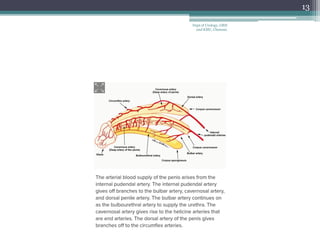
• The arterial blood supply of the penis arises
from the internal pudendal artery. The internal
pudendal artery gives off branches to the bulbar
artery, cavernosal artery, and dorsal penile
artery. The bulbar artery continues on as the
bulbourethral artery to supply the urethra. The
cavernosal artery gives rise to the helicine
arteries that are end arteries. The dorsal artery
of the penis gives branches off to the circumflex
arteries.
11
Dept of Urology, GRH
and KMC, Chennai.
12
Dept of Urology, GRH
and KMC, Chennai.
13
Dept of Urology, GRH
and KMC, Chennai.
Dorsal view of the arterial and venous
blood supply of the penis.
14
Dept of Urology, GRH
and KMC, Chennai.
• Somatic nerve supply to the penis comes by way of
the pudendal nerves, which eventually produce the
dorsal nerves of the penis on each side.
• Although cutaneous innervation to the penis is
primarily from branches of the pudendal nerve, the
proximal portion is supplied by the ilioinguinal
nerve after it leaves the superficial inguinal ring.
• The prepuce has somatosensory innervation by
the dorsal nerve of the penis and branches of the
perineal nerve.
• The glans is primarily innervated by free nerve
endings and has poor fine-touch discrimination.
15
Dept of Urology, GRH
and KMC, Chennai.
Etiology
• Physiologic phimosis is the rule in newborn males.
Formation of the prepuce is complete by 16 weeks'
gestation. The inner prepuce and glans penis share a
common, fused mucosal epithelium at birth. This
epithelium separates via desquamation over time as
the proper hormonal and growth factors are
produced. Thus, neonatal circumcision is a surgical
treatment of normal anatomy.
• Pathologic, or true, phimosis has several different
etiologies. The most common cause is infection,
such as posthitis, balanitis, or a combination of the
two (balanoposthitis). Diabetes mellitus may
predispose to such infections.
16
Dept of Urology, GRH
and KMC, Chennai.
Adult circumcision is most commonly performed to correct
phimosis. When circumcision is performed for phimosis,
25%-46% of removed foreskins are histologically normal.
Other indications for adult circumcision include the following:
• Balanitis xerotica obliterans (BXO)
• Infection without phimosis
• Paraphimosis
• Bowen disease
• Carcinoma
• Condylomas (warts)
• Trauma
• Religious or social reasons
• Disease prophylaxis (eg, HIV infection)
• Personal preference
17
Dept of Urology, GRH
and KMC, Chennai.
Pathophysiology
• The foreskin of an uncircumcised child should not
be forcefully retracted. This may result in significant
bleeding, as well as glanular excoriation and injury.
Consequently, dense fibrous adhesions may form
during the healing process, leading to true
pathologic phimosis.
• Adult phimosis may be caused by repeated episodes
of balanitis or balanoposthitis. Such infections are
commonly due to poor personal hygiene (failure to
regularly clean under the foreskin).
18
Dept of Urology, GRH
and KMC, Chennai.
• Phimosis may be a presenting symptom of early
diabetes mellitus. When the residual urine of a
patient with diabetes mellitus becomes trapped
under the foreskin, the combination of a moist
environment and glucose in the urine may lead
to a proliferation of bacteria, with subsequent
infection, scarring, and eventual phimosis.
19
Dept of Urology, GRH
and KMC, Chennai.
Prognosis
• Phimosis does not recur after proper circumcision.
• If too much penile skin is left, a repeat circumcision
may be necessary for medical or cosmetic reasons.
• In adults, some permanent skin-color discrepancy
along the suture line of the circumcision may occur.
• Overall, careful attention to proper surgical
technique will allow for a pleasing cosmetic result.
20
Dept of Urology, GRH
and KMC, Chennai.
History
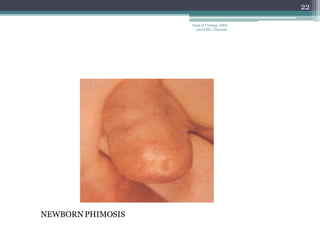
• Congenital or physiologic phimosis is clinically
asymptomatic so is not a cause for concern.
• It is often associated with "ballooning" of the
foreskin during voiding. This is a self-limited
phenomenon that, in the absence of pathologic
phimosis, does not indicate urinary tract
obstruction.
21
Dept of Urology, GRH
and KMC, Chennai.
NEWBORN PHIMOSIS
22
Dept of Urology, GRH
and KMC, Chennai.
• Pathologic, or true, phimosis is far less common.
Symptoms include skin irritation, dysuria, bleeding,
and occasionally enuresis or urinary retention.
Physical examination usually reveals white
cicatricial scarring at the preputial ring.
• Pathologic phimosis may be due to balanitis xerotica
obliterans (BXO), a genital form of lichen sclerosus
et atrophicus.
• The etiology of BXO is unknown, and it may
represent a premalignant state. Clinically, it
presents as severe phimosis and possibly meatal
stenosis, glanular lesions, or both.
23
Dept of Urology, GRH
and KMC, Chennai.
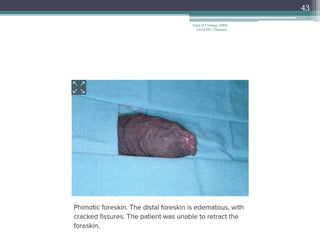
• In older men, when the phimosis is severe, the distal
foreskin often appears swollen and erythematous
with cracked fissures .
• Men who are affected report pain and discomfort
during sexual activity or when they attempt to
retract the foreskin.
• Unlike in the pediatric population, lower urinary
tract voiding symptoms are absent.
• In older men, acquired phimosis is often associated
with poor hygiene but may be a product of diabetes
mellitus.
24
Dept of Urology, GRH
and KMC, Chennai.
Physical Examination
• All uncircumcised adult men should have the
foreskin retracted to exclude occult carcinoma as
a part of a complete urologic examination.
• Squamous cell carcinoma of the penis may
manifest as an ulcerated fungating mass of the
glans or the prepuce.
• Alternatively, carcinoma in situ or penile
carcinoma may appear as a velvety macular
lesion of the glans (erythroplasia of Queyrat) or
the penile shaft (Bowen disease).
25
Dept of Urology, GRH
and KMC, Chennai.
Phimosis
• Physical examination usually reveals white
cicatricial scarring at the preputial ring.
Meuli et al devised the following scoring system
to rate the severity of phimosis: [32]
• Grade I - Fully retractable prepuce with stenotic ring
in the shaft
• Grade II - Partial retractability with partial exposure
of the glans
• Grade III - Partial retractability with exposure of the
meatus only
• Grade IV - No retractability
26
Dept of Urology, GRH
and KMC, Chennai.
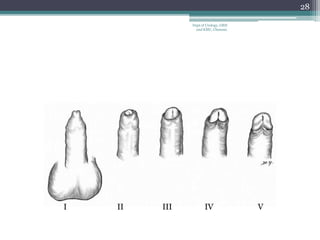
The preputial types can be classified according their
retractability
• In Type I the preputial orifice is too narrow and its retraction
cannot expose the urethral meatus.
This type of prepuce causes ballooning during urination. In
• Type II the preputial opening allows only exposure of the
meatus when retracted.
• In Type III the preputium can be retracted to expose only the
distal half of the glans.
• In Type IV most of the glans can be exposed, but because of
adhesions between the inner leaf of the preputium and the
corona the coronal sulcus cannot be exposed.
• Type V is the normal preputium that can be retracted below
the coronal sulcus without any difficulty.
27
Dept of Urology, GRH
and KMC, Chennai.
I II III IV V
28
Dept of Urology, GRH
and KMC, Chennai.
Medical Care
• Applications of steroid creams
(0.05% betamethasone) have been used to
manage phimosis medically. [33] The usual
regimen is application of the steroid cream once
or twice daily for 4-6 weeks. Studies have shown
a success rate of 87% with this treatment.
• Higher rates of success have been reported with
concomitant preputial stretching exercises.
29
Dept of Urology, GRH
and KMC, Chennai.
• If a patient has concomitant balanitis or
balanoposthitis, depending on the etiology, he
may be treated with topical antibiotics or
antifungals.
• Patients with diabetes mellitus should be
advised on proper serum glucose control.
30
Dept of Urology, GRH
and KMC, Chennai.
• Conservative Surgical Alternatives :
Preputioplasty is the medical term for
plastic surgery of the phimotic prepuce.
•preservation of foreskin, erogenous, and sexual
physiologic functions
•Disadvantages : recurrence
• Other methods : Frenulotomy and meatoplasty
is also beneficial
Y- and V-plasties (The Ebbehoj procedure)
• Conventional Male Circumcision
31
Dept of Urology, GRH
and KMC, Chennai.
Surgical Therapy:CIRCUMCISION
• The word circumcision comes from Latin:
circum=around, and caedere = to cut.
• It is the most performed surgical intervention
all over the world, done mainly for religious and
then for medical reasons, from birth to
adulthood.
• The goal of circumcision is to remove enough
preputial skin to ensure that no part of the glans
remains covered by it when the penis is flaccid.
32
Dept of Urology, GRH
and KMC, Chennai.
HISTORY
• some have suggested that this procedure likely
originated in Egypt some 15,000 years ago and that
its practice later spread throughout the world during
prehistoric human migrations.
• Egyptian mummies and wall carvings discovered in
the 19th century offer some of the earliest records of
circumcision dating this procedure to at least 6000
years BC.
• However, other authors believe that circumcision
developed independently in different cultures. For
example, on his arrival to the New World, Columbus
found that many of the natives were already
circumcised.
33
Dept of Urology, GRH
and KMC, Chennai.
• Many cultures have historically used circumcision
for hygienic reasons while others performed it as a
rite of passage to manhood, as a mark of cultural
identity (similar to a tattoo), or as a ceremonial
offering to the gods.
• Ritual circumcisions in Middle Eastern cultures
have been practiced for at least 3000 years.
• Late in the 19th century, this ancient ritual evolved
into routine medical practice influenced by reports
that associated it with miraculous cures for hernias,
paralysis, epilepsy, insanity, masturbation,
headache, strabismus, rectal prolapse,
hydrocephalus, clubfoot, asthma, enuresis, and gout.
34
Dept of Urology, GRH
and KMC, Chennai.
• Oldest documented evidence thought to date to
sixth dynasty (2345-2181 BCE) tomb artwork in
Egypt.
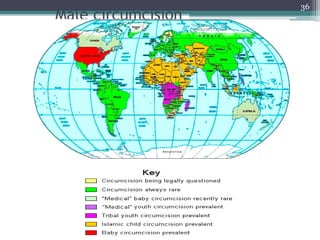
• Over 90% Religious group include jews and
muslims
35
Dept of Urology, GRH
and KMC, Chennai.
Male circumcision
36
Dept of Urology, GRH
and KMC, Chennai.
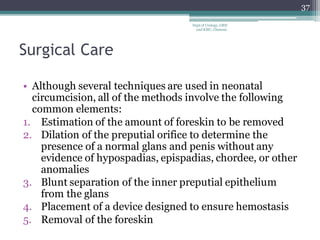
Surgical Care
• Although several techniques are used in neonatal
circumcision, all of the methods involve the following
common elements:
1. Estimation of the amount of foreskin to be removed
2. Dilation of the preputial orifice to determine the
presence of a normal glans and penis without any
evidence of hypospadias, epispadias, chordee, or other
anomalies
3. Blunt separation of the inner preputial epithelium
from the glans
4. Placement of a device designed to ensure hemostasis
5. Removal of the foreskin
37
Dept of Urology, GRH
and KMC, Chennai.
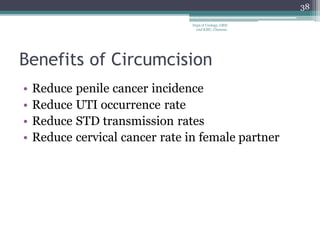
Benefits of Circumcision
• Reduce penile cancer incidence
• Reduce UTI occurrence rate
• Reduce STD transmission rates
• Reduce cervical cancer rate in female partner
38
Dept of Urology, GRH
and KMC, Chennai.
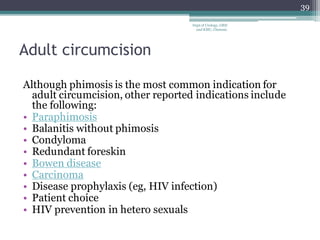
Adult circumcision
Although phimosis is the most common indication for
adult circumcision, other reported indications include
the following:
• Paraphimosis
• Balanitis without phimosis
• Condyloma
• Redundant foreskin
• Bowen disease
• Carcinoma
• Disease prophylaxis (eg, HIV infection)
• Patient choice
• HIV prevention in hetero sexuals
39
Dept of Urology, GRH
and KMC, Chennai.
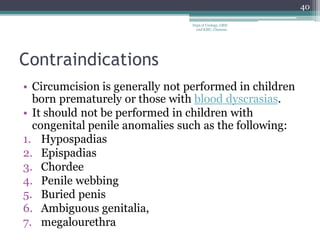
Contraindications
• Circumcision is generally not performed in children
born prematurely or those with blood dyscrasias.
• It should not be performed in children with
congenital penile anomalies such as the following:
1. Hypospadias
2. Epispadias
3. Chordee
4. Penile webbing
5. Buried penis
6. Ambiguous genitalia,
7. megalourethra
40
Dept of Urology, GRH
and KMC, Chennai.
Circumcision methods
can be classified into one of three types or
combinations thereof:
1. dorsal slit,
2. shield and clamp, and
3. excision
• In recent years, various plastic clamps have been
used
such as the Gomco, Plastibell and Shang Ring.
• These make the operation easier and quicker,
result in a neater scar and reduce the need for stitches
41
Dept of Urology, GRH
and KMC, Chennai.
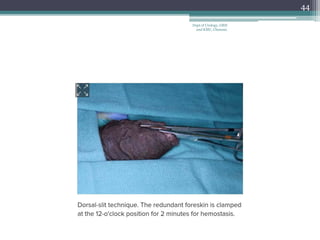
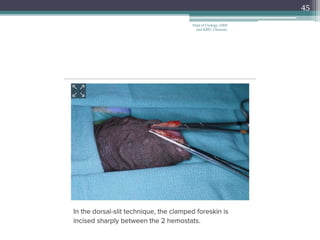
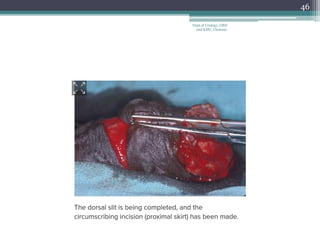
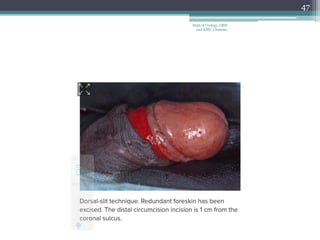
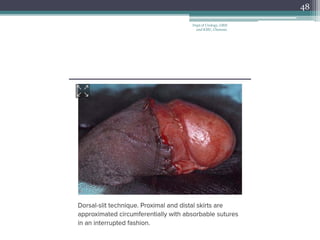
Dorsal slit technique /Free-hand circumcision:
• This is the classical surgical circumcision performed by surgeons
and done under anesthesia
• In this procedure, the prepuce is freed from the glans of
adhesions.
• Prepuce is held in artery forceps and gentle stretch
Circumferential incision in the penile skin made at the level of
corona Prepuce slit up dorsally within 1 cm from corona.
• Under surface of prepuce separated from glans .
• Leaving about 0.5cm of the inner layer of prepuce distal to
corona circumferential incision made Cutting the remaining
connective tissue completes the excision.
• Hemostasis secured by bi-Polar diathermy.
• Starting with a U-shaped hemostatic and approximating suture
applied to the frenulum, the entire cut edges are approximated
with fine sutures.
42
Dept of Urology, GRH
and KMC, Chennai.
43
Dept of Urology, GRH
and KMC, Chennai.
44
Dept of Urology, GRH
and KMC, Chennai.
45
Dept of Urology, GRH
and KMC, Chennai.
46
Dept of Urology, GRH
and KMC, Chennai.
47
Dept of Urology, GRH
and KMC, Chennai.
48
Dept of Urology, GRH
and KMC, Chennai.
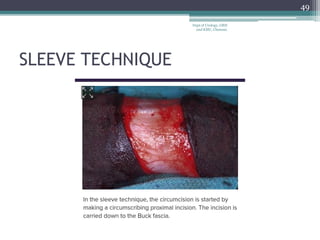
SLEEVE TECHNIQUE
49
Dept of Urology, GRH
and KMC, Chennai.
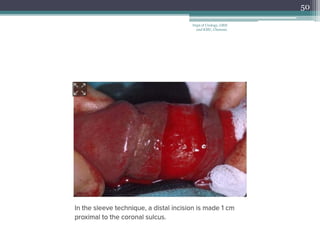
50
Dept of Urology, GRH
and KMC, Chennai.
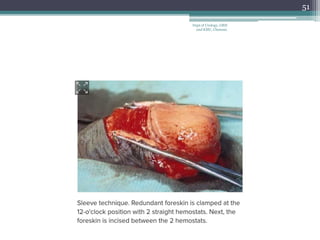
51
Dept of Urology, GRH
and KMC, Chennai.
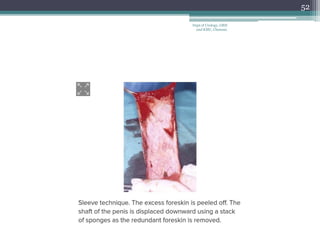
52
Dept of Urology, GRH
and KMC, Chennai.
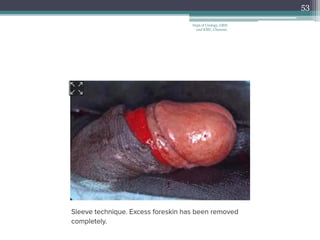
53
Dept of Urology, GRH
and KMC, Chennai.
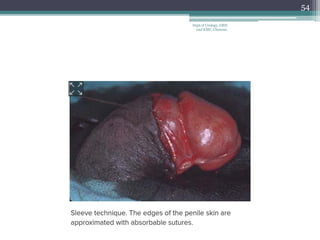
54
Dept of Urology, GRH
and KMC, Chennai.
Forceps guided circumcision
• The forceps guided circumcision method is very
similar in principle to the shield
(Mogen/Magen) circumcision.
• It is more secure than the shield circumcision in
older children and adults.
• As with the shield technique, in this technique
also the frenulum is left intact.
55
Dept of Urology, GRH
and KMC, Chennai.
• For performing the procedure, the preputium is pulled forward with
two or three hemostatic clamps placed at the transition edge of the
skin to the mucosa of the preputium.
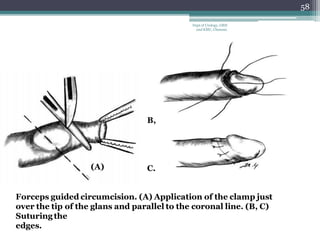
• Then a large forceps is clamped across the foreskin over the tip of
the glans.
• The forceps should be placed at an angle parallel to the base of the
corona, not straight.
• The distal preputium is cut over the crushing forceps
• The forceps has the dual function of shielding the glans and
reducing the bleeding.
• The relative amounts of inner and outer preputium remaining
depend on adjustments made before the crushing forceps is fully
closed.
• Usually, the minimum amount of inner preputial skin remaining
equals the length of the glans
56
Dept of Urology, GRH
and KMC, Chennai.
• Then the distal preputium is cut with the scalpel
over the crushing forceps.
• It is advisable to suture the edges after removing
the forceps to prevent dehiscence and secure
hemostasis.
• After removing the forceps, a hemostatic U-
suture is applied at the frenulum, then sutures
are applied at 3, 6, 9, and 12 o’clock.
• In adults, additional sutures are applied
between the quadrant sutures.
57
Dept of Urology, GRH
and KMC, Chennai.
Forceps guided circumcision. (A) Application of the clamp just
over the tip of the glans and parallel to the coronal line. (B, C)
Suturing the
edges.
(A)
B,
C.
58
Dept of Urology, GRH
and KMC, Chennai.
59
Dept of Urology, GRH
and KMC, Chennai.
The Mogen/Magen/shield
circumcision
• This is the most ancient type of religious circumcision still
used in the Jewish religion. This circumcision is performed
using a shield and scalpel blade.
• In its most classical form, the preputium is pulled out in front
of the glans, and a metal shield with a slot in it (Mogen/
Magen/shield) is slid over the preputium immediately in front
of the glans .
• The glans is protected from being cut by the shield, and the
frenulum is not touched.
• The scalpel is run across the face of the shield to remove the
preputium.
• The minimum amount of inner leaf of the preputium left is
equal to the length of the glans, and this does not necessarily
destroy the frenulum.
60
Dept of Urology, GRH
and KMC, Chennai.
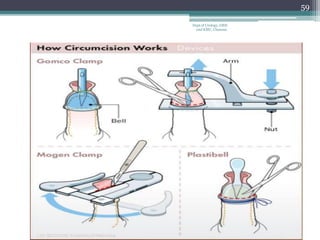
• The Mogen clamp is a variation of the classical shield . It
crushes the preputial tissue as a surgical clamp for
hemostasis.
• This is the preferred device of the more modern Jewish
Mohel (circumciser), because it removes less preputial
tissue, leaves more inner leaf of the preputium, and does
not necessarily destroy the frenulum.
• In addition, it causes less discomfort when used during
infant circumcision than does the Gomco® clamp
technique, which takes longer to perform.
• Its shortcoming is the possibility that the tip of the glans
might be caught in the clamp.
61
Dept of Urology, GRH
and KMC, Chennai.
• The more modern Mogen clamp circumcision is carried
out as follows:
• The preputial opening is entered with a blunt edged
probe to separate the preputial adhesions to the glans.
• Complete retractability of the prepuce is checked by
retracting the preputium until the corona can be seen all
around.
• The prepuce is lifted forward, the open jaws of the
Mogen clamp are placed around the prepuce (grooved
side toward the glans), and the clamp is closed, taking
care to leave the glans below the clamp.
62
Dept of Urology, GRH
and KMC, Chennai.
• The distal prepuce is excised using a scalpel blade.
• The clamp is left closed for 2–5 minutes and then opened
carefully.
• The penile skin is pulled backward to free the inner leaf
of the preputium from the glans. Care should be taken
not to separate the crushed edges at the cut line. If the
edges are separated and bleeding occurs, fine hemostatic
sutures should be applied for approximating the
separated edges (it is optional to add sutures all around).
• After covering the cut line with an antiseptic ointment, a
light dressing is wrapped around the penis.
63
Dept of Urology, GRH
and KMC, Chennai.
• Bleeding is one of the most common
complications, and can be controlled by applying
gentle circumferential pressure with gauze or a
sponge, or by using absorbable gelatin sponge
(Gelfoam®), topical thrombin, or epinephrine-
soaked gauze, or by applying sutures.
64
Dept of Urology, GRH
and KMC, Chennai.
Mogen clamp for ritual circumcision
65
Dept of Urology, GRH
and KMC, Chennai.
Instrumental circumcision
• The Gomco® clamp and the Plastibell™ are the
most widely used circumcision instruments by
physicians worldwide .
• The Plastibell is used in nearly 60% of all routine
infant circumcisions in the United States, although
the larger models are sometimes used in Europe for
performing circumcisions in teenagers and adults.
• In the USA, 40% of infant circumcisions are done
with a Gomco clamp.
• Both instruments remove a larger portion of the
inner leaf of the prepuce than do the shield or
forceps guided circumcision techniques.
66
Dept of Urology, GRH
and KMC, Chennai.
Gomco® clamp
circumcision
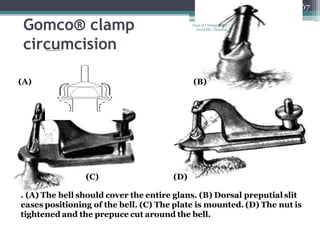
. (A) The bell should cover the entire glans. (B) Dorsal preputial slit
eases positioning of the bell. (C) The plate is mounted. (D) The nut is
tightened and the prepuce cut around the bell.
(A) (B)
(C) (D)
67
Dept of Urology, GRH
and KMC, Chennai.
Gomco® clamp circumcision
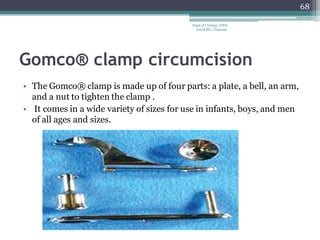
• The Gomco® clamp is made up of four parts: a plate, a bell, an arm,
and a nut to tighten the clamp .
• It comes in a wide variety of sizes for use in infants, boys, and men
of all ages and sizes.
68
Dept of Urology, GRH
and KMC, Chennai.
69
Dept of Urology, GRH
and KMC, Chennai.
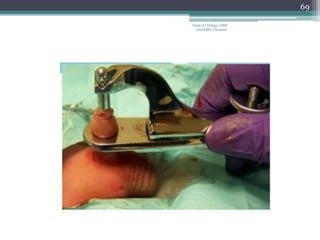
• At the beginning of the procedure, a blunt-tipped
probe is used to separate the adhesions between the
glans and the preputium so that the preputium is
completely retractile.
• The bell is introduced into the preputial cavity (over
the glans and under the foreskin) and the prepuce is
drawn over it .
• It is important to make sure that the preputial
opening is large enough to insert the bell.
• If not, the opening is stretched. If stretching does
not allow the bell to be inserted easily, a dorsal slit is
made in the preputium to enlarge its opening .
70
Dept of Urology, GRH
and KMC, Chennai.
• The preputium is retracted until the entire corona becomes
visible.
• A small amount of lubricant is applied to the glans to ease the
appropriate sized bell to slip over the glans.
• The prepuce is pulled over the bell without stretching it too
much .
Too much pulling may cause removal of too much penile shaft
skin. Also, it may even pull the urethra up, bringing it into the
cutting area, and cause a severe injury to the distal urethra.
• The appropriate plate fitting the bell of the clamp is applied at
the level of the corona and the clamp is tightened to crush the
preputial edges at the level of the corona. This tightening
exerts a crushing force on the prepuce at thejunction of the
bell and plate and prevents bleeding.
71
Dept of Urology, GRH
and KMC, Chennai.
• A circumferential incision is made using a scalpel blade. Since
Gomco® clamps are made of metal, no electrosurgical
instrument should be used for cutting the preputium.
• The clamp is left in place for at least 5 minutes to secure
hemostasis and initial adhesion of the cut skin edges.
• Then the clamp is carefully dismantled and the plate and bell
are removed, taking care not to separate the cut skin edges.
• If the crushed edges separate and bleeding occurs, fine
hemostatic sutures are applied or the edges of the skin are
sutured all around.
• If the circumcision is performed in a teenager or an adult, it is
mandatory to suture the incision line to prevent its separation
during erections.
• An antiseptic ointment is applied to the cut line and the penis
is lightly dressed.
72
Dept of Urology, GRH
and KMC, Chennai.
Plastibell circumcision
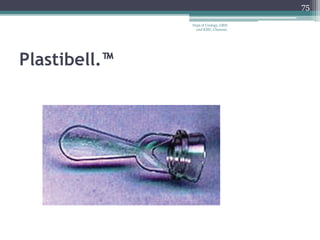
• The Plastibell is a disposable plastic bell with a
circumferential groove close to its edge.
• For performing a Plastibell circumcision the bell
is inserted over the glans and under the prepuce.
• Making a 12 o’clock incision to the prepuce
eases correct insertion of the bell .
• Then the prepuce is tied all around, over the
groove of the bell, with a tight
suture.
• The prepuce distal to the string is cut off.
73
Dept of Urology, GRH
and KMC, Chennai.
• The skin should not be pulled too tight before being
tied off. This tying ceases the blood flow to the
prepuce.
• After 7–10 days, the remaining prepuce crushed
under the suture necrotizes and falls off, providing a
bloodless circumcision.
• Because no stitches are used with a Plastibell,
usually there is no need for dressings, which makes
things very much simpler, especially with young
children who are not so cooperative.
• The difficult part of this technique is keeping the
pulled prepucein place during application of the tie.
74
Dept of Urology, GRH
and KMC, Chennai.
Plastibell.™
75
Dept of Urology, GRH
and KMC, Chennai.
SmartKlamp® circumcision
• The SmartKlamp® is an additional device for
performing an instrumental circumcision .
• The glans is first measured using the Size-O-
Meter to determine which device is required.
• As with other circumcision techniques, any
adhesions between the glans and preputium are
broken down, and the tube part of the device is
inserted between the glans and the foreskin
76
Dept of Urology, GRH
and KMC, Chennai.
• The outer portion is passed over the tube and
rotated half a turn to lock the tube to it.
• The locking arms are then half-closed to lightly hold
the foreskin. The foreskin is adjusted over the tube
so that it will be clamped at the desired place.
• The locking arms are clicked completely shut and
the excess foreskin is circumferentially cut and
removed from in front of the locking ring.
• The device is left to fall off by itself in about a week
to 10 days.
77
Dept of Urology, GRH
and KMC, Chennai.
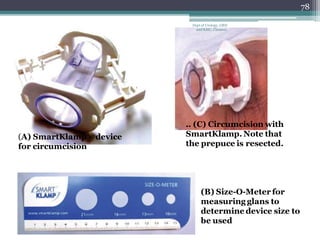
.. (C) Circumcision with
SmartKlamp. Note that
the prepuce is resected.
(A) SmartKlamp® device
for circumcision
(B) Size-O-Meter for
measuring glans to
determine device size to
be used
78
Dept of Urology, GRH
and KMC, Chennai.
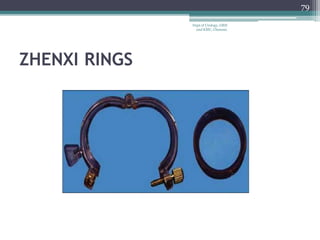
ZHENXI RINGS
79
Dept of Urology, GRH
and KMC, Chennai.
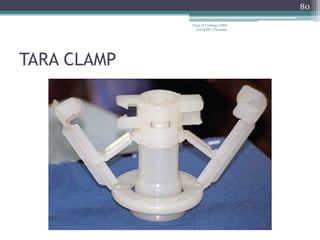
TARA CLAMP
80
Dept of Urology, GRH
and KMC, Chennai.
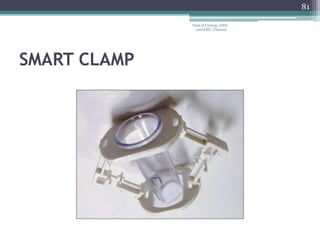
SMART CLAMP
81
Dept of Urology, GRH
and KMC, Chennai.
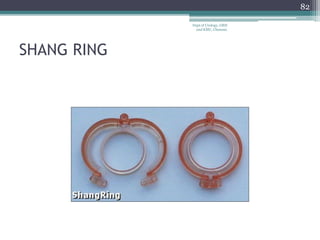
SHANG RING
82
Dept of Urology, GRH
and KMC, Chennai.
83
Dept of Urology, GRH
and KMC, Chennai.
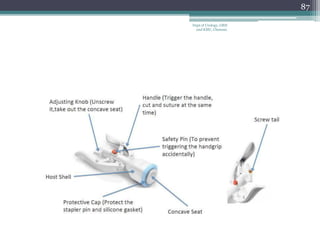
PREPEX
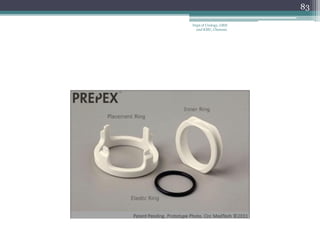
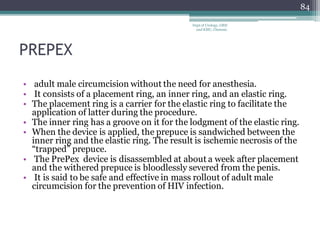
• adult male circumcision without the need for anesthesia.
• It consists of a placement ring, an inner ring, and an elastic ring.
• The placement ring is a carrier for the elastic ring to facilitate the
application of latter during the procedure.
• The inner ring has a groove on it for the lodgment of the elastic ring.
• When the device is applied, the prepuce is sandwiched between the
inner ring and the elastic ring. The result is ischemic necrosis of the
“trapped” prepuce.
• The PrePex device is disassembled at about a week after placement
and the withered prepuce is bloodlessly severed from the penis.
• It is said to be safe and effective in mass rollout of adult male
circumcision for the prevention of HIV infection.
84
Dept of Urology, GRH
and KMC, Chennai.
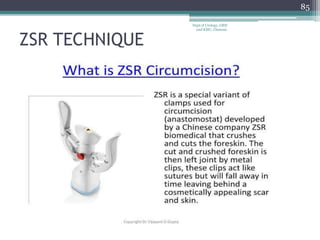
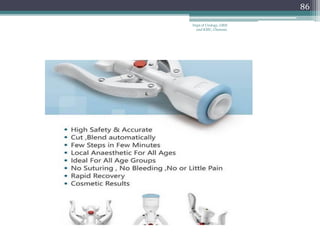
ZSR TECHNIQUE
85
Dept of Urology, GRH
and KMC, Chennai.
86
Dept of Urology, GRH
and KMC, Chennai.
87
Dept of Urology, GRH
and KMC, Chennai.
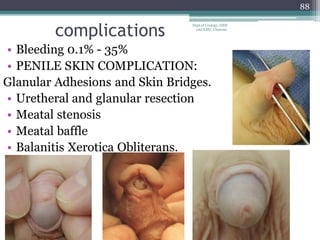
• Bleeding 0.1% - 35%
• PENILE SKIN COMPLICATION:
Glanular Adhesions and Skin Bridges.
• Uretheral and glanular resection
• Meatal stenosis
• Meatal baffle
• Balanitis Xerotica Obliterans.
complications
88
Dept of Urology, GRH
and KMC, Chennai.
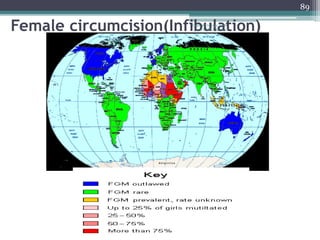
Female circumcision(Infibulation)
89
Dept of Urology, GRH
and KMC, Chennai.
Introduction
• Various forms of FGC is practiced throughout the world, but it is
most common in sub-Saharan Africa. It also exists in the Middle
East, North and South America, Indonesia and Malaysia.
• Approximately 2% of women are circumcised worldwide
• WHO definition : All procedures involving partial or total removal of
the external female genitalia or other injury to the female genital
organs whether for cultural, religious or other non-
therapeutic reasons.
• Other names are
FGC - Female Genital Cutting
FGM - Female Genital Mutilation
INFIBULATION or PHARANOIC CIRCUMCISION – closing of the
introitus
CLITORIDECTOMY
90
Dept of Urology, GRH
and KMC, Chennai.
Toubia (1994) classified the more extensive female genital mutilation
procedures according to the amount of tissue destruction:
• Type I: Complete or partial removal of the clitoris.
• Type II: Excision of the clitoris and a portion of the labia
minora.
• Type III: Excision of the entire clitoris and labia minora
with incision of the labia majora along its medial aspect
to create raw surfaces.The anterior two thirds of the
labia majora are approximated to cover the urethra and
introitus, with the lower third at the level of the posterior
fourchette left for the passage of urine and menstrual
fluid.
• Type IV: Excision of the entire clitoris and labia minora
with nearly complete approximation of the labia majora
and only a pinhole opening left near the posterior
fourchette for the passage of urine and menstrual fluid
91
Dept of Urology, GRH
and KMC, Chennai.
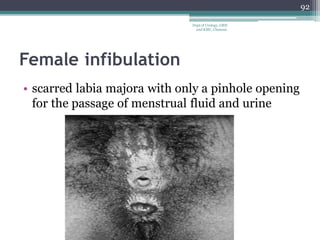
Female infibulation
• scarred labia majora with only a pinhole opening
for the passage of menstrual fluid and urine
92
Dept of Urology, GRH
and KMC, Chennai.
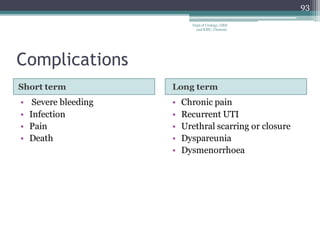
Complications
Short term Long term
• Severe bleeding
• Infection
• Pain
• Death
• Chronic pain
• Recurrent UTI
• Urethral scarring or closure
• Dyspareunia
• Dysmenorrhoea
93
Dept of Urology, GRH
and KMC, Chennai.
•THANK YOU
94
Dept of Urology, GRH
and KMC, Chennai.

Penis phimosis & circumcision

  • 1.
    Phimosis And Circumcision Deptof Urology Govt Royapettah Hospital and Kilpauk Medical College Chennai 1
  • 2.
    Moderators: Professors: • Prof. Dr.G. Sivasankar, M.S., M.Ch., • Prof. Dr. A. Senthilvel, M.S., M.Ch., Asst Professors: • Dr. J. Sivabalan, M.S., M.Ch., • Dr. R. Bhargavi, M.S., M.Ch., • Dr. S. Raju, M.S., M.Ch., • Dr. K. Muthurathinam, M.S., M.Ch., • Dr. D. Tamilselvan, M.S., M.Ch., • Dr. K. Senthilkumar, M.S., M.Ch. Dept of Urology, GRH and KMC, Chennai. 2
  • 3.
    PHIMOSIS • Phimosis isdefined as the inability of the prepuce (foreskin) to be retracted behind the glans penis in uncircumcised males. • Depending on the situation, this condition may be considered either physiologic or pathologic. • Physiologic, or congenital, phimosis is a normal condition of the newborn male. 3 Dept of Urology, GRH and KMC, Chennai.
  • 4.
    • The entityof pathologic, or true, phimosis is far less common and can affect children or adults. • This is associated with cicatricial scarring of the prepuce that is often white in appearance. • Phimosis may occur after circumcision if redundant inner prepuce slides back over the glans, with subsequent cicatricial scarring and contraction 4 Dept of Urology, GRH and KMC, Chennai.
  • 5.
    Epidemiology • Nearly allmales are born with physiologic phimosis. • Data have shown that the foreskin is retractable in 90% of boys by age 3 years. • Only 1% of boys have physiologic phimosis that persists until age 17 years. • Thus, most healthy adult men should not have phimosis; the presence of the disorder in an adult male should raise the suspicion of balanitis (infection of the foreskin), balanoposthitis (infection of glans and foreskin), diabetes, [29] or malignancy. 5 Dept of Urology, GRH and KMC, Chennai.
  • 6.
    Embryology • Developmentally, duringthe third month of intrauterine life (65 mm fetus), a fold of skin develops at the base of the glans penis. • This fold of skin grows distally from the glans penis and eventually becomes the prepuce. • The dorsal aspect of the fold grows more rapidly than the ventral aspect, initially only the dorsum of the glans penis is covered by this fold. • As the glanular urethra fuses in the midline, it carries the ventral prepuce along with it. This ventral fusion of the prepuce is marked by the frenulum. • Preputial formation is usually complete by the fifth month of intrauterine life (100 mm fetus). 6 Dept of Urology, GRH and KMC, Chennai.
  • 7.
    • The innersurface of the prepuce and epithelium of the glans, are both stratified squamous epithelium in type, and both fuses together. • Later, presumably under the influence of androgens, the squamous cells begin to keratinize and arrange themselves in whorls. The whorled cells then disintegrate so that clefts appear between the prepuce and the glans. • These clefts eventually propagate and separate the inner preputial epithelium and the epithelium of the glans from each other. This process of separation is usually incomplete at birth and continues through childhood and sometimes to adult life. 7 Dept of Urology, GRH and KMC, Chennai.
  • 8.
    Relevant Anatomy • Thepenis is composed of paired corpora cavernosa, the crura of which are attached to the pubic arch, and the corpus spongiosum . • The proximal portion of the corpus spongiosum is referred to as the bulb of the penis, and the glans represents the distal expansion. • The urethra traverses the corpus spongiosum to exit at the meatus. • The cavernosal bodies produce the male erection when they are engorged with blood. 8 Dept of Urology, GRH and KMC, Chennai.
  • 9.
    • The fasciallayers of the penis are continuous with the fascial layers of the perineum and lower abdomen. Dartos fascia represents the superficial penile fascia. • Deep to this lies the Buck fascia, which covers the tunica albuginea of the penile bodies. Proximally, the Buck fascia is in continuity with the suspensory ligament of the penis, which attaches to the symphysis pubis. 9 Dept of Urology, GRH and KMC, Chennai.
  • 10.
    • The penisis supplied by a superficial system of arteries that arise from the external pudendal arteries and a deep system of arteries that stem from the internal pudendal arteries . • The superficial blood supply lies in the superficial penile fascia and supplies the penile skin and prepuce. • The internal pudendal artery, which arises from the hypogastric artery, gives rise to the penile artery. • The penile artery then gives rise to the bulbourethral artery, the urethral artery, and the cavernous artery (deep artery of the penis) before terminating as the dorsal artery of the penis. 10 Dept of Urology, GRH and KMC, Chennai.
  • 11.
    • The arterialblood supply of the penis arises from the internal pudendal artery. The internal pudendal artery gives off branches to the bulbar artery, cavernosal artery, and dorsal penile artery. The bulbar artery continues on as the bulbourethral artery to supply the urethra. The cavernosal artery gives rise to the helicine arteries that are end arteries. The dorsal artery of the penis gives branches off to the circumflex arteries. 11 Dept of Urology, GRH and KMC, Chennai.
  • 12.
    12 Dept of Urology,GRH and KMC, Chennai.
  • 13.
    13 Dept of Urology,GRH and KMC, Chennai.
  • 14.
    Dorsal view ofthe arterial and venous blood supply of the penis. 14 Dept of Urology, GRH and KMC, Chennai.
  • 15.
    • Somatic nervesupply to the penis comes by way of the pudendal nerves, which eventually produce the dorsal nerves of the penis on each side. • Although cutaneous innervation to the penis is primarily from branches of the pudendal nerve, the proximal portion is supplied by the ilioinguinal nerve after it leaves the superficial inguinal ring. • The prepuce has somatosensory innervation by the dorsal nerve of the penis and branches of the perineal nerve. • The glans is primarily innervated by free nerve endings and has poor fine-touch discrimination. 15 Dept of Urology, GRH and KMC, Chennai.
  • 16.
    Etiology • Physiologic phimosisis the rule in newborn males. Formation of the prepuce is complete by 16 weeks' gestation. The inner prepuce and glans penis share a common, fused mucosal epithelium at birth. This epithelium separates via desquamation over time as the proper hormonal and growth factors are produced. Thus, neonatal circumcision is a surgical treatment of normal anatomy. • Pathologic, or true, phimosis has several different etiologies. The most common cause is infection, such as posthitis, balanitis, or a combination of the two (balanoposthitis). Diabetes mellitus may predispose to such infections. 16 Dept of Urology, GRH and KMC, Chennai.
  • 17.
    Adult circumcision ismost commonly performed to correct phimosis. When circumcision is performed for phimosis, 25%-46% of removed foreskins are histologically normal. Other indications for adult circumcision include the following: • Balanitis xerotica obliterans (BXO) • Infection without phimosis • Paraphimosis • Bowen disease • Carcinoma • Condylomas (warts) • Trauma • Religious or social reasons • Disease prophylaxis (eg, HIV infection) • Personal preference 17 Dept of Urology, GRH and KMC, Chennai.
  • 18.
    Pathophysiology • The foreskinof an uncircumcised child should not be forcefully retracted. This may result in significant bleeding, as well as glanular excoriation and injury. Consequently, dense fibrous adhesions may form during the healing process, leading to true pathologic phimosis. • Adult phimosis may be caused by repeated episodes of balanitis or balanoposthitis. Such infections are commonly due to poor personal hygiene (failure to regularly clean under the foreskin). 18 Dept of Urology, GRH and KMC, Chennai.
  • 19.
    • Phimosis maybe a presenting symptom of early diabetes mellitus. When the residual urine of a patient with diabetes mellitus becomes trapped under the foreskin, the combination of a moist environment and glucose in the urine may lead to a proliferation of bacteria, with subsequent infection, scarring, and eventual phimosis. 19 Dept of Urology, GRH and KMC, Chennai.
  • 20.
    Prognosis • Phimosis doesnot recur after proper circumcision. • If too much penile skin is left, a repeat circumcision may be necessary for medical or cosmetic reasons. • In adults, some permanent skin-color discrepancy along the suture line of the circumcision may occur. • Overall, careful attention to proper surgical technique will allow for a pleasing cosmetic result. 20 Dept of Urology, GRH and KMC, Chennai.
  • 21.
    History • Congenital orphysiologic phimosis is clinically asymptomatic so is not a cause for concern. • It is often associated with "ballooning" of the foreskin during voiding. This is a self-limited phenomenon that, in the absence of pathologic phimosis, does not indicate urinary tract obstruction. 21 Dept of Urology, GRH and KMC, Chennai.
  • 22.
    NEWBORN PHIMOSIS 22 Dept ofUrology, GRH and KMC, Chennai.
  • 23.
    • Pathologic, ortrue, phimosis is far less common. Symptoms include skin irritation, dysuria, bleeding, and occasionally enuresis or urinary retention. Physical examination usually reveals white cicatricial scarring at the preputial ring. • Pathologic phimosis may be due to balanitis xerotica obliterans (BXO), a genital form of lichen sclerosus et atrophicus. • The etiology of BXO is unknown, and it may represent a premalignant state. Clinically, it presents as severe phimosis and possibly meatal stenosis, glanular lesions, or both. 23 Dept of Urology, GRH and KMC, Chennai.
  • 24.
    • In oldermen, when the phimosis is severe, the distal foreskin often appears swollen and erythematous with cracked fissures . • Men who are affected report pain and discomfort during sexual activity or when they attempt to retract the foreskin. • Unlike in the pediatric population, lower urinary tract voiding symptoms are absent. • In older men, acquired phimosis is often associated with poor hygiene but may be a product of diabetes mellitus. 24 Dept of Urology, GRH and KMC, Chennai.
  • 25.
    Physical Examination • Alluncircumcised adult men should have the foreskin retracted to exclude occult carcinoma as a part of a complete urologic examination. • Squamous cell carcinoma of the penis may manifest as an ulcerated fungating mass of the glans or the prepuce. • Alternatively, carcinoma in situ or penile carcinoma may appear as a velvety macular lesion of the glans (erythroplasia of Queyrat) or the penile shaft (Bowen disease). 25 Dept of Urology, GRH and KMC, Chennai.
  • 26.
    Phimosis • Physical examinationusually reveals white cicatricial scarring at the preputial ring. Meuli et al devised the following scoring system to rate the severity of phimosis: [32] • Grade I - Fully retractable prepuce with stenotic ring in the shaft • Grade II - Partial retractability with partial exposure of the glans • Grade III - Partial retractability with exposure of the meatus only • Grade IV - No retractability 26 Dept of Urology, GRH and KMC, Chennai.
  • 27.
    The preputial typescan be classified according their retractability • In Type I the preputial orifice is too narrow and its retraction cannot expose the urethral meatus. This type of prepuce causes ballooning during urination. In • Type II the preputial opening allows only exposure of the meatus when retracted. • In Type III the preputium can be retracted to expose only the distal half of the glans. • In Type IV most of the glans can be exposed, but because of adhesions between the inner leaf of the preputium and the corona the coronal sulcus cannot be exposed. • Type V is the normal preputium that can be retracted below the coronal sulcus without any difficulty. 27 Dept of Urology, GRH and KMC, Chennai.
  • 28.
    I II IIIIV V 28 Dept of Urology, GRH and KMC, Chennai.
  • 29.
    Medical Care • Applicationsof steroid creams (0.05% betamethasone) have been used to manage phimosis medically. [33] The usual regimen is application of the steroid cream once or twice daily for 4-6 weeks. Studies have shown a success rate of 87% with this treatment. • Higher rates of success have been reported with concomitant preputial stretching exercises. 29 Dept of Urology, GRH and KMC, Chennai.
  • 30.
    • If apatient has concomitant balanitis or balanoposthitis, depending on the etiology, he may be treated with topical antibiotics or antifungals. • Patients with diabetes mellitus should be advised on proper serum glucose control. 30 Dept of Urology, GRH and KMC, Chennai.
  • 31.
    • Conservative SurgicalAlternatives : Preputioplasty is the medical term for plastic surgery of the phimotic prepuce. •preservation of foreskin, erogenous, and sexual physiologic functions •Disadvantages : recurrence • Other methods : Frenulotomy and meatoplasty is also beneficial Y- and V-plasties (The Ebbehoj procedure) • Conventional Male Circumcision 31 Dept of Urology, GRH and KMC, Chennai.
  • 32.
    Surgical Therapy:CIRCUMCISION • Theword circumcision comes from Latin: circum=around, and caedere = to cut. • It is the most performed surgical intervention all over the world, done mainly for religious and then for medical reasons, from birth to adulthood. • The goal of circumcision is to remove enough preputial skin to ensure that no part of the glans remains covered by it when the penis is flaccid. 32 Dept of Urology, GRH and KMC, Chennai.
  • 33.
    HISTORY • some havesuggested that this procedure likely originated in Egypt some 15,000 years ago and that its practice later spread throughout the world during prehistoric human migrations. • Egyptian mummies and wall carvings discovered in the 19th century offer some of the earliest records of circumcision dating this procedure to at least 6000 years BC. • However, other authors believe that circumcision developed independently in different cultures. For example, on his arrival to the New World, Columbus found that many of the natives were already circumcised. 33 Dept of Urology, GRH and KMC, Chennai.
  • 34.
    • Many cultureshave historically used circumcision for hygienic reasons while others performed it as a rite of passage to manhood, as a mark of cultural identity (similar to a tattoo), or as a ceremonial offering to the gods. • Ritual circumcisions in Middle Eastern cultures have been practiced for at least 3000 years. • Late in the 19th century, this ancient ritual evolved into routine medical practice influenced by reports that associated it with miraculous cures for hernias, paralysis, epilepsy, insanity, masturbation, headache, strabismus, rectal prolapse, hydrocephalus, clubfoot, asthma, enuresis, and gout. 34 Dept of Urology, GRH and KMC, Chennai.
  • 35.
    • Oldest documentedevidence thought to date to sixth dynasty (2345-2181 BCE) tomb artwork in Egypt. • Over 90% Religious group include jews and muslims 35 Dept of Urology, GRH and KMC, Chennai.
  • 36.
    Male circumcision 36 Dept ofUrology, GRH and KMC, Chennai.
  • 37.
    Surgical Care • Althoughseveral techniques are used in neonatal circumcision, all of the methods involve the following common elements: 1. Estimation of the amount of foreskin to be removed 2. Dilation of the preputial orifice to determine the presence of a normal glans and penis without any evidence of hypospadias, epispadias, chordee, or other anomalies 3. Blunt separation of the inner preputial epithelium from the glans 4. Placement of a device designed to ensure hemostasis 5. Removal of the foreskin 37 Dept of Urology, GRH and KMC, Chennai.
  • 38.
    Benefits of Circumcision •Reduce penile cancer incidence • Reduce UTI occurrence rate • Reduce STD transmission rates • Reduce cervical cancer rate in female partner 38 Dept of Urology, GRH and KMC, Chennai.
  • 39.
    Adult circumcision Although phimosisis the most common indication for adult circumcision, other reported indications include the following: • Paraphimosis • Balanitis without phimosis • Condyloma • Redundant foreskin • Bowen disease • Carcinoma • Disease prophylaxis (eg, HIV infection) • Patient choice • HIV prevention in hetero sexuals 39 Dept of Urology, GRH and KMC, Chennai.
  • 40.
    Contraindications • Circumcision isgenerally not performed in children born prematurely or those with blood dyscrasias. • It should not be performed in children with congenital penile anomalies such as the following: 1. Hypospadias 2. Epispadias 3. Chordee 4. Penile webbing 5. Buried penis 6. Ambiguous genitalia, 7. megalourethra 40 Dept of Urology, GRH and KMC, Chennai.
  • 41.
    Circumcision methods can beclassified into one of three types or combinations thereof: 1. dorsal slit, 2. shield and clamp, and 3. excision • In recent years, various plastic clamps have been used such as the Gomco, Plastibell and Shang Ring. • These make the operation easier and quicker, result in a neater scar and reduce the need for stitches 41 Dept of Urology, GRH and KMC, Chennai.
  • 42.
    Dorsal slit technique/Free-hand circumcision: • This is the classical surgical circumcision performed by surgeons and done under anesthesia • In this procedure, the prepuce is freed from the glans of adhesions. • Prepuce is held in artery forceps and gentle stretch Circumferential incision in the penile skin made at the level of corona Prepuce slit up dorsally within 1 cm from corona. • Under surface of prepuce separated from glans . • Leaving about 0.5cm of the inner layer of prepuce distal to corona circumferential incision made Cutting the remaining connective tissue completes the excision. • Hemostasis secured by bi-Polar diathermy. • Starting with a U-shaped hemostatic and approximating suture applied to the frenulum, the entire cut edges are approximated with fine sutures. 42 Dept of Urology, GRH and KMC, Chennai.
  • 43.
    43 Dept of Urology,GRH and KMC, Chennai.
  • 44.
    44 Dept of Urology,GRH and KMC, Chennai.
  • 45.
    45 Dept of Urology,GRH and KMC, Chennai.
  • 46.
    46 Dept of Urology,GRH and KMC, Chennai.
  • 47.
    47 Dept of Urology,GRH and KMC, Chennai.
  • 48.
    48 Dept of Urology,GRH and KMC, Chennai.
  • 49.
    SLEEVE TECHNIQUE 49 Dept ofUrology, GRH and KMC, Chennai.
  • 50.
    50 Dept of Urology,GRH and KMC, Chennai.
  • 51.
    51 Dept of Urology,GRH and KMC, Chennai.
  • 52.
    52 Dept of Urology,GRH and KMC, Chennai.
  • 53.
    53 Dept of Urology,GRH and KMC, Chennai.
  • 54.
    54 Dept of Urology,GRH and KMC, Chennai.
  • 55.
    Forceps guided circumcision •The forceps guided circumcision method is very similar in principle to the shield (Mogen/Magen) circumcision. • It is more secure than the shield circumcision in older children and adults. • As with the shield technique, in this technique also the frenulum is left intact. 55 Dept of Urology, GRH and KMC, Chennai.
  • 56.
    • For performingthe procedure, the preputium is pulled forward with two or three hemostatic clamps placed at the transition edge of the skin to the mucosa of the preputium. • Then a large forceps is clamped across the foreskin over the tip of the glans. • The forceps should be placed at an angle parallel to the base of the corona, not straight. • The distal preputium is cut over the crushing forceps • The forceps has the dual function of shielding the glans and reducing the bleeding. • The relative amounts of inner and outer preputium remaining depend on adjustments made before the crushing forceps is fully closed. • Usually, the minimum amount of inner preputial skin remaining equals the length of the glans 56 Dept of Urology, GRH and KMC, Chennai.
  • 57.
    • Then thedistal preputium is cut with the scalpel over the crushing forceps. • It is advisable to suture the edges after removing the forceps to prevent dehiscence and secure hemostasis. • After removing the forceps, a hemostatic U- suture is applied at the frenulum, then sutures are applied at 3, 6, 9, and 12 o’clock. • In adults, additional sutures are applied between the quadrant sutures. 57 Dept of Urology, GRH and KMC, Chennai.
  • 58.
    Forceps guided circumcision.(A) Application of the clamp just over the tip of the glans and parallel to the coronal line. (B, C) Suturing the edges. (A) B, C. 58 Dept of Urology, GRH and KMC, Chennai.
  • 59.
    59 Dept of Urology,GRH and KMC, Chennai.
  • 60.
    The Mogen/Magen/shield circumcision • Thisis the most ancient type of religious circumcision still used in the Jewish religion. This circumcision is performed using a shield and scalpel blade. • In its most classical form, the preputium is pulled out in front of the glans, and a metal shield with a slot in it (Mogen/ Magen/shield) is slid over the preputium immediately in front of the glans . • The glans is protected from being cut by the shield, and the frenulum is not touched. • The scalpel is run across the face of the shield to remove the preputium. • The minimum amount of inner leaf of the preputium left is equal to the length of the glans, and this does not necessarily destroy the frenulum. 60 Dept of Urology, GRH and KMC, Chennai.
  • 61.
    • The Mogenclamp is a variation of the classical shield . It crushes the preputial tissue as a surgical clamp for hemostasis. • This is the preferred device of the more modern Jewish Mohel (circumciser), because it removes less preputial tissue, leaves more inner leaf of the preputium, and does not necessarily destroy the frenulum. • In addition, it causes less discomfort when used during infant circumcision than does the Gomco® clamp technique, which takes longer to perform. • Its shortcoming is the possibility that the tip of the glans might be caught in the clamp. 61 Dept of Urology, GRH and KMC, Chennai.
  • 62.
    • The moremodern Mogen clamp circumcision is carried out as follows: • The preputial opening is entered with a blunt edged probe to separate the preputial adhesions to the glans. • Complete retractability of the prepuce is checked by retracting the preputium until the corona can be seen all around. • The prepuce is lifted forward, the open jaws of the Mogen clamp are placed around the prepuce (grooved side toward the glans), and the clamp is closed, taking care to leave the glans below the clamp. 62 Dept of Urology, GRH and KMC, Chennai.
  • 63.
    • The distalprepuce is excised using a scalpel blade. • The clamp is left closed for 2–5 minutes and then opened carefully. • The penile skin is pulled backward to free the inner leaf of the preputium from the glans. Care should be taken not to separate the crushed edges at the cut line. If the edges are separated and bleeding occurs, fine hemostatic sutures should be applied for approximating the separated edges (it is optional to add sutures all around). • After covering the cut line with an antiseptic ointment, a light dressing is wrapped around the penis. 63 Dept of Urology, GRH and KMC, Chennai.
  • 64.
    • Bleeding isone of the most common complications, and can be controlled by applying gentle circumferential pressure with gauze or a sponge, or by using absorbable gelatin sponge (Gelfoam®), topical thrombin, or epinephrine- soaked gauze, or by applying sutures. 64 Dept of Urology, GRH and KMC, Chennai.
  • 65.
    Mogen clamp forritual circumcision 65 Dept of Urology, GRH and KMC, Chennai.
  • 66.
    Instrumental circumcision • TheGomco® clamp and the Plastibell™ are the most widely used circumcision instruments by physicians worldwide . • The Plastibell is used in nearly 60% of all routine infant circumcisions in the United States, although the larger models are sometimes used in Europe for performing circumcisions in teenagers and adults. • In the USA, 40% of infant circumcisions are done with a Gomco clamp. • Both instruments remove a larger portion of the inner leaf of the prepuce than do the shield or forceps guided circumcision techniques. 66 Dept of Urology, GRH and KMC, Chennai.
  • 67.
    Gomco® clamp circumcision . (A)The bell should cover the entire glans. (B) Dorsal preputial slit eases positioning of the bell. (C) The plate is mounted. (D) The nut is tightened and the prepuce cut around the bell. (A) (B) (C) (D) 67 Dept of Urology, GRH and KMC, Chennai.
  • 68.
    Gomco® clamp circumcision •The Gomco® clamp is made up of four parts: a plate, a bell, an arm, and a nut to tighten the clamp . • It comes in a wide variety of sizes for use in infants, boys, and men of all ages and sizes. 68 Dept of Urology, GRH and KMC, Chennai.
  • 69.
    69 Dept of Urology,GRH and KMC, Chennai.
  • 70.
    • At thebeginning of the procedure, a blunt-tipped probe is used to separate the adhesions between the glans and the preputium so that the preputium is completely retractile. • The bell is introduced into the preputial cavity (over the glans and under the foreskin) and the prepuce is drawn over it . • It is important to make sure that the preputial opening is large enough to insert the bell. • If not, the opening is stretched. If stretching does not allow the bell to be inserted easily, a dorsal slit is made in the preputium to enlarge its opening . 70 Dept of Urology, GRH and KMC, Chennai.
  • 71.
    • The preputiumis retracted until the entire corona becomes visible. • A small amount of lubricant is applied to the glans to ease the appropriate sized bell to slip over the glans. • The prepuce is pulled over the bell without stretching it too much . Too much pulling may cause removal of too much penile shaft skin. Also, it may even pull the urethra up, bringing it into the cutting area, and cause a severe injury to the distal urethra. • The appropriate plate fitting the bell of the clamp is applied at the level of the corona and the clamp is tightened to crush the preputial edges at the level of the corona. This tightening exerts a crushing force on the prepuce at thejunction of the bell and plate and prevents bleeding. 71 Dept of Urology, GRH and KMC, Chennai.
  • 72.
    • A circumferentialincision is made using a scalpel blade. Since Gomco® clamps are made of metal, no electrosurgical instrument should be used for cutting the preputium. • The clamp is left in place for at least 5 minutes to secure hemostasis and initial adhesion of the cut skin edges. • Then the clamp is carefully dismantled and the plate and bell are removed, taking care not to separate the cut skin edges. • If the crushed edges separate and bleeding occurs, fine hemostatic sutures are applied or the edges of the skin are sutured all around. • If the circumcision is performed in a teenager or an adult, it is mandatory to suture the incision line to prevent its separation during erections. • An antiseptic ointment is applied to the cut line and the penis is lightly dressed. 72 Dept of Urology, GRH and KMC, Chennai.
  • 73.
    Plastibell circumcision • ThePlastibell is a disposable plastic bell with a circumferential groove close to its edge. • For performing a Plastibell circumcision the bell is inserted over the glans and under the prepuce. • Making a 12 o’clock incision to the prepuce eases correct insertion of the bell . • Then the prepuce is tied all around, over the groove of the bell, with a tight suture. • The prepuce distal to the string is cut off. 73 Dept of Urology, GRH and KMC, Chennai.
  • 74.
    • The skinshould not be pulled too tight before being tied off. This tying ceases the blood flow to the prepuce. • After 7–10 days, the remaining prepuce crushed under the suture necrotizes and falls off, providing a bloodless circumcision. • Because no stitches are used with a Plastibell, usually there is no need for dressings, which makes things very much simpler, especially with young children who are not so cooperative. • The difficult part of this technique is keeping the pulled prepucein place during application of the tie. 74 Dept of Urology, GRH and KMC, Chennai.
  • 75.
  • 76.
    SmartKlamp® circumcision • TheSmartKlamp® is an additional device for performing an instrumental circumcision . • The glans is first measured using the Size-O- Meter to determine which device is required. • As with other circumcision techniques, any adhesions between the glans and preputium are broken down, and the tube part of the device is inserted between the glans and the foreskin 76 Dept of Urology, GRH and KMC, Chennai.
  • 77.
    • The outerportion is passed over the tube and rotated half a turn to lock the tube to it. • The locking arms are then half-closed to lightly hold the foreskin. The foreskin is adjusted over the tube so that it will be clamped at the desired place. • The locking arms are clicked completely shut and the excess foreskin is circumferentially cut and removed from in front of the locking ring. • The device is left to fall off by itself in about a week to 10 days. 77 Dept of Urology, GRH and KMC, Chennai.
  • 78.
    .. (C) Circumcisionwith SmartKlamp. Note that the prepuce is resected. (A) SmartKlamp® device for circumcision (B) Size-O-Meter for measuring glans to determine device size to be used 78 Dept of Urology, GRH and KMC, Chennai.
  • 79.
    ZHENXI RINGS 79 Dept ofUrology, GRH and KMC, Chennai.
  • 80.
    TARA CLAMP 80 Dept ofUrology, GRH and KMC, Chennai.
  • 81.
    SMART CLAMP 81 Dept ofUrology, GRH and KMC, Chennai.
  • 82.
    SHANG RING 82 Dept ofUrology, GRH and KMC, Chennai.
  • 83.
    83 Dept of Urology,GRH and KMC, Chennai.
  • 84.
    PREPEX • adult malecircumcision without the need for anesthesia. • It consists of a placement ring, an inner ring, and an elastic ring. • The placement ring is a carrier for the elastic ring to facilitate the application of latter during the procedure. • The inner ring has a groove on it for the lodgment of the elastic ring. • When the device is applied, the prepuce is sandwiched between the inner ring and the elastic ring. The result is ischemic necrosis of the “trapped” prepuce. • The PrePex device is disassembled at about a week after placement and the withered prepuce is bloodlessly severed from the penis. • It is said to be safe and effective in mass rollout of adult male circumcision for the prevention of HIV infection. 84 Dept of Urology, GRH and KMC, Chennai.
  • 85.
    ZSR TECHNIQUE 85 Dept ofUrology, GRH and KMC, Chennai.
  • 86.
    86 Dept of Urology,GRH and KMC, Chennai.
  • 87.
    87 Dept of Urology,GRH and KMC, Chennai.
  • 88.
    • Bleeding 0.1%- 35% • PENILE SKIN COMPLICATION: Glanular Adhesions and Skin Bridges. • Uretheral and glanular resection • Meatal stenosis • Meatal baffle • Balanitis Xerotica Obliterans. complications 88 Dept of Urology, GRH and KMC, Chennai.
  • 89.
    Female circumcision(Infibulation) 89 Dept ofUrology, GRH and KMC, Chennai.
  • 90.
    Introduction • Various formsof FGC is practiced throughout the world, but it is most common in sub-Saharan Africa. It also exists in the Middle East, North and South America, Indonesia and Malaysia. • Approximately 2% of women are circumcised worldwide • WHO definition : All procedures involving partial or total removal of the external female genitalia or other injury to the female genital organs whether for cultural, religious or other non- therapeutic reasons. • Other names are FGC - Female Genital Cutting FGM - Female Genital Mutilation INFIBULATION or PHARANOIC CIRCUMCISION – closing of the introitus CLITORIDECTOMY 90 Dept of Urology, GRH and KMC, Chennai.
  • 91.
    Toubia (1994) classifiedthe more extensive female genital mutilation procedures according to the amount of tissue destruction: • Type I: Complete or partial removal of the clitoris. • Type II: Excision of the clitoris and a portion of the labia minora. • Type III: Excision of the entire clitoris and labia minora with incision of the labia majora along its medial aspect to create raw surfaces.The anterior two thirds of the labia majora are approximated to cover the urethra and introitus, with the lower third at the level of the posterior fourchette left for the passage of urine and menstrual fluid. • Type IV: Excision of the entire clitoris and labia minora with nearly complete approximation of the labia majora and only a pinhole opening left near the posterior fourchette for the passage of urine and menstrual fluid 91 Dept of Urology, GRH and KMC, Chennai.
  • 92.
    Female infibulation • scarredlabia majora with only a pinhole opening for the passage of menstrual fluid and urine 92 Dept of Urology, GRH and KMC, Chennai.
  • 93.
    Complications Short term Longterm • Severe bleeding • Infection • Pain • Death • Chronic pain • Recurrent UTI • Urethral scarring or closure • Dyspareunia • Dysmenorrhoea 93 Dept of Urology, GRH and KMC, Chennai.
  • 94.
    •THANK YOU 94 Dept ofUrology, GRH and KMC, Chennai.