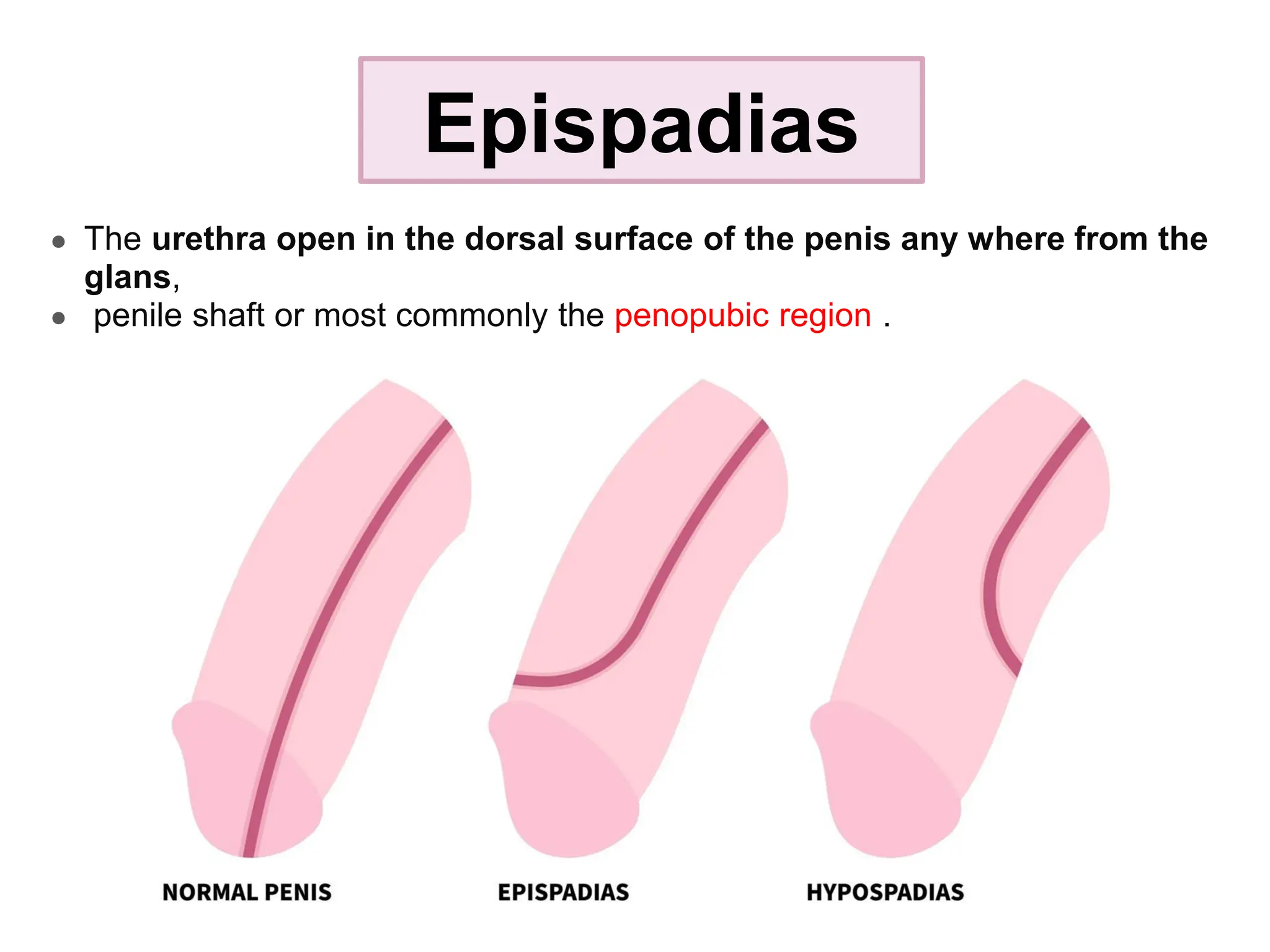
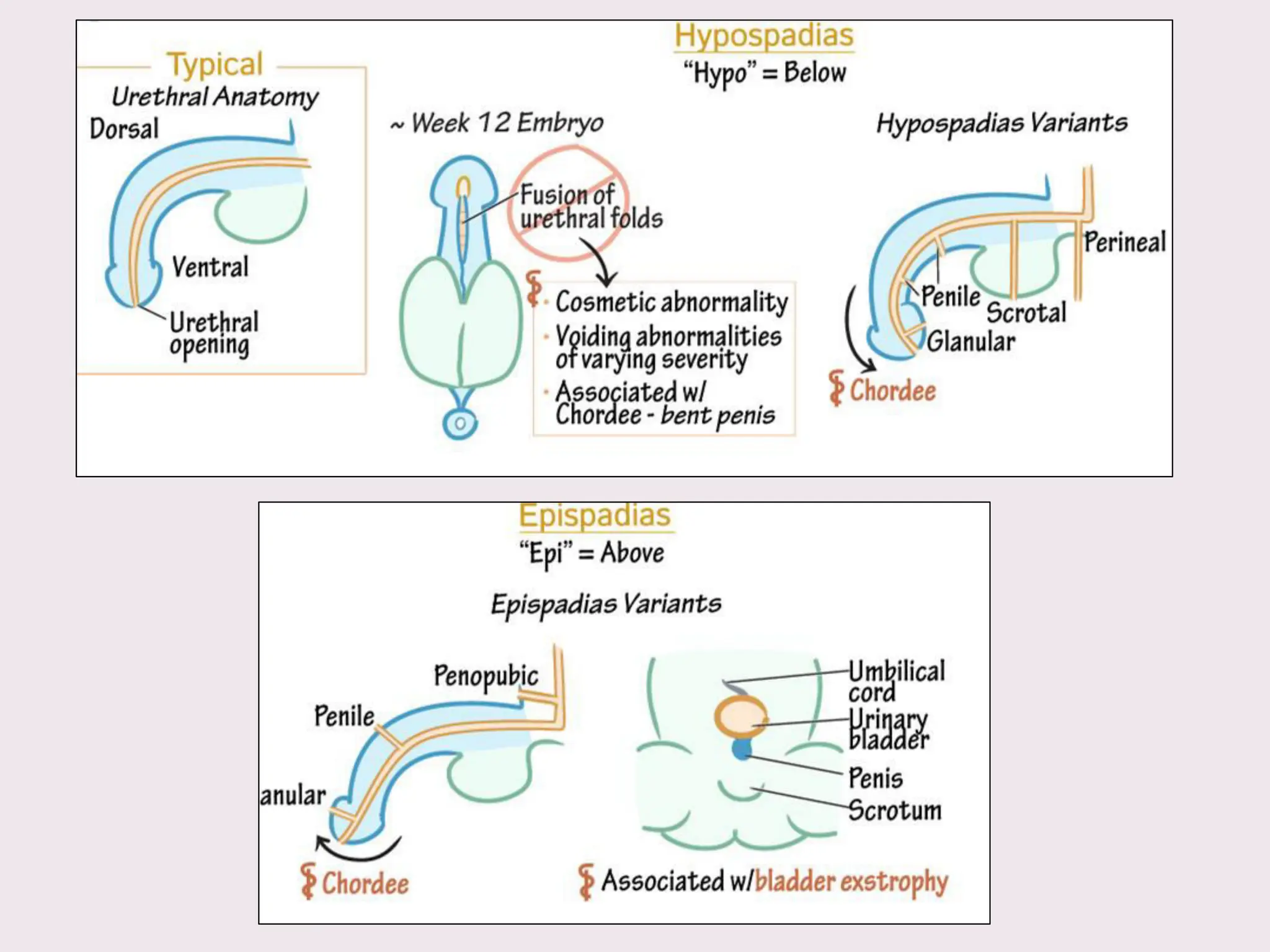
● The urethra open in the dorsal surface of the penis any where from the
glans,
● penile shaft or most commonly the penopubic region .
Epispadias
● diagnosis of epispadias and hypospadias will be obvious.
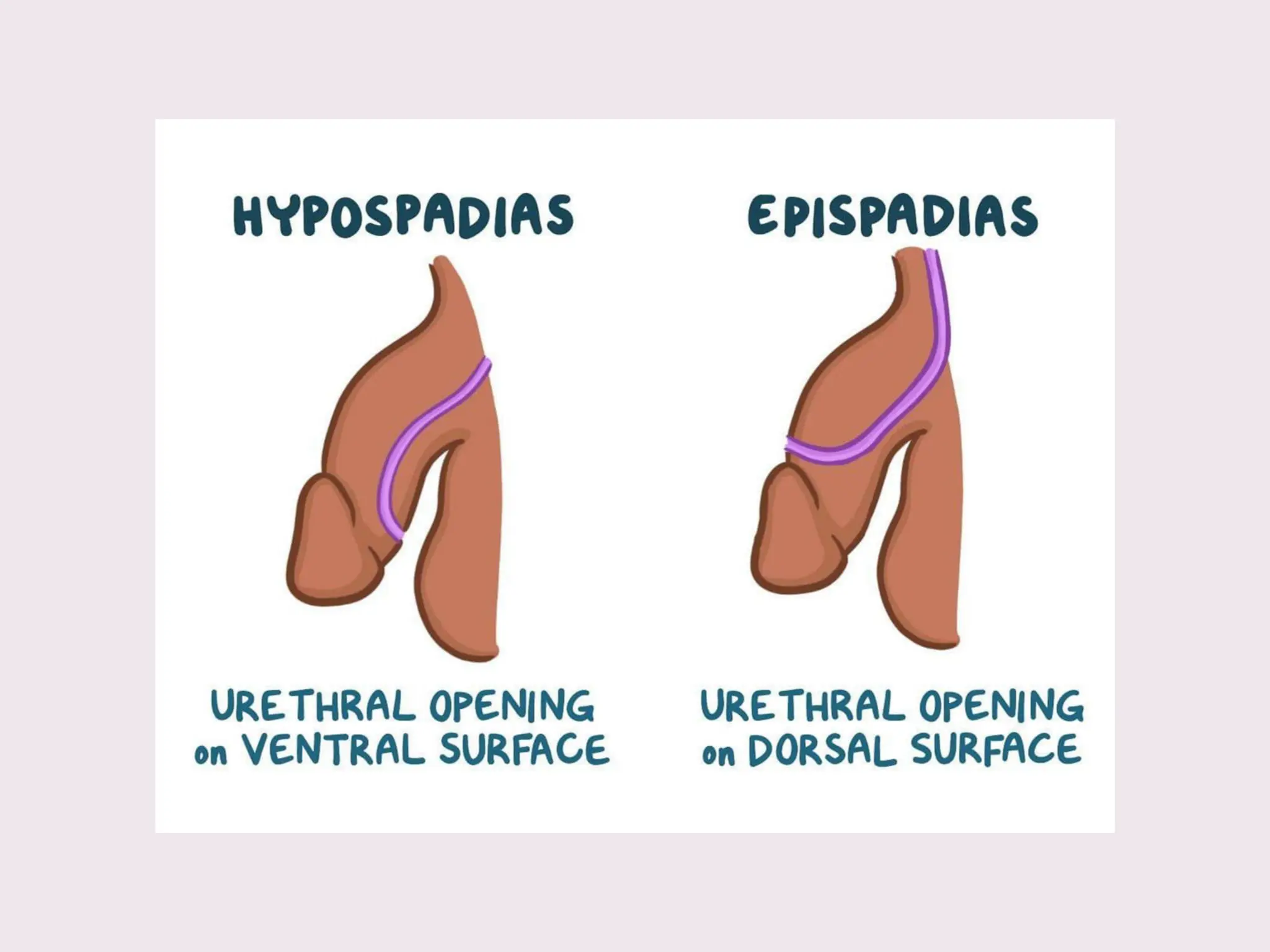
● In hypospadias, the opening of the urethra may be anywhere
along the line of the urethra, from a few millimetres from the tip of
the penis to the perineum.
● In epispadias, which is rare, the urethral opening is on the dorsal
surface of the glans penis.
● M:F 5:1
● This is rare. The patient, a baby or child, usually presents with the
urethra opening on the dorsal surface of the glans penis.
● Etiology represents failure of closure of the cloacal membrane ,
resulting in the bladder and urethra opening directly through the
abdominal wall
● High morbidity -+ incontinence , infertility , reflux .
Management
● at 6–12 months >> This involves urethroplasty with functional and cosmetic
reconstruction of the external genitalia (penile lengthening and correction of
chordee) .
● The modified Cantwell–Ransley technique is commonly used in males. It
describes mobilizing the urethra to the ventral aspect of the penis, with
advancement of the urethral meatus onto the glans with a reverse MAGPI
(meatal advancement-glanuloplasty) .
● From age 4–5 years >> when children can be toilet trained, bladder neck
reconstruction can be performed (Young–Dees–Leadbetter procedure). This
achieves continence, and any bladder residuals may then be emptied by urethral
catheterization.
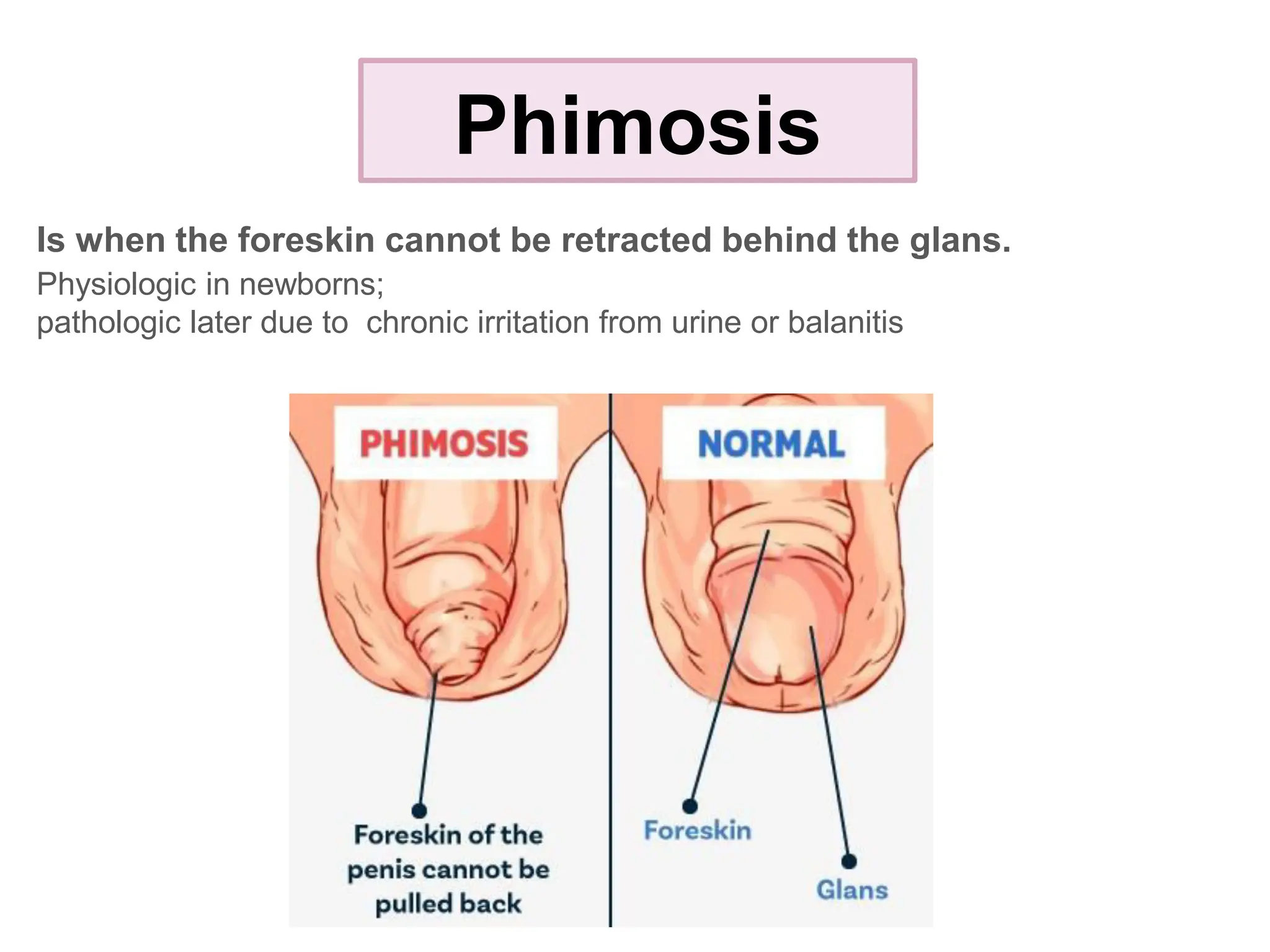
Phimosis
Is when the foreskin cannot be retracted behind the glans.
Physiologic in newborns;
pathologic later due to chronic irritation from urine or balanitis
7
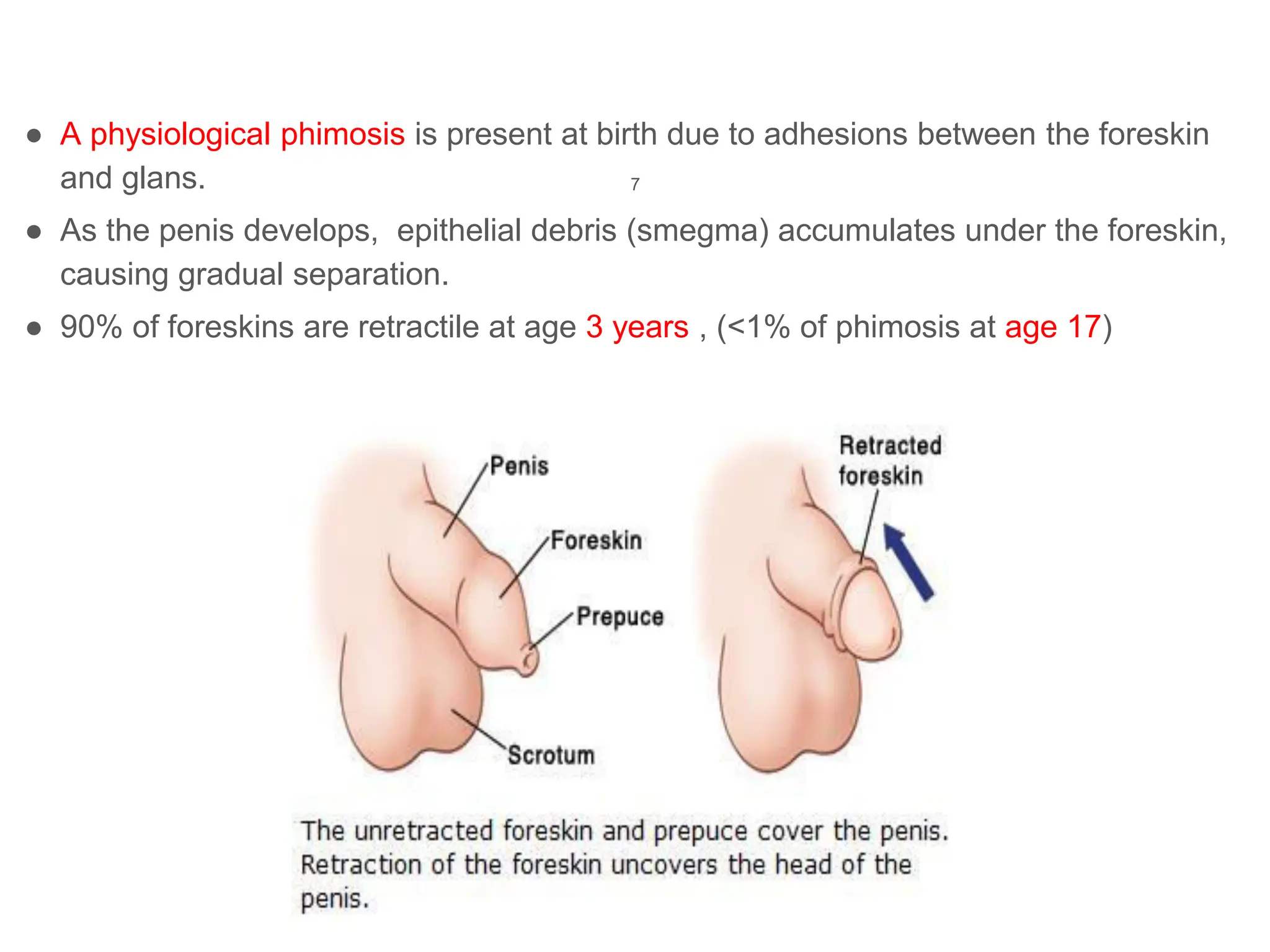
● A physiological phimosis is present at birth due to adhesions between the foreskin
and glans.
● As the penis develops, epithelial debris (smegma) accumulates under the foreskin,
causing gradual separation.
● 90% of foreskins are retractile at age 3 years , (<1% of phimosis at age 17)
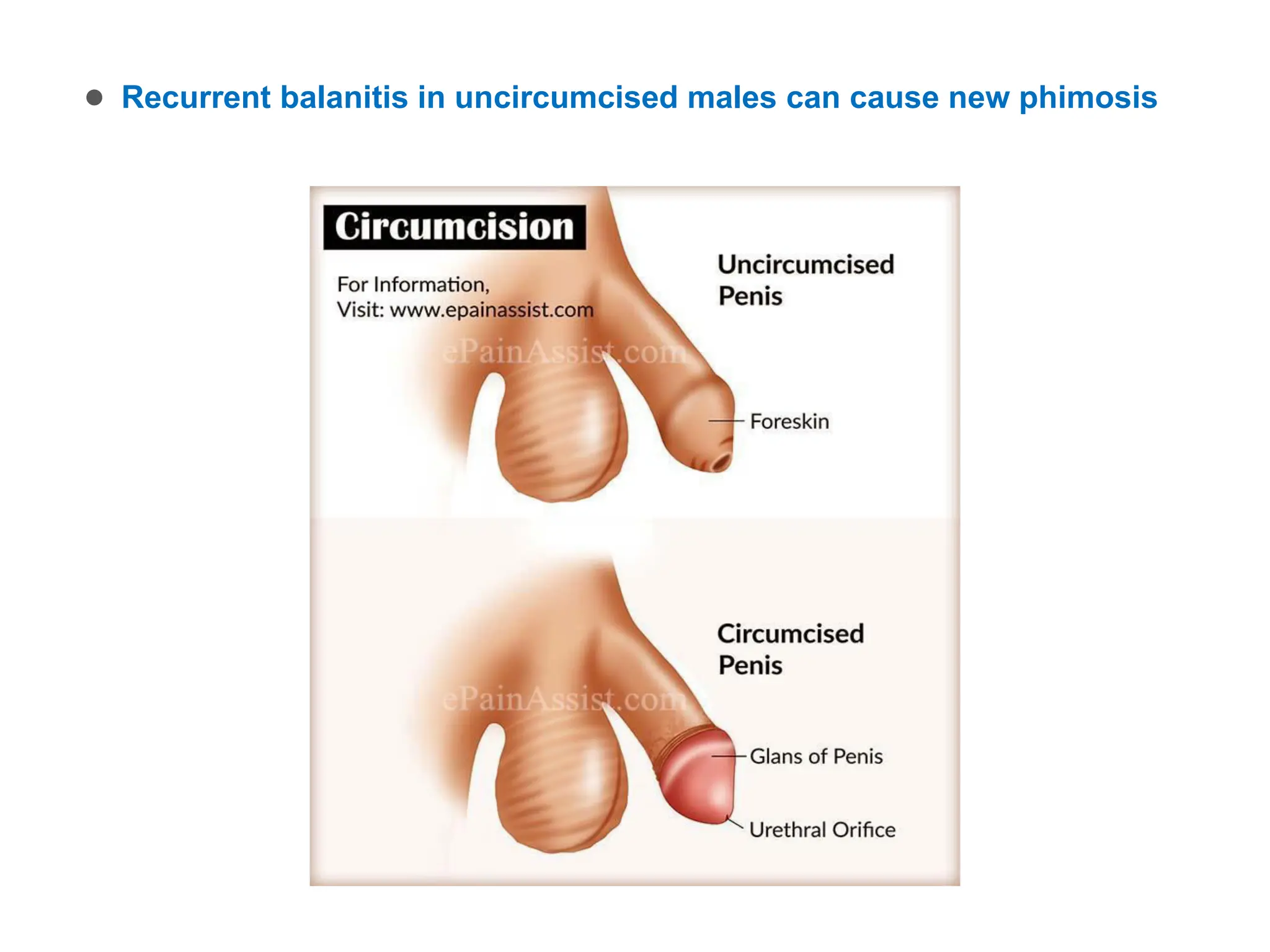
● Recurrent balanitis in uncircumcised males can cause new phimosis
● Treatment – Spontaneous resolution by 3–4 years in physiologic (due to
smegma and erections).
● Older children with phimosis, suffering recurrent infection (balanitis), can be
treated with a 6-week course of topical 0.1% dexamethasone cream, which acts
to soften the phimosis and allow foreskin retraction (avoid circumcision where
possible).
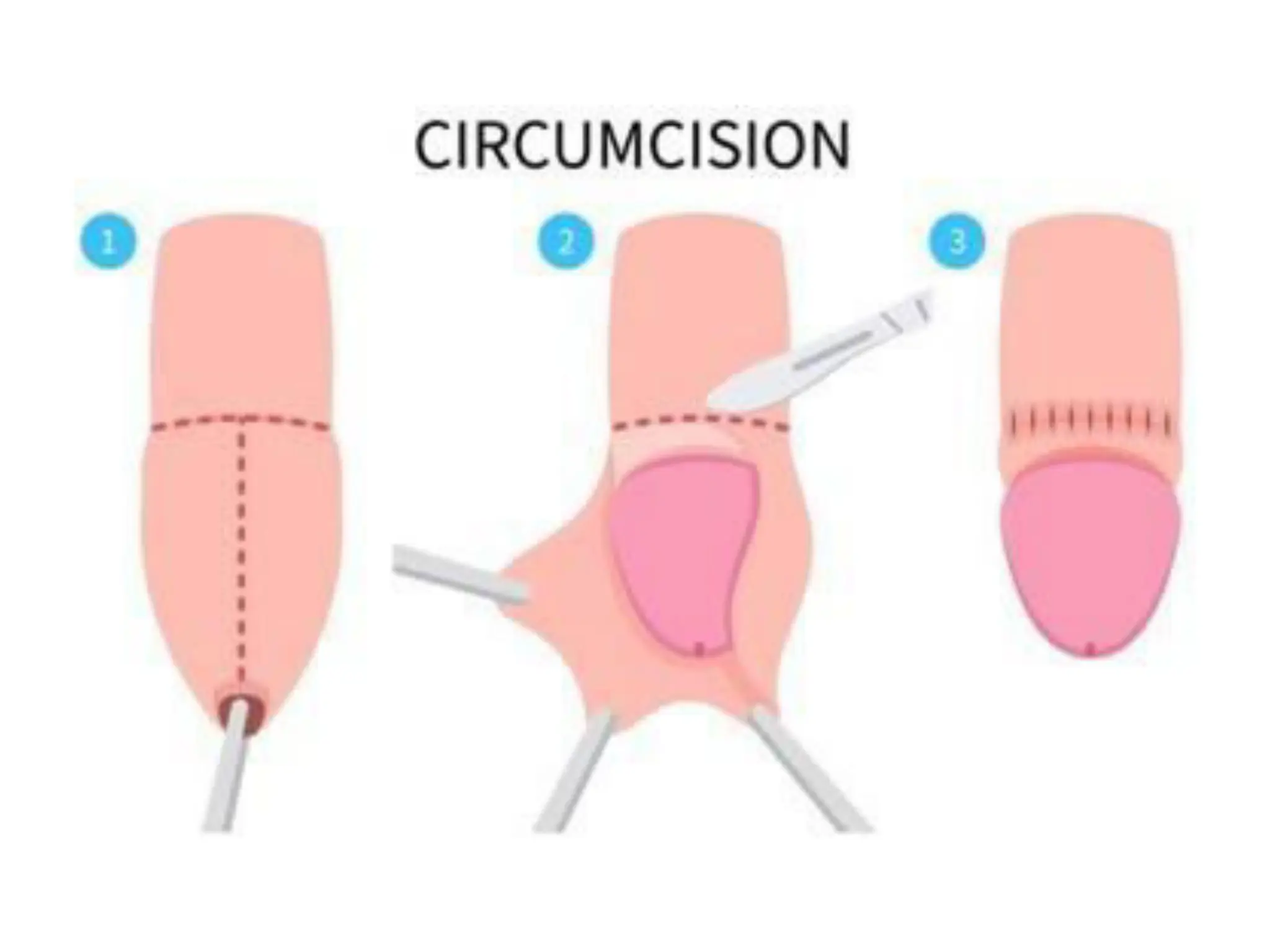
● Adults may require a dorsal slit or circumcision for recurrent balanitis, voiding
obstruction, or difficulties with sexual intercourse.a
Management
Paraphimosis
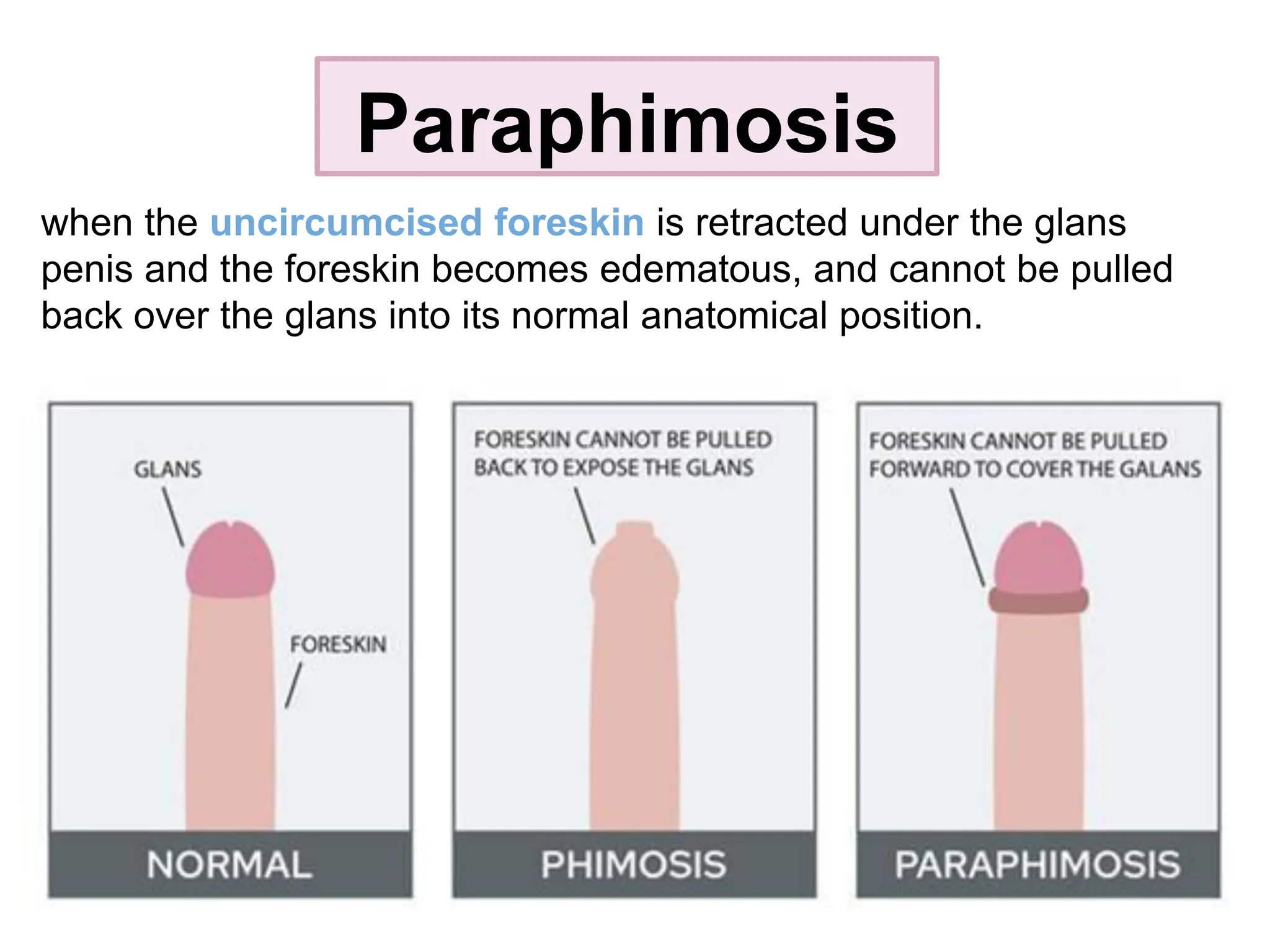
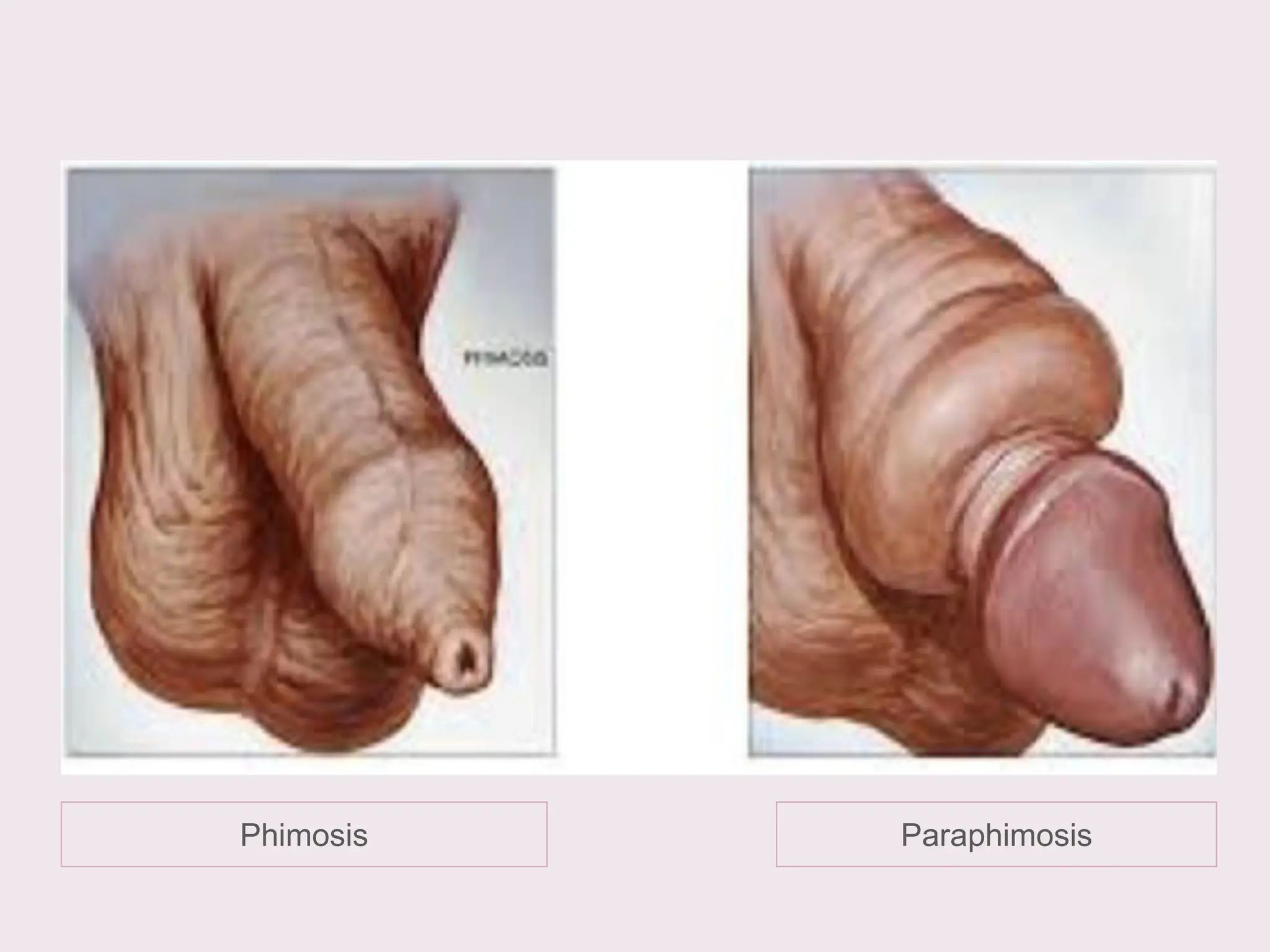
when the uncircumcised foreskin is retracted under the glans
penis and the foreskin becomes edematous, and cannot be pulled
back over the glans into its normal anatomical position.
Paraphimosis
Phimosis
● It occurs most commonly in teenagers or young men and
also in elderly men
(who have had the foreskin retracted during catheterization, but where
it has not been returned to its normal position).
● Paraphimosis is usually painful.
The foreskin is edematous and a small area of ulceration of the
foreskin may have developed.
15
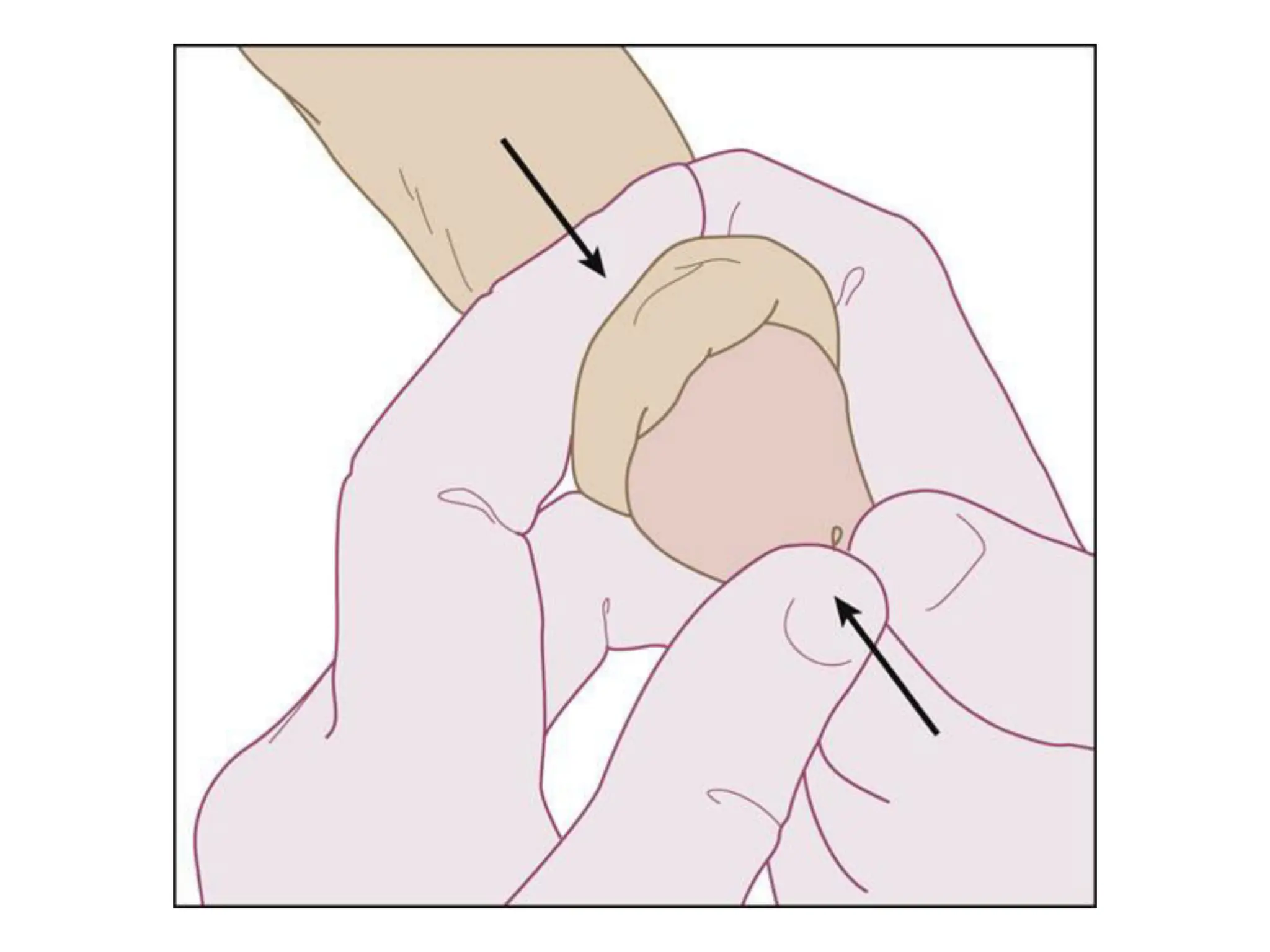
● Manual reduction is preferred using ice packs, elastic
compression, and topical anesthetic such as 2% lidocaine gel.
● Operative dorsal slit may be required in refractory cases.
● Elective circumcision for definitive treatment
(paraphimosis tends to recur).
Management
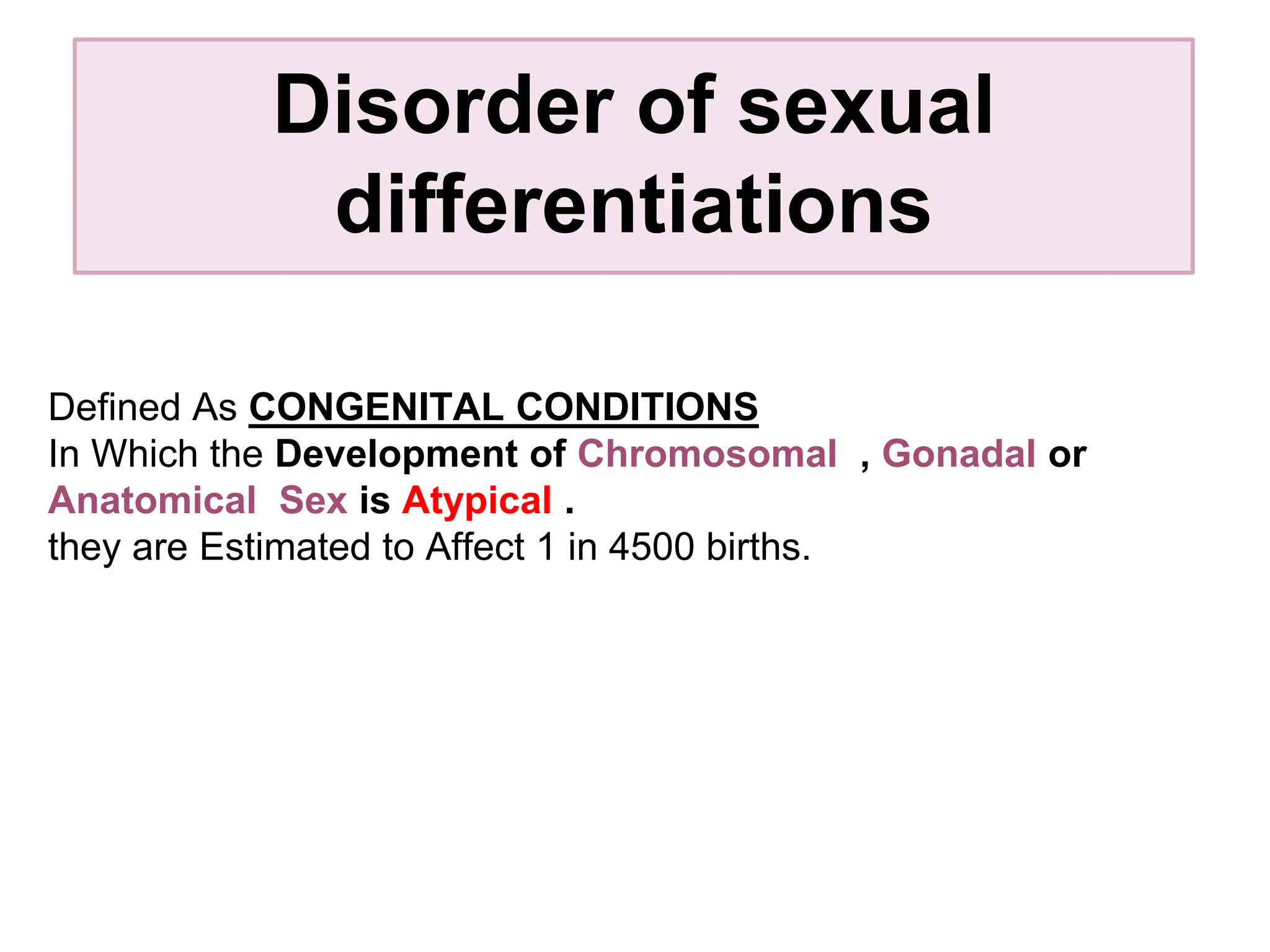
Disorder of sexual
differentiations
Defined As CONGENITAL CONDITIONS
In Which the Development of Chromosomal , Gonadal or
Anatomical Sex is Atypical .
they are Estimated to Affect 1 in 4500 births.
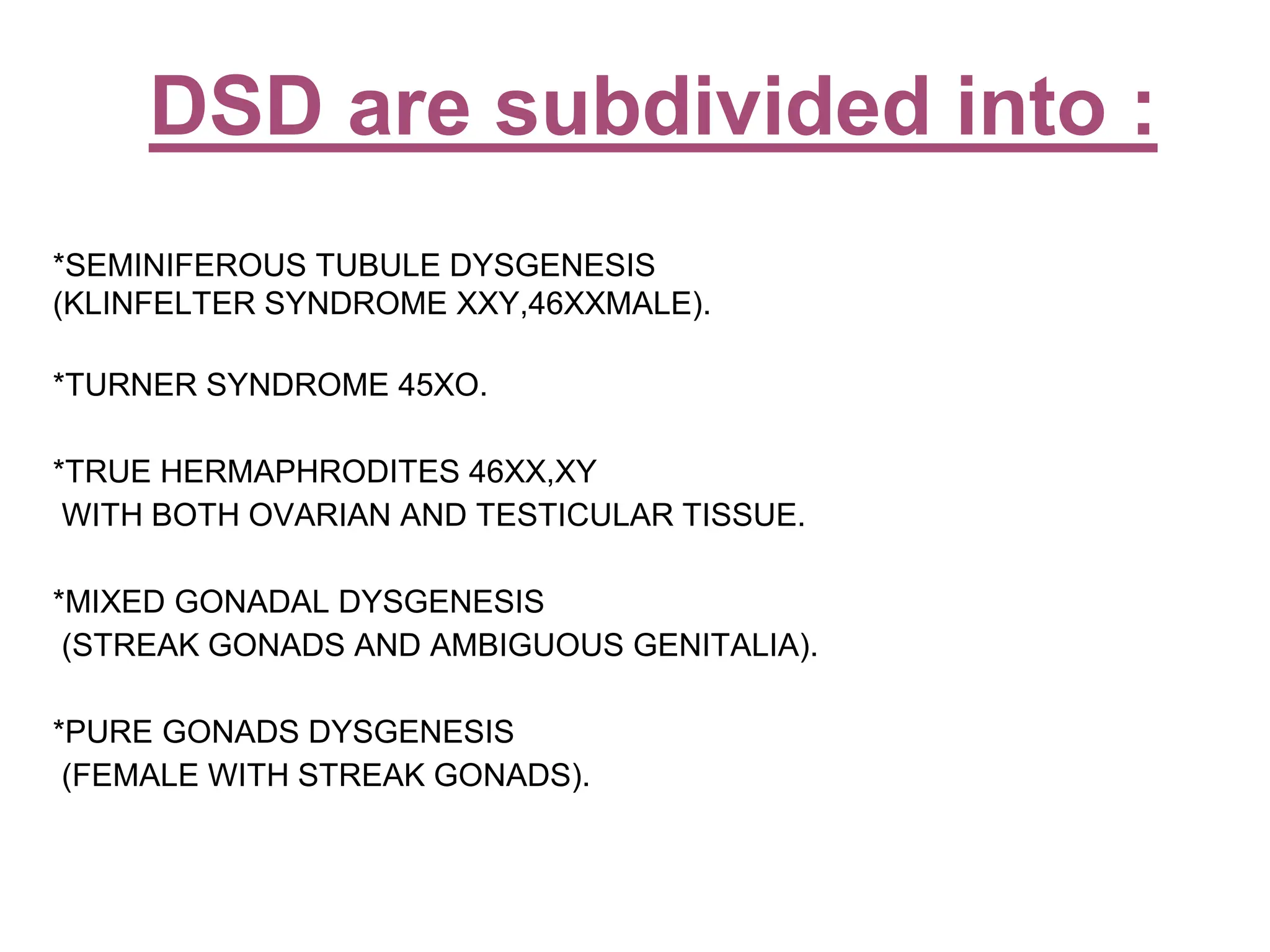
*SEMINIFEROUS TUBULE DYSGENESIS
(KLINFELTER SYNDROME XXY,46XXMALE).
*TURNER SYNDROME 45XO.
*TRUE HERMAPHRODITES 46XX,XY
WITH BOTH OVARIAN AND TESTICULAR TISSUE.
*MIXED GONADAL DYSGENESIS
(STREAK GONADS AND AMBIGUOUS GENITALIA).
*PURE GONADS DYSGENESIS
(FEMALE WITH STREAK GONADS).
DSD are subdivided into :
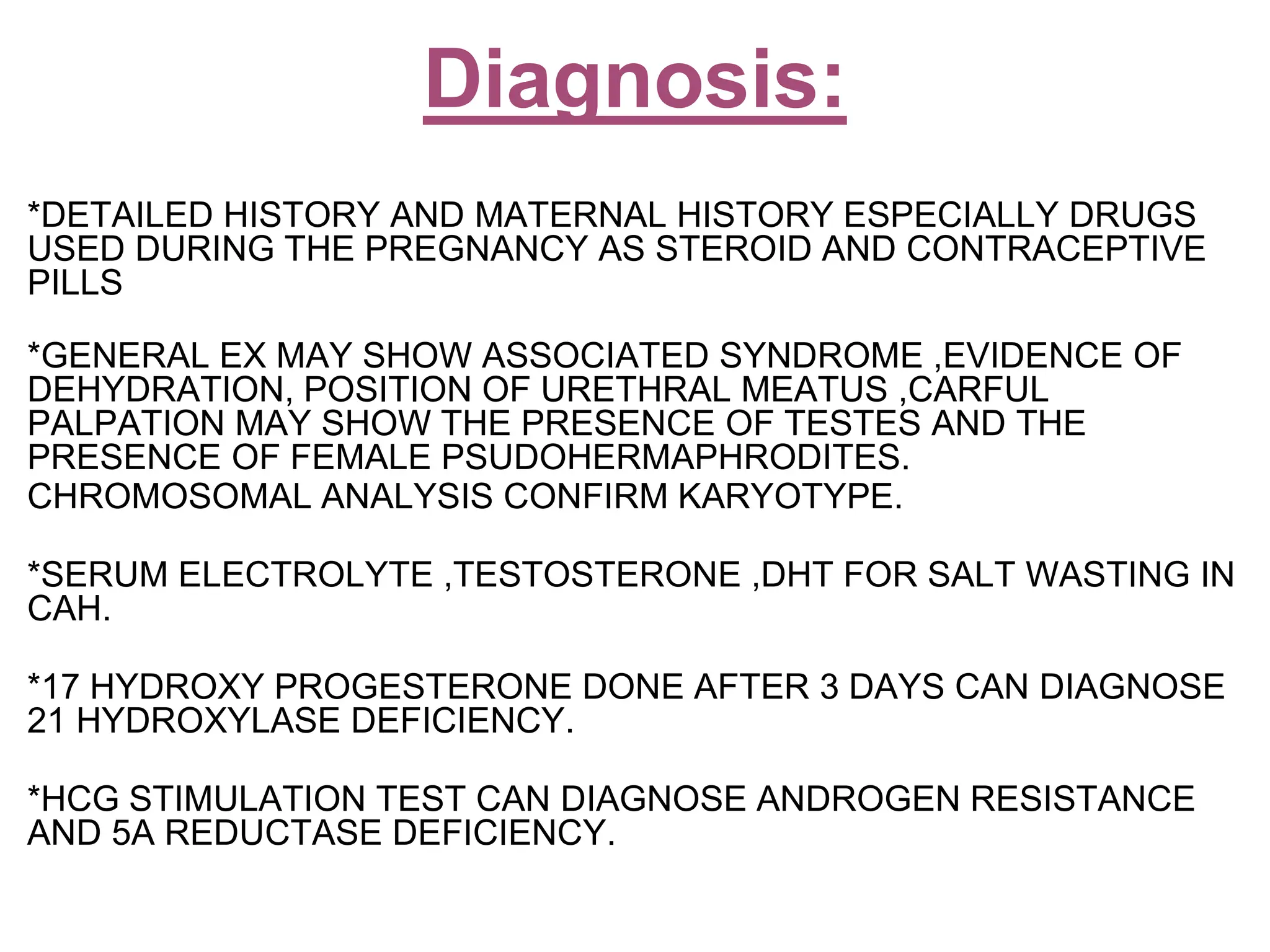
*DETAILED HISTORY AND MATERNAL HISTORY ESPECIALLY DRUGS
USED DURING THE PREGNANCY AS STEROID AND CONTRACEPTIVE
PILLS
*GENERAL EX MAY SHOW ASSOCIATED SYNDROME ,EVIDENCE OF
DEHYDRATION, POSITION OF URETHRAL MEATUS ,CARFUL
PALPATION MAY SHOW THE PRESENCE OF TESTES AND THE
PRESENCE OF FEMALE PSUDOHERMAPHRODITES.
CHROMOSOMAL ANALYSIS CONFIRM KARYOTYPE.
*SERUM ELECTROLYTE ,TESTOSTERONE ,DHT FOR SALT WASTING IN
CAH.
*17 HYDROXY PROGESTERONE DONE AFTER 3 DAYS CAN DIAGNOSE
21 HYDROXYLASE DEFICIENCY.
*HCG STIMULATION TEST CAN DIAGNOSE ANDROGEN RESISTANCE
AND 5A REDUCTASE DEFICIENCY.
Diagnosis:
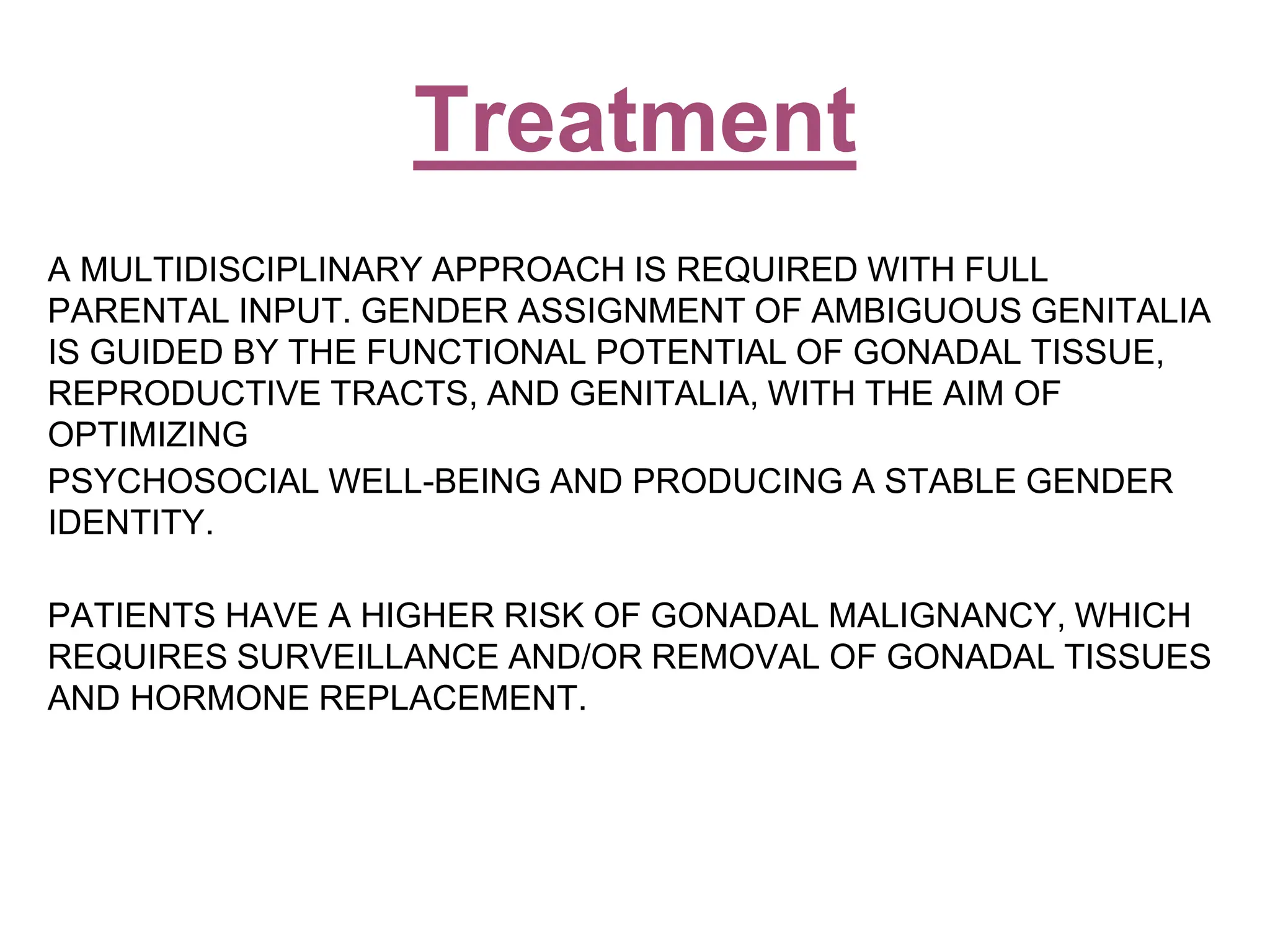
A MULTIDISCIPLINARY APPROACH IS REQUIRED WITH FULL
PARENTAL INPUT. GENDER ASSIGNMENT OF AMBIGUOUS GENITALIA
IS GUIDED BY THE FUNCTIONAL POTENTIAL OF GONADAL TISSUE,
REPRODUCTIVE TRACTS, AND GENITALIA, WITH THE AIM OF
OPTIMIZING
PSYCHOSOCIAL WELL-BEING AND PRODUCING A STABLE GENDER
IDENTITY.
PATIENTS HAVE A HIGHER RISK OF GONADAL MALIGNANCY, WHICH
REQUIRES SURVEILLANCE AND/OR REMOVAL OF GONADAL TISSUES
AND HORMONE REPLACEMENT.
Treatment
THANK YOU

_seminar.pdf in pediatric urology problem

  • 1.
    ● The urethraopen in the dorsal surface of the penis any where from the glans, ● penile shaft or most commonly the penopubic region . Epispadias
  • 2.
    ● diagnosis ofepispadias and hypospadias will be obvious. ● In hypospadias, the opening of the urethra may be anywhere along the line of the urethra, from a few millimetres from the tip of the penis to the perineum. ● In epispadias, which is rare, the urethral opening is on the dorsal surface of the glans penis.
  • 3.
    ● M:F 5:1 ●This is rare. The patient, a baby or child, usually presents with the urethra opening on the dorsal surface of the glans penis. ● Etiology represents failure of closure of the cloacal membrane , resulting in the bladder and urethra opening directly through the abdominal wall ● High morbidity -+ incontinence , infertility , reflux .
  • 4.
    Management ● at 6–12months >> This involves urethroplasty with functional and cosmetic reconstruction of the external genitalia (penile lengthening and correction of chordee) . ● The modified Cantwell–Ransley technique is commonly used in males. It describes mobilizing the urethra to the ventral aspect of the penis, with advancement of the urethral meatus onto the glans with a reverse MAGPI (meatal advancement-glanuloplasty) . ● From age 4–5 years >> when children can be toilet trained, bladder neck reconstruction can be performed (Young–Dees–Leadbetter procedure). This achieves continence, and any bladder residuals may then be emptied by urethral catheterization.
  • 6.
    Phimosis Is when theforeskin cannot be retracted behind the glans. Physiologic in newborns; pathologic later due to chronic irritation from urine or balanitis
  • 7.
    7 ● A physiologicalphimosis is present at birth due to adhesions between the foreskin and glans. ● As the penis develops, epithelial debris (smegma) accumulates under the foreskin, causing gradual separation. ● 90% of foreskins are retractile at age 3 years , (<1% of phimosis at age 17)
  • 8.
    ● Recurrent balanitisin uncircumcised males can cause new phimosis
  • 9.
    ● Treatment –Spontaneous resolution by 3–4 years in physiologic (due to smegma and erections). ● Older children with phimosis, suffering recurrent infection (balanitis), can be treated with a 6-week course of topical 0.1% dexamethasone cream, which acts to soften the phimosis and allow foreskin retraction (avoid circumcision where possible). ● Adults may require a dorsal slit or circumcision for recurrent balanitis, voiding obstruction, or difficulties with sexual intercourse.a Management
  • 11.
    Paraphimosis when the uncircumcisedforeskin is retracted under the glans penis and the foreskin becomes edematous, and cannot be pulled back over the glans into its normal anatomical position.
  • 13.
  • 14.
    ● It occursmost commonly in teenagers or young men and also in elderly men (who have had the foreskin retracted during catheterization, but where it has not been returned to its normal position). ● Paraphimosis is usually painful. The foreskin is edematous and a small area of ulceration of the foreskin may have developed.
  • 15.
    15 ● Manual reductionis preferred using ice packs, elastic compression, and topical anesthetic such as 2% lidocaine gel. ● Operative dorsal slit may be required in refractory cases. ● Elective circumcision for definitive treatment (paraphimosis tends to recur). Management
  • 17.
    Disorder of sexual differentiations DefinedAs CONGENITAL CONDITIONS In Which the Development of Chromosomal , Gonadal or Anatomical Sex is Atypical . they are Estimated to Affect 1 in 4500 births.
  • 18.
    *SEMINIFEROUS TUBULE DYSGENESIS (KLINFELTERSYNDROME XXY,46XXMALE). *TURNER SYNDROME 45XO. *TRUE HERMAPHRODITES 46XX,XY WITH BOTH OVARIAN AND TESTICULAR TISSUE. *MIXED GONADAL DYSGENESIS (STREAK GONADS AND AMBIGUOUS GENITALIA). *PURE GONADS DYSGENESIS (FEMALE WITH STREAK GONADS). DSD are subdivided into :
  • 19.
    *DETAILED HISTORY ANDMATERNAL HISTORY ESPECIALLY DRUGS USED DURING THE PREGNANCY AS STEROID AND CONTRACEPTIVE PILLS *GENERAL EX MAY SHOW ASSOCIATED SYNDROME ,EVIDENCE OF DEHYDRATION, POSITION OF URETHRAL MEATUS ,CARFUL PALPATION MAY SHOW THE PRESENCE OF TESTES AND THE PRESENCE OF FEMALE PSUDOHERMAPHRODITES. CHROMOSOMAL ANALYSIS CONFIRM KARYOTYPE. *SERUM ELECTROLYTE ,TESTOSTERONE ,DHT FOR SALT WASTING IN CAH. *17 HYDROXY PROGESTERONE DONE AFTER 3 DAYS CAN DIAGNOSE 21 HYDROXYLASE DEFICIENCY. *HCG STIMULATION TEST CAN DIAGNOSE ANDROGEN RESISTANCE AND 5A REDUCTASE DEFICIENCY. Diagnosis:
  • 20.
    A MULTIDISCIPLINARY APPROACHIS REQUIRED WITH FULL PARENTAL INPUT. GENDER ASSIGNMENT OF AMBIGUOUS GENITALIA IS GUIDED BY THE FUNCTIONAL POTENTIAL OF GONADAL TISSUE, REPRODUCTIVE TRACTS, AND GENITALIA, WITH THE AIM OF OPTIMIZING PSYCHOSOCIAL WELL-BEING AND PRODUCING A STABLE GENDER IDENTITY. PATIENTS HAVE A HIGHER RISK OF GONADAL MALIGNANCY, WHICH REQUIRES SURVEILLANCE AND/OR REMOVAL OF GONADAL TISSUES AND HORMONE REPLACEMENT. Treatment
  • 21.