Pathway for the Treatment of
Patients with Penicillin Allergy
Erin L. Reigh, MD, PGY-5
Department of Allergy and Immunology
Barnes-Jewish Hospital/Washington University
May 2016
Disclosures
• I have no disclosures.
Objectives
• Learn how to take a drug allergy history
• Learn how to use the penicillin allergy pathway
Why Do We Care About
Penicillin Allergy?
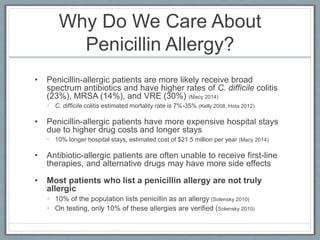
• Penicillin-allergic patients are more likely receive broad
spectrum antibiotics and have higher rates of C. difficile colitis
(23%), MRSA (14%), and VRE (30%) (Macy 2014)
• C. difficile colitis estimated mortality rate is 7%-35% (Kelly 2008, Hota 2012)
• Penicillin-allergic patients have more expensive hospital stays
due to higher drug costs and longer stays
• 10% longer hospital stays, estimated cost of $21.5 million per year (Macy 2014)
• Antibiotic-allergic patients are often unable to receive first-line
therapies, and alternative drugs may have more side effects
• Most patients who list a penicillin allergy are not truly
allergic
• 10% of the population lists penicillin as an allergy (Solensky 2010)
• On testing, only 10% of these allergies are verified (Solensky 2010)
Cephalosporin Cross-
Reactivity with Penicillin
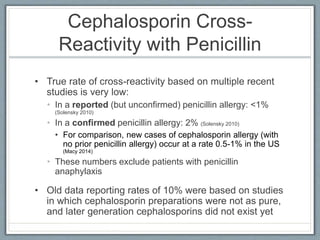
• True rate of cross-reactivity based on multiple recent
studies is very low:
• In a reported (but unconfirmed) penicillin allergy: 0.1%
(Solensky 2010)
• In a confirmed penicillin allergy: 2% (Solensky 2010)
• For comparison, new cases of cephalosporin allergy (with
no prior penicillin allergy) occur at a rate 0.5-1% in the US
(Macy 2014)
• These numbers exclude patients with penicillin
anaphylaxis
• Old data reporting rates of 10% were based on studies
in which cephalosporin preparations were not as pure,
and later generation cephalosporins did not exist yet
Cephalosporin Cross-
Reactivity with Penicillin
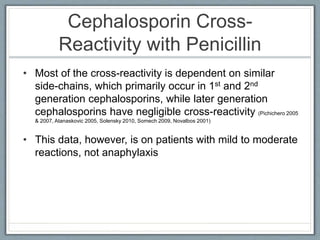
• Most of the cross-reactivity is dependent on similar
side-chains, which primarily occur in 1st and 2nd
generation cephalosporins, while later generation
cephalosporins have negligible cross-reactivity (Pichichero 2005
& 2007, Atanaskovic 2005, Solensky 2010, Somech 2009, Novalbos 2001)
• This data, however, is on patients with mild to moderate
reactions, not anaphylaxis
The Penicillin Pathway
Blumenthal 2015
• A 2014 MGH study looked at the safety and
efficacy of using a pathway to guide beta lactam
use in penicillin allergic patients
• They found that their drug allergy algorithm
reduced broad-spectrum antibiotic use by 5-30%,
and did so without an increase in adverse drug
reactions.
• Penicillin allergic patients also received appropriate
beta lactam drugs a median of 2 days faster than
before the pathway was introduced
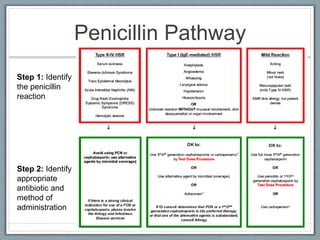
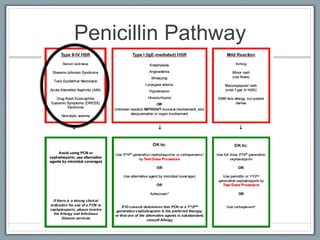
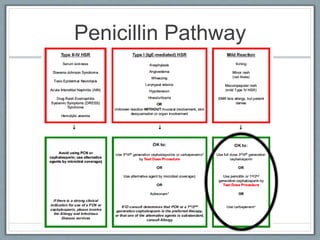
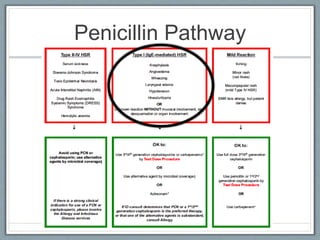
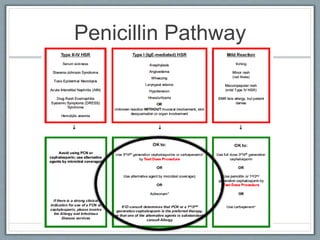
Penicillin Pathway
Step 1: Identify
the penicillin
reaction
Step 2: Identify
appropriate
antibiotic and
method of
administration
Drug Reactions:
Three Major Categories
• Severe and life-threatening reactions (Type II –
IV)
• SJS/TEN, DRESS, serum sickness, autoimmune
cytopenias, blistering rashes, AGEP, interstitial
nephritis, hepatitis
• Delayed and mild reactions (mild Type IV)
• Classic “drug rash”
• Immediate reactions (Type I)
• Hives, angioedema, wheezing, anaphylaxis
Identifying the Drug
Reaction: Helpful Questions
• What was the reaction? Make sure it was really an allergy
• Many patients will report side effects, such as nausea, and local
injection site reactions as an allergy
• Some patients will report family members’ allergies as their own
• When was the reaction?
• Sudden onset a few hours after taking a dose suggests immediate
(IgE) reaction
• Several days or weeks into course more consistent with mild
delayed reactions and life-threatening Type II-IV reactions
• Ask follow up questions and give specific examples to
help the patient describe what happened
• Most patients who have had a severe or life-threatening
reaction can answer these questions with confidence
Penicillin Pathway
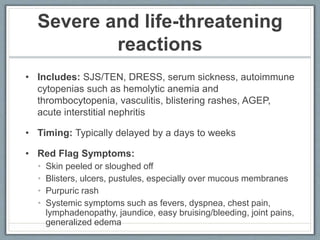
Severe and life-threatening
reactions
• Includes: SJS/TEN, DRESS, serum sickness, autoimmune
cytopenias such as hemolytic anemia and
thrombocytopenia, vasculitis, blistering rashes, AGEP,
acute interstitial nephritis
• Timing: Typically delayed by a days to weeks
• Red Flag Symptoms:
• Skin peeled or sloughed off
• Blisters, ulcers, pustules, especially over mucous membranes
• Purpuric rash
• Systemic symptoms such as fevers, dyspnea, chest pain,
lymphadenopathy, jaundice, easy bruising/bleeding, joint pains,
generalized edema
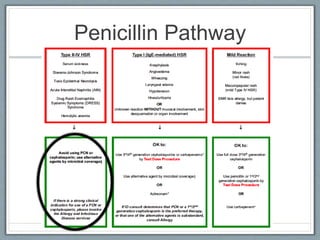
Penicillin Pathway
Penicillin Pathway
Delayed/mild reactions
• Includes:
• Morbilliform drug eruption
• Bright red, blanching, itchy rash (classic “drug rash”)
• Mild transient rashes
• Common in viral infections, especially kids. Typically not
itchy, resolve within days, and have no systemic
symptoms
• Timing: delayed; days to weeks into antibiotic
course
• Reaction occurs faster on re-exposure
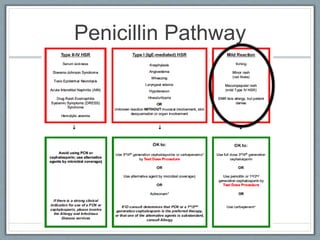
Penicillin Pathway
Penicillin Pathway
Immediate reactions
• Includes: hives, wheezing, angioedema, and
anaphylaxis
• Hives: “Itchy bumps that look like mosquito bites.”
Transient lesions - move from one place to another
and don’t leave marks
• Angioedema: rapid onset of swelling, often
disfiguring in severity. Lips, eyes, tongue, throat,
hands, feet are most common
• Anaphylaxis: systemic reaction affecting 2 or more
organ systems, often leading to respiratory and/or
cardiovascular compromise. There is a wide spectrum of
severity.
• Timing: Immediate, within minutes to hours of
exposure
• Typically resolves within 24h after receiving appropriate
therapy such as antihistamines, steroids, or epinephrine
Penicillin Pathway
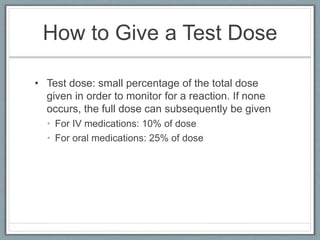
How to Give a Test Dose
• Test dose: small percentage of the total dose
given in order to monitor for a reaction. If none
occurs, the full dose can subsequently be given
• For IV medications: 10% of dose
• For oral medications: 25% of dose
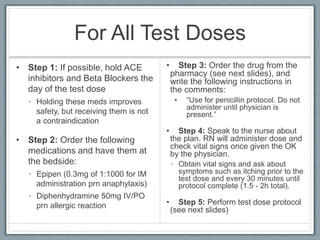
For All Test Doses
• Step 1: If possible, hold ACE
inhibitors and Beta Blockers the
day of the test dose
• Holding these meds improves
safety, but receiving them is not
a contraindication
• Step 2: Order the following
medications and have them at
the bedside:
• Epipen (0.3mg of 1:1000 for IM
administration prn anaphylaxis)
• Diphenhydramine 50mg IV/PO
prn allergic reaction
• Step 3: Order the drug from the
pharmacy (see next slides), and write
the following instructions in the
comments:
• “Use for penicillin protocol. Do not
administer until physician is present.”
• Step 4: Speak to the nurse about the
plan. RN will administer dose and check
vital signs once given the OK by the
physician.
• Obtain vital signs and ask about
symptoms such as itching prior to the test
dose and every 30 minutes until protocol
complete (1.5 - 2h total).
• Monitoring: RN must be at the bedside for
5 min. after test dose given, then only to
check in for vitals every 30 min. MD does
not need to present.
• Step 5: Perform test dose protocol (see
next slides)
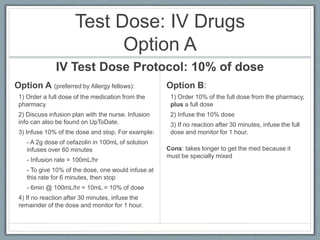
IV Test Dose Protocol:
10% of dose
Option A (preferred by Allergy fellows):
1) Order a full dose of the medication from the
pharmacy
2) Discuss infusion plan with the nurse. Infusion
info can also be found on UpToDate.
3) Infuse 10% of the dose and stop. For example:
- A 2g dose of cefazolin in 100mL of solution
infuses over 60 minutes
- Infusion rate = 100mL/hr
- To give 10% of the dose, one would infuse at
this rate for 6 minutes, then stop
- 6min @ 100mL/hr = 10mL = 10% of dose
4) If no reaction after 30 minutes, infuse the
remainder of the dose and monitor for 1 hour.
Option B:
1) Order 10% of the full dose from the pharmacy,
plus a full dose
2) Infuse the 10% dose
3) If no reaction after 30 minutes, infuse the full
dose and monitor for 1 hour.
Cons: takes longer to get the med because it
must be specially mixed
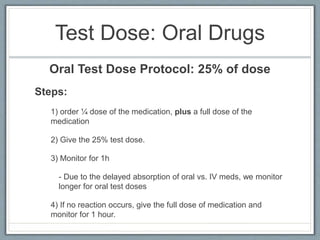
Oral Test Dose Protocol:
25% of dose
Steps:
1) order ¼ dose of the medication, plus a full dose of the
medication
2) Give the 25% test dose.
3) Monitor for 1h
- Due to the delayed absorption of oral vs. IV meds, we monitor
longer for oral test doses
4) If no reaction occurs, give the full dose of medication and
monitor for 1 hour.
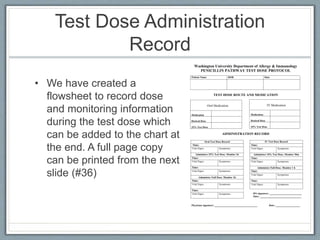
Test Dose Administration
Record
• We have created a flow
sheet to record dose and
monitoring information
during the test dose which
can be added to the chart
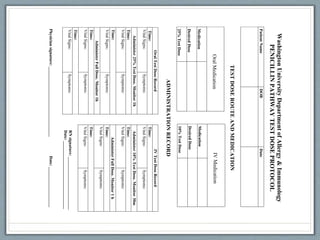
for documentation. A full
page copy can be printed
from the next slide (#36)
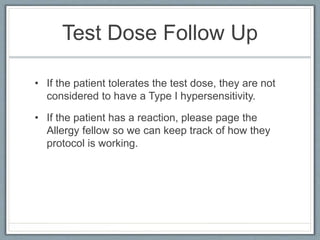
Test Dose Follow Up
• If the patient tolerates the test dose, they are not
considered to have a Type I hypersensitivity to
that drug.
• If the patient has a reaction, please page the
Allergy fellow so we can keep track of how they
protocol is working.
Penicillin Pathway
• Use of the pathway is strongly encouraged, but
not required
• We would like you to have the information
available to use at your discretion
• Allergy is always available for questions about the
pathway and for traditional consults
References
• Macy E. “Penicillin and Beta-Lactam Allergy: Epidemiology and Diagnosis.” Curr Allergy Asthma Rep (2014) 14:476.
• Macy E. et al. “Health care use and serious infection prevalence associated with penicillin ‘‘allergy’’ in hospitalized patients: A
cohort Study” J Allergy Clin Immunol Vol 133, No. 3, 2014
• Kelly, C.; LaMont, T. “Clostridium difficile — More Difficult Than Ever.” N Engl J Med 2008; 359:1932-1940.
• Hota, S.; Achonu, C.; Crowcroft, N.: et al. “Determining Mortality Rates Attributable to Clostridium difficile Infection.” Dispatch.
Volume 18, Number 2—February 2012
• Solensky, Khan, ed. “Drug Allergy: An Updated Practice Parameter.” Annals of Allergy, Asthma, and Immunology. Volume 105,
Oct. 2010.
• Pichichero, M. “A Review of Evidence Supporting the American Academy of Pediatrics Recommendation for Prescribing
Cephalosporin Antibiotics for Penicillin-Allergic Patients” Pediatrics. Vol 115, No. 4, April 2005.
• Pichichero, M.; Casey, J. “Safe use of selected cephalosporins in penicillin-allergic patients: A meta-analysis.” Otolaryngology–
Head and Neck Surgery (2007) 136, 340-347.
• Atanaskovic´-Markovic´ M. et al. “Immediate allergic reactions to cephalosporins and penicillins and their cross-reactivity in
children” Pediatr Allergy Immunol 2005: 16: 341–347
• Somech, et al. Evaluation of Immediate Allergic Reactions to Cephalosporins in Non-Penicillin-Allergic Patients” Int Arch
Allergy Immunol 2009;150:205–209
• Novalbos, et al. “Lack of allergic cross-reactivity to cephalosporins among patients allergic to penicillins” Clinical and
Experimental Allergy, 2001, Volume 31, pages 438±443
• Campagna, J. et al. “The use of cephalosporins in penicillin-allergic patients: A literature review.” The Journal of Emergency
Medicine, Vol. 42, No. 5, pp. 612–620, 2012
• Blumenthal, K. et al. “Impact of a clinical guideline for prescribing antibiotics to inpatients reporting penicillin or cephalosporin
allergy.” Ann Allergy Asthma Immunol 115 (2015): 294-300.

WUSTL Penicillin Allergy QI Pathway

  • 1.
    Pathway for theTreatment of Patients with Penicillin Allergy Erin L. Reigh, MD, PGY-5 Department of Allergy and Immunology Barnes-Jewish Hospital/Washington University May 2016
  • 2.
    Disclosures • I haveno disclosures.
  • 3.
    Objectives • Learn howto take a drug allergy history • Learn how to use the penicillin allergy pathway
  • 4.
    Why Do WeCare About Penicillin Allergy? • Penicillin-allergic patients are more likely receive broad spectrum antibiotics and have higher rates of C. difficile colitis (23%), MRSA (14%), and VRE (30%) (Macy 2014) • C. difficile colitis estimated mortality rate is 7%-35% (Kelly 2008, Hota 2012) • Penicillin-allergic patients have more expensive hospital stays due to higher drug costs and longer stays • 10% longer hospital stays, estimated cost of $21.5 million per year (Macy 2014) • Antibiotic-allergic patients are often unable to receive first-line therapies, and alternative drugs may have more side effects • Most patients who list a penicillin allergy are not truly allergic • 10% of the population lists penicillin as an allergy (Solensky 2010) • On testing, only 10% of these allergies are verified (Solensky 2010)
  • 5.
    Cephalosporin Cross- Reactivity withPenicillin • True rate of cross-reactivity based on multiple recent studies is very low: • In a reported (but unconfirmed) penicillin allergy: 0.1% (Solensky 2010) • In a confirmed penicillin allergy: 2% (Solensky 2010) • For comparison, new cases of cephalosporin allergy (with no prior penicillin allergy) occur at a rate 0.5-1% in the US (Macy 2014) • These numbers exclude patients with penicillin anaphylaxis • Old data reporting rates of 10% were based on studies in which cephalosporin preparations were not as pure, and later generation cephalosporins did not exist yet
  • 6.
    Cephalosporin Cross- Reactivity withPenicillin • Most of the cross-reactivity is dependent on similar side-chains, which primarily occur in 1st and 2nd generation cephalosporins, while later generation cephalosporins have negligible cross-reactivity (Pichichero 2005 & 2007, Atanaskovic 2005, Solensky 2010, Somech 2009, Novalbos 2001) • This data, however, is on patients with mild to moderate reactions, not anaphylaxis
  • 7.
  • 8.
    Blumenthal 2015 • A2014 MGH study looked at the safety and efficacy of using a pathway to guide beta lactam use in penicillin allergic patients • They found that their drug allergy algorithm reduced broad-spectrum antibiotic use by 5-30%, and did so without an increase in adverse drug reactions. • Penicillin allergic patients also received appropriate beta lactam drugs a median of 2 days faster than before the pathway was introduced
  • 9.
    Penicillin Pathway Step 1:Identify the penicillin reaction Step 2: Identify appropriate antibiotic and method of administration
  • 10.
    Drug Reactions: Three MajorCategories • Severe and life-threatening reactions (Type II – IV) • SJS/TEN, DRESS, serum sickness, autoimmune cytopenias, blistering rashes, AGEP, interstitial nephritis, hepatitis • Delayed and mild reactions (mild Type IV) • Classic “drug rash” • Immediate reactions (Type I) • Hives, angioedema, wheezing, anaphylaxis
  • 11.
    Identifying the Drug Reaction:Helpful Questions • What was the reaction? Make sure it was really an allergy • Many patients will report side effects, such as nausea, and local injection site reactions as an allergy • Some patients will report family members’ allergies as their own • When was the reaction? • Sudden onset a few hours after taking a dose suggests immediate (IgE) reaction • Several days or weeks into course more consistent with mild delayed reactions and life-threatening Type II-IV reactions • Ask follow up questions and give specific examples to help the patient describe what happened • Most patients who have had a severe or life-threatening reaction can answer these questions with confidence
  • 12.
  • 13.
    Severe and life-threatening reactions •Includes: SJS/TEN, DRESS, serum sickness, autoimmune cytopenias such as hemolytic anemia and thrombocytopenia, vasculitis, blistering rashes, AGEP, acute interstitial nephritis • Timing: Typically delayed by a days to weeks • Red Flag Symptoms: • Skin peeled or sloughed off • Blisters, ulcers, pustules, especially over mucous membranes • Purpuric rash • Systemic symptoms such as fevers, dyspnea, chest pain, lymphadenopathy, jaundice, easy bruising/bleeding, joint pains, generalized edema
  • 14.
  • 15.
  • 16.
    Delayed/mild reactions • Includes: •Morbilliform drug eruption • Bright red, blanching, itchy rash (classic “drug rash”) • Mild transient rashes • Common in viral infections, especially kids. Typically not itchy, resolve within days, and have no systemic symptoms • Timing: delayed; days to weeks into antibiotic course • Reaction occurs faster on re-exposure
  • 17.
  • 18.
  • 19.
    Immediate reactions • Includes:hives, wheezing, angioedema, and anaphylaxis • Hives: “Itchy bumps that look like mosquito bites.” Transient lesions - move from one place to another and don’t leave marks • Angioedema: rapid onset of swelling, often disfiguring in severity. Lips, eyes, tongue, throat, hands, feet are most common • Anaphylaxis: systemic reaction affecting 2 or more organ systems, often leading to respiratory and/or cardiovascular compromise. There is a wide spectrum of severity. • Timing: Immediate, within minutes to hours of exposure • Typically resolves within 24h after receiving appropriate therapy such as antihistamines, steroids, or epinephrine
  • 20.
  • 21.
    How to Givea Test Dose • Test dose: small percentage of the total dose given in order to monitor for a reaction. If none occurs, the full dose can subsequently be given • For IV medications: 10% of dose • For oral medications: 25% of dose
  • 22.
    For All TestDoses • Step 1: If possible, hold ACE inhibitors and Beta Blockers the day of the test dose • Holding these meds improves safety, but receiving them is not a contraindication • Step 2: Order the following medications and have them at the bedside: • Epipen (0.3mg of 1:1000 for IM administration prn anaphylaxis) • Diphenhydramine 50mg IV/PO prn allergic reaction • Step 3: Order the drug from the pharmacy (see next slides), and write the following instructions in the comments: • “Use for penicillin protocol. Do not administer until physician is present.” • Step 4: Speak to the nurse about the plan. RN will administer dose and check vital signs once given the OK by the physician. • Obtain vital signs and ask about symptoms such as itching prior to the test dose and every 30 minutes until protocol complete (1.5 - 2h total). • Monitoring: RN must be at the bedside for 5 min. after test dose given, then only to check in for vitals every 30 min. MD does not need to present. • Step 5: Perform test dose protocol (see next slides)
  • 23.
    IV Test DoseProtocol: 10% of dose Option A (preferred by Allergy fellows): 1) Order a full dose of the medication from the pharmacy 2) Discuss infusion plan with the nurse. Infusion info can also be found on UpToDate. 3) Infuse 10% of the dose and stop. For example: - A 2g dose of cefazolin in 100mL of solution infuses over 60 minutes - Infusion rate = 100mL/hr - To give 10% of the dose, one would infuse at this rate for 6 minutes, then stop - 6min @ 100mL/hr = 10mL = 10% of dose 4) If no reaction after 30 minutes, infuse the remainder of the dose and monitor for 1 hour. Option B: 1) Order 10% of the full dose from the pharmacy, plus a full dose 2) Infuse the 10% dose 3) If no reaction after 30 minutes, infuse the full dose and monitor for 1 hour. Cons: takes longer to get the med because it must be specially mixed
  • 24.
    Oral Test DoseProtocol: 25% of dose Steps: 1) order ¼ dose of the medication, plus a full dose of the medication 2) Give the 25% test dose. 3) Monitor for 1h - Due to the delayed absorption of oral vs. IV meds, we monitor longer for oral test doses 4) If no reaction occurs, give the full dose of medication and monitor for 1 hour.
  • 25.
    Test Dose Administration Record •We have created a flow sheet to record dose and monitoring information during the test dose which can be added to the chart for documentation. A full page copy can be printed from the next slide (#36)
  • 27.
    Test Dose FollowUp • If the patient tolerates the test dose, they are not considered to have a Type I hypersensitivity to that drug. • If the patient has a reaction, please page the Allergy fellow so we can keep track of how they protocol is working.
  • 28.
    Penicillin Pathway • Useof the pathway is strongly encouraged, but not required • We would like you to have the information available to use at your discretion • Allergy is always available for questions about the pathway and for traditional consults
  • 29.
    References • Macy E.“Penicillin and Beta-Lactam Allergy: Epidemiology and Diagnosis.” Curr Allergy Asthma Rep (2014) 14:476. • Macy E. et al. “Health care use and serious infection prevalence associated with penicillin ‘‘allergy’’ in hospitalized patients: A cohort Study” J Allergy Clin Immunol Vol 133, No. 3, 2014 • Kelly, C.; LaMont, T. “Clostridium difficile — More Difficult Than Ever.” N Engl J Med 2008; 359:1932-1940. • Hota, S.; Achonu, C.; Crowcroft, N.: et al. “Determining Mortality Rates Attributable to Clostridium difficile Infection.” Dispatch. Volume 18, Number 2—February 2012 • Solensky, Khan, ed. “Drug Allergy: An Updated Practice Parameter.” Annals of Allergy, Asthma, and Immunology. Volume 105, Oct. 2010. • Pichichero, M. “A Review of Evidence Supporting the American Academy of Pediatrics Recommendation for Prescribing Cephalosporin Antibiotics for Penicillin-Allergic Patients” Pediatrics. Vol 115, No. 4, April 2005. • Pichichero, M.; Casey, J. “Safe use of selected cephalosporins in penicillin-allergic patients: A meta-analysis.” Otolaryngology– Head and Neck Surgery (2007) 136, 340-347. • Atanaskovic´-Markovic´ M. et al. “Immediate allergic reactions to cephalosporins and penicillins and their cross-reactivity in children” Pediatr Allergy Immunol 2005: 16: 341–347 • Somech, et al. Evaluation of Immediate Allergic Reactions to Cephalosporins in Non-Penicillin-Allergic Patients” Int Arch Allergy Immunol 2009;150:205–209 • Novalbos, et al. “Lack of allergic cross-reactivity to cephalosporins among patients allergic to penicillins” Clinical and Experimental Allergy, 2001, Volume 31, pages 438±443 • Campagna, J. et al. “The use of cephalosporins in penicillin-allergic patients: A literature review.” The Journal of Emergency Medicine, Vol. 42, No. 5, pp. 612–620, 2012 • Blumenthal, K. et al. “Impact of a clinical guideline for prescribing antibiotics to inpatients reporting penicillin or cephalosporin allergy.” Ann Allergy Asthma Immunol 115 (2015): 294-300.

Editor's Notes

  • #11 Add more about other types