Β-lactam Antibiotic
Hypersensitivity & Cross-
       Reactivity
       Nathan Hare MD
          11/03/09
Outline
• Drug Allergy
• Allergy Testing
• Structures
• Penicillins
• Cephalosporins
• Carbapenems
• Monobactams

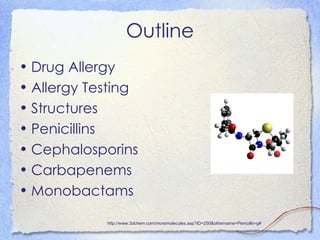
            http://www.3dchem.com/moremolecules.asp?ID=250&othername=Penicillin-g#
Adverse Drug Reactions
• Immune Mediated = “Allergy”

  – Immediate: likely IgE-mediated
  – Delayed: likely T-cell -mediated
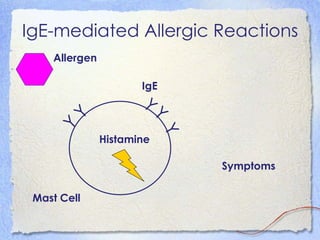
IgE-mediated Allergic Reactions
    Allergen

                      IgE


                     Y
       Y


                       Y
     Y


                            Y
               Histamine

                                Symptoms


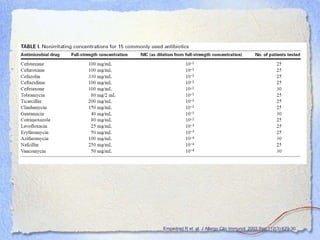
 Mast Cell
Allergy Testing
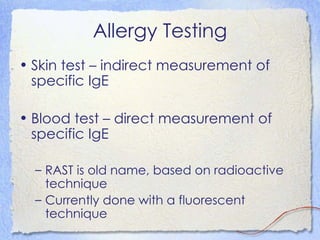
• Skin test – indirect measurement of
  specific IgE

• Blood test – direct measurement of
  specific IgE

  – RAST is old name, based on radioactive
    technique
  – Currently done with a fluorescent
    technique
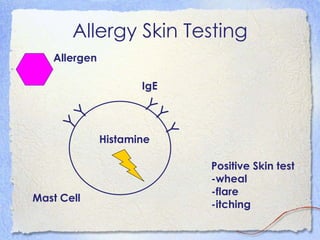
Allergy Skin Testing
   Allergen

                     IgE


                    Y
      Y


                      Y
    Y


                           Y
              Histamine

                               Positive Skin test
                               -wheal
                               -flare
Mast Cell
                               -itching
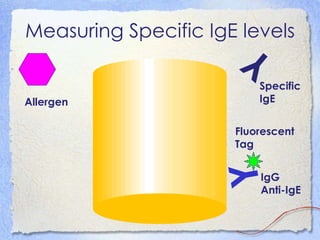
Measuring Specific IgE levels
                         Y
                          Specific
Allergen                  IgE


                      Fluorescent
                      Tag


                     Y
                          IgG
                          Anti-IgE
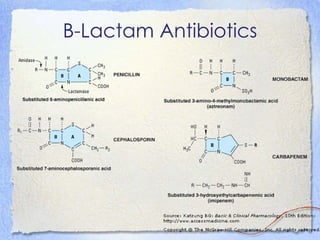
Β-Lactam Antibiotics
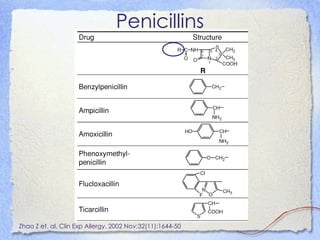
Penicillins


Zhao Z et. al. Clin Exp Allergy. 2002 Nov;32(11):1644-50
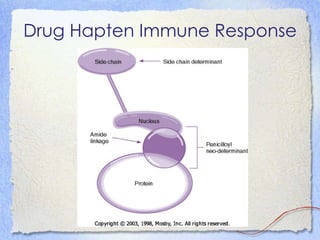
Drug Hapten Immune Response
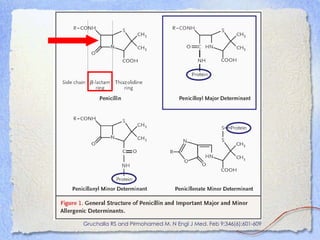
Gruchalla RS and Pirmohamed M. N Engl J Med. Feb 9;346(6):601-609
Penicillin Hypersensitivity

• Responsible for 75% of anaphylactic
  deaths in the United States

• Prevalence:1-10% per patient reports


    Schafer JA et. al. Pharmacotherapy 2007;27(4):542-545
Penicillin Allergy:
            Patient History
• May be unreliable
  – Sodhi et. al. Journal of Antimicrobial
    Chemotherapy (2004)54(6):1155-57.

• 10-20% of the patients in the general
  population who report a history of
  penicillin allergy are truly allergic
  based on skin testing
  – Salkind AR et. al. JAMA 2001;285:2498-505
Penicillin Hypersensitivity: History

• 80-95% of patients with a history of penicillin
  allergy will have negative skin-test results
     • Kelkar PS and Li JTC. N Engl J Med. Sept. 13, 2001;
       345(11):804-09
     • Quoting Levine BB, Zolov DM J Allergy 1969
Penicillin Hypersensitivity:
        Diagnostic Testing
• PrePen
  – Was the only available penicillin allergy
    skin test in the US
  – Contained the major determinant
    benzylpenicilloyl-polylysine (BP)
  – Suspended by the US FDA in 2000
  – No commercial BP (CBP) since 2004

  – UNTIL NOW
    Schafer JA et. al. Pharmacotherapy 2007;27(4):542-545
Penicillin Hypersensitivity:
        Diagnostic Testing
• Skin test of major and minor
  determinants is the gold standard

• Major determinant testing identifies ≥
  90% of potential reactors

• Accuracy approaches 100% with
  addition of a minor determinant test
    Schafer JA et. al. Pharmacotherapy 2007;27(4):542-545
Penicillin Hypersensitivity:
               Diagnostic Testing


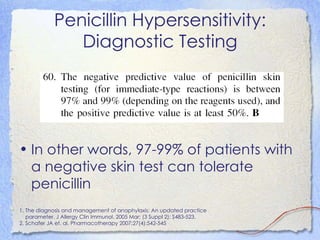
• In other words, 97-99% of patients with
  a negative skin test can tolerate
  penicillin
1. The diagnosis and management of anaphylaxis: An updated practice
   parameter. J Allergy Clin Immunol. 2005 Mar; (3 Suppl 2): S483-523.
2. Schafer JA et. al. Pharmacotherapy 2007;27(4):542-545
Penicillin Hypersensitivity:
        Diagnostic Testing
• RAST testing

  – Measures the major determinant only

  – Strong correlation between negative skin test
    results and negative RAST results

  – Wide disparity between positive skin test results
    for the minor determinants and RAST results

  – Should not be used alone to rule out Penicillin
    allergy

    Schafer JA et. al. Pharmacotherapy 2007;27(4):542-545
Penicillin Hypersensitivity:
        Diagnostic Testing

• Combined approach?

• RAST testing with skin testing for minor
  determinants

• Not tested in a controlled clinical trial

    Schafer JA et. al. Pharmacotherapy 2007;27(4):542-545
Cross-Reactivity among Penicillin
             drugs


• Virtually Complete
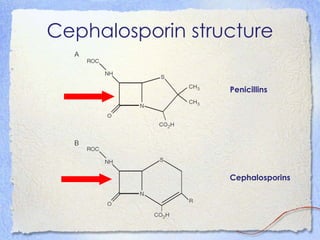
Cephalosporin structure

                  Penicillins


                  Cephalosporins
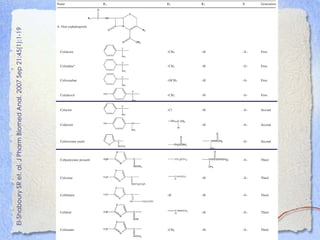
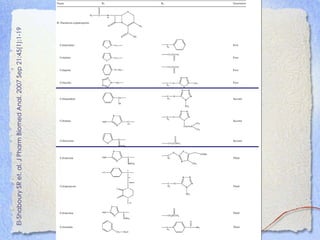
El-Shaboury SR et. al. J Pharm Biomed Anal. 2007 Sep 21;45(1):1-19
Cephalosporin Hypersensitivity
• Number of potential haptens large

• Side chain and nuclear components
  may participate

• Allergic reactions may occur because
  of sensitization to determinants shared
  with penicillins or to unique haptens

Kelkar PS and Li JTC. N Engl J Med. Sept. 13, 2001; 345(11):804-09
Romano A. et. al. J Allergy Clin Immunol. 2000;106(6):1177-83.
Cephalosporin hypersensitivity
• Risk of anaphylaxis is low

• 0.1%-0.0001%
  –   based on retrospective analysis
  –   data from 210 clinical trials
  –   2539 patients
  –   Treated with ceftazidime


  Pegler S, Healy B. BMJ 2007;335:991
Cephalosporin hypersensitivity


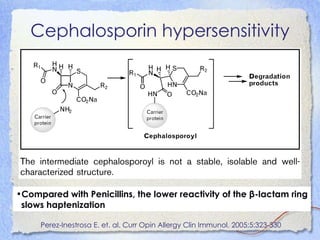
•Compared with Penicillins, the lower reactivity of the β-lactam ring
 slows haptenization

     Perez-Inestrosa E. et. al. Curr Opin Allergy Clin Immunol. 2005;5:323-330
Skin Testing: Cephalosporins
• Histories and penicillin test results do not
  reliably predict the probability of allergic
  reactions to cephalosporins in patients with
  histories of penicillin allergy
     • Salkind et. al. JAMA. May 16, 2001;285(19):2498-2505.


• Testing with the native drug alone has little
  predictive value
     • Kelkar PS and Li JTC. N Engl J Med. Sept. 13, 2001;
       345(11):804-09
Skin Testing: Cephalosporins
   – Starting to define skin testing in more
     detail
       • Romano A. et. al. Clin Exp Allergy
         2005;35:1234-1242


   – 1 to 3 mg/mL concentrations
     recommended for skin testing

The diagnosis and management of anaphylaxis: An updated practice
parameter. J Allergy Clin Immunol. 2005 Mar; (3 Suppl 2): S483-523.
Empedrad R et. al. J Allergy Clin Immunol. 2003 Sep;112(3):629-30.
Cephalosporins and Penicillin
         Cross-reactivity
• Cephalosporium mold
    – Produces some penicillin-related
      compounds

    – Early cephalosporin antibiotics contained
      trace amounts of penicillins

    – May have led to over-estimation of
      degree of cross-reactivity for Penicillin and
      Cephalosporin allergy
Kelkar PS and Li JTC. N Engl J Med. Sept. 13, 2001; 345(11):804-09
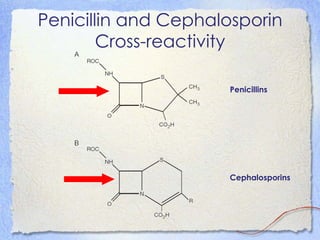
Penicillin and Cephalosporin
        Cross-reactivity

                     Penicillins


                     Cephalosporins
Penicillin and Cephalosporin
              Cross-reactivity


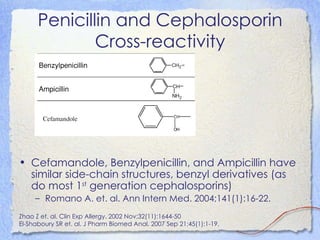
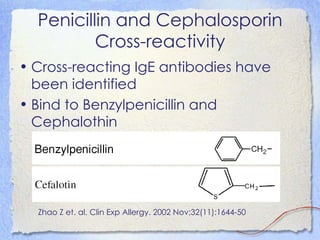
• Cefamandole, Benzylpenicillin, and Ampicillin have
  similar side-chain structures, benzyl derivatives (as
  do most 1st generation cephalosporins)
     – Romano A. et. al. Ann Intern Med. 2004;141(1):16-22.
Zhao Z et. al. Clin Exp Allergy. 2002 Nov;32(11):1644-50
El-Shaboury SR et. al. J Pharm Biomed Anal. 2007 Sep 21;45(1):1-19.
Penicillin and Cephalosporin
          Cross-reactivity
• Cross-reacting IgE antibodies have
  been identified
• Bind to Benzylpenicillin and
  Cephalothin


  Zhao Z et. al. Clin Exp Allergy. 2002 Nov;32(11):1644-50
Cephalosporin Allergy in
     Penicillin-allergic patients

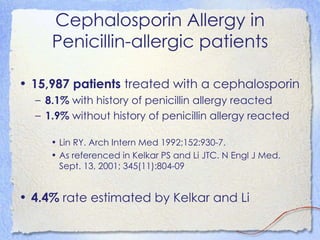
• 15,987 patients treated with a cephalosporin
  – 8.1% with history of penicillin allergy reacted
  – 1.9% without history of penicillin allergy reacted

     • Lin RY. Arch Intern Med 1992;152:930-7.
     • As referenced in Kelkar PS and Li JTC. N Engl J Med.
       Sept. 13, 2001; 345(11):804-09


• 4.4% rate estimated by Kelkar and Li
Cephalosporins in Penicillin-
        allergic Patients
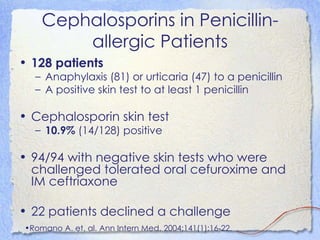
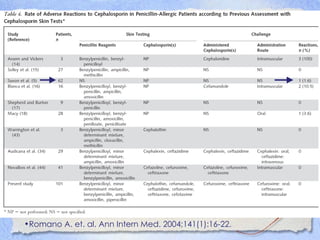
• 128 patients
  – Anaphylaxis (81) or urticaria (47) to a penicillin
  – A positive skin test to at least 1 penicillin

• Cephalosporin skin test
  – 10.9% (14/128) positive

• 94/94 with negative skin tests who were
  challenged tolerated oral cefuroxime and
  IM ceftriaxone

• 22 patients declined a challenge
•Romano A. et. al. Ann Intern Med. 2004;141(1):16-22.
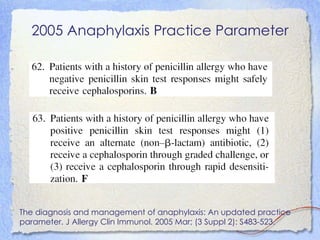
2005 Anaphylaxis Practice Parameter


The diagnosis and management of anaphylaxis: An updated practice
parameter. J Allergy Clin Immunol. 2005 Mar; (3 Suppl 2): S483-523.
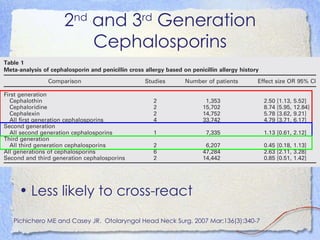
2nd and 3rd Generation
                   Cephalosporins


 • Less likely to cross-react
Pichichero ME and Casey JR. Otolaryngol Head Neck Surg. 2007 Mar;136(3):340-7
Patients with Cephalosporin
     Allergy: Penicillin Allergy?

• Patients with a history of urticaria or
  anaphylaxis to a cephalosporin

• 86.7% (26/30) had a positive skin test to
  a cephalosporin only, but not to a
  penicillin

 Romano A. et. al. J Allergy Clin Immunol. 2000;106(6):1177-83.
Penicillin Allergy in patients with
    Cephalosporin Allergy
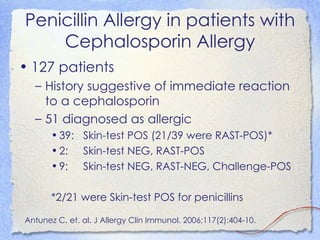
• 127 patients
  – History suggestive of immediate reaction
    to a cephalosporin
  – 51 diagnosed as allergic
       • 39: Skin-test POS (21/39 were RAST-POS)*
       • 2: Skin-test NEG, RAST-POS
       • 9: Skin-test NEG, RAST-NEG, Challenge-POS

       *2/21 were Skin-test POS for penicillins

Antunez C. et. al. J Allergy Clin Immunol. 2006;117(2):404-10.
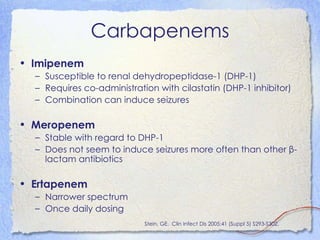
Carbapenems
• Imipenem
  – Susceptible to renal dehydropeptidase-1 (DHP-1)
  – Requires co-administration with cilastatin (DHP-1 inhibitor)
  – Combination can induce seizures

• Meropenem
  – Stable with regard to DHP-1
  – Does not seem to induce seizures more often than other β-
    lactam antibiotics

• Ertapenem
  – Narrower spectrum
  – Once daily dosing
                            Stein, GE. Clin Infect Dis 2005:41 (Suppl 5) S293-S302.
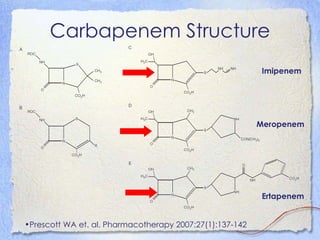
Carbapenem Structure
                                                           Imipenem


                                                          Meropenem


                                                           Ertapenem


•Prescott WA et. al. Pharmacotherapy 2007:27(1):137-142
Carbapenem-associated
        Hypersensitivity
• Reported incidence 1-3% in the
  general population

  – Sodhi M et. al. J Antimicrob Chemother
    2004;54:1155-7

  – quoting package inserts for Meropenem
    and Imipenem
Carbapenem Allergy in
        Penicillin-allergic Patients


• “Carbapenems do not cross-react
  immunologically with penicillin.”


The diagnosis and management of anaphylaxis: An updated practice
parameter. J Allergy Clin Immunol. 2005 Mar; (3 Suppl 2): S483-523.
PCN-allergic patients treated
     with a Carbapenem
• 47% with positive skin tests to Carbapenems
   – Saxon et. al. J Allergy Clin Immunol 1988 Aug;(82):213-7
   – Imipenem
   – Skin testing only, no challenges


• 11% Cross-reactivity
   – Prescott WA et. al. Clin Infect Dis 2004;38:1102-7
   – Imipenem or Meropenem


• 9% Cross-reactivity
   – Sodhi M et. al. J Antimicrob Chemother 2004;54:1155-7
   – Imipenem or Meropenem
Imipenem-cilastatin
• 112 patients
  – Immediate hypersensitivity reactions to penicillins
  – Positive skin test to at least 1 penicillin reagent


• Imipenem-cilastatin skin testing (0.5 mg/mL)
  – Positive: 1/112 (0.9%)


• Challenges with imipenem-cilastatin
  – 110/110 with no clinical reaction
Romano A et. al. N Engl J Med. 2006 Jun 29;354(26):2835-7
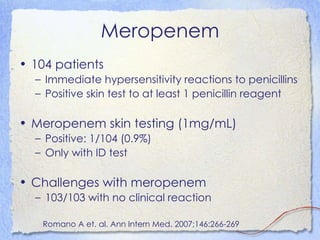
Meropenem
• 104 patients
  – Immediate hypersensitivity reactions to penicillins
  – Positive skin test to at least 1 penicillin reagent

• Meropenem skin testing (1mg/mL)
  – Positive: 1/104 (0.9%)
  – Only with ID test

• Challenges with meropenem
  – 103/103 with no clinical reaction

   Romano A et. al. Ann Intern Med. 2007;146:266-269
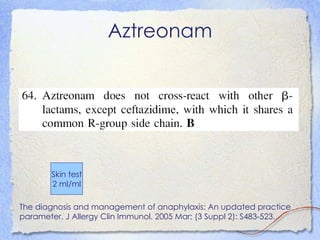
Aztreonam


       Skin test
       2 ml/ml

The diagnosis and management of anaphylaxis: An updated practice
parameter. J Allergy Clin Immunol. 2005 Mar; (3 Suppl 2): S483-523.
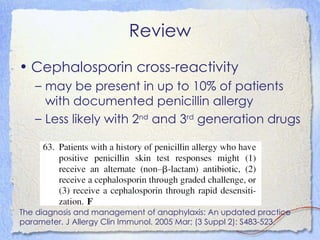
Review
• Cephalosporin cross-reactivity
   – may be present in up to 10% of patients
     with documented penicillin allergy
   – Less likely with 2nd and 3rd generation drugs


The diagnosis and management of anaphylaxis: An updated practice
parameter. J Allergy Clin Immunol. 2005 Mar; (3 Suppl 2): S483-523.
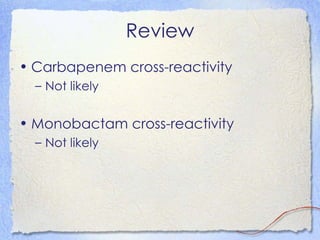
Review
• Carbapenem cross-reactivity
  – Not likely


• Monobactam cross-reactivity
  – Not likely
Thank you. Questions?


                        Windsor, VT
                        N Hare

β Lactam antibiotic hypersensitivity cross-reactivity

  • 1.
    Β-lactam Antibiotic Hypersensitivity &Cross- Reactivity Nathan Hare MD 11/03/09
  • 2.
    Outline • Drug Allergy •Allergy Testing • Structures • Penicillins • Cephalosporins • Carbapenems • Monobactams http://www.3dchem.com/moremolecules.asp?ID=250&othername=Penicillin-g#
  • 3.
    Adverse Drug Reactions •Immune Mediated = “Allergy” – Immediate: likely IgE-mediated – Delayed: likely T-cell -mediated
  • 4.
    IgE-mediated Allergic Reactions Allergen IgE Y Y Y Y Y Histamine Symptoms Mast Cell
  • 5.
    Allergy Testing • Skintest – indirect measurement of specific IgE • Blood test – direct measurement of specific IgE – RAST is old name, based on radioactive technique – Currently done with a fluorescent technique
  • 6.
    Allergy Skin Testing Allergen IgE Y Y Y Y Y Histamine Positive Skin test -wheal -flare Mast Cell -itching
  • 7.
    Measuring Specific IgElevels Y Specific Allergen IgE Fluorescent Tag Y IgG Anti-IgE
  • 8.
  • 9.
    Penicillins Zhao Z et.al. Clin Exp Allergy. 2002 Nov;32(11):1644-50
  • 10.
  • 11.
    Gruchalla RS andPirmohamed M. N Engl J Med. Feb 9;346(6):601-609
  • 12.
    Penicillin Hypersensitivity • Responsiblefor 75% of anaphylactic deaths in the United States • Prevalence:1-10% per patient reports Schafer JA et. al. Pharmacotherapy 2007;27(4):542-545
  • 13.
    Penicillin Allergy: Patient History • May be unreliable – Sodhi et. al. Journal of Antimicrobial Chemotherapy (2004)54(6):1155-57. • 10-20% of the patients in the general population who report a history of penicillin allergy are truly allergic based on skin testing – Salkind AR et. al. JAMA 2001;285:2498-505
  • 14.
    Penicillin Hypersensitivity: History •80-95% of patients with a history of penicillin allergy will have negative skin-test results • Kelkar PS and Li JTC. N Engl J Med. Sept. 13, 2001; 345(11):804-09 • Quoting Levine BB, Zolov DM J Allergy 1969
  • 15.
    Penicillin Hypersensitivity: Diagnostic Testing • PrePen – Was the only available penicillin allergy skin test in the US – Contained the major determinant benzylpenicilloyl-polylysine (BP) – Suspended by the US FDA in 2000 – No commercial BP (CBP) since 2004 – UNTIL NOW Schafer JA et. al. Pharmacotherapy 2007;27(4):542-545
  • 16.
    Penicillin Hypersensitivity: Diagnostic Testing • Skin test of major and minor determinants is the gold standard • Major determinant testing identifies ≥ 90% of potential reactors • Accuracy approaches 100% with addition of a minor determinant test Schafer JA et. al. Pharmacotherapy 2007;27(4):542-545
  • 17.
    Penicillin Hypersensitivity: Diagnostic Testing • In other words, 97-99% of patients with a negative skin test can tolerate penicillin 1. The diagnosis and management of anaphylaxis: An updated practice parameter. J Allergy Clin Immunol. 2005 Mar; (3 Suppl 2): S483-523. 2. Schafer JA et. al. Pharmacotherapy 2007;27(4):542-545
  • 18.
    Penicillin Hypersensitivity: Diagnostic Testing • RAST testing – Measures the major determinant only – Strong correlation between negative skin test results and negative RAST results – Wide disparity between positive skin test results for the minor determinants and RAST results – Should not be used alone to rule out Penicillin allergy Schafer JA et. al. Pharmacotherapy 2007;27(4):542-545
  • 19.
    Penicillin Hypersensitivity: Diagnostic Testing • Combined approach? • RAST testing with skin testing for minor determinants • Not tested in a controlled clinical trial Schafer JA et. al. Pharmacotherapy 2007;27(4):542-545
  • 20.
    Cross-Reactivity among Penicillin drugs • Virtually Complete
  • 21.
    Cephalosporin structure Penicillins Cephalosporins
  • 22.
    El-Shaboury SR et.al. J Pharm Biomed Anal. 2007 Sep 21;45(1):1-19
  • 23.
    El-Shaboury SR et.al. J Pharm Biomed Anal. 2007 Sep 21;45(1):1-19
  • 24.
    Cephalosporin Hypersensitivity • Numberof potential haptens large • Side chain and nuclear components may participate • Allergic reactions may occur because of sensitization to determinants shared with penicillins or to unique haptens Kelkar PS and Li JTC. N Engl J Med. Sept. 13, 2001; 345(11):804-09 Romano A. et. al. J Allergy Clin Immunol. 2000;106(6):1177-83.
  • 25.
    Cephalosporin hypersensitivity • Riskof anaphylaxis is low • 0.1%-0.0001% – based on retrospective analysis – data from 210 clinical trials – 2539 patients – Treated with ceftazidime Pegler S, Healy B. BMJ 2007;335:991
  • 26.
    Cephalosporin hypersensitivity •Compared withPenicillins, the lower reactivity of the β-lactam ring slows haptenization Perez-Inestrosa E. et. al. Curr Opin Allergy Clin Immunol. 2005;5:323-330
  • 27.
    Skin Testing: Cephalosporins •Histories and penicillin test results do not reliably predict the probability of allergic reactions to cephalosporins in patients with histories of penicillin allergy • Salkind et. al. JAMA. May 16, 2001;285(19):2498-2505. • Testing with the native drug alone has little predictive value • Kelkar PS and Li JTC. N Engl J Med. Sept. 13, 2001; 345(11):804-09
  • 28.
    Skin Testing: Cephalosporins – Starting to define skin testing in more detail • Romano A. et. al. Clin Exp Allergy 2005;35:1234-1242 – 1 to 3 mg/mL concentrations recommended for skin testing The diagnosis and management of anaphylaxis: An updated practice parameter. J Allergy Clin Immunol. 2005 Mar; (3 Suppl 2): S483-523.
  • 29.
    Empedrad R et.al. J Allergy Clin Immunol. 2003 Sep;112(3):629-30.
  • 30.
    Cephalosporins and Penicillin Cross-reactivity • Cephalosporium mold – Produces some penicillin-related compounds – Early cephalosporin antibiotics contained trace amounts of penicillins – May have led to over-estimation of degree of cross-reactivity for Penicillin and Cephalosporin allergy Kelkar PS and Li JTC. N Engl J Med. Sept. 13, 2001; 345(11):804-09
  • 31.
    Penicillin and Cephalosporin Cross-reactivity Penicillins Cephalosporins
  • 32.
    Penicillin and Cephalosporin Cross-reactivity • Cefamandole, Benzylpenicillin, and Ampicillin have similar side-chain structures, benzyl derivatives (as do most 1st generation cephalosporins) – Romano A. et. al. Ann Intern Med. 2004;141(1):16-22. Zhao Z et. al. Clin Exp Allergy. 2002 Nov;32(11):1644-50 El-Shaboury SR et. al. J Pharm Biomed Anal. 2007 Sep 21;45(1):1-19.
  • 33.
    Penicillin and Cephalosporin Cross-reactivity • Cross-reacting IgE antibodies have been identified • Bind to Benzylpenicillin and Cephalothin Zhao Z et. al. Clin Exp Allergy. 2002 Nov;32(11):1644-50
  • 34.
    Cephalosporin Allergy in Penicillin-allergic patients • 15,987 patients treated with a cephalosporin – 8.1% with history of penicillin allergy reacted – 1.9% without history of penicillin allergy reacted • Lin RY. Arch Intern Med 1992;152:930-7. • As referenced in Kelkar PS and Li JTC. N Engl J Med. Sept. 13, 2001; 345(11):804-09 • 4.4% rate estimated by Kelkar and Li
  • 35.
    Cephalosporins in Penicillin- allergic Patients • 128 patients – Anaphylaxis (81) or urticaria (47) to a penicillin – A positive skin test to at least 1 penicillin • Cephalosporin skin test – 10.9% (14/128) positive • 94/94 with negative skin tests who were challenged tolerated oral cefuroxime and IM ceftriaxone • 22 patients declined a challenge •Romano A. et. al. Ann Intern Med. 2004;141(1):16-22.
  • 36.
    •Romano A. et.al. Ann Intern Med. 2004;141(1):16-22.
  • 37.
    2005 Anaphylaxis PracticeParameter The diagnosis and management of anaphylaxis: An updated practice parameter. J Allergy Clin Immunol. 2005 Mar; (3 Suppl 2): S483-523.
  • 38.
    2nd and 3rdGeneration Cephalosporins • Less likely to cross-react Pichichero ME and Casey JR. Otolaryngol Head Neck Surg. 2007 Mar;136(3):340-7
  • 39.
    Patients with Cephalosporin Allergy: Penicillin Allergy? • Patients with a history of urticaria or anaphylaxis to a cephalosporin • 86.7% (26/30) had a positive skin test to a cephalosporin only, but not to a penicillin Romano A. et. al. J Allergy Clin Immunol. 2000;106(6):1177-83.
  • 40.
    Penicillin Allergy inpatients with Cephalosporin Allergy • 127 patients – History suggestive of immediate reaction to a cephalosporin – 51 diagnosed as allergic • 39: Skin-test POS (21/39 were RAST-POS)* • 2: Skin-test NEG, RAST-POS • 9: Skin-test NEG, RAST-NEG, Challenge-POS *2/21 were Skin-test POS for penicillins Antunez C. et. al. J Allergy Clin Immunol. 2006;117(2):404-10.
  • 41.
    Carbapenems • Imipenem – Susceptible to renal dehydropeptidase-1 (DHP-1) – Requires co-administration with cilastatin (DHP-1 inhibitor) – Combination can induce seizures • Meropenem – Stable with regard to DHP-1 – Does not seem to induce seizures more often than other β- lactam antibiotics • Ertapenem – Narrower spectrum – Once daily dosing Stein, GE. Clin Infect Dis 2005:41 (Suppl 5) S293-S302.
  • 42.
    Carbapenem Structure Imipenem Meropenem Ertapenem •Prescott WA et. al. Pharmacotherapy 2007:27(1):137-142
  • 43.
    Carbapenem-associated Hypersensitivity • Reported incidence 1-3% in the general population – Sodhi M et. al. J Antimicrob Chemother 2004;54:1155-7 – quoting package inserts for Meropenem and Imipenem
  • 44.
    Carbapenem Allergy in Penicillin-allergic Patients • “Carbapenems do not cross-react immunologically with penicillin.” The diagnosis and management of anaphylaxis: An updated practice parameter. J Allergy Clin Immunol. 2005 Mar; (3 Suppl 2): S483-523.
  • 45.
    PCN-allergic patients treated with a Carbapenem • 47% with positive skin tests to Carbapenems – Saxon et. al. J Allergy Clin Immunol 1988 Aug;(82):213-7 – Imipenem – Skin testing only, no challenges • 11% Cross-reactivity – Prescott WA et. al. Clin Infect Dis 2004;38:1102-7 – Imipenem or Meropenem • 9% Cross-reactivity – Sodhi M et. al. J Antimicrob Chemother 2004;54:1155-7 – Imipenem or Meropenem
  • 46.
    Imipenem-cilastatin • 112 patients – Immediate hypersensitivity reactions to penicillins – Positive skin test to at least 1 penicillin reagent • Imipenem-cilastatin skin testing (0.5 mg/mL) – Positive: 1/112 (0.9%) • Challenges with imipenem-cilastatin – 110/110 with no clinical reaction Romano A et. al. N Engl J Med. 2006 Jun 29;354(26):2835-7
  • 47.
    Meropenem • 104 patients – Immediate hypersensitivity reactions to penicillins – Positive skin test to at least 1 penicillin reagent • Meropenem skin testing (1mg/mL) – Positive: 1/104 (0.9%) – Only with ID test • Challenges with meropenem – 103/103 with no clinical reaction Romano A et. al. Ann Intern Med. 2007;146:266-269
  • 48.
    Aztreonam Skin test 2 ml/ml The diagnosis and management of anaphylaxis: An updated practice parameter. J Allergy Clin Immunol. 2005 Mar; (3 Suppl 2): S483-523.
  • 49.
    Review • Cephalosporin cross-reactivity – may be present in up to 10% of patients with documented penicillin allergy – Less likely with 2nd and 3rd generation drugs The diagnosis and management of anaphylaxis: An updated practice parameter. J Allergy Clin Immunol. 2005 Mar; (3 Suppl 2): S483-523.
  • 50.
    Review • Carbapenem cross-reactivity – Not likely • Monobactam cross-reactivity – Not likely
  • 51.
    Thank you. Questions? Windsor, VT N Hare