ADRENAL IMAGING
Dr Raman Ghimire
Resident Radiology (1st year)
NAMS
NORMAL ANATOMY AND IMAGING
APPEARANCE
• Named for its location
Ad- renal –adjacent to renal
Supra-renal –superior to renal
• The adrenal glands are retroperitoneal structures that are located
adjacent to the kidneys and enclosed within the perinephric fascia.
• Size :5 × 3 × 1 cm and weighs 4 -6 gm each
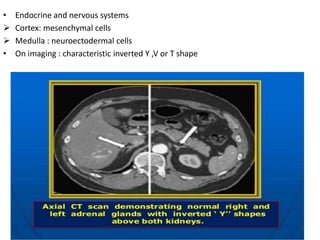
• Endocrine and nervous systems
 Cortex: mesenchymal cells
 Medulla : neuroectodermal cells
• On imaging : characteristic inverted Y ,V or T shape
• On cross-sectional imaging, both adrenal glands can be divided into a
 Body (Right <8mm; Left <10)
 Medial limb
 Lateral limb
(limb thickness <=adjacent diaphragmatic crus thickness)
<5mm
1= Body 2= Lateral Limb 3= Medial Limb
90%
10%
80%
10-15% 5-15%
RELATIONS OF ADERENALS
Right adrenal gland
• Lateral: right lobe (bare area)
of the liver
• Posteromedial: right crus of
the diaphragm
• Anteriomedial : inferior vena
cava(IVC)
• Inferior: upper pole of
right kidney
Left adrenal gland
• Posteromedial: left crus of the
diaphragm
• Anterior: stomach in upper two-
third and pancreatic body with
splenic vessels in lower one-third.
• Lateral: spleen
• Posterolateral : upper pole left
kidney
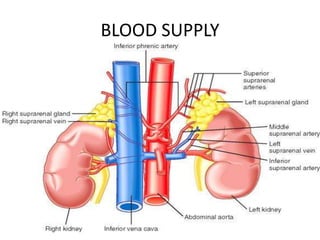
BLOOD SUPPLY
IMAGING MODALITIES
• Ultrasound
• Computed tomography
• Magnetic resonance imaging
• Nuclear medicine imaging
Interventions:
• Adrenal venous Sampling
• Adrenal biopsy
ULTRASONOGRAPHY
• US imaging of the adrenal glands is primarily limited to the pediatric
population,
 Owing to the lack of ionizing radiation
 Relative to body size, adrenal glands are much larger and more easily
identified in neonatal population
• Marchal et al. reported that the normal right and let adrenal glands were
visualized by high-resolution real-time sonography in 92% and 71% of
patients, respectively.
• Left adrenal gland is best seen along the posterior axillary line on an
oblique coronal view, using either the spleen or the left kidney as an
acoustic window.
• Right adrenal gland is best seen through a transverse oblique and coronal
view, using the liver as an acoustic window
COMPUTED TOMOGRAPHY
• Computed tomography (CT) remains the first choice of imaging modality
for evaluation of most of the adrenal diseases
Unehanced CT
“Intracellular Lipid Content of the Adrenal Mass”
• Threshold attenuation value of <10 HU
• CT histogram analysis:
 It plots the attenuation value of each pixel in region of interest (ROI) with
respect to its frequency.
 Number of negative pixels (i.e. less than 0 HU) in ROI corresponds to amount of
lipid content.
• Combination of CT attenuation value <10 HU or > 10 %negative pixel content
would correctly identify 91% of adenomas compared with 66% using CT
attenuation values alone.
• If the attenuation measurement is +10 HU or less, then no further
imaging is performed.
• If attenuation measurement is greater than +10 HU, then repeat imaging
is performed with dynamic contrast enhancement, and also delayed
images are performed.
• Enhancement washout percentages for these masses are calculated.
• The basis of Contrast Enhancement and Contrast Washout Characteristics
“physiological perfusion patterns”
• Both lipid-rich and –poor adenomas behave similarly, as this property of
adenomas is independent of their lipid content.
MAGNETIC RESONANCE IMAGING
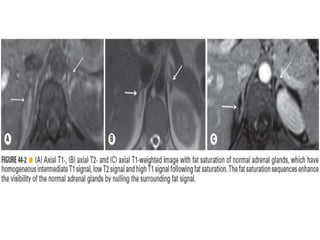
• Chemical shift imaging (CSI) is the mainstay of MRI evaluation of solid
adrenal masses.
• CSI relies on the fact that, within a magnetic field, protons in water
molecules oscillate or precess at a slightly lower frequency than the
protons in lipid molecules.
• Signal intensity in
In phase sequence: water + Fat
Out of phase sequence: water-Fat
• Therefore, adenomas which contain intracellular lipid lose signal intensity
on out-of-phase images compared to in-phase images, whereas malignant
lesions and phaeochromocytomas, which lack intracellular lipid, remain
unchanged.
QUANTIFICTION OF SIGNAL LOSS
NUCLEAR MEDICINE STUDY
• (123I)-labeled metaiodobenzylguanidine (MIBG ) : is an analogue of
norepinephrine and therefore is used to detect tumors originating from the
adrenal medulla, most commonly adrenal pheochromocytomas.
• Fluorine-18 ,Fluorodeoxyglucose (18F FDG) with Positron emission
tomography (PET):Due to relative lack of glucose-6-phosphatase in the
cancer cells as compared to cells of normal tissues, there is a focal
intracellular accumulation of FDG, resulting in high tumor uptake values as
compared to the background uptake values.
• Detect tissue with high metabolic activity and is therefore sensitive at
distinguishing malignant from benign disease
• Simultaneous co-registration with CT imaging (FDG PET/CT) allows for
fusion of functional and anatomic data.
PET-CT performed for
complete staging shows
intense uptake in the
adrenal tumor, indicative
of its malignant nature.
There is also intense
uptake in two liver
metastases and in a bone
metastasis in T12.
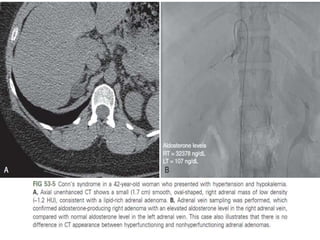
ADRENAL VENOUS SAMPLING
• Approach: transfemoral or transjugular approach under fluoroscopic guidance.
• Blood samples
 Right and left adrenal veins
 inferior vena cava below the level of the adrenal veins(as controls)
• Level of hormone compared (left vs right) to identify hyperfuctioning side .
• Most commonly this procedure is used to confirm the presence of an
aldosterone secreting adrenal adenoma initially detected on cross-sectional
imaging prior to surgical resection.
PERCUTANEOUS ADRENAL BIOPSY
• With improved imaging, only a small percentage of adrenal masses cannot
be characterized.
• Biopsy is commonly performed under CT-guidance.
• Indications : indeterminate adrenal nodules or tumors
• Contraindications
 uncooperative patient
 patient inability to cooperate with breathing instruction or suspend
respiration (because of the proximity of the adrenal gland to the
diaphragm)
 lack of safe access
 uncorrectable bleeding diathesis (abnormal coagulation indices)
Prior to percutaneous biopsy the possibility of a phaeochromocytoma must be
excluded due to risk of hypertensive crisis.
• Complications : hemorrhage ,pancreatitis , abdominal pain, hematuria,
pneumothorax.
ADRENAL LESIONS
IMAGING FINDINGS
BENIGN LESIONS
ADRENAL ADENOMA
• Adrenal adenomas are the most common adrenal lesions
• Overall prevalence: 4-6% in general population and increases with age
• 80% are benign non-functioning adenomas.
• An important characteristic of adrenal adenoma is the presence of
intracellular lipid; 70% of the adenomas are lipid-rich.
• CT is the most sensitive and specific imaging modality for characterization
of adrenal masses.
• On imaging :well-defined, homogeneous masses with smooth contours
CT
• Non-contrast CT :
attenuation value of less than 10 HU.(sensitivity: 89% and Specificity:98-100%)
• Histogram Analysis Method:
 97% of adenomas contain negative pixels.
 No metastases had negative pixels
 CT histogram analysis has been described as one method to improve the
sensitivity of unenhanced CT for diagnosis of lipid-poor adenomas
• Contrast Enhancement and Contrast Washout Characteristics:
Absolute contrast enhancement washout of >= 60%
( sensitivity: 86–88% , specificity :92–96%)
Relative enhancement washout of >= 40%
(sensitivity :96% and a specificity :100% )
MRI
• Conventional Spin-Echo Imaging (T1 / T2): considerable overlap exists between
the signal intensities of adenomas and metastases and up to a third of lesions
remain indeterminate
• Gadolinium-Enhanced MRI
 90% of adenomas demonstrate homogeneous or ring enhancement
 early peak enhancement
• Chemical Shift Imaging
Signal drop in out of phase imaging
Adrenal-splenic ratio (ASR) <=71 % (specificity:100% , sensitive: 78%)
Signal intensity index (SII) >16.5%
ADRENAL MYELOLIPOMA
• Composed of fat and hematopoietic tissue and often resemble bone marrow
• These tumors may also contain calcification in 20% of cases.
• Myelolipomas can hemorrhage when they get large (>5 cm), and as a result
there may be areas of high and low attenuation depending on the age of the
hemorrhage
• Imaging appearance may vary depending on which histological component is
dominant
• USG: echogenic or heterogeneous adrenal mass, which may be associated
with apparent posterior displacement of the diaphragm
• NCCT: In nearly all myelolipomas, some regions with attenuation values less
than –30 HU can be identified
• MRI:Fat has high signal intensity on both T1- and T2-weighted images, lose
signal in fat satuation .
ADRENAL CYST
• Adrenal cysts are rare, with a reported incidence of less than 0.1%
• Female>male ,Asymptomatic
• TYPES:
 Endothelial cysts (45%)
 Pseudocysts /hemorrhagic(40%)
 Epithelial cysts (10%)
 Parasitic cysts (5%)
• CT: well-defined oval or round masses fluid-density attenuation (<20 HU)
and no enhancement or mild wall enhancement
MRI:adrenal cysts are hypointense on T1-weighted image and hyperintense
on T2-weighted image
ADRENAL INFECTION
• Histoplasmosis and tuberculosis are the most commonly seen agents of adrenal
infection. (Less common causes: blastomycosis, Mycobacterium avium-
intracellulare, and CMV particularly in patients with HIV/AIDS).
• Adrenal abscess, caused by Escherichia coli, group B Streptococcus, and
Bacteroides, is rare and usually unilateral
• Adrenal infection, like hemorrhage, can lead to adrenal insufficiency.
CT
• Acute phase: bilateral diffuse or mass like adrenal enlargement with
heterogeneous density and central low attenuation can be seen.
• Chronic stage: calcifications, cysts and gland atrophy may occur.
ADRENAL HEMORRHAGE
Etiology:
Traumatic:
 Blunt abdominal trauma 80% (typically unilateral and on the right side)
 Liver transplant
Non traumatic:
 Systemic anticoagulation therapy
 Bleeding diatheses
 Severe stress
 Sepsis
 Underlying neoplasm
• CT :
 Round or oval hyper dense mass with smooth or irregular margins and a
CT attenuation of 50 to 90 HU
 Adjacent retroperitoneal fat stranding is sometimes observed.
 Over the course of time, the size and density of the adrenal hemorrhage
will decrease and calcifications may develop, usually after 1 year
• MRI:
 acute (<7 days) : Iso- or hypointense on T1-weighted images and marked
hypointense on T2-weighted images.
 Subacute (1 week to 2 months) : Hyperintense on T1/T2-weighted images.
 chronic stage (2-3 months) a: T1/ T2-hypointense rim along periphery
MALIGNANT LESIONS
ADRENAL METASTASES
• Metastases are the most common malignant lesions involving the adrenal
gland.
• Tumors of the lung, kidney, colon, breast, esophagus, pancreas, liver,
stomach, ovary and melanoma are the most common primary sites to
metastasize to adrenals
• In patients with a known primary malignancy up to 38% to 50% of
detected adrenal masses will represent metastatic disease
• Morphologic features of metastases
 Size greater than 4 cm
 heterogeneous density and irregular shape or margins
 bilateral lesions.
(can be helpful, they are considered nonspecific and poorly sensitive)
• An interval increase in size of an adrenal nodule over a 6-month interval
is strongly suggestive of metastatic disease in patients with a known
primary malignancy
• CT:
 >10 HU on unenhanced CT
 Heterogenous enhancement ,enhance rapidly but the washout is
delayed,
 APW< 60%, RPW <40%
( Hypervascular metastasis : 78% HCC and RCC may show contrast washout
characteristics similar to adenoma ( >60% APW and >40% RPW)
MRI:
 low-signal intensity on T1-weighted images and high-signal intensity on
T2-weighted images
 Heterogeneous enhancement after administration of contrast
 No significant signal loss on out of phase image and the signal intensity
remains unchanged
18-FDG PET/PET-CT : Increased uptake is noted
ADRENOCORTICAL CARCINOMA
• Incidence:0.6-1.67 cases per year
• Female : Male :: 2.5-3:1
• Bimodal: 1st decade of life ,4th-5th decade
• Association: Beckwith -Wiedemann syndrome ,Li-Fraumeni syndrome ,CAH
• 50% are functional ( cortisol, androgens, estrogens, and aldosterone)
• Highly necrotic tumor ,cause fever mimicking infectious process
• Metastasis: liver(60%),regional lymph nodes(40%),lungs(40%),peritoneal and
pleural surfaces
• Local invasion most commonly involve the kidneys (26%) and inferior venacava
(9%-19%).
CT
Unilateral mass, usually >6cm in size with necrosis, hemorrhage ,fibrosis and
calcification .
<60% APW and <40% RPW
MRI : T1 hypointense and T2 hyperintense
(often heterogeneous in signal because of hemorrhage and necrosis).
Post contrast Heterogeneous enhancement and slow washout
NEUROBLASTOMA
• Most common extracranial, solid malignant tumor of childhood, accounting
for 8% of childhood malignancies, with 50–80% arising in adrenal glands.
• Common sites of metastases are lymph nodes, cortical bone, marrow, skin
and liver
• MRI and CT :a large mass, with calcification, often extending across the
midline to engulf and displace the aorta anteriorly. Heterogeneous contrast
enhancement is usual.
• MRI is better than CT for defining vascular encasement, metastasis and
intraspinal extension.
• Neuroblastoma may also take up MIBG, which may detect bony metastasis
more accurately than CT or MRI.
COLLISION TUMORS
• Coexistence of two contiguous but histologically different tumors
 Both malignant
 Benign + malignant
 Both benign
• Suspected on unenhanced CT by observing that one portion of an adrenal
nodule measures +10 HU or less and another area measures greater than
+10 HU
• Presence of opposed-phase signal loss in one area of an adrenal mass and
the absence of opposed phase signal loss in another area of an adrenal
mass
• FDG avidity in only a small portion of an adrenal mass, suggesting the
coexistence of an FDG-negative adenoma with an FDG-avid metastasis.
ADRENAL HYPERFUNCTIONAL
CONDITIONS
• CORTEX
 Cushing’s Syndrome- zona glomerulosa
 Conn’s Syndrome- zona fasciculata
 Adrenogenital Syndrome- zona reticularis
• MEDULLA
 Pheochromocytoma
Imaging modalities couldnot differentiate hyperfunctioning conditions from
non functioning.
Role of imaging is to localize and characterize the lesion and assist in
interventions like venous sampling ,biopsy.
CUSHING’S SYNDROME
• Symptoms and signs that result from long-term inappropriate elevation of
free circulating glucocorticoid level
1.ACTH dependent Cushing’s syndrome( 80% to 85% ):
 Pituitary cause (85% )- Cushing’s disease
 Ectopic ACTH (15%)
2. ACTH- independent Cushing’s syndrome (15-20%): primary adrenal lesions
 Cortisol-producing adrenal adenoma
 Adrenal cortical carcinoma
 Primary pigmented nodular adrenal dysplasia (PPNAD)
 ACTH-independent macronodular hyperplasia (AIMAH)
• Diagnosis is on basis of clinical and biochemical findings
Role of imaging
• In ACTH-independent disease: to identify, localize and characterize adrenal
masses
• In ACTH-dependent Cushing’s disease :to identify an anterior pituitary
adenoma or to identify a source of ectopic ACTH.
• The contralateral gland is occasionally atrophic in ACTH independent
cushing’s syndrome.
CONN’S SYNDROME
(Primary Hyperaldosteronism)
• Causes:
 Unilateral aldosterone-producing adenoma (80%)
 Bilateral adrenal hyperplasia (20%)
 Adrenal carcinoma(<1%)
• Diagnosis of conns syndrome is clinical and biochemical.
• Surgical resection is the primary treatment for aldosteronoma and carcinomas
• Medical treatment with spironolactone and antihypertensives is
the treatment of choice for adrenal hyperplasia
• Role of Imaging : to differentiate aldosteronoma /carcioma vs Adrenal
hyperplasia
• Aldosterone-producing adenoma: detection a unilateral adrenal adenoma
• Adrenal hyperplasia.: Bilaterally diffusely enlarged adrenal limbs in the absence of
a discrete adrenal nodule
• Additional confirmatory testing with adrenal vein sampling is selectively
recommended before proceeding to surgery.
• As AVS is not without risks, it is used selectively and
reserved for patients with:
 Normal or equivocal adrenal glands on CT
 Presence of bilateral adrenal nodules, which may be either macronodules of
adrenal hyperplasia or multiple adenomas
 Disagreement between CT and MRI findings or between imaging and biochemical
findings.
ANDROGENITAL SYNDROME
• Androgenital syndrome is a consequence of excessive secretion of sex
hormones
Causes:
• Congenital adrenal hyperplasia in children
• Virilizing tumors (adenoma or carcinoma) in adults
• Role of Imaging: detection of surgically resectable sources of androgen
excess in the adrenals, ovaries or testes.
• MRI and USG (being non-ionizing) are preferred to CT to image adrenals
as well as ovaries/testes particularly in children
• If uncertainty remains adrenal and gonadal venous sampling may be
necessary to locate the source of excessive androgens
PHAEOCHROMOCYTOMA
• Commonest tumor of adrenal medulla
• Paragangliomas arising from neural crest cells
• Follow “RULE of 10”
 ~10% are extra-adrenal
 ~10% are bilateral
 ~10% are malignant
 ~10% are found in children
 ~10% are familial (MEN II A/B,VHL)
 ~10% are not associated with hypertension (non functioning)
 ~10% contain calcification
• Diagnosis :
clinical: young patient with HTN, paroxysmal hypertension, headaches,
visual blurring, sweating and vasomotor changes
Biochemical : plasma and urinary levels of catecholamine , vanillylmandelic
acid (VMA) and metanephrines .
• Imaging studies are performed to localise the tumor and to aid surgical
planning for resection
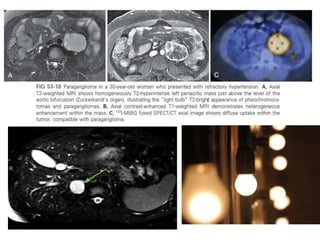
• Pheochromocytomas are nicknamed "imaging chameleons" because many
imaging features overlap with other tumors. Mimicks typically with
necrotic adrenal metastasis and about 30% with adenomas
• MRI is better for detecting extraadrenal pheochromocytoma and
recurrence after surgery.
• So called classic "light bulb sign", which is homogeneous high signal
intensity on T2W-images is seen in 65% of cases
INCIDENTALLY DETECTED
ADRENAL MASS
Adrenal incidentaloma is a term that generally refers to an adrenal mass
measuring greater than 1 cm that is discovered during a radiologic
examination that was performed for indications other than evaluation of
adrenal disease
• The prevalence of incidentally detected adrenal masses on imaging is
approximately 5% (range, 3%-7%) in the adult population.
• On the other hand, almost 50% of incidentally detected adrenal lesions in
patients with known malignancy represent metastatic disease
• The most common underlying pathology for an adrenal incidentaloma is
the nonhyperfunctioning adrenal adenoma, which accounts for 75% of
incidentalomas.
REFERENCES
• DIAGNOSTIC ULTRASOUND ;5TH EDITION
• CT AND MR IMAGING OF THE WHOLE BODY;6TH EDITION
• GRAINGER & ALLISON’S DIAGNOSTIC RADIOLOGY; 6TH EDITION
• Adrenal imaging: A practical guide to diagnostic workup and spectrum of
imaging findings Khaled M. Elsayes, MD, and Elaine M. Caoili
• Adrenal imaging : Imaging techniques and primary cortical lesions
Ananya Panday, Chandan J. Das, Ekta Dhamija, Rakesh Kumar and A. K.
Gupta
THANK YOU

Adrenal imaging

  • 1.
    ADRENAL IMAGING Dr RamanGhimire Resident Radiology (1st year) NAMS
  • 2.
    NORMAL ANATOMY ANDIMAGING APPEARANCE • Named for its location Ad- renal –adjacent to renal Supra-renal –superior to renal • The adrenal glands are retroperitoneal structures that are located adjacent to the kidneys and enclosed within the perinephric fascia. • Size :5 × 3 × 1 cm and weighs 4 -6 gm each
  • 3.
    • Endocrine andnervous systems  Cortex: mesenchymal cells  Medulla : neuroectodermal cells • On imaging : characteristic inverted Y ,V or T shape
  • 5.
    • On cross-sectionalimaging, both adrenal glands can be divided into a  Body (Right <8mm; Left <10)  Medial limb  Lateral limb (limb thickness <=adjacent diaphragmatic crus thickness) <5mm 1= Body 2= Lateral Limb 3= Medial Limb
  • 6.
  • 7.
    RELATIONS OF ADERENALS Rightadrenal gland • Lateral: right lobe (bare area) of the liver • Posteromedial: right crus of the diaphragm • Anteriomedial : inferior vena cava(IVC) • Inferior: upper pole of right kidney
  • 8.
    Left adrenal gland •Posteromedial: left crus of the diaphragm • Anterior: stomach in upper two- third and pancreatic body with splenic vessels in lower one-third. • Lateral: spleen • Posterolateral : upper pole left kidney
  • 9.
  • 10.
    IMAGING MODALITIES • Ultrasound •Computed tomography • Magnetic resonance imaging • Nuclear medicine imaging Interventions: • Adrenal venous Sampling • Adrenal biopsy
  • 11.
    ULTRASONOGRAPHY • US imagingof the adrenal glands is primarily limited to the pediatric population,  Owing to the lack of ionizing radiation  Relative to body size, adrenal glands are much larger and more easily identified in neonatal population • Marchal et al. reported that the normal right and let adrenal glands were visualized by high-resolution real-time sonography in 92% and 71% of patients, respectively. • Left adrenal gland is best seen along the posterior axillary line on an oblique coronal view, using either the spleen or the left kidney as an acoustic window. • Right adrenal gland is best seen through a transverse oblique and coronal view, using the liver as an acoustic window
  • 14.
    COMPUTED TOMOGRAPHY • Computedtomography (CT) remains the first choice of imaging modality for evaluation of most of the adrenal diseases
  • 16.
    Unehanced CT “Intracellular LipidContent of the Adrenal Mass” • Threshold attenuation value of <10 HU • CT histogram analysis:  It plots the attenuation value of each pixel in region of interest (ROI) with respect to its frequency.  Number of negative pixels (i.e. less than 0 HU) in ROI corresponds to amount of lipid content. • Combination of CT attenuation value <10 HU or > 10 %negative pixel content would correctly identify 91% of adenomas compared with 66% using CT attenuation values alone.
  • 17.
    • If theattenuation measurement is +10 HU or less, then no further imaging is performed. • If attenuation measurement is greater than +10 HU, then repeat imaging is performed with dynamic contrast enhancement, and also delayed images are performed. • Enhancement washout percentages for these masses are calculated.
  • 18.
    • The basisof Contrast Enhancement and Contrast Washout Characteristics “physiological perfusion patterns” • Both lipid-rich and –poor adenomas behave similarly, as this property of adenomas is independent of their lipid content.
  • 19.
  • 21.
    • Chemical shiftimaging (CSI) is the mainstay of MRI evaluation of solid adrenal masses. • CSI relies on the fact that, within a magnetic field, protons in water molecules oscillate or precess at a slightly lower frequency than the protons in lipid molecules. • Signal intensity in In phase sequence: water + Fat Out of phase sequence: water-Fat • Therefore, adenomas which contain intracellular lipid lose signal intensity on out-of-phase images compared to in-phase images, whereas malignant lesions and phaeochromocytomas, which lack intracellular lipid, remain unchanged.
  • 22.
  • 23.
    NUCLEAR MEDICINE STUDY •(123I)-labeled metaiodobenzylguanidine (MIBG ) : is an analogue of norepinephrine and therefore is used to detect tumors originating from the adrenal medulla, most commonly adrenal pheochromocytomas. • Fluorine-18 ,Fluorodeoxyglucose (18F FDG) with Positron emission tomography (PET):Due to relative lack of glucose-6-phosphatase in the cancer cells as compared to cells of normal tissues, there is a focal intracellular accumulation of FDG, resulting in high tumor uptake values as compared to the background uptake values. • Detect tissue with high metabolic activity and is therefore sensitive at distinguishing malignant from benign disease • Simultaneous co-registration with CT imaging (FDG PET/CT) allows for fusion of functional and anatomic data.
  • 24.
    PET-CT performed for completestaging shows intense uptake in the adrenal tumor, indicative of its malignant nature. There is also intense uptake in two liver metastases and in a bone metastasis in T12.
  • 25.
    ADRENAL VENOUS SAMPLING •Approach: transfemoral or transjugular approach under fluoroscopic guidance. • Blood samples  Right and left adrenal veins  inferior vena cava below the level of the adrenal veins(as controls) • Level of hormone compared (left vs right) to identify hyperfuctioning side . • Most commonly this procedure is used to confirm the presence of an aldosterone secreting adrenal adenoma initially detected on cross-sectional imaging prior to surgical resection.
  • 26.
    PERCUTANEOUS ADRENAL BIOPSY •With improved imaging, only a small percentage of adrenal masses cannot be characterized. • Biopsy is commonly performed under CT-guidance. • Indications : indeterminate adrenal nodules or tumors • Contraindications  uncooperative patient  patient inability to cooperate with breathing instruction or suspend respiration (because of the proximity of the adrenal gland to the diaphragm)  lack of safe access  uncorrectable bleeding diathesis (abnormal coagulation indices) Prior to percutaneous biopsy the possibility of a phaeochromocytoma must be excluded due to risk of hypertensive crisis. • Complications : hemorrhage ,pancreatitis , abdominal pain, hematuria, pneumothorax.
  • 27.
  • 29.
  • 30.
  • 31.
    ADRENAL ADENOMA • Adrenaladenomas are the most common adrenal lesions • Overall prevalence: 4-6% in general population and increases with age • 80% are benign non-functioning adenomas. • An important characteristic of adrenal adenoma is the presence of intracellular lipid; 70% of the adenomas are lipid-rich. • CT is the most sensitive and specific imaging modality for characterization of adrenal masses. • On imaging :well-defined, homogeneous masses with smooth contours
  • 32.
    CT • Non-contrast CT: attenuation value of less than 10 HU.(sensitivity: 89% and Specificity:98-100%) • Histogram Analysis Method:  97% of adenomas contain negative pixels.  No metastases had negative pixels  CT histogram analysis has been described as one method to improve the sensitivity of unenhanced CT for diagnosis of lipid-poor adenomas • Contrast Enhancement and Contrast Washout Characteristics: Absolute contrast enhancement washout of >= 60% ( sensitivity: 86–88% , specificity :92–96%) Relative enhancement washout of >= 40% (sensitivity :96% and a specificity :100% )
  • 33.
    MRI • Conventional Spin-EchoImaging (T1 / T2): considerable overlap exists between the signal intensities of adenomas and metastases and up to a third of lesions remain indeterminate • Gadolinium-Enhanced MRI  90% of adenomas demonstrate homogeneous or ring enhancement  early peak enhancement • Chemical Shift Imaging Signal drop in out of phase imaging Adrenal-splenic ratio (ASR) <=71 % (specificity:100% , sensitive: 78%) Signal intensity index (SII) >16.5%
  • 35.
    ADRENAL MYELOLIPOMA • Composedof fat and hematopoietic tissue and often resemble bone marrow • These tumors may also contain calcification in 20% of cases. • Myelolipomas can hemorrhage when they get large (>5 cm), and as a result there may be areas of high and low attenuation depending on the age of the hemorrhage • Imaging appearance may vary depending on which histological component is dominant • USG: echogenic or heterogeneous adrenal mass, which may be associated with apparent posterior displacement of the diaphragm
  • 36.
    • NCCT: Innearly all myelolipomas, some regions with attenuation values less than –30 HU can be identified • MRI:Fat has high signal intensity on both T1- and T2-weighted images, lose signal in fat satuation .
  • 37.
    ADRENAL CYST • Adrenalcysts are rare, with a reported incidence of less than 0.1% • Female>male ,Asymptomatic • TYPES:  Endothelial cysts (45%)  Pseudocysts /hemorrhagic(40%)  Epithelial cysts (10%)  Parasitic cysts (5%) • CT: well-defined oval or round masses fluid-density attenuation (<20 HU) and no enhancement or mild wall enhancement
  • 38.
    MRI:adrenal cysts arehypointense on T1-weighted image and hyperintense on T2-weighted image
  • 39.
    ADRENAL INFECTION • Histoplasmosisand tuberculosis are the most commonly seen agents of adrenal infection. (Less common causes: blastomycosis, Mycobacterium avium- intracellulare, and CMV particularly in patients with HIV/AIDS). • Adrenal abscess, caused by Escherichia coli, group B Streptococcus, and Bacteroides, is rare and usually unilateral • Adrenal infection, like hemorrhage, can lead to adrenal insufficiency. CT • Acute phase: bilateral diffuse or mass like adrenal enlargement with heterogeneous density and central low attenuation can be seen. • Chronic stage: calcifications, cysts and gland atrophy may occur.
  • 40.
    ADRENAL HEMORRHAGE Etiology: Traumatic:  Bluntabdominal trauma 80% (typically unilateral and on the right side)  Liver transplant Non traumatic:  Systemic anticoagulation therapy  Bleeding diatheses  Severe stress  Sepsis  Underlying neoplasm
  • 41.
    • CT : Round or oval hyper dense mass with smooth or irregular margins and a CT attenuation of 50 to 90 HU  Adjacent retroperitoneal fat stranding is sometimes observed.  Over the course of time, the size and density of the adrenal hemorrhage will decrease and calcifications may develop, usually after 1 year • MRI:  acute (<7 days) : Iso- or hypointense on T1-weighted images and marked hypointense on T2-weighted images.  Subacute (1 week to 2 months) : Hyperintense on T1/T2-weighted images.  chronic stage (2-3 months) a: T1/ T2-hypointense rim along periphery
  • 42.
  • 43.
    ADRENAL METASTASES • Metastasesare the most common malignant lesions involving the adrenal gland. • Tumors of the lung, kidney, colon, breast, esophagus, pancreas, liver, stomach, ovary and melanoma are the most common primary sites to metastasize to adrenals • In patients with a known primary malignancy up to 38% to 50% of detected adrenal masses will represent metastatic disease • Morphologic features of metastases  Size greater than 4 cm  heterogeneous density and irregular shape or margins  bilateral lesions. (can be helpful, they are considered nonspecific and poorly sensitive)
  • 44.
    • An intervalincrease in size of an adrenal nodule over a 6-month interval is strongly suggestive of metastatic disease in patients with a known primary malignancy • CT:  >10 HU on unenhanced CT  Heterogenous enhancement ,enhance rapidly but the washout is delayed,  APW< 60%, RPW <40% ( Hypervascular metastasis : 78% HCC and RCC may show contrast washout characteristics similar to adenoma ( >60% APW and >40% RPW)
  • 45.
    MRI:  low-signal intensityon T1-weighted images and high-signal intensity on T2-weighted images  Heterogeneous enhancement after administration of contrast  No significant signal loss on out of phase image and the signal intensity remains unchanged
  • 46.
    18-FDG PET/PET-CT :Increased uptake is noted
  • 47.
    ADRENOCORTICAL CARCINOMA • Incidence:0.6-1.67cases per year • Female : Male :: 2.5-3:1 • Bimodal: 1st decade of life ,4th-5th decade • Association: Beckwith -Wiedemann syndrome ,Li-Fraumeni syndrome ,CAH • 50% are functional ( cortisol, androgens, estrogens, and aldosterone) • Highly necrotic tumor ,cause fever mimicking infectious process • Metastasis: liver(60%),regional lymph nodes(40%),lungs(40%),peritoneal and pleural surfaces • Local invasion most commonly involve the kidneys (26%) and inferior venacava (9%-19%).
  • 48.
    CT Unilateral mass, usually>6cm in size with necrosis, hemorrhage ,fibrosis and calcification . <60% APW and <40% RPW
  • 49.
    MRI : T1hypointense and T2 hyperintense (often heterogeneous in signal because of hemorrhage and necrosis). Post contrast Heterogeneous enhancement and slow washout
  • 50.
    NEUROBLASTOMA • Most commonextracranial, solid malignant tumor of childhood, accounting for 8% of childhood malignancies, with 50–80% arising in adrenal glands. • Common sites of metastases are lymph nodes, cortical bone, marrow, skin and liver • MRI and CT :a large mass, with calcification, often extending across the midline to engulf and displace the aorta anteriorly. Heterogeneous contrast enhancement is usual. • MRI is better than CT for defining vascular encasement, metastasis and intraspinal extension. • Neuroblastoma may also take up MIBG, which may detect bony metastasis more accurately than CT or MRI.
  • 51.
    COLLISION TUMORS • Coexistenceof two contiguous but histologically different tumors  Both malignant  Benign + malignant  Both benign • Suspected on unenhanced CT by observing that one portion of an adrenal nodule measures +10 HU or less and another area measures greater than +10 HU • Presence of opposed-phase signal loss in one area of an adrenal mass and the absence of opposed phase signal loss in another area of an adrenal mass • FDG avidity in only a small portion of an adrenal mass, suggesting the coexistence of an FDG-negative adenoma with an FDG-avid metastasis.
  • 52.
    ADRENAL HYPERFUNCTIONAL CONDITIONS • CORTEX Cushing’s Syndrome- zona glomerulosa  Conn’s Syndrome- zona fasciculata  Adrenogenital Syndrome- zona reticularis • MEDULLA  Pheochromocytoma Imaging modalities couldnot differentiate hyperfunctioning conditions from non functioning. Role of imaging is to localize and characterize the lesion and assist in interventions like venous sampling ,biopsy.
  • 53.
    CUSHING’S SYNDROME • Symptomsand signs that result from long-term inappropriate elevation of free circulating glucocorticoid level 1.ACTH dependent Cushing’s syndrome( 80% to 85% ):  Pituitary cause (85% )- Cushing’s disease  Ectopic ACTH (15%) 2. ACTH- independent Cushing’s syndrome (15-20%): primary adrenal lesions  Cortisol-producing adrenal adenoma  Adrenal cortical carcinoma  Primary pigmented nodular adrenal dysplasia (PPNAD)  ACTH-independent macronodular hyperplasia (AIMAH)
  • 54.
    • Diagnosis ison basis of clinical and biochemical findings Role of imaging • In ACTH-independent disease: to identify, localize and characterize adrenal masses • In ACTH-dependent Cushing’s disease :to identify an anterior pituitary adenoma or to identify a source of ectopic ACTH. • The contralateral gland is occasionally atrophic in ACTH independent cushing’s syndrome.
  • 55.
    CONN’S SYNDROME (Primary Hyperaldosteronism) •Causes:  Unilateral aldosterone-producing adenoma (80%)  Bilateral adrenal hyperplasia (20%)  Adrenal carcinoma(<1%) • Diagnosis of conns syndrome is clinical and biochemical. • Surgical resection is the primary treatment for aldosteronoma and carcinomas • Medical treatment with spironolactone and antihypertensives is the treatment of choice for adrenal hyperplasia • Role of Imaging : to differentiate aldosteronoma /carcioma vs Adrenal hyperplasia
  • 56.
    • Aldosterone-producing adenoma:detection a unilateral adrenal adenoma • Adrenal hyperplasia.: Bilaterally diffusely enlarged adrenal limbs in the absence of a discrete adrenal nodule • Additional confirmatory testing with adrenal vein sampling is selectively recommended before proceeding to surgery. • As AVS is not without risks, it is used selectively and reserved for patients with:  Normal or equivocal adrenal glands on CT  Presence of bilateral adrenal nodules, which may be either macronodules of adrenal hyperplasia or multiple adenomas  Disagreement between CT and MRI findings or between imaging and biochemical findings.
  • 58.
    ANDROGENITAL SYNDROME • Androgenitalsyndrome is a consequence of excessive secretion of sex hormones Causes: • Congenital adrenal hyperplasia in children • Virilizing tumors (adenoma or carcinoma) in adults • Role of Imaging: detection of surgically resectable sources of androgen excess in the adrenals, ovaries or testes. • MRI and USG (being non-ionizing) are preferred to CT to image adrenals as well as ovaries/testes particularly in children • If uncertainty remains adrenal and gonadal venous sampling may be necessary to locate the source of excessive androgens
  • 59.
    PHAEOCHROMOCYTOMA • Commonest tumorof adrenal medulla • Paragangliomas arising from neural crest cells • Follow “RULE of 10”  ~10% are extra-adrenal  ~10% are bilateral  ~10% are malignant  ~10% are found in children  ~10% are familial (MEN II A/B,VHL)  ~10% are not associated with hypertension (non functioning)  ~10% contain calcification
  • 60.
    • Diagnosis : clinical:young patient with HTN, paroxysmal hypertension, headaches, visual blurring, sweating and vasomotor changes Biochemical : plasma and urinary levels of catecholamine , vanillylmandelic acid (VMA) and metanephrines . • Imaging studies are performed to localise the tumor and to aid surgical planning for resection • Pheochromocytomas are nicknamed "imaging chameleons" because many imaging features overlap with other tumors. Mimicks typically with necrotic adrenal metastasis and about 30% with adenomas • MRI is better for detecting extraadrenal pheochromocytoma and recurrence after surgery. • So called classic "light bulb sign", which is homogeneous high signal intensity on T2W-images is seen in 65% of cases
  • 62.
    INCIDENTALLY DETECTED ADRENAL MASS Adrenalincidentaloma is a term that generally refers to an adrenal mass measuring greater than 1 cm that is discovered during a radiologic examination that was performed for indications other than evaluation of adrenal disease • The prevalence of incidentally detected adrenal masses on imaging is approximately 5% (range, 3%-7%) in the adult population. • On the other hand, almost 50% of incidentally detected adrenal lesions in patients with known malignancy represent metastatic disease • The most common underlying pathology for an adrenal incidentaloma is the nonhyperfunctioning adrenal adenoma, which accounts for 75% of incidentalomas.
  • 64.
    REFERENCES • DIAGNOSTIC ULTRASOUND;5TH EDITION • CT AND MR IMAGING OF THE WHOLE BODY;6TH EDITION • GRAINGER & ALLISON’S DIAGNOSTIC RADIOLOGY; 6TH EDITION • Adrenal imaging: A practical guide to diagnostic workup and spectrum of imaging findings Khaled M. Elsayes, MD, and Elaine M. Caoili • Adrenal imaging : Imaging techniques and primary cortical lesions Ananya Panday, Chandan J. Das, Ekta Dhamija, Rakesh Kumar and A. K. Gupta
  • 65.

Editor's Notes

  • #3 The right adrenal gland is typically superior to the right kidney, and the left adrenal gland is usually anterior to the superior pole of the left kidney
  • #5 Ectopic or renal agenesis
  • #7 However radiologically couldnot be differrentiated
  • #10 6-8 from inferior phrenic Arteries Left adrenal vein drains into left renal vein (usually after joining left inferior phrenic vein)
  • #12 Difficult to visualize in adult popn. NEONATE : adrenal: kidney: 1/3 adult :1/13
  • #14 is a good indication of a primary adrenal lesion
  • #15 Early systemic arterial phase15-20 sec Late systemic arterial phase Sometimes also called "arterial phase" or "early venous portal phase"35-40 sec Hepatic (most accurate) or late portal phase70-80 sec Nephrogenic phase100 sec Systemic venous phase180
  • #16 Unenhanced CT: Unenhanced CT the adrenals appear similar in density to the liver. (30HU) contrast enhancement, the adrenals may enhance quickly in the early hepatic arterial phase and then fade slightly in the portal venous phase to appear similar in density to the liver. (80-100)
  • #17 DECT:The difference in CT attenuation images acquired at 140 and 80 kVp is measured, and if the difference between the two kVp is more than 6 HU, it is suggestive of fat containing lesion
  • #18 Adrenal washout pitfalls: Adrenal metastases from hypervascular primary tumors like RCC and HCC Pheochromocytomas Adrenocortical carcinomas
  • #20 CSI-intracellular fat T1 Fat sat-macroscopic fat T2-cysts –cystic components and pheochromocytoma Gd -enhancement
  • #22 H=O,H=C Chemical shift imaging is less sensitive than washout CT for detecting lipid-poor adenomas, in particular when unenhanced CT density is 20 HU or higher
  • #23 Visual evaluation : qualitaitve
  • #24 FDG is not specific for any certain adrenal tumor, but can be used to differentiate pheochromocytomas, paragangliomas, adrenocortical carcinomas and adrenal metastases from benign tumors.
  • #25 18F-dihydroxyphenylalanine (DOPA) and 18F-fluorodopamine (DA) are 18F-labeled pheochromocytoma-specific compounds which can be used for PET-CT imaging Somatostatin scan (or Octreoscan) is now being replaced more and more by PET-CT using 68 gallium-labeled somatostatin analogues like DOTA-TOC, DOTA-NOC or DOTA-TATE [19].
  • #27 The main indication currently is when the mass retains imaging features suggestive of a solitary adrenal metastasis in patients with extra-adrenal primary malignancy, prior to deeming them unresectable.
  • #36 Propagation speed artifact (also called misregistration artifact)
  • #45 Compared with adrenal adenomas, adrenal metastases are unlikely to contain significant amounts of intracellular lipid It has been speculated that this difference in enhancement wash out in nonadenoma is possibly due to disturbed capillary permeability, with prolonged retention of contrast in the effective extra cellular space.
  • #48 BWS: 11q , marosomia, organomegaly,abdominal wall defects,hypoglycemia, Embryonal tumors (e.g., Wilms tumor, hepatoblastoma, neuroblastoma, and rhabdomyosarcoma), visceromegaly, adrenocortical cytomegaly, renal abnormalities (e.g., medullary dysplasia, nephrocalcinosis, medullary sponge kidney, and nephromegaly) LFS: TP53 A/w difft cancers soft tissue mainly
  • #54 Ectopic ACTH: Small cell CA, bronchial carcinoid tumor, islet cell tumor of the pancreas, medullary carcinoma of thyroid, thymic carcinoid tumor and pheochromocytoma