By : Marcell Wijaya, S.Ked. MD.
 Combination of bones
 2 part –false and true
 Function :
 Transmit weight
 Protection for vital organs
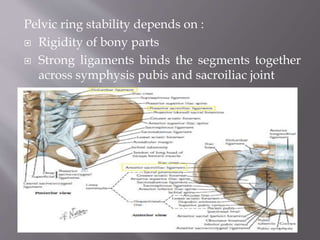
Pelvic ring stability depends on :
 Rigidity of bony parts
 Strong ligaments binds the segments together
across symphysis pubis and sacroiliac joint
 Pelvic fractures accounts for 3% of all skeletal
fractures
 95% of pelvic injuries -> minor trauma
 Severe trauma have high mortality rate due to
hemorrhage or multiple injuries
 Hemorrhage is 80-90% venous in origin
Radiographic lines :
1. Iliopectineal
2. Ilioischial
3. Radiographic
tear drop /
acetabulum
4. Acetabular roof
5. Acetabulum rim
/ wall : anterior
and posterior
6. Shenton
7. Arcuate
Iliac = unaffected hip 45 Obturator = affected 45
Inlet = caudal 45 to inf Outlet = cephalad 45 to sup
Generally injuries of the pelvis is classified into 4
groups :
 Isolated fractures with an intact pelvic ring
 Sacrococcygeal fractures
 Fractures of acetabulum
 Fractures with broken ring – stable or unstable
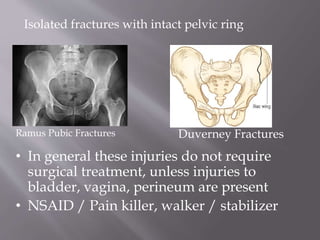
Isolated fractures with intact pelvic ring
Ramus Pubic Fractures Duverney Fractures
• In general these injuries do not require
surgical treatment, unless injuries to
bladder, vagina, perineum are present
• NSAID / Pain killer, walker / stabilizer
Fractures of acetabulum
 Acetabular fracture may cause disruption in hip joint
integrity and dislocation / subluxation of hip joint
 When dislocation occur, emergency relocation /
reduction of the dislocation is necessary to prevent
necrosis of bone (avascular necrosis)
Judet and Letournell Classification
Pediatic Acetabular Fractures Classification
Watts Classification
1. Type A – Small fragments occuring with hip
dislocation
2. Type B – Stable linear fractures without
displacement in association with pelvic
fractures
3. Type C – Linear fractures with hip joint
instability
4. Type D – Fractures secondary to central
fracture-dislocation of the hip
Radiographs
 AP View
 Judet / Oblique View
 Inlet View
 Outlet View
 CT Scan
 Define fragment size and
orientation
 Marginal impaction
 Loose bodies
 Articular gaps
 Treatment :
 Non – operative
 Protected weight bearing 6-8 weeks
 minimally displaced fracture (< 2mm)
 < 20% posterior wall fractures
 femoral head remains congruent with weight bearing roof
(out of traction)
 both column fracture with secondary congruence (out of
traction)
 displaced fracture with roof arcs > 45 degrees in AP and
Judet views
 relative contraindications to surgery :
 Morbid obesity
 Open contaminated wound
 DVT
 Operative
 ORIF
 displacement of roof (>2mm)
 posterior wall fracture involving > 40-50%
 marginal impaction
 intra-articular loose bodies
 irreducible fracture-dislocation
 pregnancy is not contraindication to surgical fixation
 ORIF – Hip Arthroplasty
 significant osteopenia and/or significant comminution
 Percutaneous Fixation with column screws
Complication
 Post-traumatic DJD
 most common complication
 anatomic reduction essential to prevent
 treat with hip fusion or THA
 Heterotopic Ossification
 treat with
 indomethacin x 5 weeks post-op
 low dose external radiation (no difference shown in direct comparison)
 Osteonecrosis
 6-7% of all acetabular fractures
 18% of posterior fracture patterns
 DVT and PE
 Infection
 Bleeding
 Neurovascular injury
 Intraarticular hardware placement
 Abductor muscle weakness
Sacrococcygeal fractures
 Common in pelvic ring injury (30-45%) or after
repetitive stress / insuficiency fracture in old
age
 Fractures may damage Sacral Plexus – loss of
neurological function
 Sacrum contain :
 Lumbar Plexus (L4-S1)
 Sacral Plexus (S2-S4)
 S2-S5 controls sexual, bowel and bladder function
(parasymphatethic pathway)
 presence of a neurologic deficit is the most
important factor in predicting outcome
Denis classification
 Comprised of 3 zones
 Lateral to neuroforamina
 50% of patient, neurological injuries
in 6% cases, affecting L4-L5 nerve
 In neuroforamina, excluding spinal
canal
 34% of patient, neurological injuries
in 28% cases, affecting L5-S1-S2 nerve
 Extend into spinal canal
 16% of patient, neurological injuries
in 57% cases
 Highest prevalence and severity of
injuries
 Transverse sacral fractures
 High incidence of nerve
dysfunction
 U-type sacral fractures
 Result from axial loading
 High incidence of neurologic
complication
Treatment :
Operative
 Surgical fixation w/w/out
decompression
 displaced fractures >1 cm
 soft tissue compromise
 persistent pain and/or
displacement of fracture after non-
operative management
 Neurological deficit
Non – operative
 Progressive weight bearing and
orthosis
 <1 cm displacement and no
neurologic deficit
 insufficiency fractures
 Physical examination reveal :
 Soft tissue trauma around pelvis
 Pelvic ring instability
 Rectal / vaginal touche
 Radiograph : AP, Inlet, Outlet, Cross-table view, CT, MRI
Complication
 Venous thromboembolism
 often as a result of immobility
 Iatrogenic nerve injury
 may result from
 overcompression of fracture
 improper hardware placement
 Malreduction
 more common with vertically displaced fractures
Fractures with broken ring – stable or unstable
 Pelvic ring injury are categorized into 3
classification :
 Letournel and Judet’s classification
 Young and Burgess’ Classification
 Tile Classification
 Mortality rate 15-20% for closed fractures, up to
50% for open fractures
 Hemorrhage is the leading cause of death
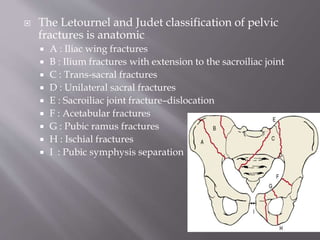
 The Letournel and Judet classification of pelvic
fractures is anatomic
 A : Iliac wing fractures
 B : Ilium fractures with extension to the sacroiliac joint
 C : Trans-sacral fractures
 D : Unilateral sacral fractures
 E : Sacroiliac joint fracture–dislocation
 F : Acetabular fractures
 G : Pubic ramus fractures
 H : Ischial fractures
 I : Pubic symphysis separation
 Young and Burgess’ Classification is based on the mechanism
of injury
 Anterior-posterior Compression (APC)
I. Symphysis widening < 2.5 cm
II. Symphysis widening > 2.5 cm. Sacrospinous and
sacrotuberous disruption
III. Sacroilium dislocation with vascular injury
 Lateral Compression (LC)
I. Ipsilateral ramus pubis and sacral ala fracture
II. Ipsilateral ramus pubis and ilium posterior fracture; also
known as crescent fracture
III. Ipsilateral compression and contralateral APC. Ex : Run
over by car
 Vertical Shear (VS)
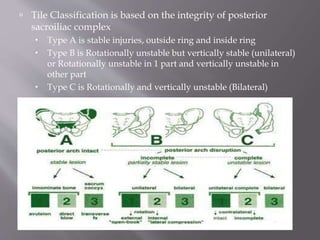
 Tile Classification is based on the integrity of posterior
sacroiliac complex
 Type A is stable injuries, outside ring and inside ring
 Type B is Rotationally unstable but vertically stable (unilateral)
or Rotationally unstable in 1 part and vertically unstable in
other part
 Type C is Rotationally and vertically unstable (Bilateral)
Pediatric Pelvic Injury Classification
Watts Classification modified by Torode and Zieg
1. Type I – avulsion fracture
2. Type II – Iliac wing Fractures
3. Type III – Stable pelvic ring injuries
4. Type IV – unstable pelvic ring injuries
 Radiographic imaging
 Cervical Spine – in suspected high-speed MVI
 Thorax – in suspected high-speed MVI
 AP pelvis
 Inlet view
 Outlet view
 CT
 Signs of Instability
 > 5 mm displacement of
posterior sacroiliac complex
 presence of posterior sacral
fracture gap
 Avulsion fractures (ischial
spine, ischial tuberosity,
sacrum, transverse process of
5th lumbar vertebrae)
Treatment
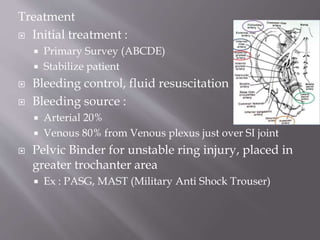
 Initial treatment :
 Primary Survey (ABCDE)
 Stabilize patient
 Bleeding control, fluid resuscitation
 Bleeding source :
 Arterial 20%
 Venous 80% from Venous plexus just over SI joint
 Pelvic Binder for unstable ring injury, placed in
greater trochanter area
 Ex : PASG, MAST (Military Anti Shock Trouser)
 Secondary survey
 Open wound in perineum, groin area
 Abnormal pelvic mobility
 Leg – length discrepancy
 Blood in urethral orifice, anus, perineum, vagina
 Neurological deficit in lower part of body
 External Fixation
 Indications
 pelvic ring injuries with an external rotation component
(APC, VS, CM)
 unstable ring injury with ongoing blood loss, to reduce
pelvic volume
 Contraindications
 ilium fracture that precludes safe application
 acetabular fracture
 Angiography / Embolization
 Indications
 CT angiography useful for
determining presence or absence of
ongoing arterial hemorrhage
 Can not detect venous hemorrhage
 Flush pelvic aortogram, then selected pelvic
angiography
Definitive treatment
 Nonoperative
 weight bearing as tolerated
 mechanically stable pelvic ring injuries including
 LC1
 anterior impaction fracture of sacrum and oblique ramus
fractures with < 1cm of posterior ring displacement
 APC1
 widening of symphysis < 2.5 cm with intact posterior
pelvic ring
 isolated pubic ramus fractures
 Operative
 ORIF
 symphysis diastasis > 2.5 cm
 SI joint displacement > 1 cm
 sacral fracture with displacement > 1 cm
 displacement or rotation of hemipelvis
 open fracture
 diverting colostomy
 consider in open pelvic fractures, especially with
extensive perineal injury or rectal involvement
 RPH : retro –
peritoneal
hematome
 R/O : rule out
Complication
 Neurologic injury
 DVT and PE
 Chronic instability – persistent pain
 Urogenital injury – Urethral tear, bladder
rupture
 Pelvic infection in open fractures
Other Disorder of Pelvis
Osteitis Pubis
 Inflammation or
degeneration of symphysis
pubis
 Repetitive microtrauma or
fracture
 Anterior pubic pain, most
commonly after trauma or
sport.
 Symphysis pubis is tender
to palpation
 Imaging : AP view
with/without inlet and
outlet view
 Treatment consist of activity
modification, NSAID and
fusion as last resort
Sacroilitis
 Inflammation or degeneration of sacroiliac joint
 Low back pain
 Sacro iliac joint is tender to palpation
 Imaging used is X-ray or CT-scan
 Lab report necessary is CBC, ESR, CRP if infection
is suspected
 Treatment consist of rest, NSAID, corticosteroid
local injection
Ischial Bursitis
 Inflammation of bursa of ischial tuberosity
 Prolonged sitting
 Buttock pain on sitting
 Ischial tuberosity is tender on palpation.
 May mimick hamstring injury, however on phys ex,
hamstring movement is not painful
 Imaging used is X-ray or MRI
 Treatment consist of Rest, NSAID and activity
modification (either to decrease seating or adding
more cushion)
Iliac Crest Contusion / Hip Pointer
 Usually from direct trauma to iliac crest
 More common in contact sport
 There is history of trauma or hip pain
 Iliac crest is tender to palpation
 Imaging used is X-ray
 Treatment consist of rest, NSAID, padding to
Iliac Crest and local corticosteroid injection
All about pelvic

All about pelvic

  • 1.
    By : MarcellWijaya, S.Ked. MD.
  • 2.
     Combination ofbones  2 part –false and true  Function :  Transmit weight  Protection for vital organs
  • 4.
    Pelvic ring stabilitydepends on :  Rigidity of bony parts  Strong ligaments binds the segments together across symphysis pubis and sacroiliac joint
  • 5.
     Pelvic fracturesaccounts for 3% of all skeletal fractures  95% of pelvic injuries -> minor trauma  Severe trauma have high mortality rate due to hemorrhage or multiple injuries  Hemorrhage is 80-90% venous in origin
  • 6.
    Radiographic lines : 1.Iliopectineal 2. Ilioischial 3. Radiographic tear drop / acetabulum 4. Acetabular roof 5. Acetabulum rim / wall : anterior and posterior 6. Shenton 7. Arcuate
  • 7.
    Iliac = unaffectedhip 45 Obturator = affected 45 Inlet = caudal 45 to inf Outlet = cephalad 45 to sup
  • 9.
    Generally injuries ofthe pelvis is classified into 4 groups :  Isolated fractures with an intact pelvic ring  Sacrococcygeal fractures  Fractures of acetabulum  Fractures with broken ring – stable or unstable
  • 10.
    Isolated fractures withintact pelvic ring Ramus Pubic Fractures Duverney Fractures • In general these injuries do not require surgical treatment, unless injuries to bladder, vagina, perineum are present • NSAID / Pain killer, walker / stabilizer
  • 11.
    Fractures of acetabulum Acetabular fracture may cause disruption in hip joint integrity and dislocation / subluxation of hip joint  When dislocation occur, emergency relocation / reduction of the dislocation is necessary to prevent necrosis of bone (avascular necrosis)
  • 12.
    Judet and LetournellClassification
  • 13.
    Pediatic Acetabular FracturesClassification Watts Classification 1. Type A – Small fragments occuring with hip dislocation 2. Type B – Stable linear fractures without displacement in association with pelvic fractures 3. Type C – Linear fractures with hip joint instability 4. Type D – Fractures secondary to central fracture-dislocation of the hip
  • 14.
    Radiographs  AP View Judet / Oblique View  Inlet View  Outlet View  CT Scan  Define fragment size and orientation  Marginal impaction  Loose bodies  Articular gaps
  • 16.
     Treatment : Non – operative  Protected weight bearing 6-8 weeks  minimally displaced fracture (< 2mm)  < 20% posterior wall fractures  femoral head remains congruent with weight bearing roof (out of traction)  both column fracture with secondary congruence (out of traction)  displaced fracture with roof arcs > 45 degrees in AP and Judet views  relative contraindications to surgery :  Morbid obesity  Open contaminated wound  DVT
  • 17.
     Operative  ORIF displacement of roof (>2mm)  posterior wall fracture involving > 40-50%  marginal impaction  intra-articular loose bodies  irreducible fracture-dislocation  pregnancy is not contraindication to surgical fixation  ORIF – Hip Arthroplasty  significant osteopenia and/or significant comminution  Percutaneous Fixation with column screws
  • 18.
    Complication  Post-traumatic DJD most common complication  anatomic reduction essential to prevent  treat with hip fusion or THA  Heterotopic Ossification  treat with  indomethacin x 5 weeks post-op  low dose external radiation (no difference shown in direct comparison)  Osteonecrosis  6-7% of all acetabular fractures  18% of posterior fracture patterns  DVT and PE  Infection  Bleeding  Neurovascular injury  Intraarticular hardware placement  Abductor muscle weakness
  • 19.
    Sacrococcygeal fractures  Commonin pelvic ring injury (30-45%) or after repetitive stress / insuficiency fracture in old age  Fractures may damage Sacral Plexus – loss of neurological function  Sacrum contain :  Lumbar Plexus (L4-S1)  Sacral Plexus (S2-S4)  S2-S5 controls sexual, bowel and bladder function (parasymphatethic pathway)  presence of a neurologic deficit is the most important factor in predicting outcome
  • 20.
    Denis classification  Comprisedof 3 zones  Lateral to neuroforamina  50% of patient, neurological injuries in 6% cases, affecting L4-L5 nerve  In neuroforamina, excluding spinal canal  34% of patient, neurological injuries in 28% cases, affecting L5-S1-S2 nerve  Extend into spinal canal  16% of patient, neurological injuries in 57% cases  Highest prevalence and severity of injuries
  • 21.
     Transverse sacralfractures  High incidence of nerve dysfunction  U-type sacral fractures  Result from axial loading  High incidence of neurologic complication
  • 22.
    Treatment : Operative  Surgicalfixation w/w/out decompression  displaced fractures >1 cm  soft tissue compromise  persistent pain and/or displacement of fracture after non- operative management  Neurological deficit Non – operative  Progressive weight bearing and orthosis  <1 cm displacement and no neurologic deficit  insufficiency fractures  Physical examination reveal :  Soft tissue trauma around pelvis  Pelvic ring instability  Rectal / vaginal touche  Radiograph : AP, Inlet, Outlet, Cross-table view, CT, MRI
  • 23.
    Complication  Venous thromboembolism often as a result of immobility  Iatrogenic nerve injury  may result from  overcompression of fracture  improper hardware placement  Malreduction  more common with vertically displaced fractures
  • 24.
    Fractures with brokenring – stable or unstable  Pelvic ring injury are categorized into 3 classification :  Letournel and Judet’s classification  Young and Burgess’ Classification  Tile Classification  Mortality rate 15-20% for closed fractures, up to 50% for open fractures  Hemorrhage is the leading cause of death
  • 25.
     The Letourneland Judet classification of pelvic fractures is anatomic  A : Iliac wing fractures  B : Ilium fractures with extension to the sacroiliac joint  C : Trans-sacral fractures  D : Unilateral sacral fractures  E : Sacroiliac joint fracture–dislocation  F : Acetabular fractures  G : Pubic ramus fractures  H : Ischial fractures  I : Pubic symphysis separation
  • 26.
     Young andBurgess’ Classification is based on the mechanism of injury  Anterior-posterior Compression (APC) I. Symphysis widening < 2.5 cm II. Symphysis widening > 2.5 cm. Sacrospinous and sacrotuberous disruption III. Sacroilium dislocation with vascular injury  Lateral Compression (LC) I. Ipsilateral ramus pubis and sacral ala fracture II. Ipsilateral ramus pubis and ilium posterior fracture; also known as crescent fracture III. Ipsilateral compression and contralateral APC. Ex : Run over by car  Vertical Shear (VS)
  • 28.
     Tile Classificationis based on the integrity of posterior sacroiliac complex  Type A is stable injuries, outside ring and inside ring  Type B is Rotationally unstable but vertically stable (unilateral) or Rotationally unstable in 1 part and vertically unstable in other part  Type C is Rotationally and vertically unstable (Bilateral)
  • 30.
    Pediatric Pelvic InjuryClassification Watts Classification modified by Torode and Zieg 1. Type I – avulsion fracture 2. Type II – Iliac wing Fractures 3. Type III – Stable pelvic ring injuries 4. Type IV – unstable pelvic ring injuries
  • 31.
     Radiographic imaging Cervical Spine – in suspected high-speed MVI  Thorax – in suspected high-speed MVI  AP pelvis  Inlet view  Outlet view  CT  Signs of Instability  > 5 mm displacement of posterior sacroiliac complex  presence of posterior sacral fracture gap  Avulsion fractures (ischial spine, ischial tuberosity, sacrum, transverse process of 5th lumbar vertebrae)
  • 32.
    Treatment  Initial treatment:  Primary Survey (ABCDE)  Stabilize patient  Bleeding control, fluid resuscitation  Bleeding source :  Arterial 20%  Venous 80% from Venous plexus just over SI joint  Pelvic Binder for unstable ring injury, placed in greater trochanter area  Ex : PASG, MAST (Military Anti Shock Trouser)
  • 33.
     Secondary survey Open wound in perineum, groin area  Abnormal pelvic mobility  Leg – length discrepancy  Blood in urethral orifice, anus, perineum, vagina  Neurological deficit in lower part of body
  • 35.
     External Fixation Indications  pelvic ring injuries with an external rotation component (APC, VS, CM)  unstable ring injury with ongoing blood loss, to reduce pelvic volume  Contraindications  ilium fracture that precludes safe application  acetabular fracture  Angiography / Embolization  Indications  CT angiography useful for determining presence or absence of ongoing arterial hemorrhage  Can not detect venous hemorrhage  Flush pelvic aortogram, then selected pelvic angiography
  • 36.
    Definitive treatment  Nonoperative weight bearing as tolerated  mechanically stable pelvic ring injuries including  LC1  anterior impaction fracture of sacrum and oblique ramus fractures with < 1cm of posterior ring displacement  APC1  widening of symphysis < 2.5 cm with intact posterior pelvic ring  isolated pubic ramus fractures
  • 37.
     Operative  ORIF symphysis diastasis > 2.5 cm  SI joint displacement > 1 cm  sacral fracture with displacement > 1 cm  displacement or rotation of hemipelvis  open fracture  diverting colostomy  consider in open pelvic fractures, especially with extensive perineal injury or rectal involvement
  • 38.
     RPH :retro – peritoneal hematome  R/O : rule out
  • 40.
    Complication  Neurologic injury DVT and PE  Chronic instability – persistent pain  Urogenital injury – Urethral tear, bladder rupture  Pelvic infection in open fractures
  • 41.
    Other Disorder ofPelvis Osteitis Pubis  Inflammation or degeneration of symphysis pubis  Repetitive microtrauma or fracture  Anterior pubic pain, most commonly after trauma or sport.  Symphysis pubis is tender to palpation  Imaging : AP view with/without inlet and outlet view  Treatment consist of activity modification, NSAID and fusion as last resort
  • 42.
    Sacroilitis  Inflammation ordegeneration of sacroiliac joint  Low back pain  Sacro iliac joint is tender to palpation  Imaging used is X-ray or CT-scan  Lab report necessary is CBC, ESR, CRP if infection is suspected  Treatment consist of rest, NSAID, corticosteroid local injection
  • 43.
    Ischial Bursitis  Inflammationof bursa of ischial tuberosity  Prolonged sitting  Buttock pain on sitting  Ischial tuberosity is tender on palpation.  May mimick hamstring injury, however on phys ex, hamstring movement is not painful  Imaging used is X-ray or MRI  Treatment consist of Rest, NSAID and activity modification (either to decrease seating or adding more cushion)
  • 45.
    Iliac Crest Contusion/ Hip Pointer  Usually from direct trauma to iliac crest  More common in contact sport  There is history of trauma or hip pain  Iliac crest is tender to palpation  Imaging used is X-ray  Treatment consist of rest, NSAID, padding to Iliac Crest and local corticosteroid injection