Importance of Primary Teeth
ļ‚— Smiling & self-esteem
ļ‚— Chewing and eating
ļ‚— Speech development
ļ‚— Aid proper jaw and face formation
ļ‚— Guide permanent teeth into place
Tooth eruption
ļ‚—ā€œIt is a series of metabolic events in the
alveolar bone characterized by bone
resorption & formation on opposite sides of
dental follicle but tooth does not contribute
to this processā€
Tooth eruption
ļ‚— The interval between crown completion & beginning of eruption until
tooth is in full occlusion is 5 years for permanent.
ļ‚— Associated stage of root formation not chronologic or skeletal age.
ļ‚— ¾ of the root formed.
ļ‚— Tooth reach occlusion before root completion
ļ‚— Sex difference in root completion ( girls).
STEPS OF TOOTH ERUPTION
1.Pre-emergent eruption - Pre-eruptive phase
a) resorption of the bone & primary tooth
roots
b) the eruption mechanism
2. Post-emergent eruption - Eruptive phase
STEPS OF TOOTH ERUPTION
2. Post-emergent eruption - Eruptive phase
a) post-emergent spurt - Eruptive phase
(Pre-functional)
b) Juvenile occlusal equilibrium
Eruptive phase (Functional)
c)Adult occlusal equilibrium
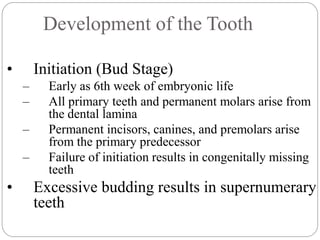
Development of the Tooth
• Initiation (Bud Stage)
– Early as 6th week of embryonic life
– All primary teeth and permanent molars arise from
the dental lamina
– Permanent incisors, canines, and premolars arise
from the primary predecessor
– Failure of initiation results in congenitally missing
teeth
• Excessive budding results in supernumerary
teeth
Factors related to tooth eruption
ļ‚— Elongation of the root.
ļ‚— Force of vascular tissues around & beneath root.
ļ‚— Growth of the alveolar bone.
ļ‚— Growth of dentin.
ļ‚— Growth & pull of the periodontal membrane.
ļ‚— Hormonal influences
ļ‚— Presence of dental follicle.
ļ‚— Pressure from muscles action.
ļ‚— Resorption of the alveolar crest.
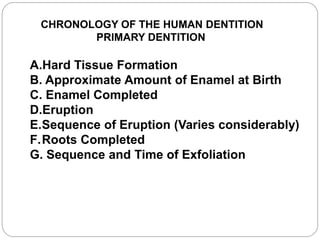
CHRONOLOGY OF THE HUMAN DENTITION
PRIMARY DENTITION
A.Hard Tissue Formation
B. Approximate Amount of Enamel at Birth
C. Enamel Completed
D.Eruption
E.Sequence of Eruption (Varies considerably)
F.Roots Completed
G. Sequence and Time of Exfoliation
- Primary Root completion 12- 18 months post
eruption.
- Teeth erupt when the root is 2/3 complete.
- Most favorable eruption sequence for primary
teeth both Maxillary & Mandibular:
ABDCE
- Tooth germs form at 6-8 wks IU
- enamel forms 4-6 months
CHRONOLOGY OF THE HUMAN DENTITION
PRIMARY DENTITION
(Varies considerably)
1. Centrals: Mandibular then maxillary
2. Laterals: Mandibular then maxillary
3. 1st Molars: Mandibular then maxillary
4. Cuspids: Mandibular then maxillary
5. 2nd Molars: Mandibular then maxillary
Usually the mandibular teeth erupt first
Eruption Sequence of primary
Primary dentition
 Mandibular central: 6 mos
 Mandibular lateral: 7 mos
 Maxillary central: 7 ½ mos
 Maxillary lateral: 9 mos
 Mandibular 1st molar: 12 mos
 Maxillary 1st molar 14 mos
 Mandibular cuspid: 16 mos
 Maxillary cuspid: 18 mos
 Mandibular 2nd molar: 20 mos
 Maxillary 2nd molar: 24 mos
Eruption sequence
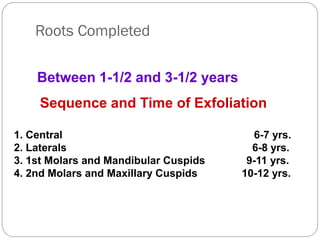
Sequence and Time of Exfoliation
1. Central 6-7 yrs.
2. Laterals 6-8 yrs.
3. 1st Molars and Mandibular Cuspids 9-11 yrs.
4. 2nd Molars and Maxillary Cuspids 10-12 yrs.
Between 1-1/2 and 3-1/2 years
Roots Completed
Root CompletedEruptionHard Tissue Formation
Begins
Tooth
Maxillary
10 yr7-8 yr3-4 moCentral Incisor
11 yr8-9 yr10-12 moLateral Incisor
13-15 yr11-12 yr4-5 moCuspid
12-13 yr10-11 yr1 ½ - 1 ¾ yrFirst Bicuspid
12-14 yr10-12 yr2 – 2 ¼ yrSecond bicuspid
9-10 yr6-7 yrat birthFirst molar
14-16 yr12-13 yr2 ½ - 3 yrSecond molar
Permanent Dentition
Mandibular
9 yr6-7 yr3-4 moCentral Incisor
10 yr7-8 yr3-4 moLateral Incisor
12-14 yr9-10 yr4-5 moCuspid
12-13 yr10-12 yr1 ¾ - 2 yrFirst Bicuspid
13-14 yr11-12 yr2 ¼ - 2 ½ yrSecond bicuspid
9-10 yr6-7 yrat birthFirst molar
14-15 yr11-13 yr2 ½ - 3 yrSecond molar
Permanent Dentition
- Max: 61245378
- Man: 61234578
- Emergence when 2/3 root present
-Root completion 3 years post eruption (2-3 yrs.)
Eruption sequence:
- mandibular incisors
- 1st permanent molars, upper incisors
- canine (mand)
- 1st premolar
- max canine
- 2nd premolar
Permanent Dentition Eruption Sequence:
- Mand 1st molar: 6/7 yrs
-Max 1st molar: 6/7 yrs
-Mand central: 6/7 yrs
-Mand lateral: 7/8 yrs
-Max central: 7/8 yrs
-Max lateral: 8/9 yrs
-Mand cuspid: 9/10 yrs
-Mand 1st bicuspid: 10/11 yrs
-Max 1st bicuspid: 10/11 yrs
-Max 2nd bicuspid: 10/12 yrs
-Mand 2nd bicuspid: 11/12 yrs
-Max cuspid: 11/12 yrs
-Mand 2nd molar: 11/13 yrs
-Max 2nd molar: 12/13 yrs
Permanent dentition sequence
Growth & Development of the Teeth
ļ‚— At birth the primary teeth have already formed
ļ‚— Permanent teeth are developing or beginning to mineralize
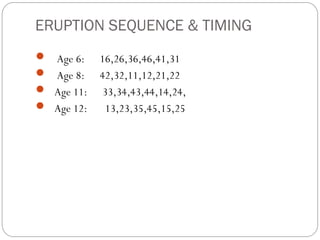
ERUPTION SEQUENCE & TIMING
ļ‚— Age 6: 16,26,36,46,41,31
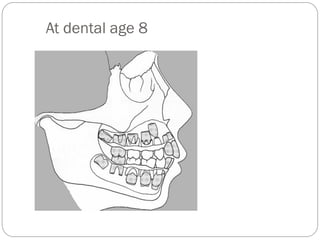
ļ‚— Age 8: 42,32,11,12,21,22
ļ‚— Age 11: 33,34,43,44,14,24,
ļ‚— Age 12: 13,23,35,45,15,25
ERUPTION SEQUENCE & TIMING
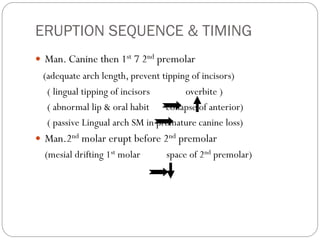
ļ‚— Man. Canine then 1st 7 2nd premolar
(adequate arch length, prevent tipping of incisors)
( lingual tipping of incisors overbite )
( abnormal lip & oral habit collapse of anterior)
( passive Lingual arch SM in premature canine loss)
ļ‚— Man.2nd molar erupt before 2nd premolar
(mesial drifting 1st molar space of 2nd premolar)
ERUPTION SEQUENCE & TIMING
ļ‚— Loss of Max. primary molar
(1st molar drift& tip mesially canine labially blocked)
ļ‚— Eruption of 2nd Max. molar premolars
( loss of arch length)
ļ‚— Delayed eruption of the canine
( effect on alignment of anterior teeth)
At dental age 6
At dental age 8
The Ugly Ducking Stage
ļ‚— Changes in the axial inclination due to the eruption of the
maxillary anterior teeth
7 years 9 years 14 years
At dental age 9
At dental age 9
ļ‚— Root maxillary canines & second premolars is just beginning,1/3
root of the mandibular canines & first premolars completed.
Maxillary lateral incisors in place for 1 year
& root incisors and first molars nearly
complete.
Dental age 11
Dental age 11
Simultaneous eruption of the mandibular canines, mandibular first
premolars, and maxillary first premolars
Dental age 12
Dental age 12
ļ‚— Eruption of the remaining succedaneous teeth (maxillary canine,
maxillary & mandibular second premolars) and, typically a few months
alter, the maxillary & mandibular second molars.
Dental age 15
Dental age 15
ļ‚— Roots of all permanent teeth except the third molars are complete,
and crown formation of third molars completed.
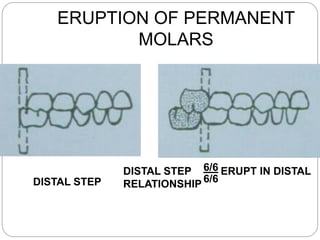
ERUPTION OF PERMANENT MOLARS
MESIAL STEP
MESIAL STEP ERUPT IN CUSP-
GROOVE RELATIONSHIP
6/6
6/6
ERUPTION OF PERMANENT
MOLARS
DISTAL STEP
DISTAL STEP ERUPT IN DISTAL
RELATIONSHIP
6/6
6/6
The Ideal Primary Occlusion
• Ovoid arches
• Good interdental or primary spacing
• Flush terminal plane or mesial step molars
• Neutro cuspids
Occlusion
Variations in eruption
ļ‚— Epstein Pearls, Bohn Nodules
ļ‚— Natal and Neonatal teeth.
ļ‚— Teething: a natural phenomenon & systemic distress.
ļ‚— Eruption Hematoma (Eruption Cyst).
ļ‚— Ankylosed teeth.
ļ‚— Congenital factors influence eruption: Down Syndrome, Cleidocaial
Dysplasia.
ļ‚— Local factors influence eruption: infection, trauma.
ļ‚— Premature eruption of preliminary teeth
ļ‚— Tooth should be retained unless mobile
Natal teeth
Natal Teeth - born with teeth.
Neonatal - 30 days after birth
- don't remove. (unless very mobile and
worried about aspiration
• 85% of natal or neonatal Teeth are
mandibular incisor.
• (1) 11% Maxillary incisor
• (2) 3% Mandibular cuspids
• (3) 1% Maxillary cuspids/molar
Dental Lamina Cyst
Eruption Hematoma
Teething Process
• Irritability • Fever
• Drooling • Diarrhea
• Mouthing • Pain
• Sleep Disturbance • Rash
• Biting • Gum rubbing
• Ear Rubbing • Decreased Appetite
Early eruption
Missing tooth
Impaction - failure to erupt
e.g., from too little gap after premature loss of deciduous
tooth
Delayed eruption
Malocclusion
Tilting (can occur early from germ rotation)
Infra-occlusion (not high enough)
Retained root fragment
Excessive drift
ERUPTION: Problems
FACTORS INFLUENCE THE ERUPTION
Local
Systemic
Congenital
ļ‚— Two rows of teeth
ļ‚— Ectopic eruption
ļ‚— Infected primary teeth
ļ‚— Ankylosis
ļ‚— Primary failure of eruption
ļ‚— Hypothyroidism
ļ‚— Down’s Syndrome
ļ‚— Achondroplastic Dwarfism
ļ‚— Cleidocranial Dysplasia
Delayed Exfoliation of primary teeth
Causes of delayed tooth exfoliation
Premature loss & eruption time of
successors
ļ‚— Unilateral loss before 4-5 year delay eruption
ļ‚— Loss after 5 year decrease the delay
ļ‚— Loss at 8-9 year accelerate the eruption
ANKYLOSIS
Primary dentition
ļ‚— First molars most common
ļ‚— Typically require no treatment and exfoliate normally
ļ‚— Involved second molar maybe indication of agenesis of
succedaneous tooth
ļ‚— Treatment:
ļ‚— Prevent space loss
o Build-up occlusion surface of involved tooth
o Extract tooth and place space maintainer
ANKYLOSIS
ļ‚— Permanent dentition
ļ‚— Difficult to treat ankylosed permanent teeth
ļ‚— Create adequate space
ļ‚— Attempt to break area of ankylosis with luxation
ļ‚— Immediately apply orthodontic traction force (>50 G) or
ļ‚— Surgically reposition tooth and hold in position orthodontically (pulp
endodontic therapy necessary)
ļ‚— Ankylosed permanent teeth tend to re-ankylose.
Causes of delayed tooth eruption
1. Endocrine disorders
• Hypothyroidism
• Calcium/phosphorus metabolism problems
• Hypopituitarism
2. Genetic disorders and bone disorders
Ectodermal dysplasias
• Down syndrome
• Cleidocranial dysplasia
• Gaucher disease
• Osteoporosis
3. Local factors
• Tooth in path of erupting tooth,
insufficient space, impacted teeth
• Dental infection
• Radiation therapy
ECTOPIC ERUPTION/IMPACTIONS
ļ‚— Primary dentition
Extremely rare in primary dentition
ļ‚— Permanent dentition
Permanent molars
ļ‚— 1st > 2nd; maxillary > mandibular
ļ‚— Incidence of 1st molar: - 2-3%
ļ‚— Suggested etiologies include
ļ‚— Small maxilla
ļ‚— Posterioly positioned maxilla
ļ‚— relative to cranial base
Etiologies of ectopic eruption
ļ‚— Molar path of eruption
• Mesio-distal dimension
• A synchronization between tuberosity
• Growth and molar eruption
• Retarded calcification and eruption
• Genetic
Treatment of ectopic eruption
ļ‚— Treatment
ļ‚— Mild: observation ( 2/3 of ectopically erupting 1st molars
will self-correct)
ļ‚— Moderate: brass ligature; spring; distalize 1st permanent
molar
ļ‚— Severe: extract primary molar and distalize 1st permanent
molar
Ectopic eruption
Permanent mandibular incisor
ļ‚— Common: typically erupt lingual to over- retained primary incisors
ļ‚— Rationale for treatment: allow teeth to move into area of attached gingival
ļ‚— Treatment: extract primary incisors; tongue pressure will typically push
incisors into place
ļ‚— Prevalence 1-2%
ļ‚— Reported incisor root resorption - 50%
ļ‚— Diagnosis
ļ‚— Palpation
ļ‚— Radiographic
─ Poor prognosis indicators
─ Permanent canine crown mesial of midline of lateral incisor root
─ Palatal displacement of permanent canine as viewed on cephalometric
Ectopic eruption
Permanent maxillary canines

Pedia eruption

  • 1.
    Importance of PrimaryTeeth ļ‚— Smiling & self-esteem ļ‚— Chewing and eating ļ‚— Speech development ļ‚— Aid proper jaw and face formation ļ‚— Guide permanent teeth into place
  • 2.
    Tooth eruption ļ‚—ā€œIt isa series of metabolic events in the alveolar bone characterized by bone resorption & formation on opposite sides of dental follicle but tooth does not contribute to this processā€
  • 3.
    Tooth eruption ļ‚— Theinterval between crown completion & beginning of eruption until tooth is in full occlusion is 5 years for permanent. ļ‚— Associated stage of root formation not chronologic or skeletal age. ļ‚— ¾ of the root formed. ļ‚— Tooth reach occlusion before root completion ļ‚— Sex difference in root completion ( girls).
  • 4.
    STEPS OF TOOTHERUPTION 1.Pre-emergent eruption - Pre-eruptive phase a) resorption of the bone & primary tooth roots b) the eruption mechanism 2. Post-emergent eruption - Eruptive phase
  • 5.
    STEPS OF TOOTHERUPTION 2. Post-emergent eruption - Eruptive phase a) post-emergent spurt - Eruptive phase (Pre-functional) b) Juvenile occlusal equilibrium Eruptive phase (Functional) c)Adult occlusal equilibrium
  • 6.
    Development of theTooth • Initiation (Bud Stage) – Early as 6th week of embryonic life – All primary teeth and permanent molars arise from the dental lamina – Permanent incisors, canines, and premolars arise from the primary predecessor – Failure of initiation results in congenitally missing teeth • Excessive budding results in supernumerary teeth
  • 7.
    Factors related totooth eruption ļ‚— Elongation of the root. ļ‚— Force of vascular tissues around & beneath root. ļ‚— Growth of the alveolar bone. ļ‚— Growth of dentin. ļ‚— Growth & pull of the periodontal membrane. ļ‚— Hormonal influences ļ‚— Presence of dental follicle. ļ‚— Pressure from muscles action. ļ‚— Resorption of the alveolar crest.
  • 9.
    CHRONOLOGY OF THEHUMAN DENTITION PRIMARY DENTITION A.Hard Tissue Formation B. Approximate Amount of Enamel at Birth C. Enamel Completed D.Eruption E.Sequence of Eruption (Varies considerably) F.Roots Completed G. Sequence and Time of Exfoliation
  • 10.
    - Primary Rootcompletion 12- 18 months post eruption. - Teeth erupt when the root is 2/3 complete. - Most favorable eruption sequence for primary teeth both Maxillary & Mandibular: ABDCE - Tooth germs form at 6-8 wks IU - enamel forms 4-6 months CHRONOLOGY OF THE HUMAN DENTITION PRIMARY DENTITION
  • 11.
    (Varies considerably) 1. Centrals:Mandibular then maxillary 2. Laterals: Mandibular then maxillary 3. 1st Molars: Mandibular then maxillary 4. Cuspids: Mandibular then maxillary 5. 2nd Molars: Mandibular then maxillary Usually the mandibular teeth erupt first Eruption Sequence of primary
  • 12.
    Primary dentition  Mandibularcentral: 6 mos  Mandibular lateral: 7 mos  Maxillary central: 7 ½ mos  Maxillary lateral: 9 mos  Mandibular 1st molar: 12 mos  Maxillary 1st molar 14 mos  Mandibular cuspid: 16 mos  Maxillary cuspid: 18 mos  Mandibular 2nd molar: 20 mos  Maxillary 2nd molar: 24 mos Eruption sequence
  • 13.
    Sequence and Timeof Exfoliation 1. Central 6-7 yrs. 2. Laterals 6-8 yrs. 3. 1st Molars and Mandibular Cuspids 9-11 yrs. 4. 2nd Molars and Maxillary Cuspids 10-12 yrs. Between 1-1/2 and 3-1/2 years Roots Completed
  • 14.
    Root CompletedEruptionHard TissueFormation Begins Tooth Maxillary 10 yr7-8 yr3-4 moCentral Incisor 11 yr8-9 yr10-12 moLateral Incisor 13-15 yr11-12 yr4-5 moCuspid 12-13 yr10-11 yr1 ½ - 1 ¾ yrFirst Bicuspid 12-14 yr10-12 yr2 – 2 ¼ yrSecond bicuspid 9-10 yr6-7 yrat birthFirst molar 14-16 yr12-13 yr2 ½ - 3 yrSecond molar Permanent Dentition
  • 15.
    Mandibular 9 yr6-7 yr3-4moCentral Incisor 10 yr7-8 yr3-4 moLateral Incisor 12-14 yr9-10 yr4-5 moCuspid 12-13 yr10-12 yr1 ¾ - 2 yrFirst Bicuspid 13-14 yr11-12 yr2 ¼ - 2 ½ yrSecond bicuspid 9-10 yr6-7 yrat birthFirst molar 14-15 yr11-13 yr2 ½ - 3 yrSecond molar Permanent Dentition
  • 16.
    - Max: 61245378 -Man: 61234578 - Emergence when 2/3 root present -Root completion 3 years post eruption (2-3 yrs.) Eruption sequence: - mandibular incisors - 1st permanent molars, upper incisors - canine (mand) - 1st premolar - max canine - 2nd premolar Permanent Dentition Eruption Sequence:
  • 17.
    - Mand 1stmolar: 6/7 yrs -Max 1st molar: 6/7 yrs -Mand central: 6/7 yrs -Mand lateral: 7/8 yrs -Max central: 7/8 yrs -Max lateral: 8/9 yrs -Mand cuspid: 9/10 yrs -Mand 1st bicuspid: 10/11 yrs -Max 1st bicuspid: 10/11 yrs -Max 2nd bicuspid: 10/12 yrs -Mand 2nd bicuspid: 11/12 yrs -Max cuspid: 11/12 yrs -Mand 2nd molar: 11/13 yrs -Max 2nd molar: 12/13 yrs Permanent dentition sequence
  • 18.
    Growth & Developmentof the Teeth ļ‚— At birth the primary teeth have already formed ļ‚— Permanent teeth are developing or beginning to mineralize
  • 19.
    ERUPTION SEQUENCE &TIMING ļ‚— Age 6: 16,26,36,46,41,31 ļ‚— Age 8: 42,32,11,12,21,22 ļ‚— Age 11: 33,34,43,44,14,24, ļ‚— Age 12: 13,23,35,45,15,25
  • 20.
    ERUPTION SEQUENCE &TIMING ļ‚— Man. Canine then 1st 7 2nd premolar (adequate arch length, prevent tipping of incisors) ( lingual tipping of incisors overbite ) ( abnormal lip & oral habit collapse of anterior) ( passive Lingual arch SM in premature canine loss) ļ‚— Man.2nd molar erupt before 2nd premolar (mesial drifting 1st molar space of 2nd premolar)
  • 21.
    ERUPTION SEQUENCE &TIMING ļ‚— Loss of Max. primary molar (1st molar drift& tip mesially canine labially blocked) ļ‚— Eruption of 2nd Max. molar premolars ( loss of arch length) ļ‚— Delayed eruption of the canine ( effect on alignment of anterior teeth)
  • 22.
  • 23.
  • 24.
    The Ugly DuckingStage ļ‚— Changes in the axial inclination due to the eruption of the maxillary anterior teeth 7 years 9 years 14 years
  • 25.
  • 26.
    At dental age9 ļ‚— Root maxillary canines & second premolars is just beginning,1/3 root of the mandibular canines & first premolars completed. Maxillary lateral incisors in place for 1 year & root incisors and first molars nearly complete.
  • 27.
  • 28.
    Dental age 11 Simultaneouseruption of the mandibular canines, mandibular first premolars, and maxillary first premolars
  • 29.
  • 30.
    Dental age 12 ļ‚—Eruption of the remaining succedaneous teeth (maxillary canine, maxillary & mandibular second premolars) and, typically a few months alter, the maxillary & mandibular second molars.
  • 31.
  • 32.
    Dental age 15 ļ‚—Roots of all permanent teeth except the third molars are complete, and crown formation of third molars completed.
  • 33.
    ERUPTION OF PERMANENTMOLARS MESIAL STEP MESIAL STEP ERUPT IN CUSP- GROOVE RELATIONSHIP 6/6 6/6
  • 34.
    ERUPTION OF PERMANENT MOLARS DISTALSTEP DISTAL STEP ERUPT IN DISTAL RELATIONSHIP 6/6 6/6
  • 35.
    The Ideal PrimaryOcclusion • Ovoid arches • Good interdental or primary spacing • Flush terminal plane or mesial step molars • Neutro cuspids
  • 36.
  • 37.
    Variations in eruption ļ‚—Epstein Pearls, Bohn Nodules ļ‚— Natal and Neonatal teeth. ļ‚— Teething: a natural phenomenon & systemic distress. ļ‚— Eruption Hematoma (Eruption Cyst). ļ‚— Ankylosed teeth. ļ‚— Congenital factors influence eruption: Down Syndrome, Cleidocaial Dysplasia. ļ‚— Local factors influence eruption: infection, trauma.
  • 38.
    ļ‚— Premature eruptionof preliminary teeth ļ‚— Tooth should be retained unless mobile Natal teeth Natal Teeth - born with teeth. Neonatal - 30 days after birth - don't remove. (unless very mobile and worried about aspiration • 85% of natal or neonatal Teeth are mandibular incisor. • (1) 11% Maxillary incisor • (2) 3% Mandibular cuspids • (3) 1% Maxillary cuspids/molar
  • 39.
  • 40.
  • 41.
  • 42.
    • Irritability •Fever • Drooling • Diarrhea • Mouthing • Pain • Sleep Disturbance • Rash • Biting • Gum rubbing • Ear Rubbing • Decreased Appetite
  • 43.
    Early eruption Missing tooth Impaction- failure to erupt e.g., from too little gap after premature loss of deciduous tooth Delayed eruption Malocclusion Tilting (can occur early from germ rotation) Infra-occlusion (not high enough) Retained root fragment Excessive drift ERUPTION: Problems
  • 44.
    FACTORS INFLUENCE THEERUPTION Local Systemic Congenital ļ‚— Two rows of teeth ļ‚— Ectopic eruption ļ‚— Infected primary teeth ļ‚— Ankylosis ļ‚— Primary failure of eruption ļ‚— Hypothyroidism ļ‚— Down’s Syndrome ļ‚— Achondroplastic Dwarfism ļ‚— Cleidocranial Dysplasia
  • 45.
  • 46.
    Causes of delayedtooth exfoliation
  • 47.
    Premature loss &eruption time of successors ļ‚— Unilateral loss before 4-5 year delay eruption ļ‚— Loss after 5 year decrease the delay ļ‚— Loss at 8-9 year accelerate the eruption
  • 48.
    ANKYLOSIS Primary dentition ļ‚— Firstmolars most common ļ‚— Typically require no treatment and exfoliate normally ļ‚— Involved second molar maybe indication of agenesis of succedaneous tooth ļ‚— Treatment: ļ‚— Prevent space loss o Build-up occlusion surface of involved tooth o Extract tooth and place space maintainer
  • 49.
    ANKYLOSIS ļ‚— Permanent dentition ļ‚—Difficult to treat ankylosed permanent teeth ļ‚— Create adequate space ļ‚— Attempt to break area of ankylosis with luxation ļ‚— Immediately apply orthodontic traction force (>50 G) or ļ‚— Surgically reposition tooth and hold in position orthodontically (pulp endodontic therapy necessary) ļ‚— Ankylosed permanent teeth tend to re-ankylose.
  • 50.
    Causes of delayedtooth eruption 1. Endocrine disorders • Hypothyroidism • Calcium/phosphorus metabolism problems • Hypopituitarism 2. Genetic disorders and bone disorders Ectodermal dysplasias • Down syndrome • Cleidocranial dysplasia • Gaucher disease • Osteoporosis 3. Local factors • Tooth in path of erupting tooth, insufficient space, impacted teeth • Dental infection • Radiation therapy
  • 51.
    ECTOPIC ERUPTION/IMPACTIONS ļ‚— Primarydentition Extremely rare in primary dentition ļ‚— Permanent dentition Permanent molars ļ‚— 1st > 2nd; maxillary > mandibular ļ‚— Incidence of 1st molar: - 2-3% ļ‚— Suggested etiologies include ļ‚— Small maxilla ļ‚— Posterioly positioned maxilla ļ‚— relative to cranial base
  • 52.
    Etiologies of ectopiceruption ļ‚— Molar path of eruption • Mesio-distal dimension • A synchronization between tuberosity • Growth and molar eruption • Retarded calcification and eruption • Genetic
  • 53.
    Treatment of ectopiceruption ļ‚— Treatment ļ‚— Mild: observation ( 2/3 of ectopically erupting 1st molars will self-correct) ļ‚— Moderate: brass ligature; spring; distalize 1st permanent molar ļ‚— Severe: extract primary molar and distalize 1st permanent molar
  • 54.
    Ectopic eruption Permanent mandibularincisor ļ‚— Common: typically erupt lingual to over- retained primary incisors ļ‚— Rationale for treatment: allow teeth to move into area of attached gingival ļ‚— Treatment: extract primary incisors; tongue pressure will typically push incisors into place
  • 55.
    ļ‚— Prevalence 1-2% ļ‚—Reported incisor root resorption - 50% ļ‚— Diagnosis ļ‚— Palpation ļ‚— Radiographic ─ Poor prognosis indicators ─ Permanent canine crown mesial of midline of lateral incisor root ─ Palatal displacement of permanent canine as viewed on cephalometric Ectopic eruption Permanent maxillary canines