ANGLE’S CLASSIFICATION OF MALOCCLUSION
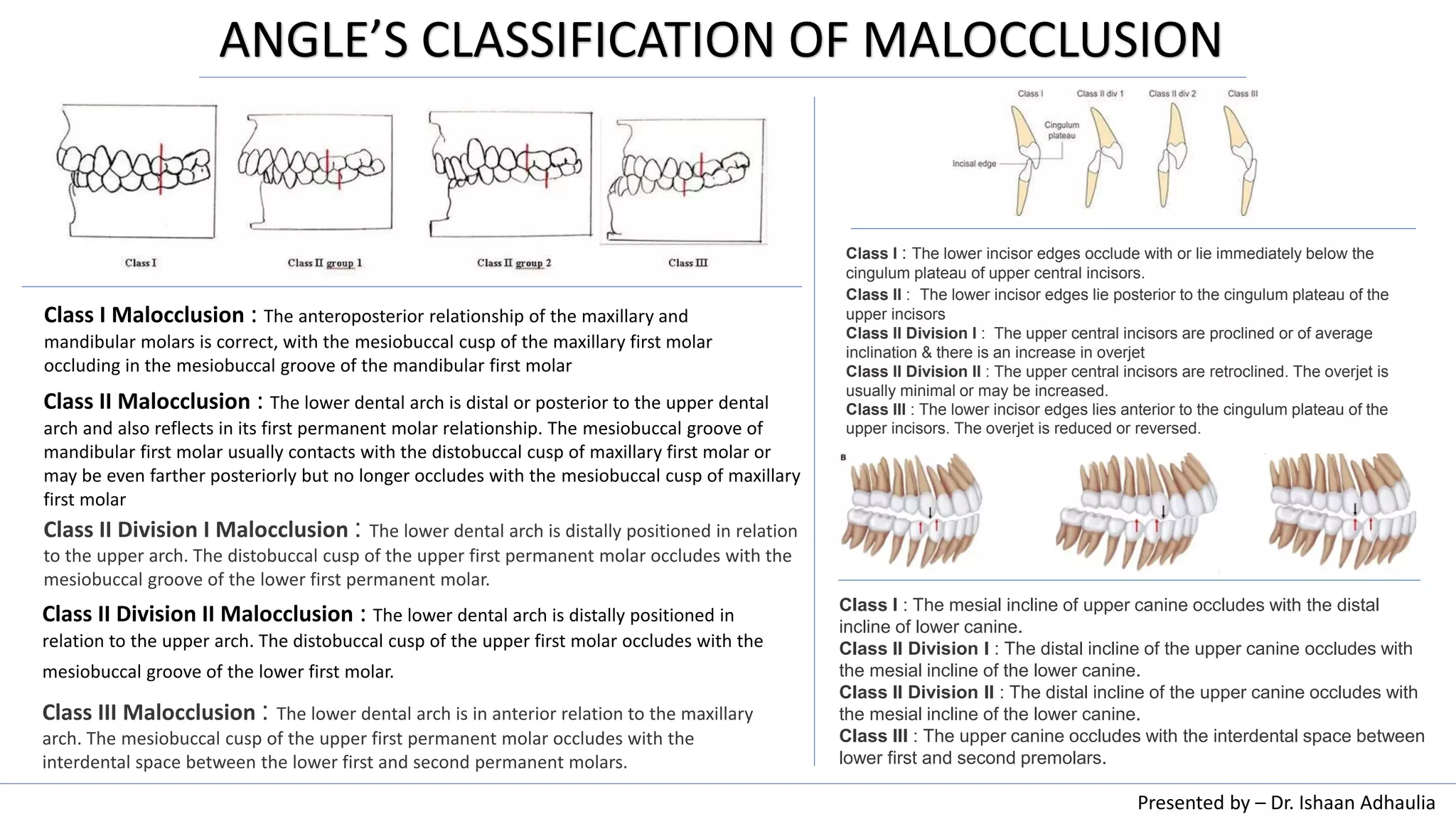
Class I Malocclusion : The anteroposterior relationship of the maxillary and
mandibular molars is correct, with the mesiobuccal cusp of the maxillary first molar
occluding in the mesiobuccal groove of the mandibular first molar
Class II Malocclusion : The lower dental arch is distal or posterior to the upper dental
arch and also reflects in its first permanent molar relationship. The mesiobuccal groove of
mandibular first molar usually contacts with the distobuccal cusp of maxillary first molar or
may be even farther posteriorly but no longer occludes with the mesiobuccal cusp of maxillary
first molar
Class II Division I Malocclusion : The lower dental arch is distally positioned in relation
to the upper arch. The distobuccal cusp of the upper first permanent molar occludes with the
mesiobuccal groove of the lower first permanent molar.
Class II Division II Malocclusion : The lower dental arch is distally positioned in
relation to the upper arch. The distobuccal cusp of the upper first molar occludes with the
mesiobuccal groove of the lower first molar.
Class III Malocclusion : The lower dental arch is in anterior relation to the maxillary
arch. The mesiobuccal cusp of the upper first permanent molar occludes with the
interdental space between the lower first and second permanent molars.
Class I : The lower incisor edges occlude with or lie immediately below the
cingulum plateau of upper central incisors.
Class II : The lower incisor edges lie posterior to the cingulum plateau of the
upper incisors
Class II Division I : The upper central incisors are proclined or of average
inclination & there is an increase in overjet
Class II Division II : The upper central incisors are retroclined. The overjet is
usually minimal or may be increased.
Class III : The lower incisor edges lies anterior to the cingulum plateau of the
upper incisors. The overjet is reduced or reversed.
Presented by – Dr. Ishaan Adhaulia
Class I : The mesial incline of upper canine occludes with the distal
incline of lower canine.
Class II Division I : The distal incline of the upper canine occludes with
the mesial incline of the lower canine.
Class II Division II : The distal incline of the upper canine occludes with
the mesial incline of the lower canine.
Class III : The upper canine occludes with the interdental space between
lower first and second premolars.

Angle's Classification Of Malocclusion

  • 1.
    ANGLE’S CLASSIFICATION OFMALOCCLUSION Class I Malocclusion : The anteroposterior relationship of the maxillary and mandibular molars is correct, with the mesiobuccal cusp of the maxillary first molar occluding in the mesiobuccal groove of the mandibular first molar Class II Malocclusion : The lower dental arch is distal or posterior to the upper dental arch and also reflects in its first permanent molar relationship. The mesiobuccal groove of mandibular first molar usually contacts with the distobuccal cusp of maxillary first molar or may be even farther posteriorly but no longer occludes with the mesiobuccal cusp of maxillary first molar Class II Division I Malocclusion : The lower dental arch is distally positioned in relation to the upper arch. The distobuccal cusp of the upper first permanent molar occludes with the mesiobuccal groove of the lower first permanent molar. Class II Division II Malocclusion : The lower dental arch is distally positioned in relation to the upper arch. The distobuccal cusp of the upper first molar occludes with the mesiobuccal groove of the lower first molar. Class III Malocclusion : The lower dental arch is in anterior relation to the maxillary arch. The mesiobuccal cusp of the upper first permanent molar occludes with the interdental space between the lower first and second permanent molars. Class I : The lower incisor edges occlude with or lie immediately below the cingulum plateau of upper central incisors. Class II : The lower incisor edges lie posterior to the cingulum plateau of the upper incisors Class II Division I : The upper central incisors are proclined or of average inclination & there is an increase in overjet Class II Division II : The upper central incisors are retroclined. The overjet is usually minimal or may be increased. Class III : The lower incisor edges lies anterior to the cingulum plateau of the upper incisors. The overjet is reduced or reversed. Presented by – Dr. Ishaan Adhaulia Class I : The mesial incline of upper canine occludes with the distal incline of lower canine. Class II Division I : The distal incline of the upper canine occludes with the mesial incline of the lower canine. Class II Division II : The distal incline of the upper canine occludes with the mesial incline of the lower canine. Class III : The upper canine occludes with the interdental space between lower first and second premolars.