1
NAVODAYA DENTAL COLLEGE
DEPARTMENT OF PEDODONTICS
STAFF NAME – Dr NAVEEN KUMAR
Professor
TOPIC NAME – EARLY CHILDHOOD CARIES
Dental Caries:
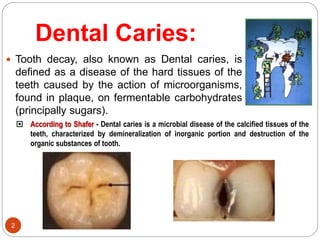
 Tooth decay, also known as Dental caries, is
defined as a disease of the hard tissues of the
teeth caused by the action of microorganisms,
found in plaque, on fermentable carbohydrates
(principally sugars).
2
 According to Shafer - Dental caries is a microbial disease of the calcified tissues of the
teeth, characterized by demineralization of inorganic portion and destruction of the
organic substances of tooth.
EARLY CHILDHOOD CARIES
it is a unique pattern of dental caries in very young children due to
prolonged and improper feeding habits.
Terminologies
 -Nursing Caries
 -Nursing Bottle Caries/ Mouth/ Syndrome
 -Night Bottle Syndrome
 -Baby Bottle Tooth Decay
 -Milk Bottle Syndrome
 -Tooth Cleaning Neglect
 -Infant & Early Childhood Decay
 -RIECDO [Rampant Infant and Early Childhood Dental
 Decay]
 -Maternally Derived Streptococcus Mutants Disease
 [MDSMD]
 -Early Childhood Caries [ECC]
3
DEFINITIONS
 ECC is defined as “the presence of one or more
decayed (non- cavitated or cavitated lesions)
missing (due to caries) or filled tooth surfaces” in
any primary tooth in a child 71 months of age or
younger .
American Academy of Pediatric Dentistry (2016)
 ECC is defined as the presence of one or more decayed
(noncavitated or cavitated lesions), missing (due to caries),
or filled tooth surfaces in any primary tooth in a child under
the age of six.
4
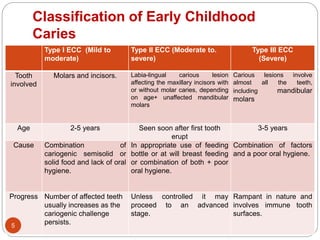
Classification of Early Childhood
Caries
Type I ECC (Mild to
moderate)
Type II ECC (Moderate to.
severe)
Type III ECC
(Severe)
Tooth
involved
Molars and incisors. Labia-lingual carious lesion
affecting the maxillary incisors with
or without molar caries, depending
on age+ unaffected mandibular
molars
Carious lesions involve
almost all the teeth,
including mandibular
molars
Age 2-5 years Seen soon after first tooth
erupt
3-5 years
Cause Combination of
cariogenic semisolid or
solid food and lack of oral
hygiene.
In appropriate use of feeding
bottle or at will breast feeding
or combination of both + poor
oral hygiene.
Combination of factors
and a poor oral hygiene.
Progress Number of affected teeth
usually increases as the
cariogenic challenge
persists.
Unless controlled it may
proceed to an advanced
stage.
Rampant in nature and
involves immune tooth
surfaces.
5
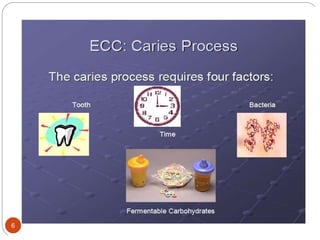
6
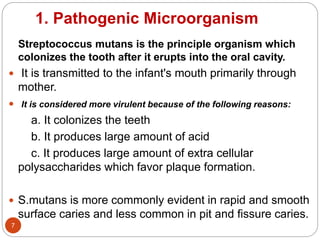
1. Pathogenic Microorganism
Streptococcus mutans is the principle organism which
colonizes the tooth after it erupts into the oral cavity.
 It is transmitted to the infant's mouth primarily through
mother.
 It is considered more virulent because of the following reasons:
a. It colonizes the teeth
b. It produces large amount of acid
c. It produces large amount of extra cellular
polysaccharides which favor plaque formation.
 S.mutans is more commonly evident in rapid and smooth
surface caries and less common in pit and fissure caries.
7
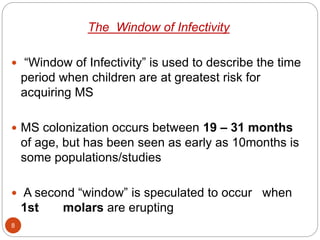
The Window of Infectivity
 “Window of Infectivity” is used to describe the time
period when children are at greatest risk for
acquiring MS
 MS colonization occurs between 19 – 31 months
of age, but has been seen as early as 10months is
some populations/studies
 A second “window” is speculated to occur when
1st molars are erupting
8
2. Substrate (Fermentable carbohydrate)
Carbohydrates are utilized by microorganisms to form dextrin’s
which
a. adhere organisms to tooth surface
b. cause organic acid to demineralize the tooth
In infants and toddler, the main sources of fermentable
carbohydrate
are:
 Bovine milk or milk formulas
 Human milk (breast feeding at will or on demand)
 Fruit juices and other sweet liquids
 Sweet syrups like vitamin preparations
 Pacifiers dipped in honey or sugar solution
 Chocolates or other sweets
9
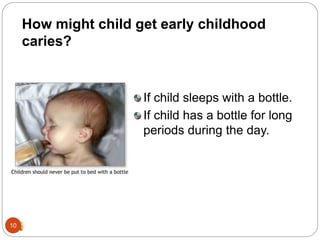
If child sleeps with a bottle.
If child has a bottle for long
periods during the day.
How might child get early childhood
caries?
10
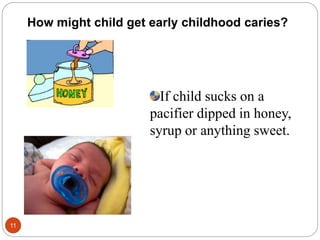
How might child get early childhood caries?
If child sucks on a
pacifier dipped in honey,
syrup or anything sweet.
11
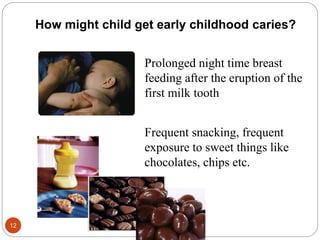
How might child get early childhood caries?
Prolonged night time breast
feeding after the eruption of the
first milk tooth
Frequent snacking, frequent
exposure to sweet things like
chocolates, chips etc.
12
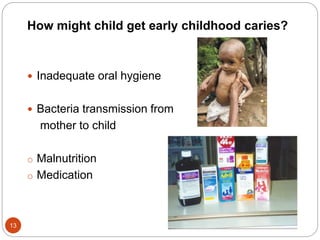
How might child get early childhood caries?
 Inadequate oral hygiene
 Bacteria transmission from
mother to child
o Malnutrition
o Medication
13
3. Host
 Teeth act as the host for the micro-organisms
 Hypomineralisation or hypoplasia of the teeth increases the
susceptibility of the child to caries
 Thin enamel in the primary teeth is one of the reasons for
early spread of lesions
 Developmental grooves also may act as the plaque
retentive areas
14
4. Time
 It is an important factor that determines
caries activity. More the time child sleeps
with the bottle in the mouth, the higher is
the risk of caries.
 This is because the salivary flow and the
swallowing reflex decrease, thus providing
more time for the accumulation of
carbohydrates in the mouth which are acted
upon by microorganisms to produce acid
leading to caries.
15
5. Other predisposing factors
 Over indulgence of parents
 Crowded homes
 Child who has less sleep
 Malnutrition
 Recently, it has been seen that salivary gland
function is impaired by iron deficiency and excess
of lead exposure, which makes the oral
environment more caries susceptible.
 Low birth-weight infants (less than 2500 g)
16
CLINICAL FEATURES
It affects the primary teeth in the following sequence of
involvement.
a. Maxillary central incisors
b. Maxillary lateral incisors
c. Maxillary first molars
d. Maxillary canine and second molars
e. Mandibular molars: At later stage
Mandibular anterior teeth (nursing caries) are usually
spared
because of:
a. Protection by the tongue
b. Cleansing action by saliva due to presence of the orifice
of the duct of the sublingual glands very close to lower
17
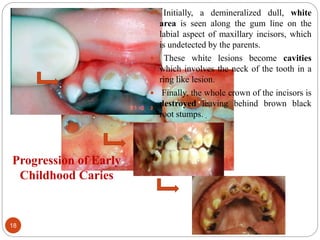
Progression of Early
Childhood Caries
18
 Initially, a demineralized dull, white
area is seen along the gum line on the
labial aspect of maxillary incisors, which
is undetected by the parents.
 These white lesions become cavities
which involves the neck of the tooth in a
ring like lesion.
 Finally, the whole crown of the incisors is
destroyed leaving behind brown black
root stumps.
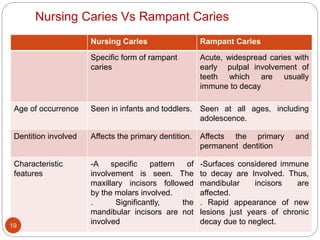
Nursing Caries Vs Rampant Caries
Nursing Caries Rampant Caries
Specific form of rampant
caries
Acute, widespread caries with
early pulpal involvement of
teeth which are usually
immune to decay
Age of occurrence Seen in infants and toddlers. Seen at all ages, including
adolescence.
Dentition involved Affects the primary dentition. Affects the primary and
permanent dentition
Characteristic
features
-A specific pattern of
involvement is seen. The
maxillary incisors followed
by the molars involved.
. Significantly, the
mandibular incisors are not
involved
-Surfaces considered immune
to decay are Involved. Thus,
mandibular incisors are
affected.
. Rapid appearance of new
lesions just years of chronic
decay due to neglect.
19
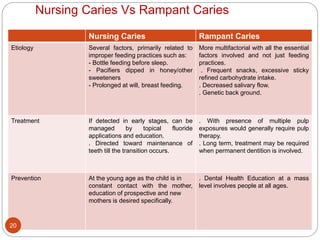
Nursing Caries Vs Rampant Caries
Nursing Caries Rampant Caries
Etiology Several factors, primarily related to
improper feeding practices such as:
- Bottle feeding before sleep.
- Pacifiers dipped in honey/other
sweeteners
- Prolonged at will, breast feeding.
More multifactorial with all the essential
factors involved and not just feeding
practices.
. Frequent snacks, excessive sticky
refined carbohydrate intake.
. Decreased salivary flow.
. Genetic back ground.
Treatment If detected in early stages, can be
managed by topical fluoride
applications and education.
. Directed toward maintenance of
teeth till the transition occurs.
. With presence of multiple pulp
exposures would generally require pulp
therapy.
. Long term, treatment may be required
when permanent dentition is involved.
Prevention At the young age as the child is in
constant contact with the mother,
education of prospective and new
mothers is desired specifically.
. Dental Health Education at a mass
level involves people at all ages.
20
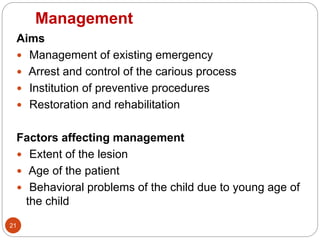
Management
Aims
 Management of existing emergency
 Arrest and control of the carious process
 Institution of preventive procedures
 Restoration and rehabilitation
Factors affecting management
 Extent of the lesion
 Age of the patient
 Behavioral problems of the child due to young age of
the child
21
Treatment
It can be divided into three visits
First visit
 This phase of treatment constitutes treatment of the lesion,
identification of the cause for counseling of the parent.
 All lesions should be excavated and restored
 Indirect pulp capping or pulp therapy procedures can be
evaluated by further investigation
 If the abscess is present it can be treated through drainage
 X-rays are advised to assess the condition of the
succedaneous teeth.
 Collection of saliva for determining the salivary flow and
viscosity,
 Also, the application of fluoride topically
22
Treatment
Parent counseling
 The parent should be questioned about the child's feeding
habits, especially regarding the use of nocturnal bottles,
demand the breast feeding, pacifiers dipped in sweetening
agents.
 The parents should be asked to try weaning the child from
using the bottle as a pacifier while in bed.
 In case of considerable emotional dependence on the
bottle, suggest the use of plain or fluoridated water.
 The parents should be instructed to clean the child's teeth
after every feed.
 Parents are advised to maintain a diet record of the child for
one week which includes the time, amount of food given to
the child, the type of food and the number of sugar
exposures.
23
Treatment
Second visit
 It should be scheduled one week after the first visit.
 Analysis of diet chart and explanation of the disease
process of the child's teeth should be undertaken.
 Isolate the sugar factors from the diet chart and
control sugar exposure.
 Reassess the restoration and redo if needed.
 Caries activity tests can be started and repeated at
monthly intervals to monitor the success of treatment.
24

Early childhood caries.ppt

  • 1.
    1 NAVODAYA DENTAL COLLEGE DEPARTMENTOF PEDODONTICS STAFF NAME – Dr NAVEEN KUMAR Professor TOPIC NAME – EARLY CHILDHOOD CARIES
  • 2.
    Dental Caries:  Toothdecay, also known as Dental caries, is defined as a disease of the hard tissues of the teeth caused by the action of microorganisms, found in plaque, on fermentable carbohydrates (principally sugars). 2  According to Shafer - Dental caries is a microbial disease of the calcified tissues of the teeth, characterized by demineralization of inorganic portion and destruction of the organic substances of tooth.
  • 3.
    EARLY CHILDHOOD CARIES itis a unique pattern of dental caries in very young children due to prolonged and improper feeding habits. Terminologies  -Nursing Caries  -Nursing Bottle Caries/ Mouth/ Syndrome  -Night Bottle Syndrome  -Baby Bottle Tooth Decay  -Milk Bottle Syndrome  -Tooth Cleaning Neglect  -Infant & Early Childhood Decay  -RIECDO [Rampant Infant and Early Childhood Dental  Decay]  -Maternally Derived Streptococcus Mutants Disease  [MDSMD]  -Early Childhood Caries [ECC] 3
  • 4.
    DEFINITIONS  ECC isdefined as “the presence of one or more decayed (non- cavitated or cavitated lesions) missing (due to caries) or filled tooth surfaces” in any primary tooth in a child 71 months of age or younger . American Academy of Pediatric Dentistry (2016)  ECC is defined as the presence of one or more decayed (noncavitated or cavitated lesions), missing (due to caries), or filled tooth surfaces in any primary tooth in a child under the age of six. 4
  • 5.
    Classification of EarlyChildhood Caries Type I ECC (Mild to moderate) Type II ECC (Moderate to. severe) Type III ECC (Severe) Tooth involved Molars and incisors. Labia-lingual carious lesion affecting the maxillary incisors with or without molar caries, depending on age+ unaffected mandibular molars Carious lesions involve almost all the teeth, including mandibular molars Age 2-5 years Seen soon after first tooth erupt 3-5 years Cause Combination of cariogenic semisolid or solid food and lack of oral hygiene. In appropriate use of feeding bottle or at will breast feeding or combination of both + poor oral hygiene. Combination of factors and a poor oral hygiene. Progress Number of affected teeth usually increases as the cariogenic challenge persists. Unless controlled it may proceed to an advanced stage. Rampant in nature and involves immune tooth surfaces. 5
  • 6.
  • 7.
    1. Pathogenic Microorganism Streptococcusmutans is the principle organism which colonizes the tooth after it erupts into the oral cavity.  It is transmitted to the infant's mouth primarily through mother.  It is considered more virulent because of the following reasons: a. It colonizes the teeth b. It produces large amount of acid c. It produces large amount of extra cellular polysaccharides which favor plaque formation.  S.mutans is more commonly evident in rapid and smooth surface caries and less common in pit and fissure caries. 7
  • 8.
    The Window ofInfectivity  “Window of Infectivity” is used to describe the time period when children are at greatest risk for acquiring MS  MS colonization occurs between 19 – 31 months of age, but has been seen as early as 10months is some populations/studies  A second “window” is speculated to occur when 1st molars are erupting 8
  • 9.
    2. Substrate (Fermentablecarbohydrate) Carbohydrates are utilized by microorganisms to form dextrin’s which a. adhere organisms to tooth surface b. cause organic acid to demineralize the tooth In infants and toddler, the main sources of fermentable carbohydrate are:  Bovine milk or milk formulas  Human milk (breast feeding at will or on demand)  Fruit juices and other sweet liquids  Sweet syrups like vitamin preparations  Pacifiers dipped in honey or sugar solution  Chocolates or other sweets 9
  • 10.
    If child sleepswith a bottle. If child has a bottle for long periods during the day. How might child get early childhood caries? 10
  • 11.
    How might childget early childhood caries? If child sucks on a pacifier dipped in honey, syrup or anything sweet. 11
  • 12.
    How might childget early childhood caries? Prolonged night time breast feeding after the eruption of the first milk tooth Frequent snacking, frequent exposure to sweet things like chocolates, chips etc. 12
  • 13.
    How might childget early childhood caries?  Inadequate oral hygiene  Bacteria transmission from mother to child o Malnutrition o Medication 13
  • 14.
    3. Host  Teethact as the host for the micro-organisms  Hypomineralisation or hypoplasia of the teeth increases the susceptibility of the child to caries  Thin enamel in the primary teeth is one of the reasons for early spread of lesions  Developmental grooves also may act as the plaque retentive areas 14
  • 15.
    4. Time  Itis an important factor that determines caries activity. More the time child sleeps with the bottle in the mouth, the higher is the risk of caries.  This is because the salivary flow and the swallowing reflex decrease, thus providing more time for the accumulation of carbohydrates in the mouth which are acted upon by microorganisms to produce acid leading to caries. 15
  • 16.
    5. Other predisposingfactors  Over indulgence of parents  Crowded homes  Child who has less sleep  Malnutrition  Recently, it has been seen that salivary gland function is impaired by iron deficiency and excess of lead exposure, which makes the oral environment more caries susceptible.  Low birth-weight infants (less than 2500 g) 16
  • 17.
    CLINICAL FEATURES It affectsthe primary teeth in the following sequence of involvement. a. Maxillary central incisors b. Maxillary lateral incisors c. Maxillary first molars d. Maxillary canine and second molars e. Mandibular molars: At later stage Mandibular anterior teeth (nursing caries) are usually spared because of: a. Protection by the tongue b. Cleansing action by saliva due to presence of the orifice of the duct of the sublingual glands very close to lower 17
  • 18.
    Progression of Early ChildhoodCaries 18  Initially, a demineralized dull, white area is seen along the gum line on the labial aspect of maxillary incisors, which is undetected by the parents.  These white lesions become cavities which involves the neck of the tooth in a ring like lesion.  Finally, the whole crown of the incisors is destroyed leaving behind brown black root stumps.
  • 19.
    Nursing Caries VsRampant Caries Nursing Caries Rampant Caries Specific form of rampant caries Acute, widespread caries with early pulpal involvement of teeth which are usually immune to decay Age of occurrence Seen in infants and toddlers. Seen at all ages, including adolescence. Dentition involved Affects the primary dentition. Affects the primary and permanent dentition Characteristic features -A specific pattern of involvement is seen. The maxillary incisors followed by the molars involved. . Significantly, the mandibular incisors are not involved -Surfaces considered immune to decay are Involved. Thus, mandibular incisors are affected. . Rapid appearance of new lesions just years of chronic decay due to neglect. 19
  • 20.
    Nursing Caries VsRampant Caries Nursing Caries Rampant Caries Etiology Several factors, primarily related to improper feeding practices such as: - Bottle feeding before sleep. - Pacifiers dipped in honey/other sweeteners - Prolonged at will, breast feeding. More multifactorial with all the essential factors involved and not just feeding practices. . Frequent snacks, excessive sticky refined carbohydrate intake. . Decreased salivary flow. . Genetic back ground. Treatment If detected in early stages, can be managed by topical fluoride applications and education. . Directed toward maintenance of teeth till the transition occurs. . With presence of multiple pulp exposures would generally require pulp therapy. . Long term, treatment may be required when permanent dentition is involved. Prevention At the young age as the child is in constant contact with the mother, education of prospective and new mothers is desired specifically. . Dental Health Education at a mass level involves people at all ages. 20
  • 21.
    Management Aims  Management ofexisting emergency  Arrest and control of the carious process  Institution of preventive procedures  Restoration and rehabilitation Factors affecting management  Extent of the lesion  Age of the patient  Behavioral problems of the child due to young age of the child 21
  • 22.
    Treatment It can bedivided into three visits First visit  This phase of treatment constitutes treatment of the lesion, identification of the cause for counseling of the parent.  All lesions should be excavated and restored  Indirect pulp capping or pulp therapy procedures can be evaluated by further investigation  If the abscess is present it can be treated through drainage  X-rays are advised to assess the condition of the succedaneous teeth.  Collection of saliva for determining the salivary flow and viscosity,  Also, the application of fluoride topically 22
  • 23.
    Treatment Parent counseling  Theparent should be questioned about the child's feeding habits, especially regarding the use of nocturnal bottles, demand the breast feeding, pacifiers dipped in sweetening agents.  The parents should be asked to try weaning the child from using the bottle as a pacifier while in bed.  In case of considerable emotional dependence on the bottle, suggest the use of plain or fluoridated water.  The parents should be instructed to clean the child's teeth after every feed.  Parents are advised to maintain a diet record of the child for one week which includes the time, amount of food given to the child, the type of food and the number of sugar exposures. 23
  • 24.
    Treatment Second visit  Itshould be scheduled one week after the first visit.  Analysis of diet chart and explanation of the disease process of the child's teeth should be undertaken.  Isolate the sugar factors from the diet chart and control sugar exposure.  Reassess the restoration and redo if needed.  Caries activity tests can be started and repeated at monthly intervals to monitor the success of treatment. 24