EARLY STAGES OF
DEVELOPMENT
FINAL YEAR BDS
ORTHODONTICS
MATURATION OF ORAL
FUNCTION
• The principal physiologic functions of the oral cavity are: respiration, swallowing,
mastication and speech
• RESPIRATION:
• Important for survival of newborn infant
• Mandible is positioned downward and tongue positioned forward away from posterior pharyngeal
wall
• Allows air to move through nose, across pharynx and into lungs
• Newborn infants are obligatory nasal breathers
• SUCKLING:
• Suckling consists of small nibbling movements of lips, a reflex action
• The infant grooves their tongue so that the milk flows posteriorly into oesophagus and pharynx
• Tongue is placed anteriorly in contact with lower lip so that milk is deposited on the tongue
• Defined as “infantile swallow pattern”
• SWALLOWING:
• As infant matures, there is increasing activation of the elevator muscle
of mandible
• Tongue gathers bolus, positions it along the middle and transports it
posteriorly
• Juvenile chewing pattern: Mandible opens laterally on mouth opening,
then bringing it back toward the midline and closing to bring teeth into
contact with food. Established by the time primary molars erupt
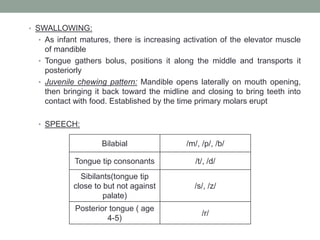
• SPEECH:
Bilabial /m/, /p/, /b/
Tongue tip consonants /t/, /d/
Sibilants(tongue tip
close to but not against
palate)
/s/, /z/
Posterior tongue ( age
4-5)
/r/
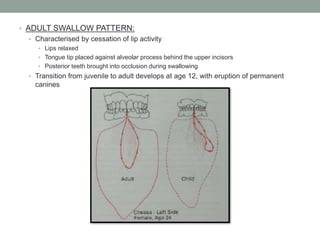
• ADULT SWALLOW PATTERN:
• Characterised by cessation of lip activity
• Lips relaxed
• Tongue tip placed against alveolar process behind the upper incisors
• Posterior teeth brought into occlusion during swallowing
• Transition from juvenile to adult develops at age 12, with eruption of permanent
canines
ERUPTION OF PRIMARY
TEETH
• Natal teeth: aberration of dental lamina. Supernumerary tooth
present at time of birth. Most common in anterior Md. Interferes with
breast feeding, risk of inhalation if mobile
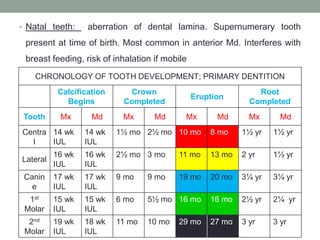
CHRONOLOGY OF TOOTH DEVELOPMENT; PRIMARY DENTITION
Calcification
Begins
Crown
Completed
Eruption
Root
Completed
Tooth Mx Md Mx Md Mx Md Mx Md
Centra
l
14 wk
IUL
14 wk
IUL
1½ mo 2½ mo 10 mo 8 mo 1½ yr 1½ yr
Lateral
16 wk
IUL
16 wk
IUL
2½ mo 3 mo 11 mo 13 mo 2 yr 1½ yr
Canin
e
17 wk
IUL
17 wk
IUL
9 mo 9 mo 19 mo 20 mo 3¼ yr 3¼ yr
1st
Molar
15 wk
IUL
15 wk
IUL
6 mo 5½ mo 16 mo 16 mo 2½ yr 2¼ yr
2nd
Molar
19 wk
IUL
18 wk
IUL
11 mo 10 mo 29 mo 27 mo 3 yr 3 yr
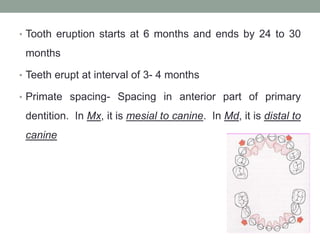
• Tooth eruption starts at 6 months and ends by 24 to 30
months
• Teeth erupt at interval of 3- 4 months
• Primate spacing- Spacing in anterior part of primary
dentition. In Mx, it is mesial to canine. In Md, it is distal to
canine
ERUPTION OF THE
PERMANENT TEETH
PRE-EMERGENT ERUPTION
• Labial or buccal drift of the tooth follicle within bone during
crown formation
• Two processes necessary for pre emergent eruption:
• Bone and root resorption overlying the crown
• Propulsive mechanism to move the tooth
• Resorption is rate limiting factor
• Signal for resorption of bone over the crown activated by crown
completion
• Dilaceration- occurs due to mechanical blockage of eruption. It
causes the apical area to move in opposite direction
THEORIES FOR PRE EMERGENT
ERUPTION
• Resorption of overlying bone
• Root elongation
• Cross-linking of maturing collagen in PDL
• Localised variation in blood pressure or flow
• Forces derived from contraction of fibroblasts
• Alterations in extra-cellular ground substance
POST-EMERGENT ERUPTION
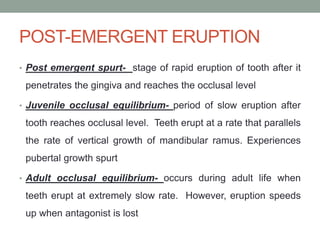
• Post emergent spurt- stage of rapid eruption of tooth after it
penetrates the gingiva and reaches the occlusal level
• Juvenile occlusal equilibrium- period of slow eruption after
tooth reaches occlusal level. Teeth erupt at a rate that parallels
the rate of vertical growth of mandibular ramus. Experiences
pubertal growth spurt
• Adult occlusal equilibrium- occurs during adult life when
teeth erupt at extremely slow rate. However, eruption speeds
up when antagonist is lost
CHRONOLOGY OF TOOTH DEVELOPMENT; PRIMARY DENTITION
Calcification
Begins
Crown
Completed
Eruption
Root
Completed
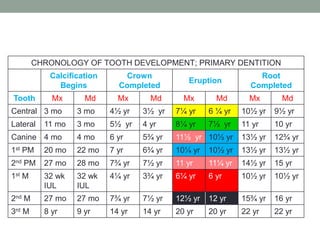
Tooth Mx Md Mx Md Mx Md Mx Md
Central 3 mo 3 mo 4½ yr 3½ yr 7¼ yr 6 ¼ yr 10½ yr 9½ yr
Lateral 11 mo 3 mo 5½ yr 4 yr 8¼ yr 7½ yr 11 yr 10 yr
Canine 4 mo 4 mo 6 yr 5¾ yr 11½ yr 10½ yr 13½ yr 12¾ yr
1st PM 20 mo 22 mo 7 yr 6¾ yr 10¼ yr 10½ yr 13½ yr 13½ yr
2nd PM 27 mo 28 mo 7¾ yr 7½ yr 11 yr 11¼ yr 14½ yr 15 yr
1st M 32 wk
IUL
32 wk
IUL
4¼ yr 3¾ yr 6¼ yr 6 yr 10½ yr 10½ yr
2nd M 27 mo 27 mo 7¾ yr 7½ yr 12½ yr 12 yr 15¾ yr 16 yr
3rd M 8 yr 9 yr 14 yr 14 yr 20 yr 20 yr 22 yr 22 yr
SPACE RELATIONSHIP IN
REPLACEMENT OF INCISORS
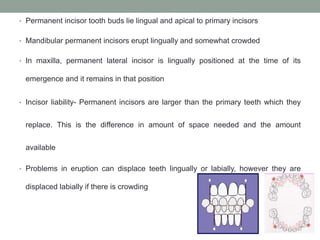
• Permanent incisor tooth buds lie lingual and apical to primary incisors
• Mandibular permanent incisors erupt lingually and somewhat crowded
• In maxilla, permanent lateral incisor is lingually positioned at the time of its
emergence and it remains in that position
• Incisor liability- Permanent incisors are larger than the primary teeth which they
replace. This is the difference in amount of space needed and the amount
available
• Problems in eruption can displace teeth lingually or labially, however they are
displaced labially if there is crowding
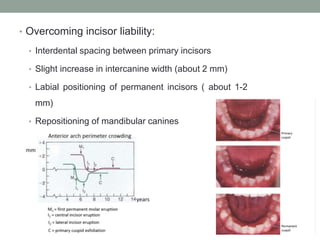
• Overcoming incisor liability:
• Interdental spacing between primary incisors
• Slight increase in intercanine width (about 2 mm)
• Labial positioning of permanent incisors ( about 1-2
mm)
• Repositioning of mandibular canines
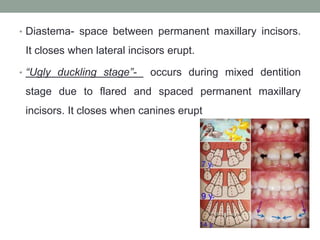
• Diastema- space between permanent maxillary incisors.
It closes when lateral incisors erupt.
• “Ugly duckling stage”- occurs during mixed dentition
stage due to flared and spaced permanent maxillary
incisors. It closes when canines erupt
SPACE RELATIONSHIP IN
REPLACEMENT OF CANINES
AND PREMOLARS
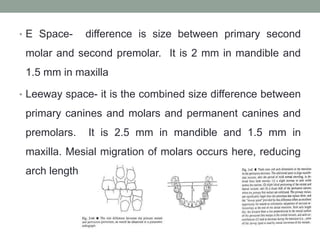
• E Space- difference is size between primary second
molar and second premolar. It is 2 mm in mandible and
1.5 mm in maxilla
• Leeway space- it is the combined size difference between
primary canines and molars and permanent canines and
premolars. It is 2.5 mm in mandible and 1.5 mm in
maxilla. Mesial migration of molars occurs here, reducing
arch length
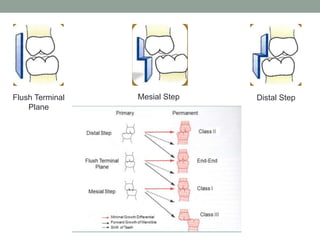
Flush Terminal
Plane
Mesial Step Distal Step
Questions ??

5. early stages of development

  • 1.
    EARLY STAGES OF DEVELOPMENT FINALYEAR BDS ORTHODONTICS
  • 2.
  • 3.
    • The principalphysiologic functions of the oral cavity are: respiration, swallowing, mastication and speech • RESPIRATION: • Important for survival of newborn infant • Mandible is positioned downward and tongue positioned forward away from posterior pharyngeal wall • Allows air to move through nose, across pharynx and into lungs • Newborn infants are obligatory nasal breathers • SUCKLING: • Suckling consists of small nibbling movements of lips, a reflex action • The infant grooves their tongue so that the milk flows posteriorly into oesophagus and pharynx • Tongue is placed anteriorly in contact with lower lip so that milk is deposited on the tongue • Defined as “infantile swallow pattern”
  • 4.
    • SWALLOWING: • Asinfant matures, there is increasing activation of the elevator muscle of mandible • Tongue gathers bolus, positions it along the middle and transports it posteriorly • Juvenile chewing pattern: Mandible opens laterally on mouth opening, then bringing it back toward the midline and closing to bring teeth into contact with food. Established by the time primary molars erupt • SPEECH: Bilabial /m/, /p/, /b/ Tongue tip consonants /t/, /d/ Sibilants(tongue tip close to but not against palate) /s/, /z/ Posterior tongue ( age 4-5) /r/
  • 5.
    • ADULT SWALLOWPATTERN: • Characterised by cessation of lip activity • Lips relaxed • Tongue tip placed against alveolar process behind the upper incisors • Posterior teeth brought into occlusion during swallowing • Transition from juvenile to adult develops at age 12, with eruption of permanent canines
  • 6.
  • 7.
    • Natal teeth:aberration of dental lamina. Supernumerary tooth present at time of birth. Most common in anterior Md. Interferes with breast feeding, risk of inhalation if mobile CHRONOLOGY OF TOOTH DEVELOPMENT; PRIMARY DENTITION Calcification Begins Crown Completed Eruption Root Completed Tooth Mx Md Mx Md Mx Md Mx Md Centra l 14 wk IUL 14 wk IUL 1½ mo 2½ mo 10 mo 8 mo 1½ yr 1½ yr Lateral 16 wk IUL 16 wk IUL 2½ mo 3 mo 11 mo 13 mo 2 yr 1½ yr Canin e 17 wk IUL 17 wk IUL 9 mo 9 mo 19 mo 20 mo 3¼ yr 3¼ yr 1st Molar 15 wk IUL 15 wk IUL 6 mo 5½ mo 16 mo 16 mo 2½ yr 2¼ yr 2nd Molar 19 wk IUL 18 wk IUL 11 mo 10 mo 29 mo 27 mo 3 yr 3 yr
  • 8.
    • Tooth eruptionstarts at 6 months and ends by 24 to 30 months • Teeth erupt at interval of 3- 4 months • Primate spacing- Spacing in anterior part of primary dentition. In Mx, it is mesial to canine. In Md, it is distal to canine
  • 9.
  • 10.
    PRE-EMERGENT ERUPTION • Labialor buccal drift of the tooth follicle within bone during crown formation • Two processes necessary for pre emergent eruption: • Bone and root resorption overlying the crown • Propulsive mechanism to move the tooth • Resorption is rate limiting factor • Signal for resorption of bone over the crown activated by crown completion • Dilaceration- occurs due to mechanical blockage of eruption. It causes the apical area to move in opposite direction
  • 11.
    THEORIES FOR PREEMERGENT ERUPTION • Resorption of overlying bone • Root elongation • Cross-linking of maturing collagen in PDL • Localised variation in blood pressure or flow • Forces derived from contraction of fibroblasts • Alterations in extra-cellular ground substance
  • 12.
    POST-EMERGENT ERUPTION • Postemergent spurt- stage of rapid eruption of tooth after it penetrates the gingiva and reaches the occlusal level • Juvenile occlusal equilibrium- period of slow eruption after tooth reaches occlusal level. Teeth erupt at a rate that parallels the rate of vertical growth of mandibular ramus. Experiences pubertal growth spurt • Adult occlusal equilibrium- occurs during adult life when teeth erupt at extremely slow rate. However, eruption speeds up when antagonist is lost
  • 13.
    CHRONOLOGY OF TOOTHDEVELOPMENT; PRIMARY DENTITION Calcification Begins Crown Completed Eruption Root Completed Tooth Mx Md Mx Md Mx Md Mx Md Central 3 mo 3 mo 4½ yr 3½ yr 7¼ yr 6 ¼ yr 10½ yr 9½ yr Lateral 11 mo 3 mo 5½ yr 4 yr 8¼ yr 7½ yr 11 yr 10 yr Canine 4 mo 4 mo 6 yr 5¾ yr 11½ yr 10½ yr 13½ yr 12¾ yr 1st PM 20 mo 22 mo 7 yr 6¾ yr 10¼ yr 10½ yr 13½ yr 13½ yr 2nd PM 27 mo 28 mo 7¾ yr 7½ yr 11 yr 11¼ yr 14½ yr 15 yr 1st M 32 wk IUL 32 wk IUL 4¼ yr 3¾ yr 6¼ yr 6 yr 10½ yr 10½ yr 2nd M 27 mo 27 mo 7¾ yr 7½ yr 12½ yr 12 yr 15¾ yr 16 yr 3rd M 8 yr 9 yr 14 yr 14 yr 20 yr 20 yr 22 yr 22 yr
  • 14.
  • 15.
    • Permanent incisortooth buds lie lingual and apical to primary incisors • Mandibular permanent incisors erupt lingually and somewhat crowded • In maxilla, permanent lateral incisor is lingually positioned at the time of its emergence and it remains in that position • Incisor liability- Permanent incisors are larger than the primary teeth which they replace. This is the difference in amount of space needed and the amount available • Problems in eruption can displace teeth lingually or labially, however they are displaced labially if there is crowding
  • 16.
    • Overcoming incisorliability: • Interdental spacing between primary incisors • Slight increase in intercanine width (about 2 mm) • Labial positioning of permanent incisors ( about 1-2 mm) • Repositioning of mandibular canines
  • 17.
    • Diastema- spacebetween permanent maxillary incisors. It closes when lateral incisors erupt. • “Ugly duckling stage”- occurs during mixed dentition stage due to flared and spaced permanent maxillary incisors. It closes when canines erupt
  • 18.
    SPACE RELATIONSHIP IN REPLACEMENTOF CANINES AND PREMOLARS
  • 19.
    • E Space-difference is size between primary second molar and second premolar. It is 2 mm in mandible and 1.5 mm in maxilla • Leeway space- it is the combined size difference between primary canines and molars and permanent canines and premolars. It is 2.5 mm in mandible and 1.5 mm in maxilla. Mesial migration of molars occurs here, reducing arch length
  • 20.
  • 21.