Space
         maintainers
Dr. Masar Mohammed
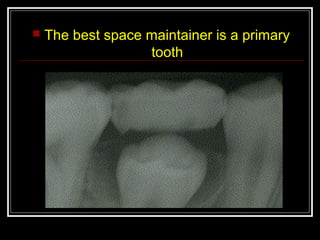
   The best space maintainer is a primary
                   tooth
Definition:

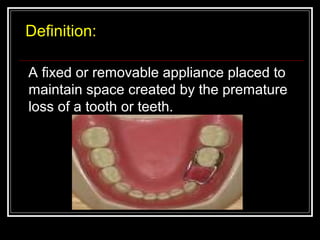
A fixed or removable appliance placed to
maintain space created by the premature
loss of a tooth or teeth.
why we do space maintainer?
   The space of prematurely lost teeth
    usually change in the following 6 months
    period, sometimes a decrease in space
    may occur within days or weeks which
    may cause loss of arch length, resulting in
    crowding of the permanent dentition,
    impaction of permanent teeth, esthetic
    difficulties, malocclusion, and other
    problems
Indications of space maintainer:

1. If the space shows signs of closing.
2. If the use of space maintainer will make
   the future orthodontic less complicated.
3. If the need for treatment of malocclusion
   at a later date is not indicated.
4. When the space should be maintained for
   two year or more.
5. To avoid supra eruption of opposing tooth.
6. To improve the masticatory system and
   restore dental health.
contraindications of space maintainer:
1. if the radiograph shows that the
   succedaneum tooth will erupt soon.
2. If the radiograph shows one third of the root
   of is already calcified.
3. When the space left is greater than the
   needed for the permanent as indicated from
   radiographically.
4. If the space shows no signs of closing.
5. When the succedenous tooth is absent.
FACTORS INFLUNCE PLANNING FOR
 SPACE MAINTAINER

    Time lapse since lost
     Dental age of patient
     Amount of bone covering the unerupted
    tooth
     Sequence of eruption of teeth
     Delayed eruption of permanent teeth
   Congenital absence of permanent teeth
   Presence of oral habits
CLASSIFICATION OF SPACE MAINTAINER

The classification of the space maintainers
  can be summarized in the following
According to function:
 Functional
 Non-functional
According to activity:
 Active
 Passive

According to retention:
 Fixed
 Semi fixed
 Removable
COMMONLY USED SPACE MAINTAINERS

   BAND & LOOP
   CROWN & LOOP
   LINGUAL ARCH HOLDING DEVICE
   NANCE’S PALATAL HOLDING DEVICE
   TRANS PALTAL
   DISTAL SHOE
   REMOVABLE SPACE MAINTAINER
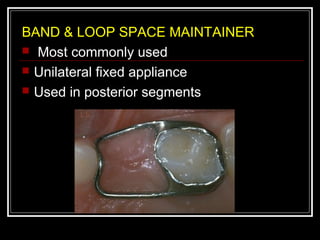
BAND & LOOP SPACE MAINTAINER
 Most commonly used
 Unilateral fixed appliance
 Used in posterior segments
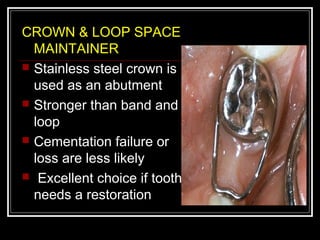
CROWN & LOOP SPACE
  MAINTAINER
 Stainless steel crown is
  used as an abutment
 Stronger than band and
  loop
 Cementation failure or
  loss are less likely
 Excellent choice if tooth
  needs a restoration
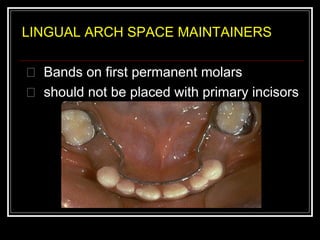
LINGUAL ARCH SPACE MAINTAINERS

 Bands on first permanent molars
 should not be placed with primary incisors
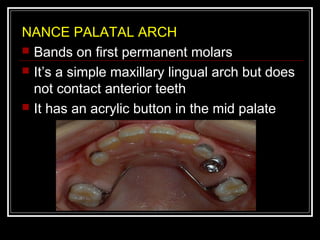
NANCE PALATAL ARCH
 Bands on first permanent molars
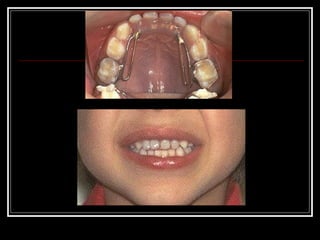
 It’s a simple maxillary lingual arch but does
  not contact anterior teeth
 It has an acrylic button in the mid palate
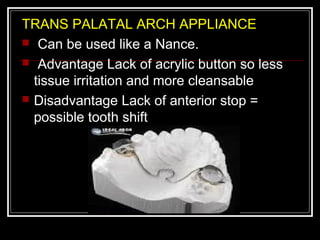
TRANS PALATAL ARCH APPLIANCE
 Can be used like a Nance.
 Advantage Lack of acrylic button so less
  tissue irritation and more cleansable
 Disadvantage Lack of anterior stop =
  possible tooth shift
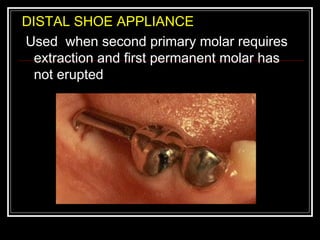
DISTAL SHOE APPLIANCE
Used when second primary molar requires
  extraction and first permanent molar has
  not erupted
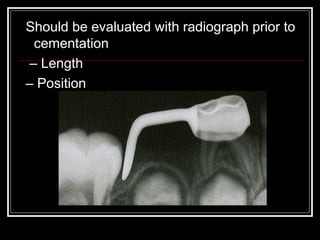
Should be evaluated with radiograph prior to
 cementation
– Length
– Position
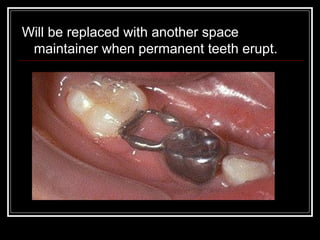
Will be replaced with another space
 maintainer when permanent teeth erupt.
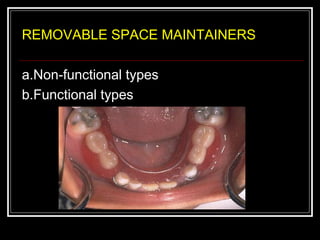
REMOVABLE SPACE MAINTAINERS

a.Non-functional types
b.Functional types
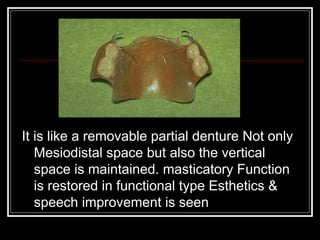
It is like a removable partial denture Not only
   Mesiodistal space but also the vertical
   space is maintained. masticatory Function
   is restored in functional type Esthetics &
   speech improvement is seen
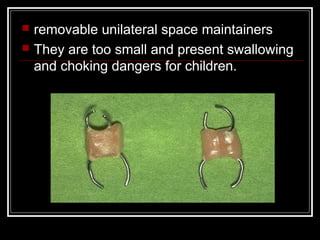
   removable unilateral space maintainers
   They are too small and present swallowing
    and choking dangers for children.
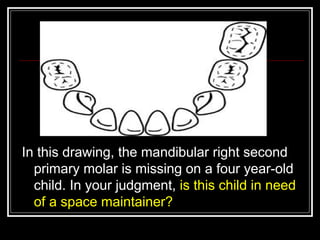
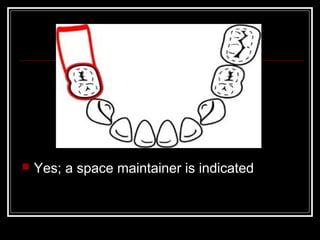
In this drawing, the mandibular right second
  primary molar is missing on a four year-old
  child. In your judgment, is this child in need
  of a space maintainer?
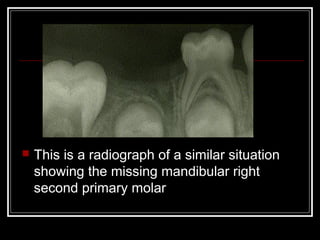
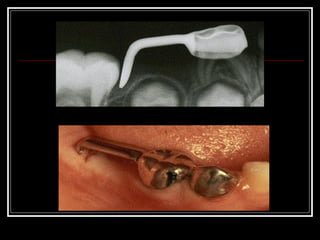
   This is a radiograph of a similar situation
    showing the missing mandibular right
    second primary molar
Again, is this a situation requiring
placement of a space maintainer?
   Yes; a space maintainer is indicated
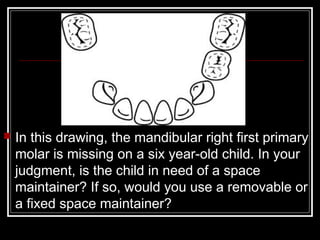
   In this drawing, the mandibular right first primary
    molar is missing on a six year-old child. In your
    judgment, is the child in need of a space
    maintainer? If so, would you use a removable or
    a fixed space maintainer?
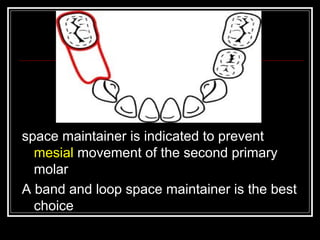
space maintainer is indicated to prevent
  mesial movement of the second primary
  molar
A band and loop space maintainer is the best
  choice
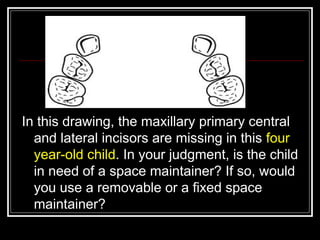
In this drawing, the maxillary primary central
  and lateral incisors are missing in this four
  year-old child. In your judgment, is the child
  in need of a space maintainer? If so, would
  you use a removable or a fixed space
  maintainer?
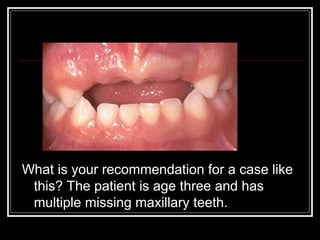
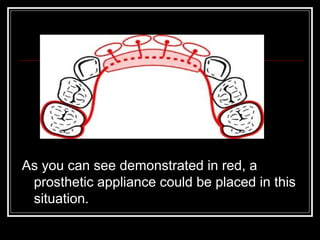
What is your recommendation for a case like
 this? The patient is age three and has
 multiple missing maxillary teeth.
As you can see demonstrated in red, a
 prosthetic appliance could be placed in this
 situation.
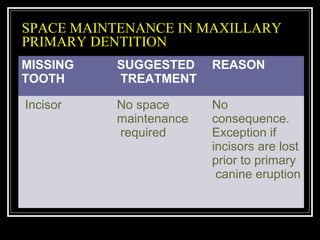
SPACE MAINTENANCE IN MAXILLARY
PRIMARY DENTITION
MISSING   SUGGESTED     REASON
TOOTH     TREATMENT

Incisor   No space      No
          maintenance   consequence.
          required      Exception if
                        incisors are lost
                        prior to primary
                         canine eruption
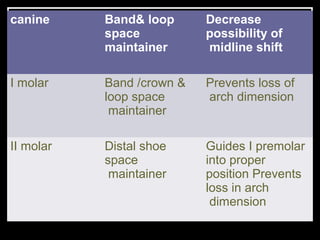
canine     Band& loop      Decrease
           space           possibility of
           maintainer      midline shift

I molar    Band /crown &   Prevents loss of
           loop space      arch dimension
            maintainer

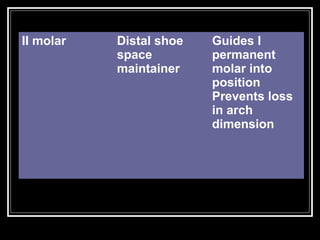
II molar   Distal shoe     Guides I premolar
           space           into proper
            maintainer     position Prevents
                           loss in arch
                            dimension
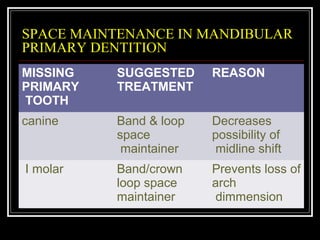
SPACE MAINTENANCE IN MANDIBULAR
PRIMARY DENTITION
MISSING   SUGGESTED     REASON
PRIMARY   TREATMENT
TOOTH
canine    Band & loop   Decreases
          space         possibility of
           maintainer    midline shift
I molar   Band/crown    Prevents loss of
          loop space    arch
          maintainer     dimmension
II molar   Distal shoe   Guides I
           space         permanent
           maintainer    molar into
                         position
                         Prevents loss
                         in arch
                         dimension
Space maintainer

Space maintainer

  • 1.
    Space maintainers Dr. Masar Mohammed
  • 2.
    The best space maintainer is a primary tooth
  • 3.
    Definition: A fixed orremovable appliance placed to maintain space created by the premature loss of a tooth or teeth.
  • 4.
    why we dospace maintainer?  The space of prematurely lost teeth usually change in the following 6 months period, sometimes a decrease in space may occur within days or weeks which may cause loss of arch length, resulting in crowding of the permanent dentition, impaction of permanent teeth, esthetic difficulties, malocclusion, and other problems
  • 7.
    Indications of spacemaintainer: 1. If the space shows signs of closing. 2. If the use of space maintainer will make the future orthodontic less complicated. 3. If the need for treatment of malocclusion at a later date is not indicated.
  • 8.
    4. When thespace should be maintained for two year or more. 5. To avoid supra eruption of opposing tooth. 6. To improve the masticatory system and restore dental health.
  • 9.
    contraindications of spacemaintainer: 1. if the radiograph shows that the succedaneum tooth will erupt soon. 2. If the radiograph shows one third of the root of is already calcified. 3. When the space left is greater than the needed for the permanent as indicated from radiographically. 4. If the space shows no signs of closing. 5. When the succedenous tooth is absent.
  • 10.
    FACTORS INFLUNCE PLANNINGFOR SPACE MAINTAINER  Time lapse since lost  Dental age of patient  Amount of bone covering the unerupted tooth  Sequence of eruption of teeth  Delayed eruption of permanent teeth
  • 11.
    Congenital absence of permanent teeth  Presence of oral habits
  • 12.
    CLASSIFICATION OF SPACEMAINTAINER The classification of the space maintainers can be summarized in the following According to function:  Functional  Non-functional
  • 13.
    According to activity: Active  Passive According to retention:  Fixed  Semi fixed  Removable
  • 14.
    COMMONLY USED SPACEMAINTAINERS  BAND & LOOP  CROWN & LOOP  LINGUAL ARCH HOLDING DEVICE  NANCE’S PALATAL HOLDING DEVICE  TRANS PALTAL  DISTAL SHOE  REMOVABLE SPACE MAINTAINER
  • 15.
    BAND & LOOPSPACE MAINTAINER  Most commonly used  Unilateral fixed appliance  Used in posterior segments
  • 16.
    CROWN & LOOPSPACE MAINTAINER  Stainless steel crown is used as an abutment  Stronger than band and loop  Cementation failure or loss are less likely  Excellent choice if tooth needs a restoration
  • 17.
    LINGUAL ARCH SPACEMAINTAINERS  Bands on first permanent molars  should not be placed with primary incisors
  • 18.
    NANCE PALATAL ARCH Bands on first permanent molars  It’s a simple maxillary lingual arch but does not contact anterior teeth  It has an acrylic button in the mid palate
  • 19.
    TRANS PALATAL ARCHAPPLIANCE  Can be used like a Nance.  Advantage Lack of acrylic button so less tissue irritation and more cleansable  Disadvantage Lack of anterior stop = possible tooth shift
  • 20.
    DISTAL SHOE APPLIANCE Usedwhen second primary molar requires extraction and first permanent molar has not erupted
  • 21.
    Should be evaluatedwith radiograph prior to cementation – Length – Position
  • 22.
    Will be replacedwith another space maintainer when permanent teeth erupt.
  • 23.
  • 24.
    It is likea removable partial denture Not only Mesiodistal space but also the vertical space is maintained. masticatory Function is restored in functional type Esthetics & speech improvement is seen
  • 25.
    removable unilateral space maintainers  They are too small and present swallowing and choking dangers for children.
  • 26.
    In this drawing,the mandibular right second primary molar is missing on a four year-old child. In your judgment, is this child in need of a space maintainer?
  • 27.
    This is a radiograph of a similar situation showing the missing mandibular right second primary molar
  • 28.
    Again, is thisa situation requiring placement of a space maintainer?
  • 29.
    Yes; a space maintainer is indicated
  • 31.
    In this drawing, the mandibular right first primary molar is missing on a six year-old child. In your judgment, is the child in need of a space maintainer? If so, would you use a removable or a fixed space maintainer?
  • 32.
    space maintainer isindicated to prevent mesial movement of the second primary molar A band and loop space maintainer is the best choice
  • 33.
    In this drawing,the maxillary primary central and lateral incisors are missing in this four year-old child. In your judgment, is the child in need of a space maintainer? If so, would you use a removable or a fixed space maintainer?
  • 34.
    What is yourrecommendation for a case like this? The patient is age three and has multiple missing maxillary teeth.
  • 35.
    As you cansee demonstrated in red, a prosthetic appliance could be placed in this situation.
  • 37.
    SPACE MAINTENANCE INMAXILLARY PRIMARY DENTITION MISSING SUGGESTED REASON TOOTH TREATMENT Incisor No space No maintenance consequence. required Exception if incisors are lost prior to primary canine eruption
  • 38.
    canine Band& loop Decrease space possibility of maintainer midline shift I molar Band /crown & Prevents loss of loop space arch dimension maintainer II molar Distal shoe Guides I premolar space into proper maintainer position Prevents loss in arch dimension
  • 39.
    SPACE MAINTENANCE INMANDIBULAR PRIMARY DENTITION MISSING SUGGESTED REASON PRIMARY TREATMENT TOOTH canine Band & loop Decreases space possibility of maintainer midline shift I molar Band/crown Prevents loss of loop space arch maintainer dimmension
  • 40.
    II molar Distal shoe Guides I space permanent maintainer molar into position Prevents loss in arch dimension