BEHAVIOURAL
MANAGEMENT
PRESENTATION BY
-SWALIHA ALTHAF
DEFINITION :
- BEHAVIOUR
-BEHAVIOUR MANAGEMENT
-BEHAVIOUR SHAPING
-BEHAVIOUR MODIFICATION
CLASSIFICATION
 NON-PHARMACOLOGICAL BEHAVIOUR MANAGEMENT
• COMMUNICATION
• USE OF SECOND LANGUAGE
• TELL-SHOW-DO
• DESENSETIZATION
• MODELING
• BEHAVIOUR SHAPING
• CONTINGENCY MANAGEMENT
• EXTERNALIZATION
• DISTRACTION
• ASSIMILATION AND COPING
• PARENTAL PRESENCE ORABSENCE
• RETRAINING
• VISUAL IMAGERY
• -FLOODING TECHNIQUE
• -VOICE CONTROL
• -USE OF POETRY ANDDRAWINGS
• -HYPNOSIS
• -HAND OVER MOUTH TECHNIQUE
• -PROTECTIVE STABILIZATION
BEHAVIOUR-
BEHAVIOUR is any activity that can be
observed , recorded and measured.
BEHAVIOUR MANAGEMENT-
BEHAVIOUR management is the means
by which dental health team effectively and
efficiently performs treatment for a child and
at the same time instills a positive dental
attitude.(WRIGHT,1975)
BEHAVIOUR SHAPING-
It is the procedure , which slowly develops
BEHAVIOUR by reinforcing a successive
approximation of desired BEHAVIOUR until desired
BEHAVIOUR comes into being.
BEHAVIOUR MODIFICATION-
It is definedas the attempt to alter human
BEHAVIOUR and emotion in a beneficial manner
according to laws of modern learning
theory.(EYSENCK,1964)
NON-
PHARMACOLOGICAL
(PSYCHOLOGICAL APPROACH)
• -COMMUNICATION
• -USE OF SECOND LANGUAGE
• -TELL-SHOW-DO
• - DESENSITIZATION
• -MODELING
• -BEHAVIOUR SHAPING
• CONTINGENCY MANAGEMENT
• -EXTERNALIZATION
• -DISTRACTION
• -ASSIMILATION AND COPING
• -PARENTAL PRESENCE OR ABSENCE
• -RETRANING
• -VISUAL IMAGERY
• VOICE CONTROL
• USE OF POETRY AND DRAWINGS
• HYPNOSIS
• HAND OVER MOUTH TECHNIQUE
• PROTECTIVE STABILISATION
-PHARMACOLOGICAL MANAGEMENT
• PRE-MEDICATION
• CONSCIOUS SEDATION
• GENERAL ANESTHESIA
COMMUNICATION
• Communicative management is universally used in
pediatric dentistry with both the cooperative and
uncooperative child (chambers,1976)
•By involving in conversation, the dentist not only
learns about the patient but may also relax the
patient
Types of communication
1. Verbal communication by speech
2.Nonverbal communication –
Expressions without words like hand shaking ,
eye contact , smiling.
-Both verbal and non verbal
• communication should be comfortable and
relaxed.
• Communication with children aged 3 to7 years
should be based on Piagetian
• Concept which involves life like name to dental
instruments like hand piece called whistling
Charlie.
• The most important aspect of communication is
getting the child to respond to dentist’s command.
• The three most important facets of communication
are source, medium and receiver . In reference to
dentistry , dentist is the source , dental clinic is the
medium and child is the receiver
• -If the dentist is good , sympathetic , confident and
honest; dental is neat ,quiet , familiar to children
,full of toys; the automatically child is
communicating and is well managed.
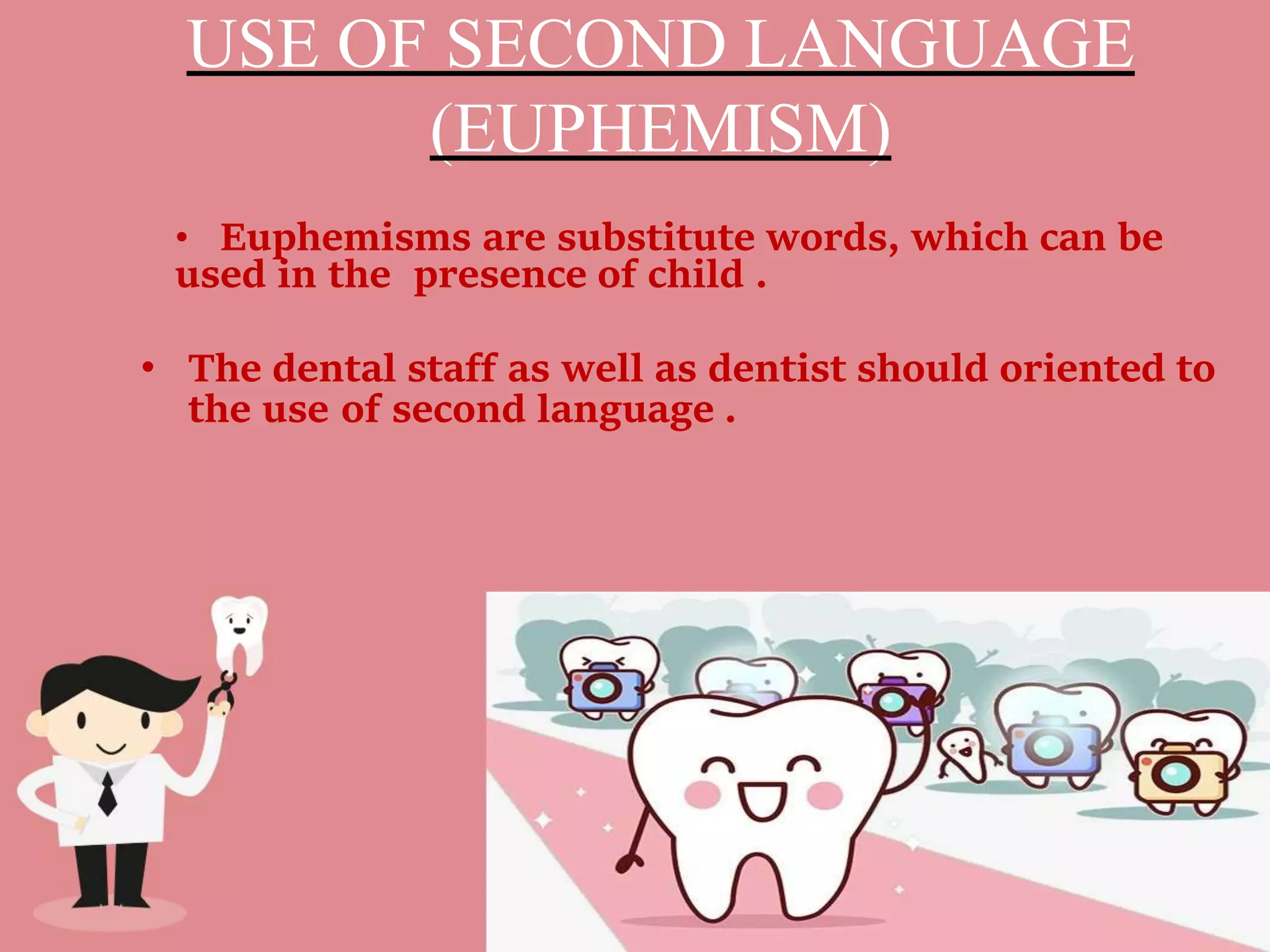
USE OF SECOND LANGUAGE
(EUPHEMISM)
• Euphemisms are substitute words, which can be
used in the presence of child .
• The dental staff as well as dentist should oriented to
the use of second language .
DENTALTERMINOLOGY
Air
Anesthetic
Bur
Impression material
Caries
Matrix
Rubber dam
stainless steel crown
X – ray
Radiograph
Hand piece
WORD SUSTITUTE
• Wind
• Sleepy medicine or sleepy water
• Brush or pencil
• Pudding or mashed potatoes
• Brown spot : sugar bugs
• Fence for filling
• Hat for tooth
• Raincoat
• Camera
• Picture
• Whistling train
TELL-SHOW- DO :
The cornerstone of behaviour management was given
by Addleston in 1959.
 Specifically , the dentist tells the child what is
going to be done in words the child can understand
.Second , the dentist demonstrates to child exactly
how the procedure will be conducted . Finally
,practitioner performs the procedure exactly as it
was described and demonstrated
Objectives :
- To teach the patient aspect of dental
visit and to familiarize him with the dental
settings.
- To shape the patients response to various
procedures.
TELL:
• Tell the child before you do it, while you are
doing it and after you have done it . You voice
should be soft , yet firm.
• Confident , and continuous .You should be
truthful with the child and if the procedure is
going to be painful or uncomfortable , say so.
SHOW ;
• Demonstration of the visual,auditory,
olfactory and tactile aspect of the procedure in
a carefully defined, nonthreatening setting
• The dentist can either demonstrate on
himself or an inanimate object.
• The noise of running hand piece shows the child
through the hearing medium . A pinch on the arm
before anesthesia administration demonstrate to the
child how the pinch of the injection in the mouth might
feel.
• Bring equipment from behind the child or the visual
level is preferred.
DO :
• Without deviating from explanation and
demonstration dentist perform the previewed
operation .
* In doing, do what you said you would do.
* Do not do until the child has clear awareness
of what it is you are going to do.
- This technique was demonstrated by James and
popularize by Wolpe.
- It means take away ones sensitivity to a type of
behavior.
-This is used in children having pre-established fears
and uncooperative behavior .
• Desensitization accomplished by teaching
the child a competing response such as relaxation
and then introducing progressively more
threatening stimuli.
Is an effective method for reducing maladaptive
behaviour
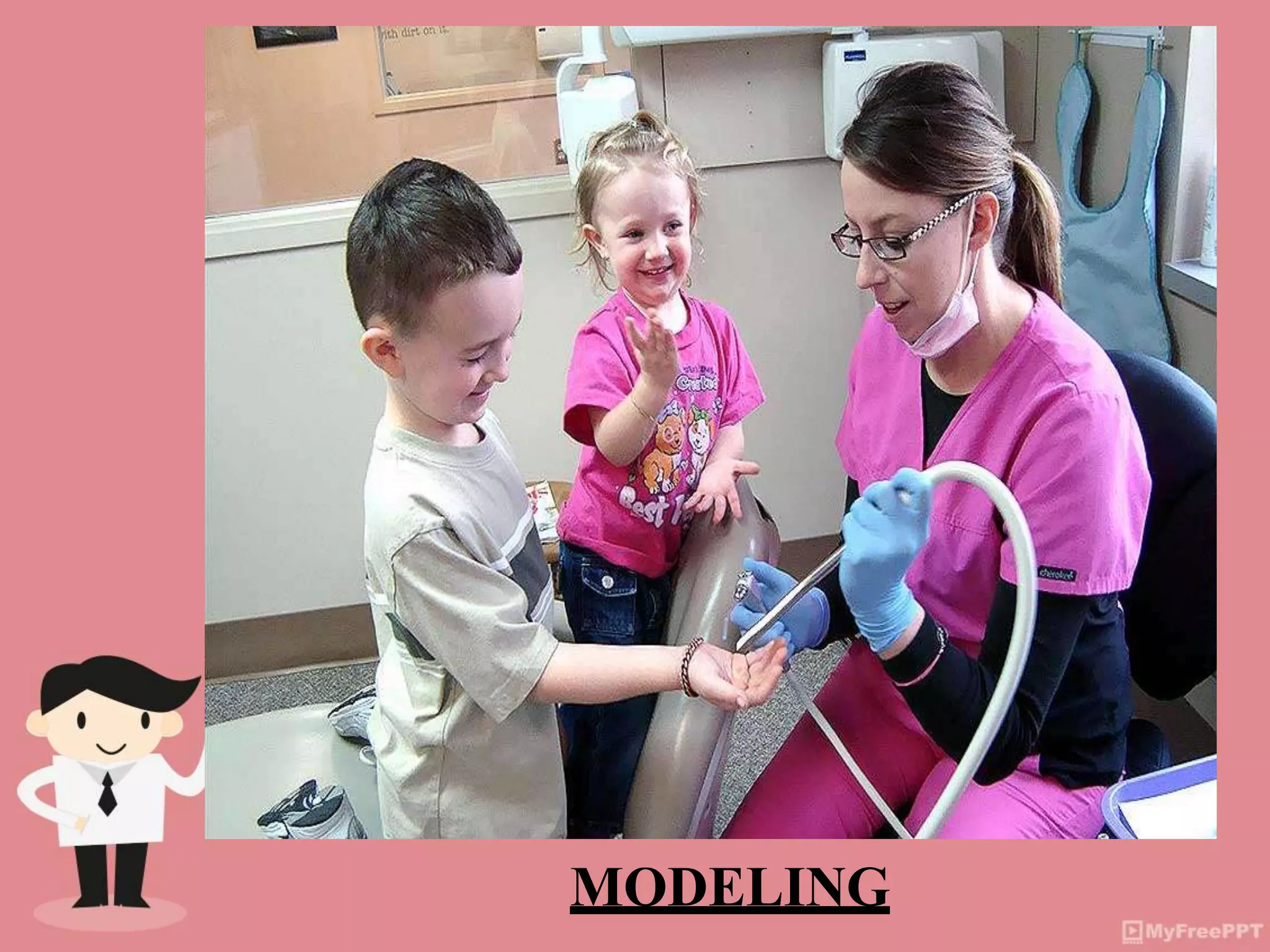
• Introduced by Bandura ( 1969).
-It is based on one’s learning or behaviour acquisition
occurs through observation of suitable model
performing specific behaviour.
-Synonyms : imitation , observational learning ,
identification, internalization , coping .
-Modeling seems to improve of the apprehensive child
who have had no previous dental experience .
-Types of modeling:
1. Audiovisual
2. Live modeling by parents , sibling etc.
OBJECTIVES OF MODELING:
 Stimulates acquisition of new behavior .
 facilitating the behavior already in the patients
in more appropriate manner.
 Elimination of avoidance behaviour .
 Extinction of fear.
ADVANTAGES OF MODELING:
 Patient’s attention is obtained.
 Designed behavior is modeled.
 Physical guidance of the desired behaviour.
 Reinforcement of the desired behaviour
MODELING
• It is defined as a process which slowly develops a
behavior by reinforcing successive approximation of the
desired behavior
until the desired behavior is expressed(Lenchner and
wright ,1975)
- It is based on stimulus- response theory.
-when shaping the behavior the dentist is teaching to a child
to behave .
- The presentation of positive reinforcers or
withdrawal of negative reinforcers is termed
contingency management.
- It include :
- Positive reinforcement
- Negative reinforcement
- Omisssion or time out
- Punishment
a) Positive reinforcement – is one whose
contingent presentation increases the
frequency of behavior ( Henry W Fields ,1984)
a) Negative reinforcement – is one whose
contingent withdrawal increases the
frequency of behavior ( Stokes and
Kenndy,1980).
Types of reinforcers
 Social – e.g. , praise , positive facial
expression , physical contact by shaking hand
, hug ,pat on shoulder.
 Material - may be given in the form of games
,toys.
 Activity reinforcers – Involving child in some
activity like watching TV shows , visit to park.
• It Is the process by which child’s attention is
focus away from the sensation associated with
dental treatment by involving in verbal or
dental activity.
Objectives:
- To decrease perception of unpleasantness
- to interest and involve children .
• The patient is distracted from the sound and/or
sight of dental treatment thus reducing anxiety.
- Objective is to relax the patient and to reduce
anxiety during treatment.
- Use stories and fairy tales.
- Use slow instrumental music .
• - Types of distraction:
a. Audio distraction
b. Audiovisual distraction .
- Stress can act to increase pain perception
while coping decrease it by process called
assimilation .
• Coping is defines as the cognitive and behavioral
efforts made by an individual to master, tolerate
or reduce stressful situations (Lazaue ,1980) .
-Coping effect may be of two types :
1.Behavioral –
are physical and verbal activity in which the
child engages to overcome a stressful situation
2.cognitive –
Efforts which involves manipulation of
emotions .
OBJECTIVES –
To avert avoidance behavior
• -To establish authority
• -To gain patient’s attention and compliance
Advantages of parental absence
a) Overcoming parental conditioning
b) Avoiding communication interference
c) Avoiding parental interference
• Advantagesof parental presence
a) Supporting and communicating with the
child
b) Very young patients.
Behavioural Management in Pediatric Dentistry

Behavioural Management in Pediatric Dentistry

  • 1.
  • 2.
    DEFINITION : - BEHAVIOUR -BEHAVIOURMANAGEMENT -BEHAVIOUR SHAPING -BEHAVIOUR MODIFICATION
  • 3.
    CLASSIFICATION  NON-PHARMACOLOGICAL BEHAVIOURMANAGEMENT • COMMUNICATION • USE OF SECOND LANGUAGE • TELL-SHOW-DO • DESENSETIZATION • MODELING • BEHAVIOUR SHAPING
  • 4.
    • CONTINGENCY MANAGEMENT •EXTERNALIZATION • DISTRACTION • ASSIMILATION AND COPING • PARENTAL PRESENCE ORABSENCE • RETRAINING • VISUAL IMAGERY
  • 5.
    • -FLOODING TECHNIQUE •-VOICE CONTROL • -USE OF POETRY ANDDRAWINGS • -HYPNOSIS • -HAND OVER MOUTH TECHNIQUE • -PROTECTIVE STABILIZATION
  • 6.
    BEHAVIOUR- BEHAVIOUR is anyactivity that can be observed , recorded and measured. BEHAVIOUR MANAGEMENT- BEHAVIOUR management is the means by which dental health team effectively and efficiently performs treatment for a child and at the same time instills a positive dental attitude.(WRIGHT,1975)
  • 7.
    BEHAVIOUR SHAPING- It isthe procedure , which slowly develops BEHAVIOUR by reinforcing a successive approximation of desired BEHAVIOUR until desired BEHAVIOUR comes into being. BEHAVIOUR MODIFICATION- It is definedas the attempt to alter human BEHAVIOUR and emotion in a beneficial manner according to laws of modern learning theory.(EYSENCK,1964)
  • 8.
    NON- PHARMACOLOGICAL (PSYCHOLOGICAL APPROACH) • -COMMUNICATION •-USE OF SECOND LANGUAGE • -TELL-SHOW-DO • - DESENSITIZATION • -MODELING • -BEHAVIOUR SHAPING
  • 9.
    • CONTINGENCY MANAGEMENT •-EXTERNALIZATION • -DISTRACTION • -ASSIMILATION AND COPING • -PARENTAL PRESENCE OR ABSENCE • -RETRANING • -VISUAL IMAGERY
  • 10.
    • VOICE CONTROL •USE OF POETRY AND DRAWINGS • HYPNOSIS • HAND OVER MOUTH TECHNIQUE • PROTECTIVE STABILISATION -PHARMACOLOGICAL MANAGEMENT • PRE-MEDICATION • CONSCIOUS SEDATION • GENERAL ANESTHESIA
  • 11.
    COMMUNICATION • Communicative managementis universally used in pediatric dentistry with both the cooperative and uncooperative child (chambers,1976) •By involving in conversation, the dentist not only learns about the patient but may also relax the patient
  • 12.
    Types of communication 1.Verbal communication by speech 2.Nonverbal communication – Expressions without words like hand shaking , eye contact , smiling. -Both verbal and non verbal
  • 13.
    • communication shouldbe comfortable and relaxed. • Communication with children aged 3 to7 years should be based on Piagetian • Concept which involves life like name to dental instruments like hand piece called whistling Charlie. • The most important aspect of communication is getting the child to respond to dentist’s command.
  • 14.
    • The threemost important facets of communication are source, medium and receiver . In reference to dentistry , dentist is the source , dental clinic is the medium and child is the receiver • -If the dentist is good , sympathetic , confident and honest; dental is neat ,quiet , familiar to children ,full of toys; the automatically child is communicating and is well managed.
  • 16.
    USE OF SECONDLANGUAGE (EUPHEMISM) • Euphemisms are substitute words, which can be used in the presence of child . • The dental staff as well as dentist should oriented to the use of second language .
  • 17.
    DENTALTERMINOLOGY Air Anesthetic Bur Impression material Caries Matrix Rubber dam stainlesssteel crown X – ray Radiograph Hand piece WORD SUSTITUTE • Wind • Sleepy medicine or sleepy water • Brush or pencil • Pudding or mashed potatoes • Brown spot : sugar bugs • Fence for filling • Hat for tooth • Raincoat • Camera • Picture • Whistling train
  • 18.
    TELL-SHOW- DO : Thecornerstone of behaviour management was given by Addleston in 1959.  Specifically , the dentist tells the child what is going to be done in words the child can understand .Second , the dentist demonstrates to child exactly how the procedure will be conducted . Finally ,practitioner performs the procedure exactly as it was described and demonstrated Objectives : - To teach the patient aspect of dental visit and to familiarize him with the dental settings. - To shape the patients response to various procedures.
  • 19.
    TELL: • Tell thechild before you do it, while you are doing it and after you have done it . You voice should be soft , yet firm. • Confident , and continuous .You should be truthful with the child and if the procedure is going to be painful or uncomfortable , say so. SHOW ; • Demonstration of the visual,auditory, olfactory and tactile aspect of the procedure in a carefully defined, nonthreatening setting • The dentist can either demonstrate on himself or an inanimate object.
  • 20.
    • The noiseof running hand piece shows the child through the hearing medium . A pinch on the arm before anesthesia administration demonstrate to the child how the pinch of the injection in the mouth might feel. • Bring equipment from behind the child or the visual level is preferred. DO : • Without deviating from explanation and demonstration dentist perform the previewed operation . * In doing, do what you said you would do. * Do not do until the child has clear awareness of what it is you are going to do.
  • 22.
    - This techniquewas demonstrated by James and popularize by Wolpe. - It means take away ones sensitivity to a type of behavior. -This is used in children having pre-established fears and uncooperative behavior . • Desensitization accomplished by teaching the child a competing response such as relaxation and then introducing progressively more threatening stimuli. Is an effective method for reducing maladaptive behaviour
  • 23.
    • Introduced byBandura ( 1969). -It is based on one’s learning or behaviour acquisition occurs through observation of suitable model performing specific behaviour. -Synonyms : imitation , observational learning , identification, internalization , coping . -Modeling seems to improve of the apprehensive child who have had no previous dental experience . -Types of modeling: 1. Audiovisual 2. Live modeling by parents , sibling etc.
  • 24.
    OBJECTIVES OF MODELING: Stimulates acquisition of new behavior .  facilitating the behavior already in the patients in more appropriate manner.  Elimination of avoidance behaviour .  Extinction of fear. ADVANTAGES OF MODELING:  Patient’s attention is obtained.  Designed behavior is modeled.  Physical guidance of the desired behaviour.  Reinforcement of the desired behaviour
  • 25.
  • 26.
    • It isdefined as a process which slowly develops a behavior by reinforcing successive approximation of the desired behavior until the desired behavior is expressed(Lenchner and wright ,1975) - It is based on stimulus- response theory. -when shaping the behavior the dentist is teaching to a child to behave .
  • 28.
    - The presentationof positive reinforcers or withdrawal of negative reinforcers is termed contingency management. - It include : - Positive reinforcement - Negative reinforcement - Omisssion or time out - Punishment a) Positive reinforcement – is one whose contingent presentation increases the frequency of behavior ( Henry W Fields ,1984) a) Negative reinforcement – is one whose contingent withdrawal increases the frequency of behavior ( Stokes and Kenndy,1980).
  • 29.
    Types of reinforcers Social – e.g. , praise , positive facial expression , physical contact by shaking hand , hug ,pat on shoulder.  Material - may be given in the form of games ,toys.  Activity reinforcers – Involving child in some activity like watching TV shows , visit to park.
  • 31.
    • It Isthe process by which child’s attention is focus away from the sensation associated with dental treatment by involving in verbal or dental activity. Objectives: - To decrease perception of unpleasantness - to interest and involve children .
  • 32.
    • The patientis distracted from the sound and/or sight of dental treatment thus reducing anxiety. - Objective is to relax the patient and to reduce anxiety during treatment. - Use stories and fairy tales. - Use slow instrumental music . • - Types of distraction: a. Audio distraction b. Audiovisual distraction .
  • 34.
    - Stress canact to increase pain perception while coping decrease it by process called assimilation . • Coping is defines as the cognitive and behavioral efforts made by an individual to master, tolerate or reduce stressful situations (Lazaue ,1980) . -Coping effect may be of two types : 1.Behavioral – are physical and verbal activity in which the child engages to overcome a stressful situation 2.cognitive – Efforts which involves manipulation of emotions .
  • 35.
    OBJECTIVES – To avertavoidance behavior • -To establish authority • -To gain patient’s attention and compliance Advantages of parental absence a) Overcoming parental conditioning b) Avoiding communication interference c) Avoiding parental interference • Advantagesof parental presence a) Supporting and communicating with the child b) Very young patients.