DR. ALI WAQAR HASAN
FCPS-II TRAINEE ORTHODONTICS
UCMD LAHORE
SUPERVISED BY : DR. SAAD ASAD
ASSOCIATE PROFESSOR OF ORTHODONTICS
UCMD LAHORE
INTRODUCTION
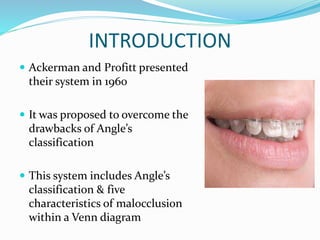
 Ackerman and Profitt presented
their system in 1960
 It was proposed to overcome the
drawbacks of Angle’s
classification
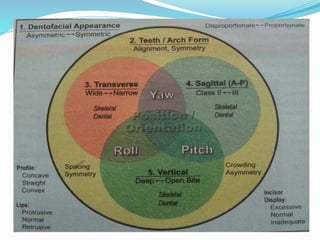
 This system includes Angle’s
classification & five
characteristics of malocclusion
within a Venn diagram
SALIENT FEATURES
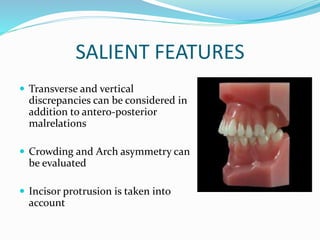
 Transverse and vertical
discrepancies can be considered in
addition to antero-posterior
malrelations
 Crowding and Arch asymmetry can
be evaluated
 Incisor protrusion is taken into
account
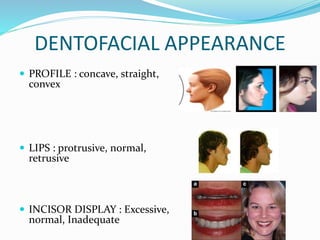
DENTOFACIAL APPEARANCE
 PROFILE : concave, straight,
convex
 LIPS : protrusive, normal,
retrusive
 INCISOR DISPLAY : Excessive,
normal, Inadequate
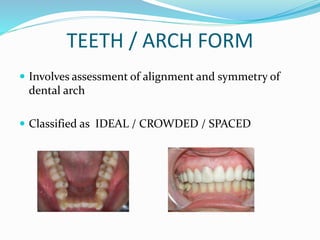
TEETH / ARCH FORM
 Involves assessment of alignment and symmetry of
dental arch
 Classified as IDEAL / CROWDED / SPACED
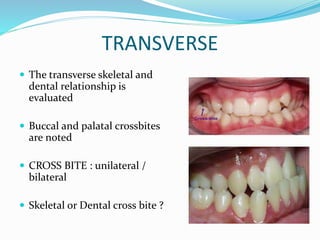
TRANSVERSE
 The transverse skeletal and
dental relationship is
evaluated
 Buccal and palatal crossbites
are noted
 CROSS BITE : unilateral /
bilateral
 Skeletal or Dental cross bite ?
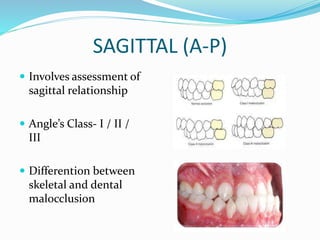
SAGITTAL (A-P)
 Involves assessment of
sagittal relationship
 Angle’s Class- I / II /
III
 Differention between
skeletal and dental
malocclusion
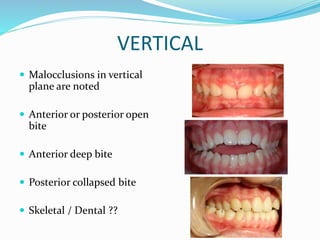
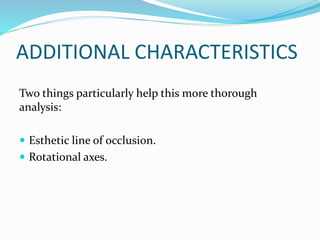
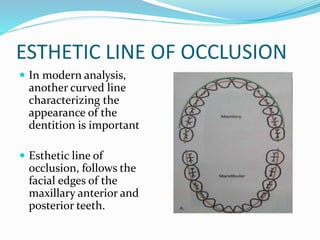
VERTICAL
 Malocclusions in vertical
plane are noted
 Anterior or posterior open
bite
 Anterior deep bite
 Posterior collapsed bite
 Skeletal / Dental ??
ADDITIONAL CHARACTERISTICS
Two things particularly help this more thorough
analysis:
 Esthetic line of occlusion.
 Rotational axes.
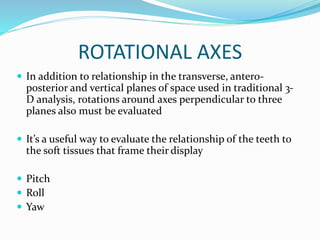
ESTHETIC LINE OF OCCLUSION
 In modern analysis,
another curved line
characterizing the
appearance of the
dentition is important
 Esthetic line of
occlusion, follows the
facial edges of the
maxillary anterior and
posterior teeth.
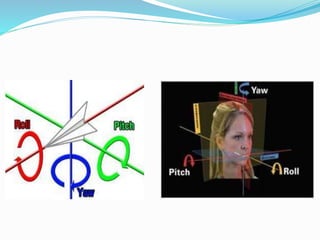
ROTATIONAL AXES
 In addition to relationship in the transverse, antero-
posterior and vertical planes of space used in traditional 3-
D analysis, rotations around axes perpendicular to three
planes also must be evaluated
 It’s a useful way to evaluate the relationship of the teeth to
the soft tissues that frame their display
 Pitch
 Roll
 Yaw
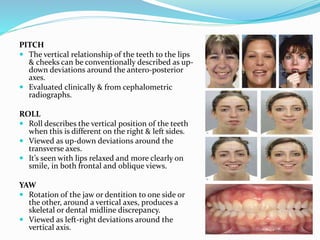
PITCH
 The vertical relationship of the teeth to the lips
& cheeks can be conventionally described as up-
down deviations around the antero-posterior
axes.
 Evaluated clinically & from cephalometric
radiographs.
ROLL
 Roll describes the vertical position of the teeth
when this is different on the right & left sides.
 Viewed as up-down deviations around the
transverse axes.
 It’s seen with lips relaxed and more clearly on
smile, in both frontal and oblique views.
YAW
 Rotation of the jaw or dentition to one side or
the other, around a vertical axes, produces a
skeletal or dental midline discrepancy.
 Viewed as left-right deviations around the
vertical axis.
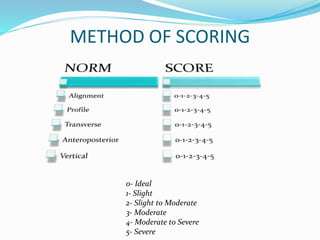
METHOD OF SCORING
0- Ideal
1- Slight
2- Slight to Moderate
3- Moderate
4- Moderate to Severe
5- Severe
Ackerman & proffit classification of malocclusion

Ackerman & proffit classification of malocclusion

  • 1.
    DR. ALI WAQARHASAN FCPS-II TRAINEE ORTHODONTICS UCMD LAHORE SUPERVISED BY : DR. SAAD ASAD ASSOCIATE PROFESSOR OF ORTHODONTICS UCMD LAHORE
  • 2.
    INTRODUCTION  Ackerman andProfitt presented their system in 1960  It was proposed to overcome the drawbacks of Angle’s classification  This system includes Angle’s classification & five characteristics of malocclusion within a Venn diagram
  • 3.
    SALIENT FEATURES  Transverseand vertical discrepancies can be considered in addition to antero-posterior malrelations  Crowding and Arch asymmetry can be evaluated  Incisor protrusion is taken into account
  • 5.
    DENTOFACIAL APPEARANCE  PROFILE: concave, straight, convex  LIPS : protrusive, normal, retrusive  INCISOR DISPLAY : Excessive, normal, Inadequate
  • 6.
    TEETH / ARCHFORM  Involves assessment of alignment and symmetry of dental arch  Classified as IDEAL / CROWDED / SPACED
  • 7.
    TRANSVERSE  The transverseskeletal and dental relationship is evaluated  Buccal and palatal crossbites are noted  CROSS BITE : unilateral / bilateral  Skeletal or Dental cross bite ?
  • 8.
    SAGITTAL (A-P)  Involvesassessment of sagittal relationship  Angle’s Class- I / II / III  Differention between skeletal and dental malocclusion
  • 9.
    VERTICAL  Malocclusions invertical plane are noted  Anterior or posterior open bite  Anterior deep bite  Posterior collapsed bite  Skeletal / Dental ??
  • 10.
    ADDITIONAL CHARACTERISTICS Two thingsparticularly help this more thorough analysis:  Esthetic line of occlusion.  Rotational axes.
  • 11.
    ESTHETIC LINE OFOCCLUSION  In modern analysis, another curved line characterizing the appearance of the dentition is important  Esthetic line of occlusion, follows the facial edges of the maxillary anterior and posterior teeth.
  • 12.
    ROTATIONAL AXES  Inaddition to relationship in the transverse, antero- posterior and vertical planes of space used in traditional 3- D analysis, rotations around axes perpendicular to three planes also must be evaluated  It’s a useful way to evaluate the relationship of the teeth to the soft tissues that frame their display  Pitch  Roll  Yaw
  • 13.
    PITCH  The verticalrelationship of the teeth to the lips & cheeks can be conventionally described as up- down deviations around the antero-posterior axes.  Evaluated clinically & from cephalometric radiographs. ROLL  Roll describes the vertical position of the teeth when this is different on the right & left sides.  Viewed as up-down deviations around the transverse axes.  It’s seen with lips relaxed and more clearly on smile, in both frontal and oblique views. YAW  Rotation of the jaw or dentition to one side or the other, around a vertical axes, produces a skeletal or dental midline discrepancy.  Viewed as left-right deviations around the vertical axis.
  • 15.
    METHOD OF SCORING 0-Ideal 1- Slight 2- Slight to Moderate 3- Moderate 4- Moderate to Severe 5- Severe