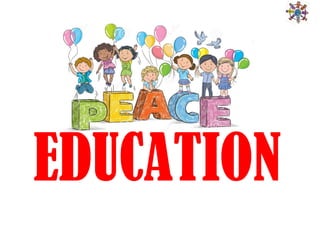
EDUCATION
Youth are the foundation of our
future and often can serve as
transformed mentors to their
friends, family and society.
INTRODUCTION
The process of promoting the knowledge, skills,
attitudes and values needed to bring about
behaviour changes that will enable children, youth
and adults
to prevent conflict and violence, both overt and
structural;
to resolve conflict peacefully;
and
to create the conditions conducive to peace,
whether at an intrapersonal, interpersonal,
intergroup, national or international level.
DEFINITION
AIM OF PEACE EDUCATION
Investigate the causes of conflicts and violence
embedded within perceptions, values and attitudes of
individuals as well as within social and political
structures of society. Encourage the search for
alternatives and possible nonviolent skills. Equip children
and adults with personal conflict resolution skills.
Early decades of the 20th century, “peace
education” programs around the world have
represented a spectrum of focal themes,
including anti-nuclearism, international
understanding, environmental responsibility,
communication skills, nonviolence, conflict
resolution techniques, democracy, human
rights awareness, tolerance of diversity,
coexistence and gender equality,
HISTORY
Ian Harris and John Synott have
described peace education as a series of
"teaching encounters" that draw from
people:
• their desire for peace,
• nonviolent alternatives for managing
conflict,
• skills for critical analysis of structural
arrangements that produce and legitimize
injustice and inequality
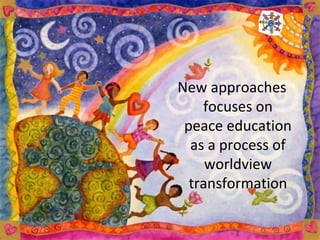
New approaches
focuses on
peace education
as a process of
worldview
transformation
PEACE EDUCATION
AN ESSENTIAL COMPONENT OF
QUALITY BASIC EDUCATION
The 1990 World Declaration on Education for
All (the Jomtien Declaration) clearly states
that basic learning needs comprise not only
essential tools such as literacy and numeracy,
but also the knowledge, skills, attitudes and
values required to live and work in dignity and
to participate in development.
Windows of opportunity
• There are a number of creative avenues that can
be used to introduce peace education concepts,
skills and attitudes, whether in or out of the
school .
• Traditional folk stories
• Nearly every country in the world has ratified
the Convention on the Rights of the Child,
• Proverbs
OUTSIDE OF SCHOOLS
• Peace education should not limited to activities that
take place in schools. A number activities can be
performed after -school programmes and summer
programmes with a peace education focus.
• Workshops, training programmes, and activities for
out of school youth can be created, along with
initiatives that focus on the media, publications for
youth, and community-based arts programmes. Taken
together, such approaches demonstrate that learning
takes place in many different contexts, all of which can
promote messages of peace
? Peace Education
Peace education programs centered on conflict
resolution typically focus on the social-
behavioural symptoms of conflict, training
individuals to resolve inter-personal disputes
through techniques of negotiation and (peer)
mediation. Learning to manage anger, “fight fair”
and improve communication through skills such
as listening, turn-taking, identifying needs, and
separating facts from emotions, constitute the
main elements of these programs
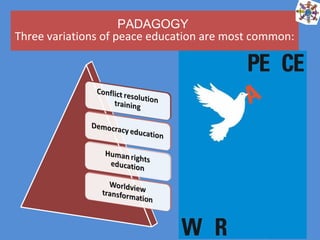
PADAGOGY
Three variations of peace education are most common:
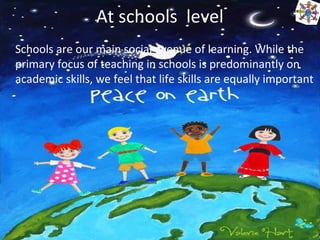
At schools level
Schools are our main social avenue of learning. While the
primary focus of teaching in schools is predominantly on
academic skills, we feel that life skills are equally important
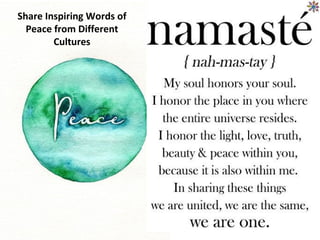
Share Inspiring Words of
Peace from Different
Cultures
Develop healthy habits and regular schedules,
including enough sleep, daily exercise and
relaxation.
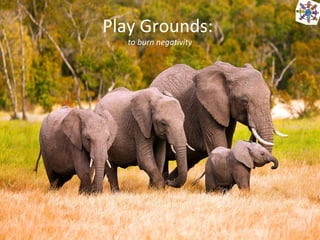
Play Grounds:
to burn negativity
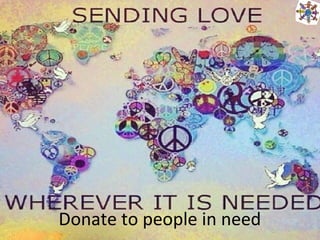
Donate to people in need
Make Room for Peace/ prayer at
Home
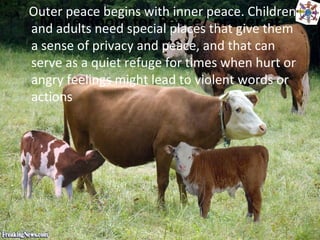
Outer peace begins with inner peace. Children
and adults need special places that give them
a sense of privacy and peace, and that can
serve as a quiet refuge for times when hurt or
angry feelings might lead to violent words or
actions
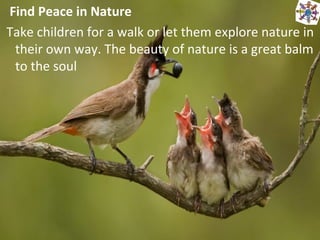
Find Peace in Nature
Take children for a walk or let them explore nature in
their own way. The beauty of nature is a great balm
to the soul
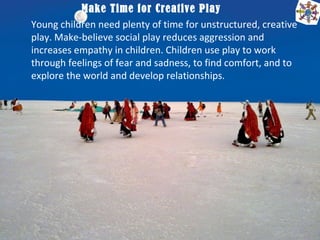
Make Time for Creative Play
Young children need plenty of time for unstructured, creative
play. Make-believe social play reduces aggression and
increases empathy in children. Children use play to work
through feelings of fear and sadness, to find comfort, and to
explore the world and develop relationships.
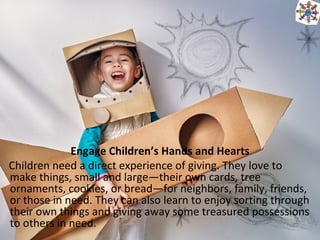
Engage Children’s Hands and Hearts
Children need a direct experience of giving. They love to
make things, small and large—their own cards, tree
ornaments, cookies, or bread—for neighbors, family, friends,
or those in need. They can also learn to enjoy sorting through
their own things and giving away some treasured possessions
to others in need.
Help young people find active ways to collaborate with
other children globally, through organizations like
Jane Goodall’s Roots and Shoots www.janegoodall.org
Craig Kielburger’s Free the Children www.freethechildren.org
Peace Jam, in which students work directly with Nobel
Peace Laureates www.peacejam.org
Peace education in schools

Peace education in schools

  • 1.
  • 2.
    Youth are thefoundation of our future and often can serve as transformed mentors to their friends, family and society. INTRODUCTION
  • 3.
    The process ofpromoting the knowledge, skills, attitudes and values needed to bring about behaviour changes that will enable children, youth and adults to prevent conflict and violence, both overt and structural; to resolve conflict peacefully; and to create the conditions conducive to peace, whether at an intrapersonal, interpersonal, intergroup, national or international level. DEFINITION
  • 4.
    AIM OF PEACEEDUCATION Investigate the causes of conflicts and violence embedded within perceptions, values and attitudes of individuals as well as within social and political structures of society. Encourage the search for alternatives and possible nonviolent skills. Equip children and adults with personal conflict resolution skills.
  • 5.
    Early decades ofthe 20th century, “peace education” programs around the world have represented a spectrum of focal themes, including anti-nuclearism, international understanding, environmental responsibility, communication skills, nonviolence, conflict resolution techniques, democracy, human rights awareness, tolerance of diversity, coexistence and gender equality, HISTORY
  • 6.
    Ian Harris andJohn Synott have described peace education as a series of "teaching encounters" that draw from people: • their desire for peace, • nonviolent alternatives for managing conflict, • skills for critical analysis of structural arrangements that produce and legitimize injustice and inequality
  • 7.
    New approaches focuses on peaceeducation as a process of worldview transformation
  • 8.
    PEACE EDUCATION AN ESSENTIALCOMPONENT OF QUALITY BASIC EDUCATION The 1990 World Declaration on Education for All (the Jomtien Declaration) clearly states that basic learning needs comprise not only essential tools such as literacy and numeracy, but also the knowledge, skills, attitudes and values required to live and work in dignity and to participate in development.
  • 9.
    Windows of opportunity •There are a number of creative avenues that can be used to introduce peace education concepts, skills and attitudes, whether in or out of the school . • Traditional folk stories • Nearly every country in the world has ratified the Convention on the Rights of the Child, • Proverbs
  • 10.
    OUTSIDE OF SCHOOLS •Peace education should not limited to activities that take place in schools. A number activities can be performed after -school programmes and summer programmes with a peace education focus. • Workshops, training programmes, and activities for out of school youth can be created, along with initiatives that focus on the media, publications for youth, and community-based arts programmes. Taken together, such approaches demonstrate that learning takes place in many different contexts, all of which can promote messages of peace
  • 11.
    ? Peace Education Peaceeducation programs centered on conflict resolution typically focus on the social- behavioural symptoms of conflict, training individuals to resolve inter-personal disputes through techniques of negotiation and (peer) mediation. Learning to manage anger, “fight fair” and improve communication through skills such as listening, turn-taking, identifying needs, and separating facts from emotions, constitute the main elements of these programs
  • 14.
    PADAGOGY Three variations ofpeace education are most common:
  • 15.
    At schools level Schoolsare our main social avenue of learning. While the primary focus of teaching in schools is predominantly on academic skills, we feel that life skills are equally important
  • 18.
    Share Inspiring Wordsof Peace from Different Cultures
  • 20.
    Develop healthy habitsand regular schedules, including enough sleep, daily exercise and relaxation.
  • 21.
  • 22.
  • 23.
    Make Room forPeace/ prayer at Home Outer peace begins with inner peace. Children and adults need special places that give them a sense of privacy and peace, and that can serve as a quiet refuge for times when hurt or angry feelings might lead to violent words or actions
  • 24.
    Find Peace inNature Take children for a walk or let them explore nature in their own way. The beauty of nature is a great balm to the soul
  • 25.
    Make Time forCreative Play Young children need plenty of time for unstructured, creative play. Make-believe social play reduces aggression and increases empathy in children. Children use play to work through feelings of fear and sadness, to find comfort, and to explore the world and develop relationships.
  • 26.
    Engage Children’s Handsand Hearts Children need a direct experience of giving. They love to make things, small and large—their own cards, tree ornaments, cookies, or bread—for neighbors, family, friends, or those in need. They can also learn to enjoy sorting through their own things and giving away some treasured possessions to others in need.
  • 27.
    Help young peoplefind active ways to collaborate with other children globally, through organizations like Jane Goodall’s Roots and Shoots www.janegoodall.org Craig Kielburger’s Free the Children www.freethechildren.org Peace Jam, in which students work directly with Nobel Peace Laureates www.peacejam.org