Social
Reconstructionism
A Presentation in Educ. 501
by Gigi Lumbre Mondelo,
MA Ed. in Social Science
The Two Major Premises of
Reconstructionism
• Society is in need of constant
reconstruction or change
• Such social change involves a
reconstruction of education and the use
of education in reconstructing the
society
Historical Background of Reconstructionism
• Reconstructionist ideas in one form or another have
existed throughout history.
• Plato, in preparing his design for a future state, was
a “reconstructionist” philosopher. He outlined a plan
for a just state in which education would become
the building material for a new and better society.
In his book, Laws, he envisioned a time when
interest charges would be forbidden, profits would
be limited, and human beings would live as friends.
• Stoic philosophers, particularly in their concern for
a world state, promoted a reconstructionist ideal.
Historical Background of Reconstructionism
• Marcus Aurelius, a Roman emperor and philosopher,
maintained that he was a citizen of the world, not of
Rome. This concept is one of that reconstructionists
articulate today in their attempts to minimize
nationalistic fervour and chauvinism.
• Augustine preached reconstructionist reforms to bring
about an ideal Christian state through his book The
City of God.
• Thomas More, Thomas Campanella, Johann Valentin
Andreae, Samuel Gott and other Christian utopian
writers also proposed things we might do to bring the
state into better accord with Christian thinking.
Historical Background of Reconstructionism
• Writings of 18th and 19th century utopian socialists,
such as Comte de Saint Simon, Charles Fourier and
Francois Noel Babeuf, advocated reconstructionist ideals
through the development of various forms of socialism.
• Robert Owen and Edward Bellamy were part of the
industrial revolution, but saw the use of technology not
only for the production of wealth, but for improving
the lot of humanity throughout the world.
• Karl Marx, decrying the harm done to workers by the
dehumanization of the industrial system, who pictured
a reconstructed world based on international
communism.
Historical Background of Reconstructionism
• After the World War, Bertrand Russell in his
Principles of Social Reconstruction, listed steps that
might be taken to avoid the holocaust of war.
• B. F. Skinner advocates the use of conditioning or
“behavioural engineering” in his book Walden Two.
In his Beyond Freedom and Dignity, Skinner
maintains that people cannot afford freedom in the
traditional sense and that they must engineer a
new social order based on a technology of behaviour.
• Horace Mann and John Dewey view education as a
tool for social reform.
Modern
Reconstructionism
Modern reconstructionism is basically pragmatic and
owes a tremendous debt to Dewey. Reconstructionists
promotes such things as the scientific method, problem
solving, naturalism, and humanism; however,
reconstructionists diverge from pragmatists in how they
believe the pragmatic method should be used.
Although pragmatism advocates continuous change and
a forward-looking approach to the problems of people and
society it has become a tool for helping people adjust to
society rather than change it.
Education, from the reconstructionist’s view, is a tool
for immediate and continuous change.
Leading Exponents
of Reconstructionism
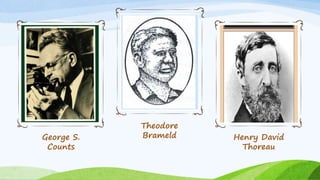
George S.
Counts
Theodore
Brameld Henry David
Thoreau
Alvin Toffler Ivan Illich
Paulo Freire
Reconstructionism
and Education
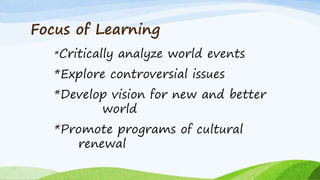
Focus of Learning
*Critically analyze world events
*Explore controversial issues
*Develop vision for new and better
world
*Promote programs of cultural
renewal
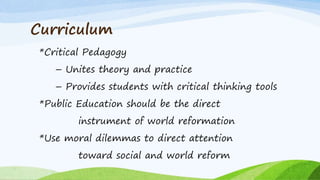
Curriculum
*Critical Pedagogy
– Unites theory and practice
– Provides students with critical thinking tools
*Public Education should be the direct
instrument of world reformation
*Use moral dilemmas to direct attention
toward social and world reform
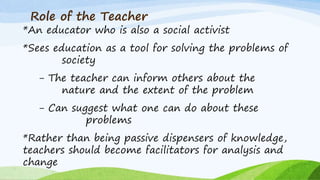
Role of the Teacher
*An educator who is also a social activist
*Sees education as a tool for solving the problems of
society
- The teacher can inform others about the
nature and the extent of the problem
- Can suggest what one can do about these
problems
*Rather than being passive dispensers of knowledge,
teachers should become facilitators for analysis and
change
Critiques of
Reconstructionism
*Reconstructionists analysis of social problems and
the accompanying remedies suffer from shallowness
and superficiality.
*Often, in their strong desire for change,
reconstructionists are precipitous in their
recommendations for reform.
*Reconstructionists have a romantic notion of what
schools can do.
*The views about democracy and decision making
are questionable.
Post Script
Reconstructionist philosophy has been an
antidote to the easy virtues of
materialism, traditional cultural values,
and social stability. Its theory is not widely
accepted but it can stimulate and provoke
critical thinking. It has provided visions for
a more perfect world and suggested ways
of obtaining them.
Concern for social values, humane justice,
human community, world peace,
economic justice, equality of opportunity,
freedom and democracy – are the
significant goals for reconstructionism.

Educational Theories: Social Reconstructionism

  • 1.
    Social Reconstructionism A Presentation inEduc. 501 by Gigi Lumbre Mondelo, MA Ed. in Social Science
  • 2.
    The Two MajorPremises of Reconstructionism • Society is in need of constant reconstruction or change • Such social change involves a reconstruction of education and the use of education in reconstructing the society
  • 3.
    Historical Background ofReconstructionism • Reconstructionist ideas in one form or another have existed throughout history. • Plato, in preparing his design for a future state, was a “reconstructionist” philosopher. He outlined a plan for a just state in which education would become the building material for a new and better society. In his book, Laws, he envisioned a time when interest charges would be forbidden, profits would be limited, and human beings would live as friends. • Stoic philosophers, particularly in their concern for a world state, promoted a reconstructionist ideal.
  • 4.
    Historical Background ofReconstructionism • Marcus Aurelius, a Roman emperor and philosopher, maintained that he was a citizen of the world, not of Rome. This concept is one of that reconstructionists articulate today in their attempts to minimize nationalistic fervour and chauvinism. • Augustine preached reconstructionist reforms to bring about an ideal Christian state through his book The City of God. • Thomas More, Thomas Campanella, Johann Valentin Andreae, Samuel Gott and other Christian utopian writers also proposed things we might do to bring the state into better accord with Christian thinking.
  • 5.
    Historical Background ofReconstructionism • Writings of 18th and 19th century utopian socialists, such as Comte de Saint Simon, Charles Fourier and Francois Noel Babeuf, advocated reconstructionist ideals through the development of various forms of socialism. • Robert Owen and Edward Bellamy were part of the industrial revolution, but saw the use of technology not only for the production of wealth, but for improving the lot of humanity throughout the world. • Karl Marx, decrying the harm done to workers by the dehumanization of the industrial system, who pictured a reconstructed world based on international communism.
  • 6.
    Historical Background ofReconstructionism • After the World War, Bertrand Russell in his Principles of Social Reconstruction, listed steps that might be taken to avoid the holocaust of war. • B. F. Skinner advocates the use of conditioning or “behavioural engineering” in his book Walden Two. In his Beyond Freedom and Dignity, Skinner maintains that people cannot afford freedom in the traditional sense and that they must engineer a new social order based on a technology of behaviour. • Horace Mann and John Dewey view education as a tool for social reform.
  • 7.
  • 8.
    Modern reconstructionism isbasically pragmatic and owes a tremendous debt to Dewey. Reconstructionists promotes such things as the scientific method, problem solving, naturalism, and humanism; however, reconstructionists diverge from pragmatists in how they believe the pragmatic method should be used. Although pragmatism advocates continuous change and a forward-looking approach to the problems of people and society it has become a tool for helping people adjust to society rather than change it. Education, from the reconstructionist’s view, is a tool for immediate and continuous change.
  • 9.
  • 10.
  • 11.
  • 12.
  • 13.
  • 14.
    Focus of Learning *Criticallyanalyze world events *Explore controversial issues *Develop vision for new and better world *Promote programs of cultural renewal
  • 15.
    Curriculum *Critical Pedagogy – Unitestheory and practice – Provides students with critical thinking tools *Public Education should be the direct instrument of world reformation *Use moral dilemmas to direct attention toward social and world reform
  • 16.
    Role of theTeacher *An educator who is also a social activist *Sees education as a tool for solving the problems of society - The teacher can inform others about the nature and the extent of the problem - Can suggest what one can do about these problems *Rather than being passive dispensers of knowledge, teachers should become facilitators for analysis and change
  • 17.
  • 18.
    *Reconstructionists analysis ofsocial problems and the accompanying remedies suffer from shallowness and superficiality. *Often, in their strong desire for change, reconstructionists are precipitous in their recommendations for reform. *Reconstructionists have a romantic notion of what schools can do. *The views about democracy and decision making are questionable.
  • 19.
    Post Script Reconstructionist philosophyhas been an antidote to the easy virtues of materialism, traditional cultural values, and social stability. Its theory is not widely accepted but it can stimulate and provoke critical thinking. It has provided visions for a more perfect world and suggested ways of obtaining them. Concern for social values, humane justice, human community, world peace, economic justice, equality of opportunity, freedom and democracy – are the significant goals for reconstructionism.