
Advanced Computer Architecture
Embedded Platform Architecture
Dr. Muhammad Asif
drasifpk@hotmail.com
Outline
Components of Embedded System Platform
– Embedded Processor
– System Memory Map
– Interrupt Controller
– Timers
Dr. M. Asif drasifpk@hotmail.com Advanced Computer Architecture
Embedded System Platforms
• Electronic devices are becoming Internet-
accessible with software-defined feature sets
• Not Just Computers and Mobile Devices
• Almost every kind of electronics device
• Major domains of processor-based systems-
on-a-chip (SoC) that are going to rely on
Internet connectivity.
–Consumer Electronics
–Telephony
–In-vehicle information systems
Dr. M. Asif drasifpk@hotmail.com Advanced Computer Architecture
Embedded System Platforms
• Changing Trend: Internet connectivity enables
the command and control of deployed
electronics.
• Example: Building Automation,
– systems such as lighting, climate, and
security can be monitored and managed
remotely. Lights can be turned off and
temperatures can be adjusted in rooms and
buildings that are known to be empty,
without requiring a physical presence in the
room.
Dr. M. Asif drasifpk@hotmail.com Advanced Computer Architecture
Embedded System Architecture
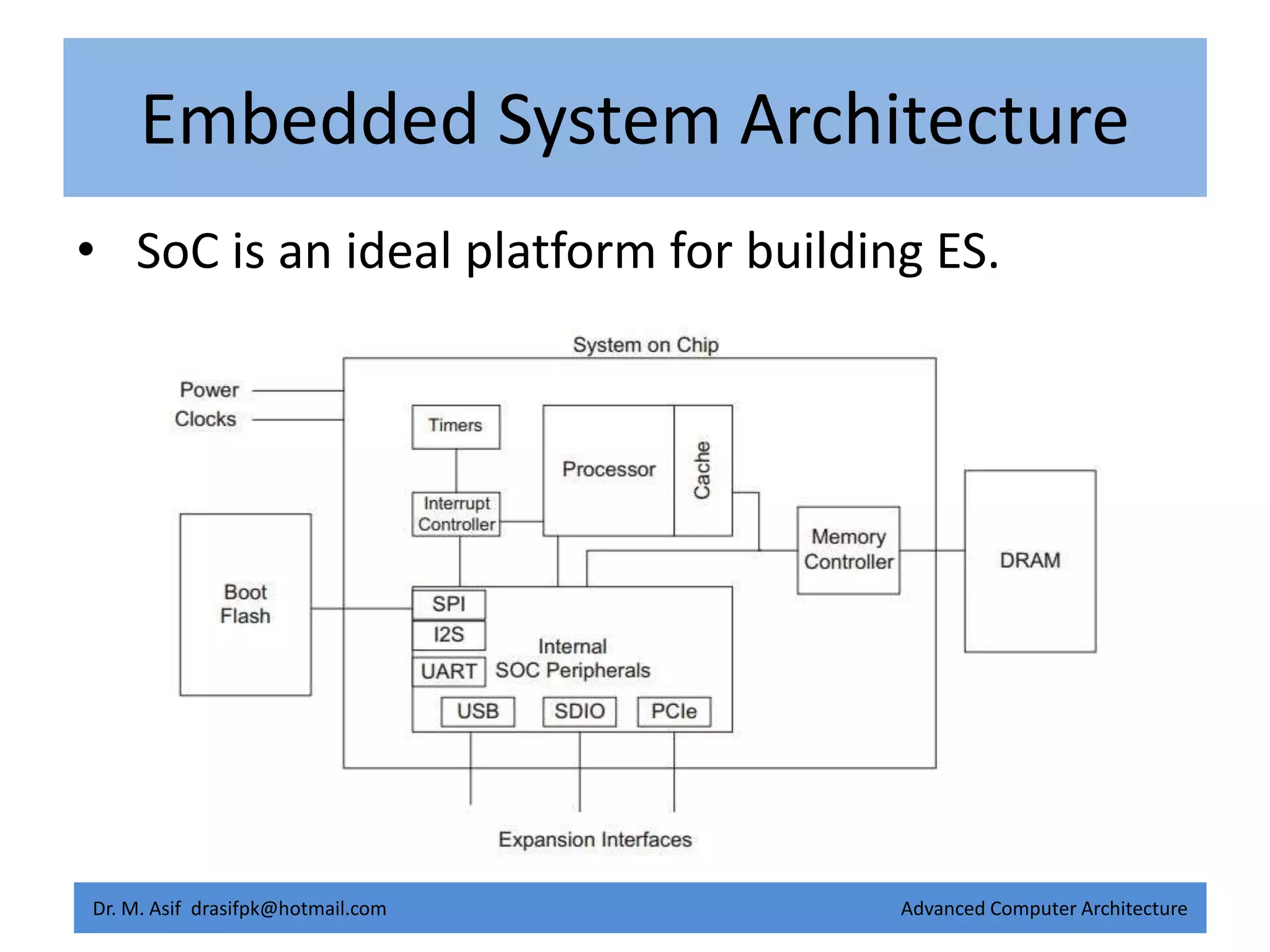
• SoC is an ideal platform for building ES.
Dr. M. Asif drasifpk@hotmail.com Advanced Computer Architecture
Embedded System Architecture
• Processor: primary execution environment
• An embedded SoC sometimes contains additional
processing elements that are designed for a more
specific function.
• Processors can be scalar or super scalar
• A superscalar-based processor supports the
parallel execution of instructions by having
multiple copies of key functional units within the
CPU
•
Dr. M. Asif drasifpk@hotmail.com Advanced Computer Architecture
Memory-Hierarchy in Embedded
System Architecture
• When the processor is waiting for the memory
subsystem, the processor stalls and is no longer doing
useful work.
• stalls directly impact the performance of the
system.
• Solution is to provide large amounts of the extremely
fast memory technology tightly coupled to the
processor core.
• Costly solution
Dr. M. Asif drasifpk@hotmail.com Advanced Computer Architecture
Memory-Hierarchy in Embedded
System Architecture
•
Dr. M. Asif drasifpk@hotmail.com Advanced Computer Architecture
Memory-Hierarchy in Embedded
System Architecture
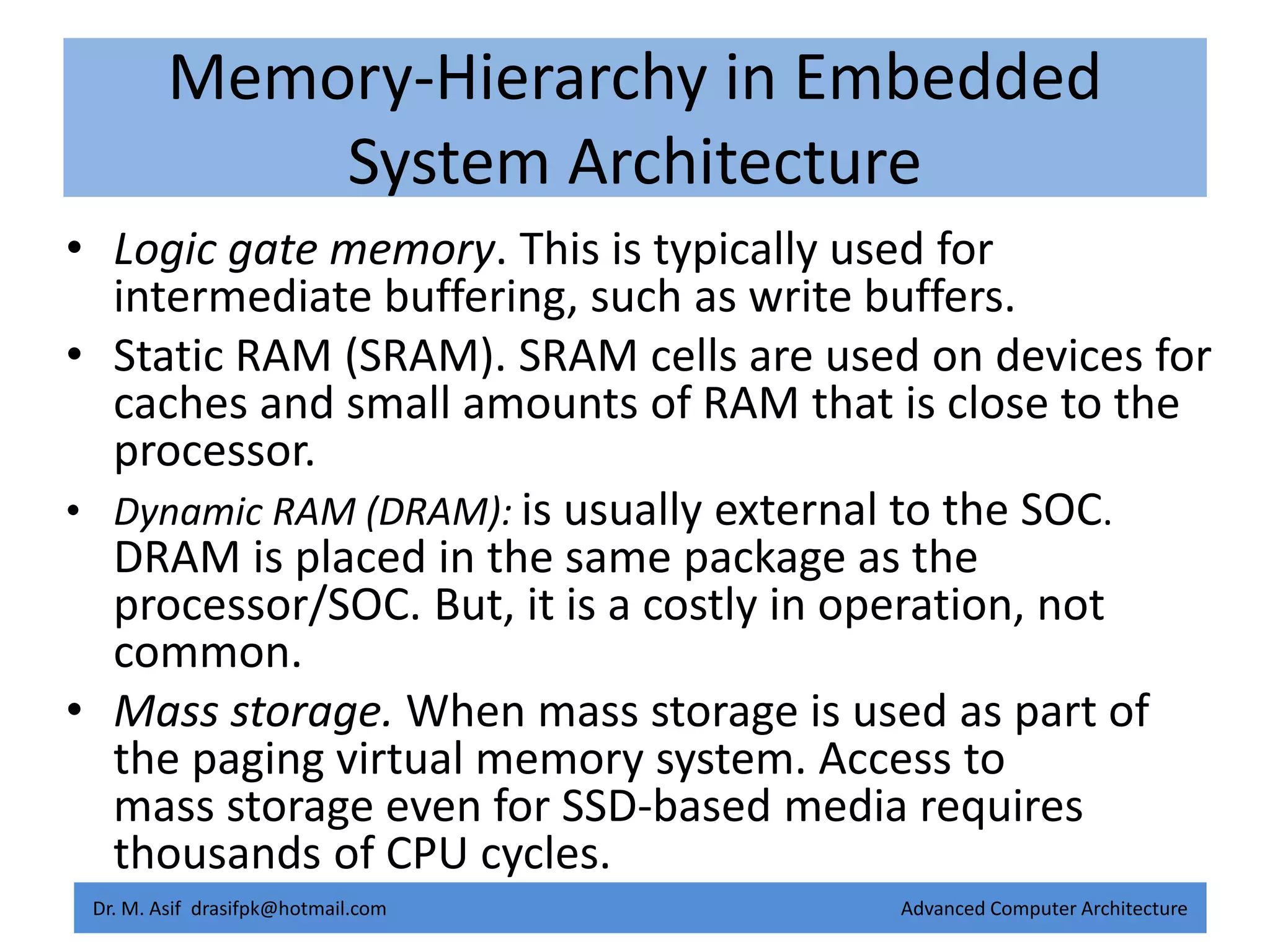
• Logic gate memory. This is typically used for
intermediate buffering, such as write buffers.
• Static RAM (SRAM). SRAM cells are used on devices for
caches and small amounts of RAM that is close to the
processor.
• Dynamic RAM (DRAM): is usually external to the SOC.
DRAM is placed in the same package as the
processor/SOC. But, it is a costly in operation, not
common.
• Mass storage. When mass storage is used as part of
the paging virtual memory system. Access to
mass storage even for SSD-based media requires
thousands of CPU cycles.
Dr. M. Asif drasifpk@hotmail.com Advanced Computer Architecture
Embedded System Architecture
An embedded Processor require followings to operate:
• A memory subsystem for initial instruction storage
and random access memory.
• An interrupt controller to gather, prioritize, and
control generation of interrupts to the processor.
• A timer; multitasking operating systems (non-
cooperative) typically rely on at least one timer
interrupt to trigger the operating system scheduler.
• Access to I/O devices, such as graphics controllers,
network interfaces, and mouse/keypads.
Dr. M. Asif drasifpk@hotmail.com Advanced Computer Architecture
Embedded System Architecture
• The processor sits at the center of the
platform and interacts with all the other
devices on the platform.
• The locations of the devices are presented
through the memory map.
Dr. M. Asif drasifpk@hotmail.com Advanced Computer Architecture
System Memory Map
• The memory map is a list of physical addresses
of all the resources on the platform, such as
the DRAM memory, the interrupt controllers,
and I/O devices.
• System memory map is generated from
processor’s point of view and can be viewed
from other devices’ point of view
• Two distinct address spaces:
– Memory Space
– Input/output Space•
Dr. M. Asif drasifpk@hotmail.com Advanced Computer Architecture
System Memory Map
• Memory Space
–Primary address space, covers DRAM and
I/O
–It occupies the entire physical address space
of the processor
–MOV Instruction
• Input/output Space
–I/O space is far smaller (only 64 kB) and can
only be accessed via IN/OUT instructions.
•
Dr. M. Asif drasifpk@hotmail.com Advanced Computer Architecture
System Memory Map
• When the processor generates a read or write,
the address is decoded by the system memory
address decoders and is eventually routed to
the appropriate physical device to complete
the transaction.
• Memory Address Space:
– Main memory address range
– Memory Mapped I/O (MMIO)
Dr. M. Asif drasifpk@hotmail.com Advanced Computer Architecture
System Memory Map (Intel)
•
Dr. M. Asif drasifpk@hotmail.com Advanced Computer Architecture
System Memory Map
• A register in the SOC is called TOLM indicates
the top of local memory.
MIMO (Sub-category):
• Fixed Address Memory Mapped Address:
There are a number of hard coded address
ranges.
– The address in this range decodes to the flash
device (where BIOS/firmware is stored), timers,
interrupt controllers, and some other incidental
control functions.
Dr. M. Asif drasifpk@hotmail.com Advanced Computer Architecture
System Memory Map
MIMO (Sub-category):
• PCIe BUS Range: represents a range of MMIO
addressed that will all be directed to the
PCI/PCIe bus on the system.
– The devices that appear on the PCIe bus have
configurable address decoders known as Base
Address Registers (BARs).
– The devices are discovered and configured using
BARs and PCIe
•
Dr. M. Asif drasifpk@hotmail.com Advanced Computer Architecture
System Memory Map
• The address map (within the SOC) is usually
static
• All devices are assigned an address at the time
of SOC design
• Simplify the hardware design
Dr. M. Asif drasifpk@hotmail.com Advanced Computer Architecture

Embedded Platform Architecture - I

  • 1.
    Advanced Computer Architecture EmbeddedPlatform Architecture Dr. Muhammad Asif drasifpk@hotmail.com
  • 2.
    Outline Components of EmbeddedSystem Platform – Embedded Processor – System Memory Map – Interrupt Controller – Timers Dr. M. Asif drasifpk@hotmail.com Advanced Computer Architecture
  • 3.
    Embedded System Platforms •Electronic devices are becoming Internet- accessible with software-defined feature sets • Not Just Computers and Mobile Devices • Almost every kind of electronics device • Major domains of processor-based systems- on-a-chip (SoC) that are going to rely on Internet connectivity. –Consumer Electronics –Telephony –In-vehicle information systems Dr. M. Asif drasifpk@hotmail.com Advanced Computer Architecture
  • 4.
    Embedded System Platforms •Changing Trend: Internet connectivity enables the command and control of deployed electronics. • Example: Building Automation, – systems such as lighting, climate, and security can be monitored and managed remotely. Lights can be turned off and temperatures can be adjusted in rooms and buildings that are known to be empty, without requiring a physical presence in the room. Dr. M. Asif drasifpk@hotmail.com Advanced Computer Architecture
  • 5.
    Embedded System Architecture •SoC is an ideal platform for building ES. Dr. M. Asif drasifpk@hotmail.com Advanced Computer Architecture
  • 6.
    Embedded System Architecture •Processor: primary execution environment • An embedded SoC sometimes contains additional processing elements that are designed for a more specific function. • Processors can be scalar or super scalar • A superscalar-based processor supports the parallel execution of instructions by having multiple copies of key functional units within the CPU • Dr. M. Asif drasifpk@hotmail.com Advanced Computer Architecture
  • 7.
    Memory-Hierarchy in Embedded SystemArchitecture • When the processor is waiting for the memory subsystem, the processor stalls and is no longer doing useful work. • stalls directly impact the performance of the system. • Solution is to provide large amounts of the extremely fast memory technology tightly coupled to the processor core. • Costly solution Dr. M. Asif drasifpk@hotmail.com Advanced Computer Architecture
  • 8.
    Memory-Hierarchy in Embedded SystemArchitecture • Dr. M. Asif drasifpk@hotmail.com Advanced Computer Architecture
  • 9.
    Memory-Hierarchy in Embedded SystemArchitecture • Logic gate memory. This is typically used for intermediate buffering, such as write buffers. • Static RAM (SRAM). SRAM cells are used on devices for caches and small amounts of RAM that is close to the processor. • Dynamic RAM (DRAM): is usually external to the SOC. DRAM is placed in the same package as the processor/SOC. But, it is a costly in operation, not common. • Mass storage. When mass storage is used as part of the paging virtual memory system. Access to mass storage even for SSD-based media requires thousands of CPU cycles. Dr. M. Asif drasifpk@hotmail.com Advanced Computer Architecture
  • 10.
    Embedded System Architecture Anembedded Processor require followings to operate: • A memory subsystem for initial instruction storage and random access memory. • An interrupt controller to gather, prioritize, and control generation of interrupts to the processor. • A timer; multitasking operating systems (non- cooperative) typically rely on at least one timer interrupt to trigger the operating system scheduler. • Access to I/O devices, such as graphics controllers, network interfaces, and mouse/keypads. Dr. M. Asif drasifpk@hotmail.com Advanced Computer Architecture
  • 11.
    Embedded System Architecture •The processor sits at the center of the platform and interacts with all the other devices on the platform. • The locations of the devices are presented through the memory map. Dr. M. Asif drasifpk@hotmail.com Advanced Computer Architecture
  • 12.
    System Memory Map •The memory map is a list of physical addresses of all the resources on the platform, such as the DRAM memory, the interrupt controllers, and I/O devices. • System memory map is generated from processor’s point of view and can be viewed from other devices’ point of view • Two distinct address spaces: – Memory Space – Input/output Space• Dr. M. Asif drasifpk@hotmail.com Advanced Computer Architecture
  • 13.
    System Memory Map •Memory Space –Primary address space, covers DRAM and I/O –It occupies the entire physical address space of the processor –MOV Instruction • Input/output Space –I/O space is far smaller (only 64 kB) and can only be accessed via IN/OUT instructions. • Dr. M. Asif drasifpk@hotmail.com Advanced Computer Architecture
  • 14.
    System Memory Map •When the processor generates a read or write, the address is decoded by the system memory address decoders and is eventually routed to the appropriate physical device to complete the transaction. • Memory Address Space: – Main memory address range – Memory Mapped I/O (MMIO) Dr. M. Asif drasifpk@hotmail.com Advanced Computer Architecture
  • 15.
    System Memory Map(Intel) • Dr. M. Asif drasifpk@hotmail.com Advanced Computer Architecture
  • 16.
    System Memory Map •A register in the SOC is called TOLM indicates the top of local memory. MIMO (Sub-category): • Fixed Address Memory Mapped Address: There are a number of hard coded address ranges. – The address in this range decodes to the flash device (where BIOS/firmware is stored), timers, interrupt controllers, and some other incidental control functions. Dr. M. Asif drasifpk@hotmail.com Advanced Computer Architecture
  • 17.
    System Memory Map MIMO(Sub-category): • PCIe BUS Range: represents a range of MMIO addressed that will all be directed to the PCI/PCIe bus on the system. – The devices that appear on the PCIe bus have configurable address decoders known as Base Address Registers (BARs). – The devices are discovered and configured using BARs and PCIe • Dr. M. Asif drasifpk@hotmail.com Advanced Computer Architecture
  • 18.
    System Memory Map •The address map (within the SOC) is usually static • All devices are assigned an address at the time of SOC design • Simplify the hardware design Dr. M. Asif drasifpk@hotmail.com Advanced Computer Architecture