Human Rights
  Education
Fundamentals of Human Rights Education

Human rights may be generally defined as those rights which are
inherent in our nature and without which we cannot live as human
beings.

Human rights and fundamental freedoms are based on
humankind’s increasing demand for a life in which the inherent
dignity and worth of each human being are accorded respect and
protection.

Their denial is not only an individual and personal tragedy but also
creates conditions of social and political unrest, sowing the seeds
of violence and conflict within and between societies and nations.
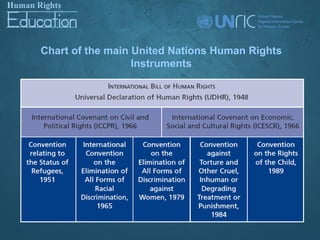
Chart of the main United Nations Human Rights
                  Instruments
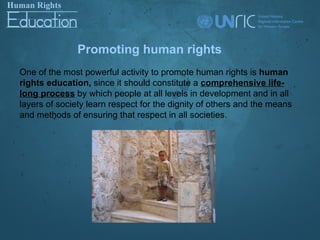
Promoting human rights
One of the most powerful activity to promote human rights is human
rights education, since it should constitute a comprehensive life-
long process by which people at all levels in development and in all
layers of society learn respect for the dignity of others and the means
and methods of ensuring that respect in all societies.
Promoting human rights


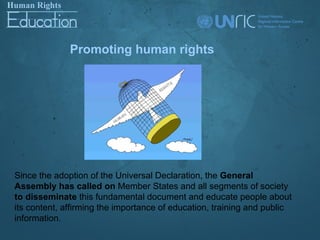
Since the adoption of the Universal Declaration, the General
Assembly has called on Member States and all segments of society
to disseminate this fundamental document and educate people about
its content, affirming the importance of education, training and public
information.
Promoting human rights
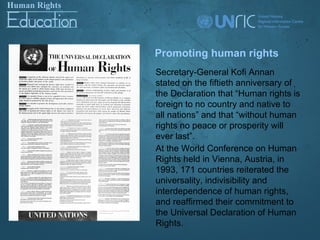
Secretary-General Kofi Annan
stated on the fiftieth anniversary of
the Declaration that “Human rights is
foreign to no country and native to
all nations” and that “without human
rights no peace or prosperity will
ever last”.
At the World Conference on Human
Rights held in Vienna, Austria, in
1993, 171 countries reiterated the
universality, indivisibility and
interdependence of human rights,
and reaffirmed their commitment to
the Universal Declaration of Human
Rights.
Human rights education definition

    Human rights education may be defined as “training,
    dissemination and information efforts” aimed at:

•   Strengthen respect for human rights and fundamental freedoms;

•   Develop fully human personality and the sense of its dignity;

•   Promote understanding, tolerance, gender equality and
    friendship among all nations, indigenous peoples and racial,
    national, ethnic, religious and linguistic groups;

•   Enable all persons to participate effectively in a free society;

•   Further the activities of the United Nations for the maintenance
    of peace.
Content for human rights education
The core content of human rights education in schools is the
Universal Declaration of Human Rights and the Convention on
the Rights of the Child. These documents provide principles and
ideas with which to assess experience and build a school culture
that values human rights.

The rights they embody are universal, meaning that all human
beings are entitled to them, on an equal basis and that they are
indivisible, meaning there is no hierarchy of rights.
Content for human rights education

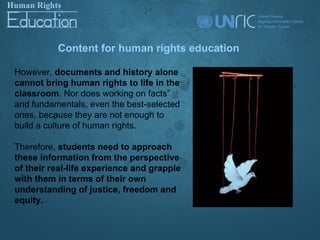
However, documents and history alone
cannot bring human rights to life in the
classroom. Nor does working on facts”
and fundamentals, even the best-selected
ones, because they are not enough to
build a culture of human rights.

Therefore, students need to approach
these information from the perspective
of their real-life experience and grapple
with them in terms of their own
understanding of justice, freedom and
equity.
Teaching human rights:
       when action speaks louder than words


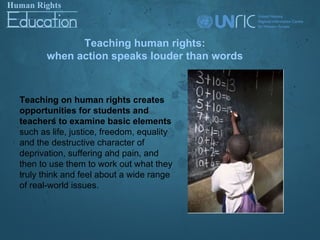
Teaching on human rights creates
opportunities for students and
teachers to examine basic elements
such as life, justice, freedom, equality
and the destructive character of
deprivation, suffering and pain, and
then to use them to work out what they
truly think and feel about a wide range
of real-world issues.
Teaching human rights:
      when action speaks louder than words
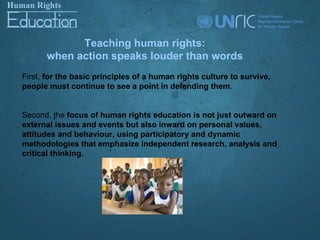
First, for the basic principles of a human rights culture to survive,
people must continue to see a point in defending them.


Second, the focus of human rights education is not just outward on
external issues and events but also inward on personal values,
attitudes and behaviour, using participatory and dynamic
methodologies that emphasize independent research, analysis and
critical thinking.
Pedagogical techniques for human rights education
The techniques suggested for human rights education illustrate how
teachers can:

•engage students’ empathy and moral imagination;

•challenge their assumptions;

•integrate concepts like human dignity and equality into their
everyday experience of people, power and responsibility.

These techniques have proved especially appropriate for human
rights education because they encourage critical thinking, both
cognitive and affective learning, respect for differences of
experience and opinion, and active engagement of all participants in
ongoing learning.
Pedagogical techniques for human rights education

Brainstorming
Case studies
Creative expression
Discussion
Field trips/Community visits
Interviews
Research projects
Role-plays/Simulations
Visual aids
Pedagogical techniques for human rights education

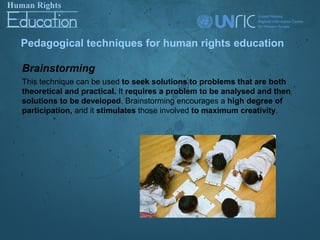
Brainstorming
This technique can be used to seek solutions to problems that are both
theoretical and practical. It requires a problem to be analysed and then
solutions to be developed. Brainstorming encourages a high degree of
participation, and it stimulates those involved to maximum creativity.
Pedagogical techniques for human rights education


Case studies

Students in small groups work
with real or fictional cases that
require them to apply human rights
standards. This method encourages
analysis, problem-solving and
planning skills, as well as cooperation
and team building.
Pedagogical techniques for human rights education

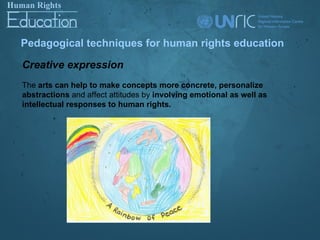
Creative expression
The arts can help to make concepts more concrete, personalize
abstractions and affect attitudes by involving emotional as well as
intellectual responses to human rights.
Pedagogical techniques for human rights education

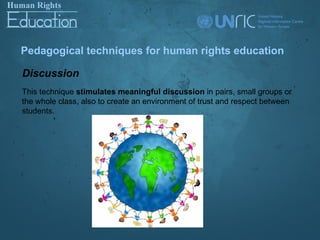
Discussion
This technique stimulates meaningful discussion in pairs, small groups or
the whole class, also to create an environment of trust and respect between
students.
Pedagogical techniques for human rights education


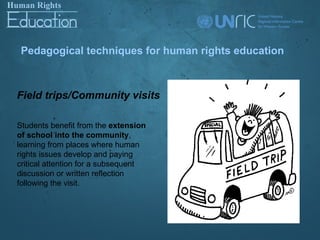
Field trips/Community visits

Students benefit from the extension
of school into the community,
learning from places where human
rights issues develop and paying
critical attention for a subsequent
discussion or written reflection
following the visit.
Pedagogical techniques for human rights education


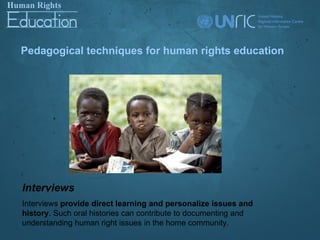
Interviews
Interviews provide direct learning and personalize issues and
history. Such oral histories can contribute to documenting and
understanding human right issues in the home community.
Pedagogical techniques for human rights education

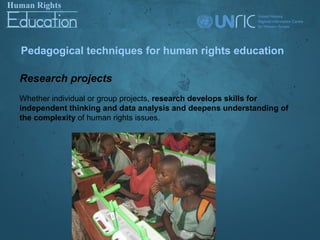
Research projects
Whether individual or group projects, research develops skills for
independent thinking and data analysis and deepens understanding of
the complexity of human rights issues.
Pedagogical techniques for human rights education


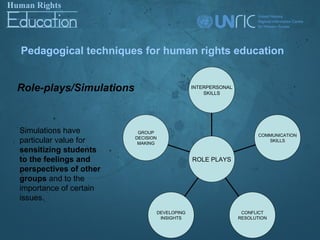
Role-plays/Simulations                           INTERPERSONAL
                                                     SKILLS


Simulations have          GROUP
                                                                        COMMUNICATION
                         DECISION
particular value for      MAKING
                                                                           SKILLS

sensitizing students
to the feelings and                              ROLE PLAYS
perspectives of other
groups and to the
importance of certain
issues.
                                    DEVELOPING                    CONFLICT
                                     INSIGHTS                    RESOLUTION
Pedagogical techniques for human rights education


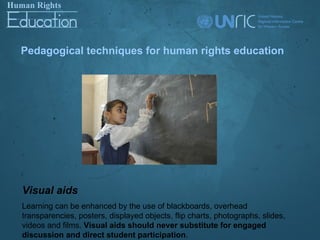
Visual aids
Learning can be enhanced by the use of blackboards, overhead
transparencies, posters, displayed objects, flip charts, photographs, slides,
videos and films. Visual aids should never substitute for engaged
discussion and direct student participation.

Human rights education

  • 1.
    Human Rights Education
  • 2.
    Fundamentals of HumanRights Education Human rights may be generally defined as those rights which are inherent in our nature and without which we cannot live as human beings. Human rights and fundamental freedoms are based on humankind’s increasing demand for a life in which the inherent dignity and worth of each human being are accorded respect and protection. Their denial is not only an individual and personal tragedy but also creates conditions of social and political unrest, sowing the seeds of violence and conflict within and between societies and nations.
  • 3.
    Chart of themain United Nations Human Rights Instruments
  • 4.
    Promoting human rights Oneof the most powerful activity to promote human rights is human rights education, since it should constitute a comprehensive life- long process by which people at all levels in development and in all layers of society learn respect for the dignity of others and the means and methods of ensuring that respect in all societies.
  • 5.
    Promoting human rights Sincethe adoption of the Universal Declaration, the General Assembly has called on Member States and all segments of society to disseminate this fundamental document and educate people about its content, affirming the importance of education, training and public information.
  • 6.
    Promoting human rights Secretary-GeneralKofi Annan stated on the fiftieth anniversary of the Declaration that “Human rights is foreign to no country and native to all nations” and that “without human rights no peace or prosperity will ever last”. At the World Conference on Human Rights held in Vienna, Austria, in 1993, 171 countries reiterated the universality, indivisibility and interdependence of human rights, and reaffirmed their commitment to the Universal Declaration of Human Rights.
  • 7.
    Human rights educationdefinition Human rights education may be defined as “training, dissemination and information efforts” aimed at: • Strengthen respect for human rights and fundamental freedoms; • Develop fully human personality and the sense of its dignity; • Promote understanding, tolerance, gender equality and friendship among all nations, indigenous peoples and racial, national, ethnic, religious and linguistic groups; • Enable all persons to participate effectively in a free society; • Further the activities of the United Nations for the maintenance of peace.
  • 8.
    Content for humanrights education The core content of human rights education in schools is the Universal Declaration of Human Rights and the Convention on the Rights of the Child. These documents provide principles and ideas with which to assess experience and build a school culture that values human rights. The rights they embody are universal, meaning that all human beings are entitled to them, on an equal basis and that they are indivisible, meaning there is no hierarchy of rights.
  • 9.
    Content for humanrights education However, documents and history alone cannot bring human rights to life in the classroom. Nor does working on facts” and fundamentals, even the best-selected ones, because they are not enough to build a culture of human rights. Therefore, students need to approach these information from the perspective of their real-life experience and grapple with them in terms of their own understanding of justice, freedom and equity.
  • 10.
    Teaching human rights: when action speaks louder than words Teaching on human rights creates opportunities for students and teachers to examine basic elements such as life, justice, freedom, equality and the destructive character of deprivation, suffering and pain, and then to use them to work out what they truly think and feel about a wide range of real-world issues.
  • 11.
    Teaching human rights: when action speaks louder than words First, for the basic principles of a human rights culture to survive, people must continue to see a point in defending them. Second, the focus of human rights education is not just outward on external issues and events but also inward on personal values, attitudes and behaviour, using participatory and dynamic methodologies that emphasize independent research, analysis and critical thinking.
  • 12.
    Pedagogical techniques forhuman rights education The techniques suggested for human rights education illustrate how teachers can: •engage students’ empathy and moral imagination; •challenge their assumptions; •integrate concepts like human dignity and equality into their everyday experience of people, power and responsibility. These techniques have proved especially appropriate for human rights education because they encourage critical thinking, both cognitive and affective learning, respect for differences of experience and opinion, and active engagement of all participants in ongoing learning.
  • 13.
    Pedagogical techniques forhuman rights education Brainstorming Case studies Creative expression Discussion Field trips/Community visits Interviews Research projects Role-plays/Simulations Visual aids
  • 14.
    Pedagogical techniques forhuman rights education Brainstorming This technique can be used to seek solutions to problems that are both theoretical and practical. It requires a problem to be analysed and then solutions to be developed. Brainstorming encourages a high degree of participation, and it stimulates those involved to maximum creativity.
  • 15.
    Pedagogical techniques forhuman rights education Case studies Students in small groups work with real or fictional cases that require them to apply human rights standards. This method encourages analysis, problem-solving and planning skills, as well as cooperation and team building.
  • 16.
    Pedagogical techniques forhuman rights education Creative expression The arts can help to make concepts more concrete, personalize abstractions and affect attitudes by involving emotional as well as intellectual responses to human rights.
  • 17.
    Pedagogical techniques forhuman rights education Discussion This technique stimulates meaningful discussion in pairs, small groups or the whole class, also to create an environment of trust and respect between students.
  • 18.
    Pedagogical techniques forhuman rights education Field trips/Community visits Students benefit from the extension of school into the community, learning from places where human rights issues develop and paying critical attention for a subsequent discussion or written reflection following the visit.
  • 19.
    Pedagogical techniques forhuman rights education Interviews Interviews provide direct learning and personalize issues and history. Such oral histories can contribute to documenting and understanding human right issues in the home community.
  • 20.
    Pedagogical techniques forhuman rights education Research projects Whether individual or group projects, research develops skills for independent thinking and data analysis and deepens understanding of the complexity of human rights issues.
  • 21.
    Pedagogical techniques forhuman rights education Role-plays/Simulations INTERPERSONAL SKILLS Simulations have GROUP COMMUNICATION DECISION particular value for MAKING SKILLS sensitizing students to the feelings and ROLE PLAYS perspectives of other groups and to the importance of certain issues. DEVELOPING CONFLICT INSIGHTS RESOLUTION
  • 22.
    Pedagogical techniques forhuman rights education Visual aids Learning can be enhanced by the use of blackboards, overhead transparencies, posters, displayed objects, flip charts, photographs, slides, videos and films. Visual aids should never substitute for engaged discussion and direct student participation.