D
PEACE EDUCATION:
A Transformative Response
to Major Societal
Challenges
LEARNING OBJECTIVES
After reading this chapter you should be able
to:
1.Define the concept of peace in a holistic
way;
2.Explain the contribution or importance of
peace education in the quest for positive social
changes or transformation;
3.Identify and explain the key themes of peace
education.
4. Describe the attributes of a peaceable
classroom and teacher.
5. Discuss some of the most important
peaceable teaching-learning approaches used in
peace education.
Peace education is
the process of acquiring
the values,
the knowledge and
developing the attitudes,
skills, and behaviors to
live in harmony with
oneself, with others, and
with the natural
environment.
 The greatest resource for building a
culture of peace are the people
themselves, for it is through them that
peaceful relationships are created.
 Educating people toward becoming
peace agents is central to the task of
peace building.
 Peace building – refers generally to
the long-term period of building
peaceful communities, a desirable goal.
INTRODUCTION
 A new way of thinking about peace is important
today.
 Our ideas shape our feelings and our actions, as well
as how we live, and how we relate to each other
confidential to me.
 The simplest and most widespread understanding of
peace was that absence of death and destruction as a
result of war and physical/direct violence.
 It was realized that it was not only war and direct
violence that caused death and disfigurement. Structural
violence also led to death and suffering because of the
conditions that resulted from it: extreme poverty,
starvation, avoidable diseases, discrimination against
minority groups and denial of human rights.
A HOLISTIC UNDERSTANDING OF
PEACE
 Peace is both the absence of personal/direct violence, and the
presence of social justice.
 Negative peace refers to the absence of war or physical/direct
violence, while positive peace refers to the presence of just and
non-exploitative relationships, as well as human ecological
well-being, such that the root causes of conflict are diminished.
 Peace with nature is considered the foundation of “positive
peace” because the earth is ultimately the source of our survival,
physical sustenance, health and wealth; it is not possible to provide
for human survival if nature’s capacity to renew itself is seriously
impaired. It must also be remembered that human behavior is
intimately related to the availability of basic resources.
A HOLISTIC UNDERSTANDING OF
PEACE
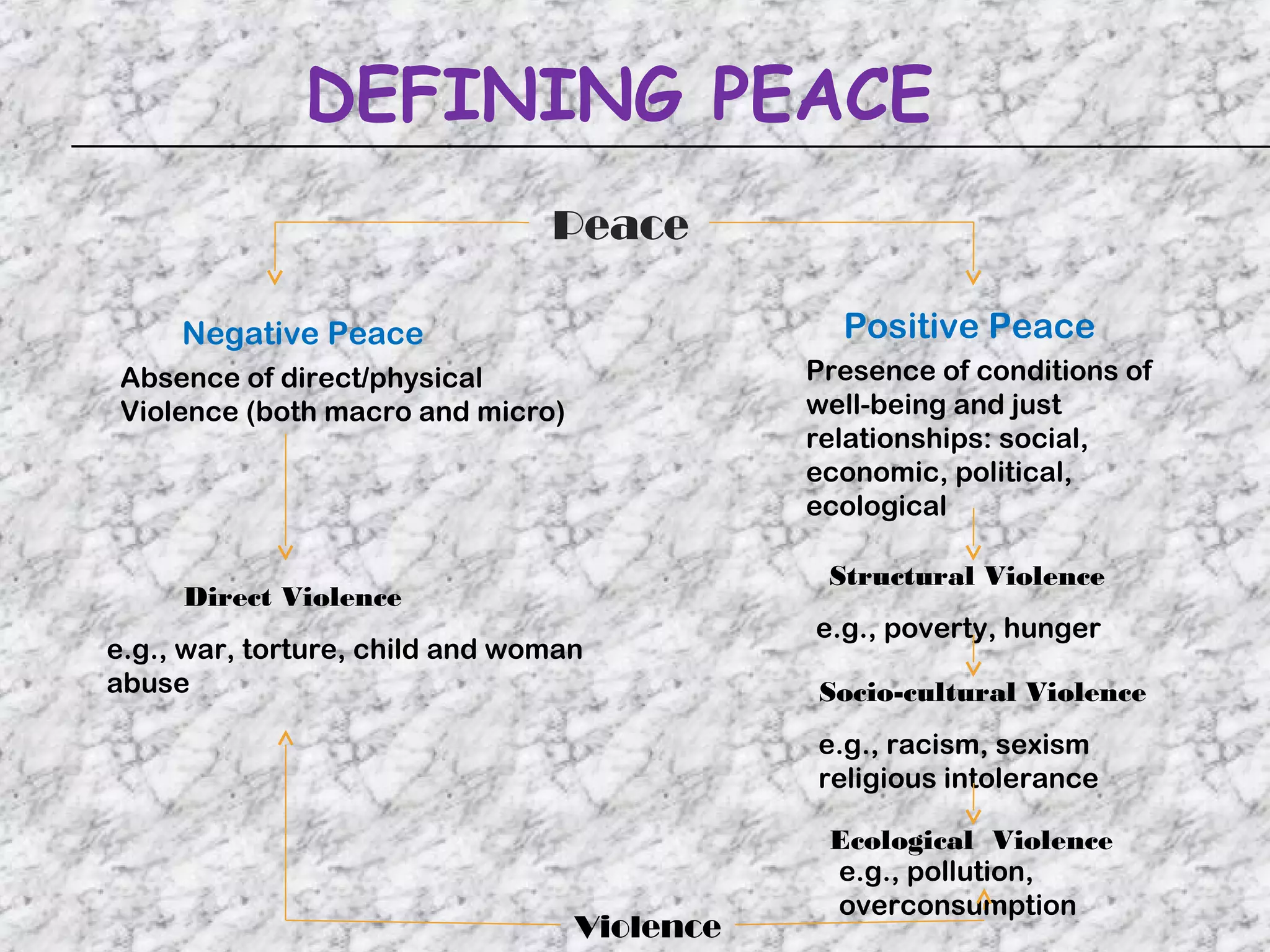
Peace
Positive Peace
Presence of conditions of
well-being and just
relationships: social,
economic, political,
ecological
Structural Violence
e.g., poverty, hunger
Socio-cultural Violence
e.g., racism, sexism
religious intolerance
Ecological Violence
e.g., pollution,
overconsumption
Negative Peace
Absence of direct/physical
Violence (both macro and micro)
Direct Violence
e.g., war, torture, child and woman
abuse
Violence
DEFINING PEACE
LEVELS OF PEACE
level
Form
of violence
Personal
Interperson
al/Commun
ity
National Global
Direct/
physical
Suicide
Drug abuse
Domestic
violence
Violent crimes
Civil War
Violent Crimes
Human rights
abuses
Conventional war
Nuclear war
Human rights
abuses
Structural/
economic,
political
Socio-cultural/
psychological
Powerlessness
Alienation
Low self-esteem
anxiety
Local inequalities
Poverty, hunger
Prejudice/enemy
images
Cultural domination
Racism
Sexism
Religious intolerance
National inequalities
Poverty, hunger
Prejudice/enemy
images
Cultural domination
Racism
Sexism
Religious intolerance
Global inequalities
Poverty, hunger
Prejudice/enemy
images
Cultural domination
Racism
Sexism
Religious
intolerance
Ecological Over-
consumption
Over-
consumption
Pollution
Over-
consumption
Pollution
Chemical and
Over-
consumption
Pollution
Chemical and
TYPES OF
VIOLENCE
 Peace education or an education that
promotes a culture of peace, is essentially
transformative. It cultivates the knowledge
behaviors that, in the first place, have either
created or exacerbated violent conflicts. It
seeks this transformative by building
awareness and understanding, developing
concern,
and finally, challenging personal and social
that will enable people to create conditions
and systems that actualize nonviolence,
justice, environmental care and other peace
values.
PEACE EDUCATION AS
TRANSFORMATIVE
EDUCATION
Cognitive Phase
(being aware, Understanding)
Active Phase Affective Phase
(taking practical action) (being concerned, Responding,
Valuing)
THE PEACEABLE
TEACHING-LEARNING
PROCESS
 Educating for peace will give us the
long run the practical benefits that we
seek. As stated earlier it is expected to
build a critical mass of people who will
demand for and address the needed
personal and structural changes that will
transform the many problems that relate
to peace into nonviolent, humane and
ecological alternatives and solutions
WHY EDUCATE FOR PEACE?
Attitudes/Values
1. Self-respect
2. Respect for others
3. Gender equality
4. Respect for life/
nonviolence
5. Compassion
6. Global concern
7. Ecological concern
8. Cooperation
9. Openness & tolerance
10. Justice
11. Social responsibility
12. Positive vision
Skills
1. Reflection
2. Critical thinking &
analysis
3. Decision making
4. Imagination
5. Conflict resolution
6. Empathy
7. Group building
Knowledge
1. Holistic concept o peace
2. Conflict & Violence causes
3. Some peaceful alternatives
Disarmament
Nonviolence-Philos.& practice
Conflict resolution, Trans-
formation, prevention
Human rights
Human solidarity
Democratization
Development Based on justice
Sustainable Development
SCHEMA OF KNOWLEDGE, SKILLS AND
ATTITUDES/VALUES FOR PEACE EDUCATION
EDUCATION FOR PEACE: LIST OF KNOWLEDGE
AREAS, SKILLS AND ATTITUDES/VALUES
Knowledge/Content Areas
1. Holistic Concept for Peace
2. Conflict and Violence
3. Some Peaceful Alternatives
a. Disarmament
b. Nonviolence
• Conflict Resolution, Transformation and Prevention
• Human Rights
• Human Solidarity
1. Development Based on Justice
2. Democratization
3. Sustainable Development
It is suggested that the following attitudes and values be
cultivated:
• Self-respect
• Respect for others
• Respect for life/nonviolence
• Gender Equality
• Compassion
• Attitudes/Values
• Global Concern
• Ecological Concern
• Cooperation
• Openness/Tolerance
• Justice
• Social Responsibility
• Positive Vision
ATTITUDES/VALUE
S
Some of the skills that need to be
developed are:
• Reflection
• Critical Thinking and Analysis
• Decision-making
• Imagination
• Communication
• Conflict Resolution
• Empathy
• Group Building
Desierdo, Lea Celine
Serocifino, Donna
Egca, Kathleen Ross
Burbano, Chris Ann
Doriman, Rose Ann Pie
Flores, Ma. Rina
Nicolas Ellen
Odencio, Jhan Philip
Bautista, Mae anne
Laher, Frelan
28
THE END ……
THANK YOU 

Introduction to Peace Education

  • 1.
    D PEACE EDUCATION: A TransformativeResponse to Major Societal Challenges
  • 3.
    LEARNING OBJECTIVES After readingthis chapter you should be able to: 1.Define the concept of peace in a holistic way; 2.Explain the contribution or importance of peace education in the quest for positive social changes or transformation; 3.Identify and explain the key themes of peace education. 4. Describe the attributes of a peaceable classroom and teacher. 5. Discuss some of the most important peaceable teaching-learning approaches used in peace education.
  • 4.
    Peace education is the processof acquiring the values, the knowledge and developing the attitudes, skills, and behaviors to live in harmony with oneself, with others, and with the natural environment.
  • 5.
     The greatestresource for building a culture of peace are the people themselves, for it is through them that peaceful relationships are created.  Educating people toward becoming peace agents is central to the task of peace building.  Peace building – refers generally to the long-term period of building peaceful communities, a desirable goal. INTRODUCTION
  • 6.
     A newway of thinking about peace is important today.  Our ideas shape our feelings and our actions, as well as how we live, and how we relate to each other confidential to me.  The simplest and most widespread understanding of peace was that absence of death and destruction as a result of war and physical/direct violence.  It was realized that it was not only war and direct violence that caused death and disfigurement. Structural violence also led to death and suffering because of the conditions that resulted from it: extreme poverty, starvation, avoidable diseases, discrimination against minority groups and denial of human rights. A HOLISTIC UNDERSTANDING OF PEACE
  • 7.
     Peace isboth the absence of personal/direct violence, and the presence of social justice.  Negative peace refers to the absence of war or physical/direct violence, while positive peace refers to the presence of just and non-exploitative relationships, as well as human ecological well-being, such that the root causes of conflict are diminished.  Peace with nature is considered the foundation of “positive peace” because the earth is ultimately the source of our survival, physical sustenance, health and wealth; it is not possible to provide for human survival if nature’s capacity to renew itself is seriously impaired. It must also be remembered that human behavior is intimately related to the availability of basic resources. A HOLISTIC UNDERSTANDING OF PEACE
  • 8.
    Peace Positive Peace Presence ofconditions of well-being and just relationships: social, economic, political, ecological Structural Violence e.g., poverty, hunger Socio-cultural Violence e.g., racism, sexism religious intolerance Ecological Violence e.g., pollution, overconsumption Negative Peace Absence of direct/physical Violence (both macro and micro) Direct Violence e.g., war, torture, child and woman abuse Violence DEFINING PEACE
  • 9.
  • 10.
    level Form of violence Personal Interperson al/Commun ity National Global Direct/ physical Suicide Drugabuse Domestic violence Violent crimes Civil War Violent Crimes Human rights abuses Conventional war Nuclear war Human rights abuses Structural/ economic, political Socio-cultural/ psychological Powerlessness Alienation Low self-esteem anxiety Local inequalities Poverty, hunger Prejudice/enemy images Cultural domination Racism Sexism Religious intolerance National inequalities Poverty, hunger Prejudice/enemy images Cultural domination Racism Sexism Religious intolerance Global inequalities Poverty, hunger Prejudice/enemy images Cultural domination Racism Sexism Religious intolerance Ecological Over- consumption Over- consumption Pollution Over- consumption Pollution Chemical and Over- consumption Pollution Chemical and TYPES OF VIOLENCE
  • 11.
     Peace educationor an education that promotes a culture of peace, is essentially transformative. It cultivates the knowledge behaviors that, in the first place, have either created or exacerbated violent conflicts. It seeks this transformative by building awareness and understanding, developing concern, and finally, challenging personal and social that will enable people to create conditions and systems that actualize nonviolence, justice, environmental care and other peace values. PEACE EDUCATION AS TRANSFORMATIVE EDUCATION
  • 12.
    Cognitive Phase (being aware,Understanding) Active Phase Affective Phase (taking practical action) (being concerned, Responding, Valuing) THE PEACEABLE TEACHING-LEARNING PROCESS
  • 13.
     Educating forpeace will give us the long run the practical benefits that we seek. As stated earlier it is expected to build a critical mass of people who will demand for and address the needed personal and structural changes that will transform the many problems that relate to peace into nonviolent, humane and ecological alternatives and solutions WHY EDUCATE FOR PEACE?
  • 14.
    Attitudes/Values 1. Self-respect 2. Respectfor others 3. Gender equality 4. Respect for life/ nonviolence 5. Compassion 6. Global concern 7. Ecological concern 8. Cooperation 9. Openness & tolerance 10. Justice 11. Social responsibility 12. Positive vision Skills 1. Reflection 2. Critical thinking & analysis 3. Decision making 4. Imagination 5. Conflict resolution 6. Empathy 7. Group building Knowledge 1. Holistic concept o peace 2. Conflict & Violence causes 3. Some peaceful alternatives Disarmament Nonviolence-Philos.& practice Conflict resolution, Trans- formation, prevention Human rights Human solidarity Democratization Development Based on justice Sustainable Development SCHEMA OF KNOWLEDGE, SKILLS AND ATTITUDES/VALUES FOR PEACE EDUCATION
  • 15.
    EDUCATION FOR PEACE:LIST OF KNOWLEDGE AREAS, SKILLS AND ATTITUDES/VALUES Knowledge/Content Areas 1. Holistic Concept for Peace 2. Conflict and Violence 3. Some Peaceful Alternatives a. Disarmament b. Nonviolence • Conflict Resolution, Transformation and Prevention • Human Rights • Human Solidarity 1. Development Based on Justice 2. Democratization 3. Sustainable Development
  • 16.
    It is suggestedthat the following attitudes and values be cultivated: • Self-respect • Respect for others • Respect for life/nonviolence • Gender Equality • Compassion • Attitudes/Values • Global Concern • Ecological Concern • Cooperation • Openness/Tolerance • Justice • Social Responsibility • Positive Vision ATTITUDES/VALUE S
  • 17.
    Some of theskills that need to be developed are: • Reflection • Critical Thinking and Analysis • Decision-making • Imagination • Communication • Conflict Resolution • Empathy • Group Building
  • 18.
  • 19.
  • 20.
  • 21.
  • 22.
  • 23.
  • 24.
  • 25.
  • 26.
  • 27.
  • 28.
  • 29.