Polymerase Chain Reaction
Presented by:
Dr. Ankita
Dr. Ayushi Singh
Index
• Introduction
• Principle of PCR
• Stages of PCR
• PCR techniques
• PCR Requirements
• Steps of PCR
• Analysis of Products of PCR
• Variation in PCR
HISTORY
• 1983 : Kary Mullis, a scientist working for the
Cetus Corporation came up with the idea for the
polymerase chain reaction.
• 1985 : The polymerase chain reaction was
introduced to the scientific community.
• 1987 : Was awarded with noble prize for this
discovery.
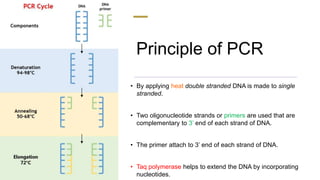
Principle of PCR
• By applying heat double stranded DNA is made to single
stranded.
• Two oligonucleotide strands or primers are used that are
complementary to 3’ end of each strand of DNA.
• The primer attach to 3’ end of each strand of DNA.
• Taq polymerase helps to extend the DNA by incorporating
nucleotides.
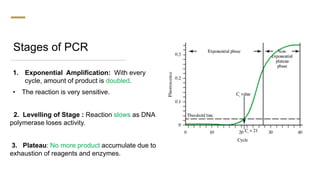
Stages of PCR
1. Exponential Amplification: With every
cycle, amount of product is doubled.
• The reaction is very sensitive.
2. Levelling of Stage : Reaction slows as DNA
polymerase loses activity.
3. Plateau: No more product accumulate due to
exhaustion of reagents and enzymes.
PCR Technique
• PCR targets and
amplifies a specific
region of a DNA strand.
• It is an in-vitro technique
to generate large
quantities of a specified
DNA (only small quantity
of DNA is used).
STEPS IN PCR
DENATURATION ANNEALING EXTENSION
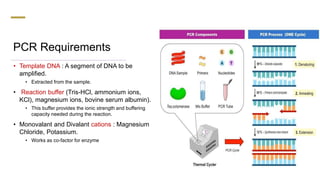
PCR Requirements
• Template DNA : A segment of DNA to be
amplified.
• Extracted from the sample.
• Reaction buffer (Tris-HCl, ammonium ions,
KCl), magnesium ions, bovine serum albumin).
• This buffer provides the ionic strength and buffering
capacity needed during the reaction.
• Monovalant and Divalant cations : Magnesium
Chloride, Potassium.
• Works as co-factor for enzyme
• Primers : small pieces of artificially made DNA strands.
• Complimentry to 3’ end of target DNA.
• 20-30 nucleotides.
• Two primers :
a) A forward primer
b) A reverse primer
• DNA polymerase : It combines at the end of the primer and then sequentially adds new
nucleotides to the DNA strand at 3′ end complementary to the target DNA
• Taq Polymerase- has the unique characteristic to work efficiently in higher temperature.
• extracted from the bacteria Thermus aquaticus.
• Deoxynucleotide Triphosphates (dNTPs): dATP, dCTP, dGTP, and dTTP.
• raw material or the basic building blocks of the new DNA strands.
• PCR Machine : A thermal cycler
Steps in PCR
Denaturaturation:
• At 94-98° C , the double-
stranded DNA melts and
opens into two pieces of
single-stranded DNA.
• 1 to 2 minutes are given in
this process.
ANNEALING :
• At medium temperatures,
around 45-60 ° C, the primers
pair up (anneal) with the
single-stranded "template“.
• On the small length of
double-stranded DNA (the
joined primer and template),
the polymerase attaches and
starts copying the template.
Extension:
• At 72 ° C (161.6 F), the polymerase works
best.
• The complementary nucleotide are attached
from 3’ end to 5’ end of DNA.
• Exponential increase in no. of genes in each
cycle.
• Atleast 30 cycles of all three steps is done in
each PCR.
Analysis of Product
• 1.Agarose gel electrophoresis: Tells:
• Any band present in agarose gel electrophoresis .
• Any other band of different size.
• Is there a smear pattern
• Single sharp band of expected size is present or not.
• 2. Cloning of Product : Done when gene is present in very
tiny amount.
• 3. Sequencing of Product : By automated sequencer machine
to analyse sequence of DNA formed as PCR product.
Modifications of PCR
1. REVERSE TRANSCRIPTASE PCR (RT-PCR)
• RNA molecules are first converted to
complementary DNA (cDNA) using
reverse transcriptase (RNA dependent
DNA polymerase).
• cDNA then acts as a template.
• Can be conducted in a single tube or as
two steps in different tubes.
• USES:
1. Detection of infectious agent.
2. Genetic disease diagnosis.
3. Gene insertion.
4. Diagnosis of cancer.
2. ASYMMETRIC
PCR
• Unequal concentration of primers is used
to preferentially amplify one strand of the
original DNA more than the other.
• DIASADVANTAGES:
- ssDNA is more vulnerable to damage
by physical and chemical factors.
- Needs more thermal cycles.
• USED for DNA sequencing and
hybridisation
Abundant
Primer
Non-targeted strand
Targeted strand
Limiting
primer
dsDNATargeted ssDNA
3. LINEAR-AFTER-THE-EXPONENTIAL (LATE)
PCR
• Uses a limiting primer (LP) with
a higher melting temperature
than the excess primer (XP)
allowing for large amounts of
product to be made after the
exponential phase of PCR.
• More efficient & highly specific
than conventional PCR.
• USED for single cell genetic
diagnosis.
( Modification of Asymmetric PCR )
4. HOT START PCR
• To avoid occurrence of
undesired products and
primer-dimers due to
non-specific DNA
amplification at lower
temperatures.
( COLD FINISH PCR )
• In hot start PCR, DNA polymerase works only at higher temperatures; done by-
1. Withhold the key agents until the end of initial denaturation process.
• DNA polymerase enzyme or magnesium cofactor
2. Mechanical barriers of the reagents:
• DNA polymerase is encapsulated and is only released at higher temperature.
• Wax barrier is used to separate the key components till the temperature is high.
• Microfluidic devices are used to create barrier.
3. Modification of DNA polymerase:
• Antibodies are used to inhibit DNA polymerase activity at lower temperature, and it releases the
enzyme in higher temperature.
• DNA polymerase enzyme is chemically modified so that it works only in higher temperature.
• The ligand is used that binds with DNA polymerase in a temperature-dependent way.
• Amino acid mutation is done in DNA polymerase enzyme to have reduced activity in lower temperature.
4. Accessory proteins: The accessory proteins can be used that sequester primers at lower temperature.
5. IN-SITU PCR
• Reaction takes place within a cell on a glass slide.
• Target sequence detected by – Immunocytochemistry.
• ADVANTAGES- High specificity, High turnaround time & Low background stain.
• USES:
• Detection and location of virus within the tissue
• Detection and also localization of the cancer
cells
• Demonstration of the genetic mutation in case of
inherited genetic disease
• Demonstration of location of gene expression
within the tissue
6. INVERSE PCR
• Amplifies anonymous DNA sequence.
• Applications of IPCR
• Identification of flanking sequence
• Identification of viral gene insertion within the genome
• Chromosomal rearrangement of oncogene
There are four steps of IPCR :
1. DNA isolation: genomic DNA is isolated
from the sample and then cut into pieces by
restriction endonuclease enzymes.
• The DNA is cut in such a way that the known
sequences of DNA are in the inner region
with unknown sequence in two sides.
2. Circularization of ds DNA.
3. Reopening of the circular DNA: By
endonuclease enzyme.
• The known DNA sequence remains in the
two ends of the unknown sequence in
middle.
4. Amplification of reverse DNA fragment:
Now with the help of the known primer, the
known DNA sequence is amplified along with
the attached unknown DNA sequence.
7. SINGLE-STRANDED CONFORMATIONAL
POLYMORPHISM ( SSCP )
• ssDNA has a specific conformation.
• Any alteration of the single base change due to mutation may lead to different migration
pattern of the ss DNA, and therefore in electrophoresis one can distinguish non-mutant
DNA from mutant DNA.
• APPLICATIONS:
• The detection of single base change mutation and polymorphism in essential
hypertension, carcinoma, diabetes, etc.
• The following steps are done in SSCP :
1. PCR amplification of the target DNA.
2. The ds DNA product is denatured.
3. The sample is cooled so that denatured
ssDNA undergoes self-annealing.
4. Electrophoresis is done to see the
mobility of the ssDNAs.
8. REAL-TIME PCR
• Provides real time detection of the DNA products during the exponential phase.
• The amplified DNA is fluorescently labelled, and the emitted fluorescent is directly
proportional to the amount of the amplified fluorescent dye.
• MECHANISMS to quantitate the amplifies DNA:
a. Hydrolysis of the probe- TaqMan assay technique
b. DNA-binding dye- SYBR green dye
c. Dual Hybridisation- donor and acceptor fluorophore
d. Molecular beacons- hair-pin like hybridised probe.
QUANTITATIVE PCR (qPCR)
a. Hydrolysis of Probe: “TaqMan” probe.
• Oligonucleotide probe- which is attached with
• fluorescence reporter dye at its 5′ terminal, and
• quencher dye at the 3′ terminal end.
• This probe anneals DNA template.
• When the “TaqMan” probe is intact, the reporter dye and
the quencher dye remain in close proximity, and
therefore fluorescence emitted from the reporter dye is
absorbed by the closely placed quencher dye.
• So no fluorescence emitted.
• During PCR- the endonuclease breaks down the
probe, and the reporter dye is away from quencher dye
that allows emission of fluorescence.
b. DNA-binding dye: DNA-intercalating agents SYBR®Green.
• The SYBR® Green dye molecules do not exhibit any fluorescence in solution.
• However, the dye molecules emit fluorescence when they are intercalated within the dsDNA that is
formed after the primer extension and polymerization.
c. Dual hybridization : Two hybridization probes.
• First probe - donor fluorophore at 3′ end, and the
other probe - acceptor fluorophore at 5′ terminal.
• In denaturation step there is no emission of
fluorescence as any fluorescent emission by donor
fluorophore is degraded by the acceptor
fluorophore.
• In the annealing stage, the donor and the acceptor
fluorophore probes hybridize to the target DNA
sequence, and they are adjusted in head to tail
position so that donor fluorophore comes in close
contact with the acceptor fluorophore.
• This allows fluorescence resonance energy transfer.
d. Molecular Beacons: Hybridised probes
• Probe is designed like a hairpin-like loop.
• The reporter and quenching dyes are attached
in the two ends of the loop, and the close
proximity of them prevents the emission of
fluorescence.
• At the time of annealing of the hybridized
probe, the hairpin loop becomes a straight
probe, and the reporter and quenching dyes
stay away.
• This allows emission of fluorescence.
9. Digital PCR (dPCR)
• More accurate quantification of nucleic acid amounts (DNA or RNA) – Viruses, Bacteria or Parasites.
Solution of
extracted DNA
contains a rare
quantity of target
DNA amongst a
much greater
quantity of wild type
DNA.
Sample is
separated into
compartments so
that only few
molecules are
present in each
compartment.
 Well with
fluorescent
signal are
considered +/1
 Well with no
signal are
considered -/0
Starting material is
calculated using
POISSON statistical
analysis.
10. NESTED PCR
• More than two primers are used.
• 1st set of primer binds outside of our
target DNA and amplifies the large
fragment.
• 2nd set – binds specifically at target site.
• Specificity of rxn is enhanced by creating
a target sequence without any
contaminating adjacent DNA not of
interest.
• Restriction enzymes are
used to digest unknown
genomic DNA and allows
attachment of ADAPTORS
to the sticky end of
fragment.
11. Amplified Fragment Length Polymorphism (AFLP) PCR
12. Allele Specific (AS) PCR
• Allele specific primers are used to
analyze single nucleotide
polymorphism.
• Two different primers are used for two
different alleles.
• APPLICATION: Single gene point
mutation – eg
• Sickle Cell Anemia,
• Thalassemia,
• ABO blood group genotypes.
( Amplification Refractory Mutation System – ARMS PCR )
13. Assembly PCR
• Large DNA oligonucleotides are assembled
from multiple shorter fragments.
• APPLICATIONS:
• Improve yield of desired protein.
• Produce large amount of RNA for
structural or biochemical studies.
14. Cold PCR
• Based on modification of the critical temperature
at which mutation-containing DNA is
preferentially denatured over wild (non-mutated)
type.
• APPLICATION:
 Detection of mutation in oncology specimens.
 Assessment of residual disease after surgery or
chemotherapy
 Tailoring the therapy for individual patients
 Disease staging and molecular profiling for
prognosis.
Mutant Wild type
Heteroduplexed
mutant dsDNA
Homoduplexed
wild dsDNA
Preferably amplifies mutant sequence
15. Colony PCR
• To determine the presence or absence of insert DNA in plasmid of bacteria.
• APPLICATIONS: Correct ligation and insertion of inserted DNA into bacteria or yeast plasmid.
Skips the extraction and purification
steps of target DNA material.
16. FAST CYCLING PCR – Reduces the cycling time by using a buffer that increases the affinity of
Taq Polymerase.
• Used for rapid diagnosis of disease and mutations.
17. HIGH FIDELITY PCR- uses a DNA Polymerase with low error rate.
• High degree of accuracy- DNA cloning, SNP analysis.
18. HIGH-RESOLUTION MELT (HRM) PCR- fast & cost effective- large scale genotyping projects.
19. INTERSEQUENCE-SPECIFIC (ISSR) PCR- Microsatellite primers (repeated sequence of DNA).
• Used in genomic fingerprinting, genetic diversity & phylogenetic analysis, genomic maping and
gene tagging).
20. LIGATION MEDIATED PCR- when sequence of only one end of target DNA is known.
• “LINKER” or “ADAPTOR” is ligated to the unknown end.
21. METHYLATION-SPECIFIC PCR (MSP)-
• Detection and analysis of DNA
methylation patterns in CpG islands.
• Two primer pairs are used:
1st- To detect methylated DNA
2nd- Unmethylated DNA.
LINKER Target DNA
Unknown known
22. LONG-RANGE PCR- amplification of longer DNA lengths – modified polymerases (high efficacy).
23. MINIPRIMER PCR- 8 to 10 bp - targets with smaller primer binding regions, eg 16S rRNA gene.
24. MULTIPLEX PCR- amplification of multiple targets in a single PCR run.
• Application: genotyping, mutation analysis, detection of pathogens or genetically modified
organisms.
25. NANOPARTICLE-ASSISTED PCR (nanoPCR)- gold nanoparticles as additive to increase SN,
SP & selectivity.
• Application: virus detection & gene sequencing.
26. REPETITIVE SEQUENCE-BASED PCR (rep-PCR)- targets noncoding repetitive
sequences interspersed throughout bacterial genome.
• Application: molecular strain typing of different bacteria.
27. SOLID PHASE PCR- primers are immobilised on a surface – preventing the formation
of primer-dimers.
28. SUICIDE PCR- primers are used only once in PCR.
• Target genome has never been amplified before using that particular primer.
• Application: paleogenetics study.
29. TOUCHDOWN PCR – the annealing temperature is
• 3-5°C > N in the begining– greater primer binding.
• Later, 3-5°C < N – more efficient amplification.
 Others:
30. Dial out PCR
31. Helicase-dependent PCR
32. Thermal Asymmetric Interlaced PCR (TAIL-PCR)
33. Variable Number of Tandem Repeats (VNTR)
PCR.
34. Degenerate PCR
35. RNase H-dependent PCR
36. Single Specific Primer PCR (SSP-PCR)
37. Alu PCR
38. Round A/ Round B PCR
39. Splicing by overlap/overhang Extension (SOE)
PCR
 Newer:
40. Extreme PCR
41. Photonic PCR
42. Heat Pulse Extension (HPE) PCR
APPLICATIONS
RESEARCH CLINICAL
Research
Applications
DNA Sequencing
Bioinformatics
Classification of Organisms
Gene Expression studies
Drug Discovery
Clinical
Applications
Diagnosis of Infection- Viral, Bacterial &
Parasitic.
• Mutation Detection – Oncogenes, Tumor Suppressor genes
• Chromosomal Changes - Translocation, Rearrangements
• Monoclonality detection – B & T cell Lymphoma
• Minimal Residual Disease – follow up cases.
Cancer- Diagnosis & Prognosis
Genetic diseases – Down’s Syndrome, Cystic
Fibrosis
• Paternity of child
• Identify corpse or mutilated body.
• Identify criminal
Forensic Pathology
Gene Therapy
Thank You

Pcr

  • 1.
    Polymerase Chain Reaction Presentedby: Dr. Ankita Dr. Ayushi Singh
  • 2.
    Index • Introduction • Principleof PCR • Stages of PCR • PCR techniques • PCR Requirements • Steps of PCR • Analysis of Products of PCR • Variation in PCR
  • 3.
    HISTORY • 1983 :Kary Mullis, a scientist working for the Cetus Corporation came up with the idea for the polymerase chain reaction. • 1985 : The polymerase chain reaction was introduced to the scientific community. • 1987 : Was awarded with noble prize for this discovery.
  • 4.
    Principle of PCR •By applying heat double stranded DNA is made to single stranded. • Two oligonucleotide strands or primers are used that are complementary to 3’ end of each strand of DNA. • The primer attach to 3’ end of each strand of DNA. • Taq polymerase helps to extend the DNA by incorporating nucleotides.
  • 5.
    Stages of PCR 1.Exponential Amplification: With every cycle, amount of product is doubled. • The reaction is very sensitive. 2. Levelling of Stage : Reaction slows as DNA polymerase loses activity. 3. Plateau: No more product accumulate due to exhaustion of reagents and enzymes.
  • 6.
    PCR Technique • PCRtargets and amplifies a specific region of a DNA strand. • It is an in-vitro technique to generate large quantities of a specified DNA (only small quantity of DNA is used). STEPS IN PCR DENATURATION ANNEALING EXTENSION
  • 7.
    PCR Requirements • TemplateDNA : A segment of DNA to be amplified. • Extracted from the sample. • Reaction buffer (Tris-HCl, ammonium ions, KCl), magnesium ions, bovine serum albumin). • This buffer provides the ionic strength and buffering capacity needed during the reaction. • Monovalant and Divalant cations : Magnesium Chloride, Potassium. • Works as co-factor for enzyme
  • 8.
    • Primers :small pieces of artificially made DNA strands. • Complimentry to 3’ end of target DNA. • 20-30 nucleotides. • Two primers : a) A forward primer b) A reverse primer • DNA polymerase : It combines at the end of the primer and then sequentially adds new nucleotides to the DNA strand at 3′ end complementary to the target DNA • Taq Polymerase- has the unique characteristic to work efficiently in higher temperature. • extracted from the bacteria Thermus aquaticus. • Deoxynucleotide Triphosphates (dNTPs): dATP, dCTP, dGTP, and dTTP. • raw material or the basic building blocks of the new DNA strands. • PCR Machine : A thermal cycler
  • 9.
    Steps in PCR Denaturaturation: •At 94-98° C , the double- stranded DNA melts and opens into two pieces of single-stranded DNA. • 1 to 2 minutes are given in this process.
  • 10.
    ANNEALING : • Atmedium temperatures, around 45-60 ° C, the primers pair up (anneal) with the single-stranded "template“. • On the small length of double-stranded DNA (the joined primer and template), the polymerase attaches and starts copying the template.
  • 11.
    Extension: • At 72° C (161.6 F), the polymerase works best. • The complementary nucleotide are attached from 3’ end to 5’ end of DNA. • Exponential increase in no. of genes in each cycle. • Atleast 30 cycles of all three steps is done in each PCR.
  • 12.
    Analysis of Product •1.Agarose gel electrophoresis: Tells: • Any band present in agarose gel electrophoresis . • Any other band of different size. • Is there a smear pattern • Single sharp band of expected size is present or not. • 2. Cloning of Product : Done when gene is present in very tiny amount. • 3. Sequencing of Product : By automated sequencer machine to analyse sequence of DNA formed as PCR product.
  • 13.
  • 14.
    1. REVERSE TRANSCRIPTASEPCR (RT-PCR) • RNA molecules are first converted to complementary DNA (cDNA) using reverse transcriptase (RNA dependent DNA polymerase). • cDNA then acts as a template. • Can be conducted in a single tube or as two steps in different tubes. • USES: 1. Detection of infectious agent. 2. Genetic disease diagnosis. 3. Gene insertion. 4. Diagnosis of cancer.
  • 15.
    2. ASYMMETRIC PCR • Unequalconcentration of primers is used to preferentially amplify one strand of the original DNA more than the other. • DIASADVANTAGES: - ssDNA is more vulnerable to damage by physical and chemical factors. - Needs more thermal cycles. • USED for DNA sequencing and hybridisation Abundant Primer Non-targeted strand Targeted strand Limiting primer dsDNATargeted ssDNA
  • 16.
    3. LINEAR-AFTER-THE-EXPONENTIAL (LATE) PCR •Uses a limiting primer (LP) with a higher melting temperature than the excess primer (XP) allowing for large amounts of product to be made after the exponential phase of PCR. • More efficient & highly specific than conventional PCR. • USED for single cell genetic diagnosis. ( Modification of Asymmetric PCR )
  • 17.
    4. HOT STARTPCR • To avoid occurrence of undesired products and primer-dimers due to non-specific DNA amplification at lower temperatures. ( COLD FINISH PCR )
  • 18.
    • In hotstart PCR, DNA polymerase works only at higher temperatures; done by- 1. Withhold the key agents until the end of initial denaturation process. • DNA polymerase enzyme or magnesium cofactor 2. Mechanical barriers of the reagents: • DNA polymerase is encapsulated and is only released at higher temperature. • Wax barrier is used to separate the key components till the temperature is high. • Microfluidic devices are used to create barrier. 3. Modification of DNA polymerase: • Antibodies are used to inhibit DNA polymerase activity at lower temperature, and it releases the enzyme in higher temperature. • DNA polymerase enzyme is chemically modified so that it works only in higher temperature. • The ligand is used that binds with DNA polymerase in a temperature-dependent way. • Amino acid mutation is done in DNA polymerase enzyme to have reduced activity in lower temperature. 4. Accessory proteins: The accessory proteins can be used that sequester primers at lower temperature.
  • 19.
    5. IN-SITU PCR •Reaction takes place within a cell on a glass slide. • Target sequence detected by – Immunocytochemistry. • ADVANTAGES- High specificity, High turnaround time & Low background stain.
  • 20.
    • USES: • Detectionand location of virus within the tissue • Detection and also localization of the cancer cells • Demonstration of the genetic mutation in case of inherited genetic disease • Demonstration of location of gene expression within the tissue
  • 21.
    6. INVERSE PCR •Amplifies anonymous DNA sequence. • Applications of IPCR • Identification of flanking sequence • Identification of viral gene insertion within the genome • Chromosomal rearrangement of oncogene
  • 22.
    There are foursteps of IPCR : 1. DNA isolation: genomic DNA is isolated from the sample and then cut into pieces by restriction endonuclease enzymes. • The DNA is cut in such a way that the known sequences of DNA are in the inner region with unknown sequence in two sides. 2. Circularization of ds DNA. 3. Reopening of the circular DNA: By endonuclease enzyme. • The known DNA sequence remains in the two ends of the unknown sequence in middle. 4. Amplification of reverse DNA fragment: Now with the help of the known primer, the known DNA sequence is amplified along with the attached unknown DNA sequence.
  • 23.
    7. SINGLE-STRANDED CONFORMATIONAL POLYMORPHISM( SSCP ) • ssDNA has a specific conformation. • Any alteration of the single base change due to mutation may lead to different migration pattern of the ss DNA, and therefore in electrophoresis one can distinguish non-mutant DNA from mutant DNA. • APPLICATIONS: • The detection of single base change mutation and polymorphism in essential hypertension, carcinoma, diabetes, etc.
  • 24.
    • The followingsteps are done in SSCP : 1. PCR amplification of the target DNA. 2. The ds DNA product is denatured. 3. The sample is cooled so that denatured ssDNA undergoes self-annealing. 4. Electrophoresis is done to see the mobility of the ssDNAs.
  • 25.
    8. REAL-TIME PCR •Provides real time detection of the DNA products during the exponential phase. • The amplified DNA is fluorescently labelled, and the emitted fluorescent is directly proportional to the amount of the amplified fluorescent dye. • MECHANISMS to quantitate the amplifies DNA: a. Hydrolysis of the probe- TaqMan assay technique b. DNA-binding dye- SYBR green dye c. Dual Hybridisation- donor and acceptor fluorophore d. Molecular beacons- hair-pin like hybridised probe. QUANTITATIVE PCR (qPCR)
  • 26.
    a. Hydrolysis ofProbe: “TaqMan” probe. • Oligonucleotide probe- which is attached with • fluorescence reporter dye at its 5′ terminal, and • quencher dye at the 3′ terminal end. • This probe anneals DNA template. • When the “TaqMan” probe is intact, the reporter dye and the quencher dye remain in close proximity, and therefore fluorescence emitted from the reporter dye is absorbed by the closely placed quencher dye. • So no fluorescence emitted. • During PCR- the endonuclease breaks down the probe, and the reporter dye is away from quencher dye that allows emission of fluorescence.
  • 27.
    b. DNA-binding dye:DNA-intercalating agents SYBR®Green. • The SYBR® Green dye molecules do not exhibit any fluorescence in solution. • However, the dye molecules emit fluorescence when they are intercalated within the dsDNA that is formed after the primer extension and polymerization.
  • 28.
    c. Dual hybridization: Two hybridization probes. • First probe - donor fluorophore at 3′ end, and the other probe - acceptor fluorophore at 5′ terminal. • In denaturation step there is no emission of fluorescence as any fluorescent emission by donor fluorophore is degraded by the acceptor fluorophore. • In the annealing stage, the donor and the acceptor fluorophore probes hybridize to the target DNA sequence, and they are adjusted in head to tail position so that donor fluorophore comes in close contact with the acceptor fluorophore. • This allows fluorescence resonance energy transfer.
  • 29.
    d. Molecular Beacons:Hybridised probes • Probe is designed like a hairpin-like loop. • The reporter and quenching dyes are attached in the two ends of the loop, and the close proximity of them prevents the emission of fluorescence. • At the time of annealing of the hybridized probe, the hairpin loop becomes a straight probe, and the reporter and quenching dyes stay away. • This allows emission of fluorescence.
  • 30.
    9. Digital PCR(dPCR) • More accurate quantification of nucleic acid amounts (DNA or RNA) – Viruses, Bacteria or Parasites. Solution of extracted DNA contains a rare quantity of target DNA amongst a much greater quantity of wild type DNA. Sample is separated into compartments so that only few molecules are present in each compartment.  Well with fluorescent signal are considered +/1  Well with no signal are considered -/0 Starting material is calculated using POISSON statistical analysis.
  • 31.
    10. NESTED PCR •More than two primers are used. • 1st set of primer binds outside of our target DNA and amplifies the large fragment. • 2nd set – binds specifically at target site. • Specificity of rxn is enhanced by creating a target sequence without any contaminating adjacent DNA not of interest.
  • 32.
    • Restriction enzymesare used to digest unknown genomic DNA and allows attachment of ADAPTORS to the sticky end of fragment. 11. Amplified Fragment Length Polymorphism (AFLP) PCR
  • 33.
    12. Allele Specific(AS) PCR • Allele specific primers are used to analyze single nucleotide polymorphism. • Two different primers are used for two different alleles. • APPLICATION: Single gene point mutation – eg • Sickle Cell Anemia, • Thalassemia, • ABO blood group genotypes. ( Amplification Refractory Mutation System – ARMS PCR )
  • 34.
    13. Assembly PCR •Large DNA oligonucleotides are assembled from multiple shorter fragments. • APPLICATIONS: • Improve yield of desired protein. • Produce large amount of RNA for structural or biochemical studies.
  • 35.
    14. Cold PCR •Based on modification of the critical temperature at which mutation-containing DNA is preferentially denatured over wild (non-mutated) type. • APPLICATION:  Detection of mutation in oncology specimens.  Assessment of residual disease after surgery or chemotherapy  Tailoring the therapy for individual patients  Disease staging and molecular profiling for prognosis. Mutant Wild type Heteroduplexed mutant dsDNA Homoduplexed wild dsDNA Preferably amplifies mutant sequence
  • 36.
    15. Colony PCR •To determine the presence or absence of insert DNA in plasmid of bacteria. • APPLICATIONS: Correct ligation and insertion of inserted DNA into bacteria or yeast plasmid. Skips the extraction and purification steps of target DNA material.
  • 37.
    16. FAST CYCLINGPCR – Reduces the cycling time by using a buffer that increases the affinity of Taq Polymerase. • Used for rapid diagnosis of disease and mutations. 17. HIGH FIDELITY PCR- uses a DNA Polymerase with low error rate. • High degree of accuracy- DNA cloning, SNP analysis. 18. HIGH-RESOLUTION MELT (HRM) PCR- fast & cost effective- large scale genotyping projects. 19. INTERSEQUENCE-SPECIFIC (ISSR) PCR- Microsatellite primers (repeated sequence of DNA). • Used in genomic fingerprinting, genetic diversity & phylogenetic analysis, genomic maping and gene tagging).
  • 38.
    20. LIGATION MEDIATEDPCR- when sequence of only one end of target DNA is known. • “LINKER” or “ADAPTOR” is ligated to the unknown end. 21. METHYLATION-SPECIFIC PCR (MSP)- • Detection and analysis of DNA methylation patterns in CpG islands. • Two primer pairs are used: 1st- To detect methylated DNA 2nd- Unmethylated DNA. LINKER Target DNA Unknown known
  • 39.
    22. LONG-RANGE PCR-amplification of longer DNA lengths – modified polymerases (high efficacy). 23. MINIPRIMER PCR- 8 to 10 bp - targets with smaller primer binding regions, eg 16S rRNA gene. 24. MULTIPLEX PCR- amplification of multiple targets in a single PCR run. • Application: genotyping, mutation analysis, detection of pathogens or genetically modified organisms. 25. NANOPARTICLE-ASSISTED PCR (nanoPCR)- gold nanoparticles as additive to increase SN, SP & selectivity. • Application: virus detection & gene sequencing.
  • 40.
    26. REPETITIVE SEQUENCE-BASEDPCR (rep-PCR)- targets noncoding repetitive sequences interspersed throughout bacterial genome. • Application: molecular strain typing of different bacteria. 27. SOLID PHASE PCR- primers are immobilised on a surface – preventing the formation of primer-dimers. 28. SUICIDE PCR- primers are used only once in PCR. • Target genome has never been amplified before using that particular primer. • Application: paleogenetics study. 29. TOUCHDOWN PCR – the annealing temperature is • 3-5°C > N in the begining– greater primer binding. • Later, 3-5°C < N – more efficient amplification.
  • 41.
     Others: 30. Dialout PCR 31. Helicase-dependent PCR 32. Thermal Asymmetric Interlaced PCR (TAIL-PCR) 33. Variable Number of Tandem Repeats (VNTR) PCR. 34. Degenerate PCR 35. RNase H-dependent PCR 36. Single Specific Primer PCR (SSP-PCR) 37. Alu PCR 38. Round A/ Round B PCR 39. Splicing by overlap/overhang Extension (SOE) PCR  Newer: 40. Extreme PCR 41. Photonic PCR 42. Heat Pulse Extension (HPE) PCR
  • 42.
  • 43.
    Research Applications DNA Sequencing Bioinformatics Classification ofOrganisms Gene Expression studies Drug Discovery
  • 44.
    Clinical Applications Diagnosis of Infection-Viral, Bacterial & Parasitic. • Mutation Detection – Oncogenes, Tumor Suppressor genes • Chromosomal Changes - Translocation, Rearrangements • Monoclonality detection – B & T cell Lymphoma • Minimal Residual Disease – follow up cases. Cancer- Diagnosis & Prognosis Genetic diseases – Down’s Syndrome, Cystic Fibrosis • Paternity of child • Identify corpse or mutilated body. • Identify criminal Forensic Pathology Gene Therapy
  • 45.