Voice Biometrics
Submitted By:
Applications
Introduction
Speaker Recognition
Technologies
Identity information in
the speech signal
Advantages and
Limitations
overview
 Recent data on mobile phone users all over the
world, the number of telephone landlines in
operation, and recent VoIP (Voice over IP networks)
deployments , confirm that voice is the most
accessible biometric trait as no extra acquisition
device or transmission system is needed ,This fact
gives voice an advantage over other
 biometric traits, especially when remote users or
systems are taken into account.
 However, the voice trait is not only related with
personal characteristics, but also with many
environmental and sociolinguistic variables
 as voice generation is the result of an extremely
complex process
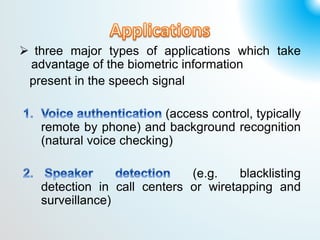
 three major types of applications which take
advantage of the biometric information
present in the speech signal
(access control, typically
remote by phone) and background recognition
(natural voice checking)
(e.g. blacklisting
detection in call centers or wiretapping and
surveillance)
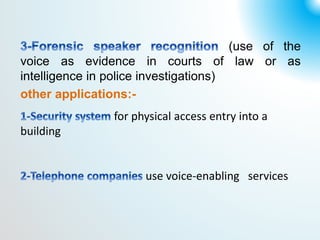
(use of the
voice as evidence in courts of law or as
intelligence in police investigations)
other applications:-
for physical access entry into a
building
use voice-enabling services
in telephone
banking: ATM machines
in credit cards
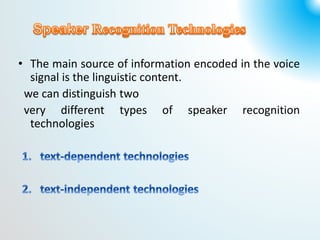
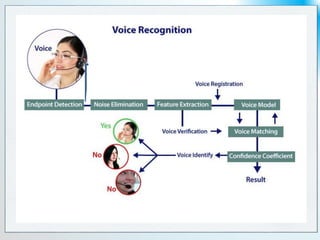
• The main source of information encoded in the voice
signal is the linguistic content.
we can distinguish two
very different types of speaker recognition
technologies
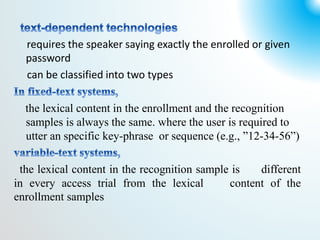
requires the speaker saying exactly the enrolled or given
password
can be classified into two types
the lexical content in the enrollment and the recognition
samples is always the same. where the user is required to
utter an specific key-phrase or sequence (e.g., ”12-34-56”)
the lexical content in the recognition sample is different
in every access trial from the lexical content of the
enrollment samples
are used for speaker
identification as they require very little if any
cooperation by the speaker.
 In this case the text during enrollment and test is
different.
 As text-independent technologies do not compare
what was said at enrollment and verification,
verification applications tend to also employ speech
recognition to determine what the user is saying at
the point of authentication.
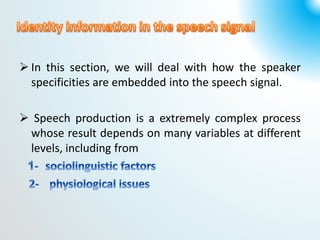
 In this section, we will deal with how the speaker
specificities are embedded into the speech signal.
 Speech production is a extremely complex process
whose result depends on many variables at different
levels, including from
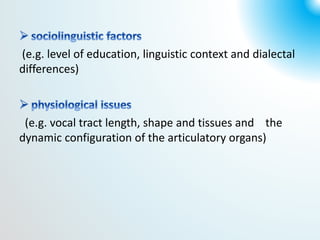
(e.g. level of education, linguistic context and dialectal
differences)
(e.g. vocal tract length, shape and tissues and the
dynamic configuration of the articulatory organs)
• The first step in the construction of automatic
speaker recognition systems is the reliable extraction
of features and tokens that contain identifying
information of interest.
In order to perform reliable spectral analysis, signals
must show stationary properties that are not easy to
observe in constantly changing speech signals
 Voice authentication is easy to use and easily
accepted by users
 voice biometrics is only biometric that allows users
to authenticate remotely
 It is quick to enroll in a voice authentication system
and the storage size of the voice print is small
 The possibility to identify the psychological state of a
person .
Less accuracy , subject to background
noise.
The human voice variability, due to colds,
and simple tiredness.
Age plays a role in changing the sound of
the person.
The mental state of the person affect his
voice
cheaper device
very easy
: Medium
:This is done by matching registration with the speaker's voice
behavioral characteristics
Applied in banks and to enter the buildings and the
company's entry.
is accepte by the people.
in real time
The database you need to update it to the person's age variable
maintenance for the hardware and software.
Thanks
http://www.mghamdi.com/

Pattern recognition voice biometrics

  • 1.
  • 2.
    Applications Introduction Speaker Recognition Technologies Identity informationin the speech signal Advantages and Limitations overview
  • 3.
     Recent dataon mobile phone users all over the world, the number of telephone landlines in operation, and recent VoIP (Voice over IP networks) deployments , confirm that voice is the most accessible biometric trait as no extra acquisition device or transmission system is needed ,This fact gives voice an advantage over other
  • 4.
     biometric traits,especially when remote users or systems are taken into account.  However, the voice trait is not only related with personal characteristics, but also with many environmental and sociolinguistic variables  as voice generation is the result of an extremely complex process
  • 5.
     three majortypes of applications which take advantage of the biometric information present in the speech signal (access control, typically remote by phone) and background recognition (natural voice checking) (e.g. blacklisting detection in call centers or wiretapping and surveillance)
  • 6.
    (use of the voiceas evidence in courts of law or as intelligence in police investigations) other applications:- for physical access entry into a building use voice-enabling services
  • 7.
    in telephone banking: ATMmachines in credit cards
  • 8.
    • The mainsource of information encoded in the voice signal is the linguistic content. we can distinguish two very different types of speaker recognition technologies
  • 9.
    requires the speakersaying exactly the enrolled or given password can be classified into two types the lexical content in the enrollment and the recognition samples is always the same. where the user is required to utter an specific key-phrase or sequence (e.g., ”12-34-56”) the lexical content in the recognition sample is different in every access trial from the lexical content of the enrollment samples
  • 10.
    are used forspeaker identification as they require very little if any cooperation by the speaker.  In this case the text during enrollment and test is different.  As text-independent technologies do not compare what was said at enrollment and verification, verification applications tend to also employ speech recognition to determine what the user is saying at the point of authentication.
  • 12.
     In thissection, we will deal with how the speaker specificities are embedded into the speech signal.  Speech production is a extremely complex process whose result depends on many variables at different levels, including from
  • 13.
    (e.g. level ofeducation, linguistic context and dialectal differences) (e.g. vocal tract length, shape and tissues and the dynamic configuration of the articulatory organs)
  • 14.
    • The firststep in the construction of automatic speaker recognition systems is the reliable extraction of features and tokens that contain identifying information of interest. In order to perform reliable spectral analysis, signals must show stationary properties that are not easy to observe in constantly changing speech signals
  • 15.
     Voice authenticationis easy to use and easily accepted by users  voice biometrics is only biometric that allows users to authenticate remotely  It is quick to enroll in a voice authentication system and the storage size of the voice print is small  The possibility to identify the psychological state of a person .
  • 16.
    Less accuracy ,subject to background noise. The human voice variability, due to colds, and simple tiredness. Age plays a role in changing the sound of the person. The mental state of the person affect his voice
  • 17.
    cheaper device very easy :Medium :This is done by matching registration with the speaker's voice behavioral characteristics Applied in banks and to enter the buildings and the company's entry. is accepte by the people. in real time The database you need to update it to the person's age variable maintenance for the hardware and software.
  • 18.