
Forensic Audio
1
TEJASVI
BHATIA
Speaker & Listener
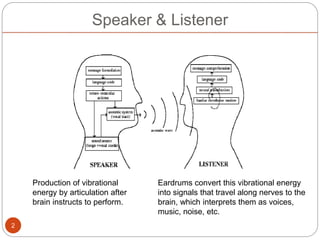
Eardrums convert this vibrational energy
into signals that travel along nerves to the
brain, which interprets them as voices,
music, noise, etc.
Production of vibrational
energy by articulation after
brain instructs to perform.
2
Production of speech
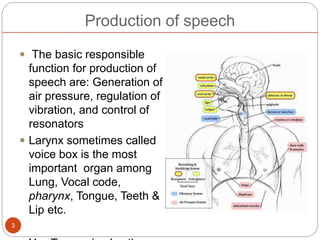
 The basic responsible
function for production of
speech are: Generation of
air pressure, regulation of
vibration, and control of
resonators
 Larynx sometimes called
voice box is the most
important organ among
Lung, Vocal code,
pharynx, Tongue, Teeth &
Lip etc.
3
Place of articulation
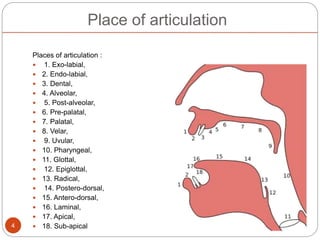
Places of articulation :
 1. Exo-labial,
 2. Endo-labial,
 3. Dental,
 4. Alveolar,
 5. Post-alveolar,
 6. Pre-palatal,
 7. Palatal,
 8. Velar,
 9. Uvular,
 10. Pharyngeal,
 11. Glottal,
 12. Epiglottal,
 13. Radical,
 14. Postero-dorsal,
 15. Antero-dorsal,
 16. Laminal,
 17. Apical,
 18. Sub-apical4
Why animal can’t produce speech
 Except Human being, any other animals can’t
produce speech because they don’t have co-
articulation system
SOUND IS NOT CONTROLLED
5
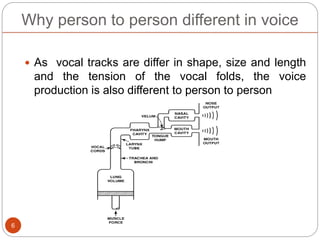
Why person to person different in voice
 As vocal tracks are differ in shape, size and length
and the tension of the vocal folds, the voice
production is also different to person to person
6
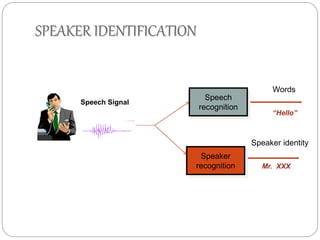
SPEAKER IDENTIFICATION
Speech Signal
Speech
recognition
Speaker
recognition
Words
Speaker identity
“Hello”
Mr. XXX
Speaker Recognition
 The process of automatically recognizing who is
speaking on the basis of individual’s speech
signals information.
 It is divided into two categories:
 Speaker Identification
 The task of determining an unknown speaker’s identity.
(Speaker identification determines which registered speaker
provides a given utterance from amongst a set of known
speakers.)
 Speaker Verification
 With certain identity the voice is used to verify (Speaker
verification accepts or rejects the identity claim of a speaker
- is the speaker the person they say they are? )
8
 In forensic applications, it is suggested to first perform a speaker
identification process to create a list of "best matches" and then
perform a series of verification processes to determine a conclusive
match
When Speaker Identification is
required
 After criminal offence, no evidence was left
except the recorded voice/voices of the
suspect/suspects then we definitely need for
Speaker Identification.
 YES, THERE IS LIMITATION ALSO:
 If the signal is distorted and not having much
information..
9
Why Speaker Identification
 Speaker Identification is carried out by a combination
of auditory and acoustic methods (and, where
appropriate, some text analysis methods) and
provides an opinion as to whether a particular voice,
for example recorded making a telephone call, or
participating in a conversation recorded by a
recording device, is that of a particular known person.
 Speaker Identification is essential for several criminal
offences, such as making hoax calls to the police,
ambulance or fire brigade, making threatening or
harassing telephone calls, blackmail or extortion
demands, or taking part in criminal conspiracies such
as those involving the importation, trafficking or
manufacture of illegal drugs etc.
10
Possibilities in Speaker Identification
• Determine the speaker identity
• Selection between a set of known voices
• The user does not claim an identity
• Closed set identification
– Assume that all speakers are known to the system
• Open set identification
– Possibility that speaker is not among the speakers known
to the system
Closed set & Open set identification
 "Closed-set identification”: The task of identifying
an unidentified speaker within a known database.
 “Open-set identification”: The task of identifying a
known speaker within the unknown database.
 In Forensic Speech Analysis, the cost-set-
identification is common one.
12
Common Facing Forensic Audio
Cases
 Kidnapping for ransom
 Anonymous calls, threatening calls
 Obscene calls
 Drug peddling
 Sharing of vital information across the border (say.
anti-social person)
 Bribery
 Match fixing
 And many more …
13
Problems in Forensic speaker
examination
 Recorded samples
 Noisy (SNR 5-6dB or less)
 Distorted/damped & short duration
 Non-contemporary
 Disguised
 Different texts
 Mode of Recording
 Telephone
 Cellular phone
 Tape recorder etc
14
Problem in Forensic speaker examination
contd..
 Speakers/suspects may suffer from a number
intrusive conditions
 Effects of health (cold, fever)
 Ingested drugs
 Emotional states(fear or stress)
 Speakers/suspects - non co-operative etc.
15
Essential parameters of good quality
audio
 If the signal contain maximum information without
any noise then we can say the signal has good
quality sample.
 It is possible only when recording in noise proof
area using sophisticated device by a professional
person.
 EXACTLY, NOISE ARE THE ENEMY OF THE
SPEECH SAMPLE!
16
Methods of speaker identification
 Aural examination of voice
 Spectrographic - visual examination of
voice spectrogram
 Semiautomatic/ Automatic method of voice
identification
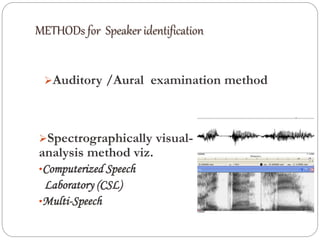
METHODs for Speaker identification
Auditory /Aural examination method
Spectrographically visual-
analysis method viz.
•Computerized Speech
Laboratory (CSL)
•Multi-Speech
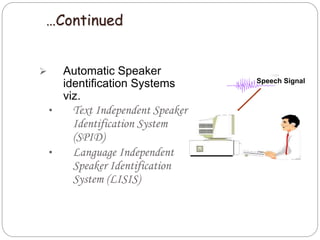
 Automatic Speaker
identification Systems
viz.
• Text Independent Speaker
Identification System
(SPID)
• Language Independent
Speaker Identification
System (LISIS)
…Continued
Speech Signal
Audio Examination Tools
 Audio High-End Professional System
 Digitization Tools
 Professional Audio System
 Pre analysis tools
 Goldwave, Adobe Audition, Cool Edit etc.
 Analysis Software
 Computerized speech Lab, Multispeech etc.
 Semi Automatic SPID
20
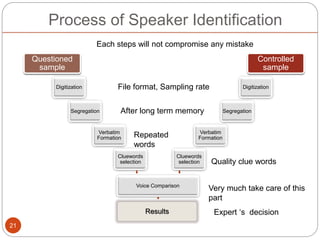
Process of Speaker Identification
Questioned
sample
Digitization
Segregation
Verbatim
Formation
Cluewords
selection
Voice Comparison
Results
Controlled
sample
Digitization
Segregation
Verbatim
Formation
Cluewords
selection
21
Each steps will not compromise any mistake
File format, Sampling rate
After long term memory
Very much take care of this
part
Quality clue words
Repeated
words
Expert ‘s decision
22

Forensic audio

  • 1.
  • 2.
    Speaker & Listener Eardrumsconvert this vibrational energy into signals that travel along nerves to the brain, which interprets them as voices, music, noise, etc. Production of vibrational energy by articulation after brain instructs to perform. 2
  • 3.
    Production of speech The basic responsible function for production of speech are: Generation of air pressure, regulation of vibration, and control of resonators  Larynx sometimes called voice box is the most important organ among Lung, Vocal code, pharynx, Tongue, Teeth & Lip etc. 3
  • 4.
    Place of articulation Placesof articulation :  1. Exo-labial,  2. Endo-labial,  3. Dental,  4. Alveolar,  5. Post-alveolar,  6. Pre-palatal,  7. Palatal,  8. Velar,  9. Uvular,  10. Pharyngeal,  11. Glottal,  12. Epiglottal,  13. Radical,  14. Postero-dorsal,  15. Antero-dorsal,  16. Laminal,  17. Apical,  18. Sub-apical4
  • 5.
    Why animal can’tproduce speech  Except Human being, any other animals can’t produce speech because they don’t have co- articulation system SOUND IS NOT CONTROLLED 5
  • 6.
    Why person toperson different in voice  As vocal tracks are differ in shape, size and length and the tension of the vocal folds, the voice production is also different to person to person 6
  • 7.
  • 8.
    Speaker Recognition  Theprocess of automatically recognizing who is speaking on the basis of individual’s speech signals information.  It is divided into two categories:  Speaker Identification  The task of determining an unknown speaker’s identity. (Speaker identification determines which registered speaker provides a given utterance from amongst a set of known speakers.)  Speaker Verification  With certain identity the voice is used to verify (Speaker verification accepts or rejects the identity claim of a speaker - is the speaker the person they say they are? ) 8  In forensic applications, it is suggested to first perform a speaker identification process to create a list of "best matches" and then perform a series of verification processes to determine a conclusive match
  • 9.
    When Speaker Identificationis required  After criminal offence, no evidence was left except the recorded voice/voices of the suspect/suspects then we definitely need for Speaker Identification.  YES, THERE IS LIMITATION ALSO:  If the signal is distorted and not having much information.. 9
  • 10.
    Why Speaker Identification Speaker Identification is carried out by a combination of auditory and acoustic methods (and, where appropriate, some text analysis methods) and provides an opinion as to whether a particular voice, for example recorded making a telephone call, or participating in a conversation recorded by a recording device, is that of a particular known person.  Speaker Identification is essential for several criminal offences, such as making hoax calls to the police, ambulance or fire brigade, making threatening or harassing telephone calls, blackmail or extortion demands, or taking part in criminal conspiracies such as those involving the importation, trafficking or manufacture of illegal drugs etc. 10
  • 11.
    Possibilities in SpeakerIdentification • Determine the speaker identity • Selection between a set of known voices • The user does not claim an identity • Closed set identification – Assume that all speakers are known to the system • Open set identification – Possibility that speaker is not among the speakers known to the system
  • 12.
    Closed set &Open set identification  "Closed-set identification”: The task of identifying an unidentified speaker within a known database.  “Open-set identification”: The task of identifying a known speaker within the unknown database.  In Forensic Speech Analysis, the cost-set- identification is common one. 12
  • 13.
    Common Facing ForensicAudio Cases  Kidnapping for ransom  Anonymous calls, threatening calls  Obscene calls  Drug peddling  Sharing of vital information across the border (say. anti-social person)  Bribery  Match fixing  And many more … 13
  • 14.
    Problems in Forensicspeaker examination  Recorded samples  Noisy (SNR 5-6dB or less)  Distorted/damped & short duration  Non-contemporary  Disguised  Different texts  Mode of Recording  Telephone  Cellular phone  Tape recorder etc 14
  • 15.
    Problem in Forensicspeaker examination contd..  Speakers/suspects may suffer from a number intrusive conditions  Effects of health (cold, fever)  Ingested drugs  Emotional states(fear or stress)  Speakers/suspects - non co-operative etc. 15
  • 16.
    Essential parameters ofgood quality audio  If the signal contain maximum information without any noise then we can say the signal has good quality sample.  It is possible only when recording in noise proof area using sophisticated device by a professional person.  EXACTLY, NOISE ARE THE ENEMY OF THE SPEECH SAMPLE! 16
  • 17.
    Methods of speakeridentification  Aural examination of voice  Spectrographic - visual examination of voice spectrogram  Semiautomatic/ Automatic method of voice identification
  • 18.
    METHODs for Speakeridentification Auditory /Aural examination method Spectrographically visual- analysis method viz. •Computerized Speech Laboratory (CSL) •Multi-Speech
  • 19.
     Automatic Speaker identificationSystems viz. • Text Independent Speaker Identification System (SPID) • Language Independent Speaker Identification System (LISIS) …Continued Speech Signal
  • 20.
    Audio Examination Tools Audio High-End Professional System  Digitization Tools  Professional Audio System  Pre analysis tools  Goldwave, Adobe Audition, Cool Edit etc.  Analysis Software  Computerized speech Lab, Multispeech etc.  Semi Automatic SPID 20
  • 21.
    Process of SpeakerIdentification Questioned sample Digitization Segregation Verbatim Formation Cluewords selection Voice Comparison Results Controlled sample Digitization Segregation Verbatim Formation Cluewords selection 21 Each steps will not compromise any mistake File format, Sampling rate After long term memory Very much take care of this part Quality clue words Repeated words Expert ‘s decision
  • 22.