Forensic Analysis of Paper
Questioned Documents
http://www.youtube.com/watch?v=p
D_sC8bT63E
Types
• Standard Paper Electrical Insulation
Newsprint Laid Paper
• Paper board Construction Paper
• Cardstock Cotton
• Inkjet Paper Origami Paper
• Bond Container Board
• Kraft Blotting Paper
• Coated Wax Paper
• Book Filter Paper
Additives Introduced to Paper
• Sizings--Sizings makes the surface of paper less porous to
ink. This allows handwriting or printing look sharp and
clear.
• Fillers--Fillers add color, surface texture, and durability.
• Coatings--Coatings help to improve the look and the
surface properties of paper. Coatings may even make paper
suitable for use in copiers, printers, or for normal
handwriting.
• Wood and cotton are the most
common ingredients that make up
many of today's paper.
• Many times, paper is treated with
chemical additives that affect its
color, opacity, strength, durability,
and brightness
Radiocarbon Dating
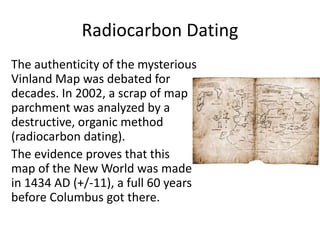
The authenticity of the mysterious
Vinland Map was debated for
decades. In 2002, a scrap of map
parchment was analyzed by a
destructive, organic method
(radiocarbon dating).
The evidence proves that this
map of the New World was made
in 1434 AD (+/-11), a full 60 years
before Columbus got there.
Paper types by weight
• http://www.youtube.com/watch?v=ntg5jaPRs
Uk
Color
• Paper chromography is used to determine any
special characteristics in the coloring of the
paper
Thickness
Texture
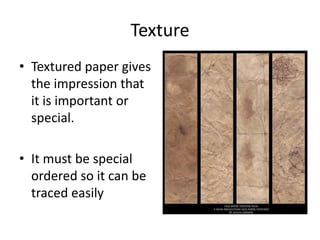
• Textured paper gives
the impression that
it is important or
special.
• It must be special
ordered so it can be
traced easily
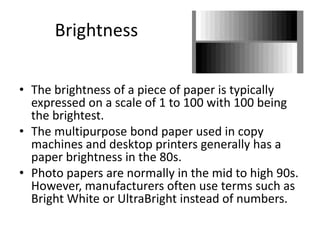
Brightness
• The brightness of a piece of paper is typically
expressed on a scale of 1 to 100 with 100 being
the brightest.
• The multipurpose bond paper used in copy
machines and desktop printers generally has a
paper brightness in the 80s.
• Photo papers are normally in the mid to high 90s.
However, manufacturers often use terms such as
Bright White or UltraBright instead of numbers.
Finishes
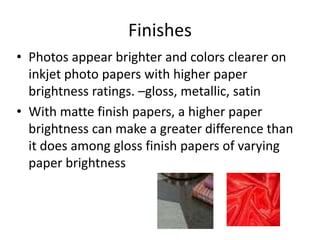
• Photos appear brighter and colors clearer on
inkjet photo papers with higher paper
brightness ratings. –gloss, metallic, satin
• With matte finish papers, a higher paper
brightness can make a greater difference than
it does among gloss finish papers of varying
paper brightness
Shades of White
• Individually white paper appears quite white.
But placed side-by-side, white papers show a
range of colors from very bright cool white to
a softer, warmer pale ivory white.
• Technically, the more blue light reflecting off
the surface, the brighter and whiter the paper
appears. For ordinary usage, the best measure
of paper brightness is your eye and the
appearance of your image on the paper
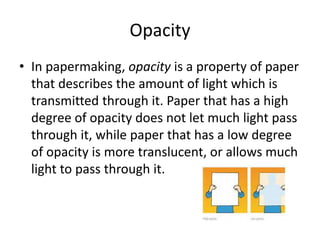
Opacity
• In papermaking, opacity is a property of paper
that describes the amount of light which is
transmitted through it. Paper that has a high
degree of opacity does not let much light pass
through it, while paper that has a low degree
of opacity is more translucent, or allows much
light to pass through it.
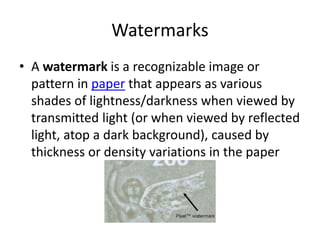
Watermarks
• A watermark is a recognizable image or
pattern in paper that appears as various
shades of lightness/darkness when viewed by
transmitted light (or when viewed by reflected
light, atop a dark background), caused by
thickness or density variations in the paper
Watermarks
• Watermarks have been used on
postage stamps, currency, and
other government documents
to discourage counterfeiting.
• There are two main ways of
producing watermarks in
paper; the dandy roll process,
and the more complex cylinder
mould process.
Clues
• The watermark tells the criminal scientist the
manufacturer, the date of manufacture, and, many
times, for whom the paper was manufactured.
• Any attempts to forge a watermark can easily be
detected. This is due to the fact that real watermarks
have fewer fibers than the rest of the paper. Forged
watermarks, on the other hand, are really added-on
images.
• Therefore, their underlying fiber density will be
consistent with that of the rest of the document.

forensic_analysis_of_paper_1.pptx

  • 1.
    Forensic Analysis ofPaper Questioned Documents http://www.youtube.com/watch?v=p D_sC8bT63E
  • 2.
    Types • Standard PaperElectrical Insulation Newsprint Laid Paper • Paper board Construction Paper • Cardstock Cotton • Inkjet Paper Origami Paper • Bond Container Board • Kraft Blotting Paper • Coated Wax Paper • Book Filter Paper
  • 3.
    Additives Introduced toPaper • Sizings--Sizings makes the surface of paper less porous to ink. This allows handwriting or printing look sharp and clear. • Fillers--Fillers add color, surface texture, and durability. • Coatings--Coatings help to improve the look and the surface properties of paper. Coatings may even make paper suitable for use in copiers, printers, or for normal handwriting.
  • 4.
    • Wood andcotton are the most common ingredients that make up many of today's paper. • Many times, paper is treated with chemical additives that affect its color, opacity, strength, durability, and brightness
  • 5.
    Radiocarbon Dating The authenticityof the mysterious Vinland Map was debated for decades. In 2002, a scrap of map parchment was analyzed by a destructive, organic method (radiocarbon dating). The evidence proves that this map of the New World was made in 1434 AD (+/-11), a full 60 years before Columbus got there.
  • 6.
    Paper types byweight • http://www.youtube.com/watch?v=ntg5jaPRs Uk
  • 7.
    Color • Paper chromographyis used to determine any special characteristics in the coloring of the paper
  • 8.
  • 11.
    Texture • Textured papergives the impression that it is important or special. • It must be special ordered so it can be traced easily
  • 12.
    Brightness • The brightnessof a piece of paper is typically expressed on a scale of 1 to 100 with 100 being the brightest. • The multipurpose bond paper used in copy machines and desktop printers generally has a paper brightness in the 80s. • Photo papers are normally in the mid to high 90s. However, manufacturers often use terms such as Bright White or UltraBright instead of numbers.
  • 13.
    Finishes • Photos appearbrighter and colors clearer on inkjet photo papers with higher paper brightness ratings. –gloss, metallic, satin • With matte finish papers, a higher paper brightness can make a greater difference than it does among gloss finish papers of varying paper brightness
  • 14.
    Shades of White •Individually white paper appears quite white. But placed side-by-side, white papers show a range of colors from very bright cool white to a softer, warmer pale ivory white. • Technically, the more blue light reflecting off the surface, the brighter and whiter the paper appears. For ordinary usage, the best measure of paper brightness is your eye and the appearance of your image on the paper
  • 16.
    Opacity • In papermaking,opacity is a property of paper that describes the amount of light which is transmitted through it. Paper that has a high degree of opacity does not let much light pass through it, while paper that has a low degree of opacity is more translucent, or allows much light to pass through it.
  • 17.
    Watermarks • A watermarkis a recognizable image or pattern in paper that appears as various shades of lightness/darkness when viewed by transmitted light (or when viewed by reflected light, atop a dark background), caused by thickness or density variations in the paper
  • 18.
    Watermarks • Watermarks havebeen used on postage stamps, currency, and other government documents to discourage counterfeiting. • There are two main ways of producing watermarks in paper; the dandy roll process, and the more complex cylinder mould process.
  • 19.
    Clues • The watermarktells the criminal scientist the manufacturer, the date of manufacture, and, many times, for whom the paper was manufactured. • Any attempts to forge a watermark can easily be detected. This is due to the fact that real watermarks have fewer fibers than the rest of the paper. Forged watermarks, on the other hand, are really added-on images. • Therefore, their underlying fiber density will be consistent with that of the rest of the document.