Juan Ortega
  10/20/09
   NTS490
Speaker recognition is the computing task of
validating a user’s claimed identity using
characteristics extracted from their voices.

Speaker recognizes who is speaking, where as
speech recognition recognizes what is being said.

Voice recognition is a combination of the two
where it uses learned aspects of a speakers voice
to determine what is being said.
Speaker verification has co-evolved with the technologies of
speech recognition and speech synthesis (TTS) because of the
similar characteristics and challenges associated with each.

1960 - Gunnar Fant, a Swedish professor published a
model describing the physiological components of
acoustic speech production, based on the analysis
of x-rays of individuals making specified phonic
sounds.

1970 – Dr. Joseph Perkell used motion x-rays and
included the tongue and jaw to expand on Fant’s
model. Original speaker recognition systems used
the average output of several analog filters to
perform matching – often aided by humans.
1976 – Texas Instruments built a prototype system
that was tested by the U.S. Air Force and The MITRE
Corporation.

Mid 1980s – The National Institute of Standards and
Technology (NIST) developed the NIST Speech
Group to study and promote the use of speech
processing techniques.

Since 1996 – Under funding from the NSA, the NIST
Speech Group has hosted yearly evaluations, the
NIST Speaker Recognition Workshop, to foster the
continued advancement of the speaker recognition
community.
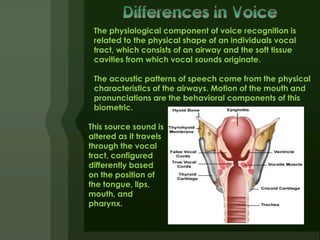
The physiological component of voice recognition is
 related to the physical shape of an individuals vocal
 tract, which consists of an airway and the soft tissue
 cavities from which vocal sounds originate.

 The acoustic patterns of speech come from the physical
 characteristics of the airways. Motion of the mouth and
 pronunciations are the behavioral components of this
 biometric.

This source sound is
altered as it travels
through the vocal
tract, configured
differently based
on the position of
the tongue, lips,
mouth, and
pharynx.
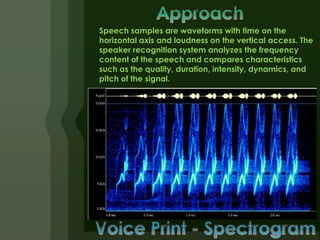
Speech samples are waveforms with time on the
horizontal axis and loudness on the vertical access. The
speaker recognition system analyzes the frequency
content of the speech and compares characteristics
such as the quality, duration, intensity, dynamics, and
pitch of the signal.
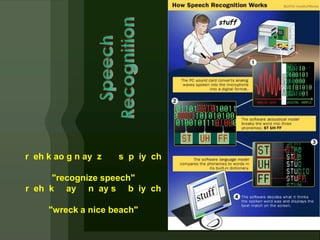
r eh k ao g n ay z   s p iy ch

      "recognize speech"
r eh k ay n ay s b iy ch

     "wreck a nice beach"
Two major applications of speaker recognition
technologies and methodologies exist.

Speaker authentication or verification is the task of
validating the identity the speaker claims to be.
The verification is a 1:1 match where one speaker’s
voice is matches against one template (called
“voice print” or “voice model”).

Speaker identification is the task of determining an
unknown speaker’s identity. Identification is a 1:N
match where it is compared against N templates.
Text-Dependent require the speaker to provide
utterances (speak) of key words or sentences, the
same text being used for both training and
recognition.

Text-Independent is when predetermined key words
cannot be used. Human beings recognize speakers
irrespective of the content of the utterance.

Text-Prompted Methods prompts each user with a
new key sentence every time the system is used.
How can speaker recognitions normalize the
variation of likelihood values in speaker verification?

In order to compensate for the variations, two types
of normalization techniques have been tried:
parameter domain, and likelihood domain.

Adaptation of the reference model as well as the
verification threshold for each speaker is
indispensable to maintaining a high recognition
accuracy over a long period.
Parameter domain
Spectral equalization (“blind equalization”) has been
confirmed to be effective in reducing linear channel
effects and long-term spectral variation. This method is
especially effective for text-dependent speaker
recognition applications using sufficiently long
utterances.

Likelihood domain
Ratio is the conditional probability of the observed
measurements of the utterance given the claimed
identity is correct, to the conditional probability of the
observed measurements given the speaker is an
impostor.

Posteriori probability method is calculated by using a set
of speakers including the claimed speaker.
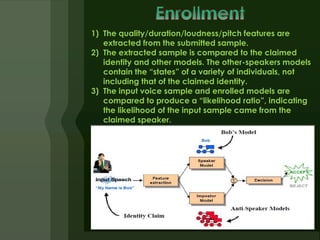
1) The quality/duration/loudness/pitch features are
   extracted from the submitted sample.
2) The extracted sample is compared to the claimed
   identity and other models. The other-speakers models
   contain the “states” of a variety of individuals, not
   including that of the claimed identity.
3) The input voice sample and enrolled models are
   compared to produce a “likelihood ratio”, indicating
   the likelihood of the input sample came from the
   claimed speaker.
How to update speaker models to cope with the gradual
changes in people’s voices.


It is necessary to build each speaker model based on a
small amount of data collected in a few sessions, and
then the model must be updated using speech data
collected when the system is used.

The reference template for each speaker is updated by
averaging new utterances and the present template
after time registration.

These methods have been extended and applied to
text-independent and text-prompted speaker
verification using HMMs.
Hidden Markov Models (HMMs) are random based
model that provides a statistical representation of the
sounds produced by the individual. The HMM represents
the underlying variations and temporal changes over
time found in the speech states using
quality/duration/intensity dynamics/pitch
characteristics.

Guassian Mixture Model (GMM) is a state-mapping
model closely related to HMM, often used for “text-
independent”. Uses the speaker’s voice to create a
number of vector “states” representing the various
sound forms. These methods all compare the similarities
and differences between the input voice and the stores
voice “states” to produce a recognition decision.
 Some companies use voiceprint recognition so people
can gain access to information or give authorization
without being physically present.

 Instead of stepping up to an iris scanner or hand
geometry reader, someone can give authorization by
making a phone call.

 Unfortunately, people can bypass some systems,
particularly those that work by phone, with a simple
recording of an authorized person's password. That's why
some systems use several randomly-chosen voice
passwords or use general voiceprints instead of prints for
specific words.
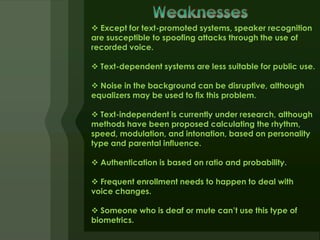
 Except for text-promoted systems, speaker recognition
are susceptible to spoofing attacks through the use of
recorded voice.

 Text-dependent systems are less suitable for public use.

 Noise in the background can be disruptive, although
equalizers may be used to fix this problem.

 Text-independent is currently under research, although
methods have been proposed calculating the rhythm,
speed, modulation, and intonation, based on personality
type and parental influence.

 Authentication is based on ratio and probability.

 Frequent enrollment needs to happen to deal with
voice changes.

 Someone who is deaf or mute can’t use this type of
biometrics.
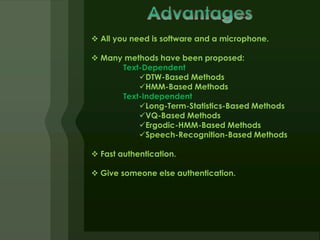
 All you need is software and a microphone.

 Many methods have been proposed:
      Text-Dependent
          DTW-Based Methods
          HMM-Based Methods
      Text-Independent
          Long-Term-Statistics-Based Methods
          VQ-Based Methods
          Ergodic-HMM-Based Methods
          Speech-Recognition-Based Methods

 Fast authentication.

 Give someone else authentication.
http://www.youtube.com/watch?v=0ec1Gtnlq1k
Speaker recognition. Retrieved October 20, from Wikipedia
web site: http://en.wikipedia.org/wiki/Speaker_recognition

Sadoki, Dr. F. (2008). Speaker Recognition. Retrieved October
20, from Scholarpedia web site:
http://www.scholarpedia.org/article/Speaker_recognition#DT
W-Based_Methods

The Speaker Recognition Homepage. Retrieved October 20,
from speaker-recognition web site: http://www.speaker-
recognition.org/

(2006). Speaker Recognition. Retrieved October 20, from
biometrics web site:
http://www.biometrics.gov/Documents/SpeakerRec.pdf

Howstuffworks “How speech recognition works”. Retrieved
October 21, from howstuffworks web site:
http://electronics.howstuffworks.com/gadgets/high-tech-
gadgets/speech-recognition.htm/printable

Wilson. T. Howstuffworks “Voiceprints”. Retrieved October 21,
from howstuffworks web site:
http://science.howstuffworks.com/biometrics3.htm

Voice

  • 1.
    Juan Ortega 10/20/09 NTS490
  • 2.
    Speaker recognition isthe computing task of validating a user’s claimed identity using characteristics extracted from their voices. Speaker recognizes who is speaking, where as speech recognition recognizes what is being said. Voice recognition is a combination of the two where it uses learned aspects of a speakers voice to determine what is being said.
  • 3.
    Speaker verification hasco-evolved with the technologies of speech recognition and speech synthesis (TTS) because of the similar characteristics and challenges associated with each. 1960 - Gunnar Fant, a Swedish professor published a model describing the physiological components of acoustic speech production, based on the analysis of x-rays of individuals making specified phonic sounds. 1970 – Dr. Joseph Perkell used motion x-rays and included the tongue and jaw to expand on Fant’s model. Original speaker recognition systems used the average output of several analog filters to perform matching – often aided by humans.
  • 4.
    1976 – TexasInstruments built a prototype system that was tested by the U.S. Air Force and The MITRE Corporation. Mid 1980s – The National Institute of Standards and Technology (NIST) developed the NIST Speech Group to study and promote the use of speech processing techniques. Since 1996 – Under funding from the NSA, the NIST Speech Group has hosted yearly evaluations, the NIST Speaker Recognition Workshop, to foster the continued advancement of the speaker recognition community.
  • 5.
    The physiological componentof voice recognition is related to the physical shape of an individuals vocal tract, which consists of an airway and the soft tissue cavities from which vocal sounds originate. The acoustic patterns of speech come from the physical characteristics of the airways. Motion of the mouth and pronunciations are the behavioral components of this biometric. This source sound is altered as it travels through the vocal tract, configured differently based on the position of the tongue, lips, mouth, and pharynx.
  • 6.
    Speech samples arewaveforms with time on the horizontal axis and loudness on the vertical access. The speaker recognition system analyzes the frequency content of the speech and compares characteristics such as the quality, duration, intensity, dynamics, and pitch of the signal.
  • 7.
    r eh kao g n ay z s p iy ch "recognize speech" r eh k ay n ay s b iy ch "wreck a nice beach"
  • 8.
    Two major applicationsof speaker recognition technologies and methodologies exist. Speaker authentication or verification is the task of validating the identity the speaker claims to be. The verification is a 1:1 match where one speaker’s voice is matches against one template (called “voice print” or “voice model”). Speaker identification is the task of determining an unknown speaker’s identity. Identification is a 1:N match where it is compared against N templates.
  • 9.
    Text-Dependent require thespeaker to provide utterances (speak) of key words or sentences, the same text being used for both training and recognition. Text-Independent is when predetermined key words cannot be used. Human beings recognize speakers irrespective of the content of the utterance. Text-Prompted Methods prompts each user with a new key sentence every time the system is used.
  • 10.
    How can speakerrecognitions normalize the variation of likelihood values in speaker verification? In order to compensate for the variations, two types of normalization techniques have been tried: parameter domain, and likelihood domain. Adaptation of the reference model as well as the verification threshold for each speaker is indispensable to maintaining a high recognition accuracy over a long period.
  • 11.
    Parameter domain Spectral equalization(“blind equalization”) has been confirmed to be effective in reducing linear channel effects and long-term spectral variation. This method is especially effective for text-dependent speaker recognition applications using sufficiently long utterances. Likelihood domain Ratio is the conditional probability of the observed measurements of the utterance given the claimed identity is correct, to the conditional probability of the observed measurements given the speaker is an impostor. Posteriori probability method is calculated by using a set of speakers including the claimed speaker.
  • 12.
    1) The quality/duration/loudness/pitchfeatures are extracted from the submitted sample. 2) The extracted sample is compared to the claimed identity and other models. The other-speakers models contain the “states” of a variety of individuals, not including that of the claimed identity. 3) The input voice sample and enrolled models are compared to produce a “likelihood ratio”, indicating the likelihood of the input sample came from the claimed speaker.
  • 13.
    How to updatespeaker models to cope with the gradual changes in people’s voices. It is necessary to build each speaker model based on a small amount of data collected in a few sessions, and then the model must be updated using speech data collected when the system is used. The reference template for each speaker is updated by averaging new utterances and the present template after time registration. These methods have been extended and applied to text-independent and text-prompted speaker verification using HMMs.
  • 14.
    Hidden Markov Models(HMMs) are random based model that provides a statistical representation of the sounds produced by the individual. The HMM represents the underlying variations and temporal changes over time found in the speech states using quality/duration/intensity dynamics/pitch characteristics. Guassian Mixture Model (GMM) is a state-mapping model closely related to HMM, often used for “text- independent”. Uses the speaker’s voice to create a number of vector “states” representing the various sound forms. These methods all compare the similarities and differences between the input voice and the stores voice “states” to produce a recognition decision.
  • 15.
     Some companiesuse voiceprint recognition so people can gain access to information or give authorization without being physically present.  Instead of stepping up to an iris scanner or hand geometry reader, someone can give authorization by making a phone call.  Unfortunately, people can bypass some systems, particularly those that work by phone, with a simple recording of an authorized person's password. That's why some systems use several randomly-chosen voice passwords or use general voiceprints instead of prints for specific words.
  • 16.
     Except fortext-promoted systems, speaker recognition are susceptible to spoofing attacks through the use of recorded voice.  Text-dependent systems are less suitable for public use.  Noise in the background can be disruptive, although equalizers may be used to fix this problem.  Text-independent is currently under research, although methods have been proposed calculating the rhythm, speed, modulation, and intonation, based on personality type and parental influence.  Authentication is based on ratio and probability.  Frequent enrollment needs to happen to deal with voice changes.  Someone who is deaf or mute can’t use this type of biometrics.
  • 17.
     All youneed is software and a microphone.  Many methods have been proposed: Text-Dependent DTW-Based Methods HMM-Based Methods Text-Independent Long-Term-Statistics-Based Methods VQ-Based Methods Ergodic-HMM-Based Methods Speech-Recognition-Based Methods  Fast authentication.  Give someone else authentication.
  • 18.
  • 19.
    Speaker recognition. RetrievedOctober 20, from Wikipedia web site: http://en.wikipedia.org/wiki/Speaker_recognition Sadoki, Dr. F. (2008). Speaker Recognition. Retrieved October 20, from Scholarpedia web site: http://www.scholarpedia.org/article/Speaker_recognition#DT W-Based_Methods The Speaker Recognition Homepage. Retrieved October 20, from speaker-recognition web site: http://www.speaker- recognition.org/ (2006). Speaker Recognition. Retrieved October 20, from biometrics web site: http://www.biometrics.gov/Documents/SpeakerRec.pdf Howstuffworks “How speech recognition works”. Retrieved October 21, from howstuffworks web site: http://electronics.howstuffworks.com/gadgets/high-tech- gadgets/speech-recognition.htm/printable Wilson. T. Howstuffworks “Voiceprints”. Retrieved October 21, from howstuffworks web site: http://science.howstuffworks.com/biometrics3.htm