Large-‐scale Visual Search:
CBIR -‐Features
Weimin Tan. Fudan University sep, 2014
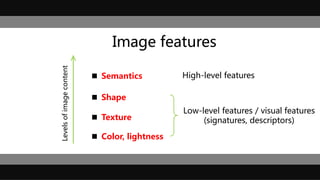
Image features
Levelsofimagecontent
High-level features Semantics
 Shape
 Texture
 Color, lightness
Low-level features / visual features
(signatures, descriptors)
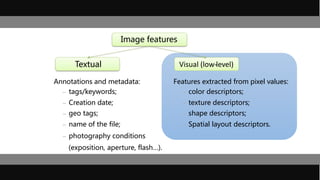
Image features
Textual Visual (low-‐level)
Annotations and metadata:
– tags/keywords;
– Creation date;
– geo tags;
– name of the file;
– photography conditions
(exposition, aperture, flash…).
Features extracted from pixel values:
– color descriptors;
– texture descriptors;
– shape descriptors;
– Spatial layout descriptors.
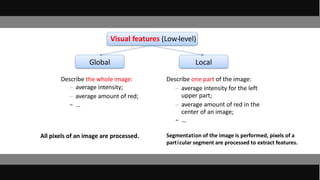
Visual features (Low-‐level)
Global Local
Describe the whole image:
– average intensity;
– average amount of red;
− …
Describe one part of the image:
– average intensity for the left
upper part;
– average amount of red in the
center of an image;
− …
All pixels of an image are processed. Segmentation of the image is performed, pixels of a
particular segment are processed to extract features.
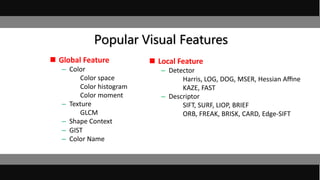
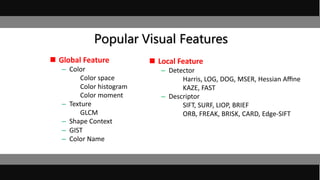
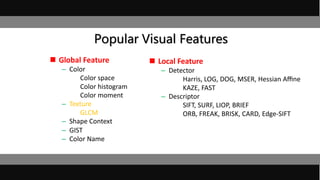
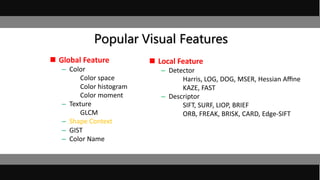
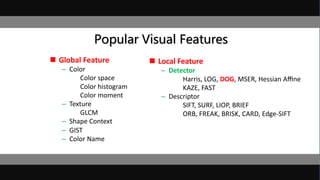
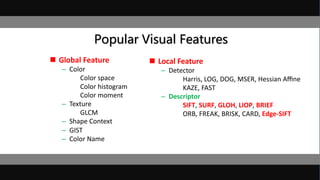
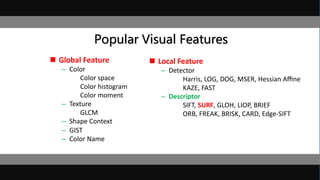
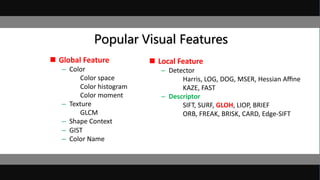
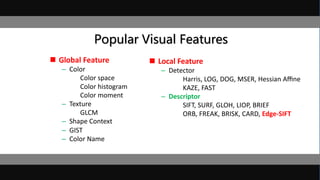
Popular Visual Features
 Global Feature
– Color
Color space
Color histogram
Color moment
– Texture
GLCM
– Shape Context
– GIST
– Color Name
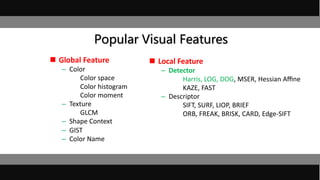
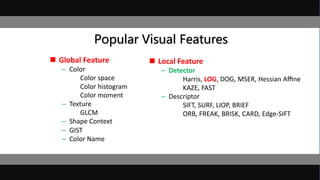
 Local Feature
– Detector
Harris, LOG, DOG, MSER, Hessian Affine
KAZE, FAST
– Descriptor
SIFT, SURF, LIOP, BRIEF
ORB, FREAK, BRISK, CARD, Edge-SIFT
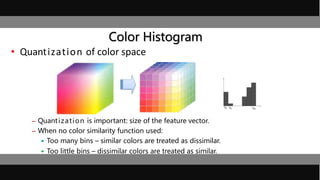
• Quantization of color space
– Quantization is important: size of the feature vector.
– When no color similarity function used:
• Too many bins – similar colors are treated as dissimilar.
• Too little bins – dissimilar colors are treated as similar.
h1 h2 hN
Color Histogram
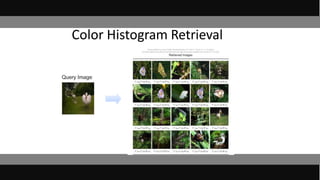
Color Histogram Retrieval
Color Histogram
Advantage :
• The color histogram is easy to compute and effective in characterizing
both the global and local distribution of colors in an image.
• Robust to translation and rotation about the view axis and changes
only slightly with the scale, occlusion and viewing angle.
Disadvantage :
• Without color distributions of images
Popular Visual Features
 Global Feature
– Color
Color space
Color histogram
Color moment
– Texture
GLCM
– Shape Context
– GIST
– Color Name
 Local Feature
– Detector
Harris, LOG, DOG, MSER, Hessian Affine
KAZE, FAST
– Descriptor
SIFT, SURF, LIOP, BRIEF
ORB, FREAK, BRISK, CARD, Edge-SIFT
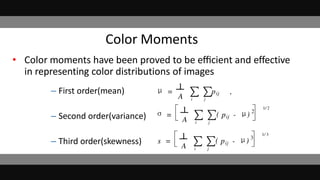
Color Moments
• Color moments have been proved to be efficient and effective
in representing color distributions of images
– First order(mean)
– Second order(variance)
– Third order(skewness)
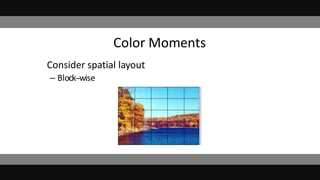
Color Moments
• Consider spatial layout
– Block-‐wise
Popular Visual Features
 Global Feature
– Color
Color space
Color histogram
Color moment
– Texture
GLCM
– Shape Context
– GIST
– Color Name
 Local Feature
– Detector
Harris, LOG, DOG, MSER, Hessian Affine
KAZE, FAST
– Descriptor
SIFT, SURF, LIOP, BRIEF
ORB, FREAK, BRISK, CARD, Edge-SIFT
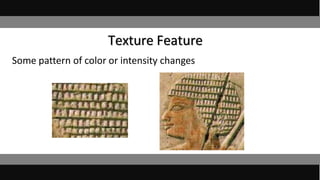
Texture Feature
Some pattern of color or intensity changes
Natural Texture
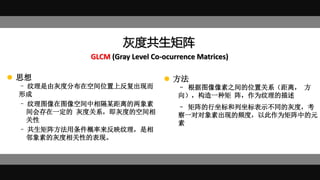
灰度共生矩阵
GLCM (Gray Level Co-ocurrence Matrices)
 思想
– 纹理是由灰度分布在空间位置上反复出现而
形成
– 纹理图像在图像空间中相隔某距离的两象素
间会存在一定的 灰度关系,即灰度的空间相
关性
– 共生矩阵方法用条件概率来反映纹理,是相
邻象素的灰度相关性的表现。
– 根据图像像素之间的位置关系(距离, 方
向),构造一种矩 阵,作为纹理的描述
– 矩阵的行坐标和列坐标表示不同的灰度,考
察一对对象素出现的频度,以此作为矩阵中的元
素
 方法
• The GLCM is defined by:
– wherenij is the number of occurrences of the pixel
values lying at distance d with angle  in the image.
– The co-occurrence matrix P has dimension n x n,
where n is the number of gray levels in the image.
P(p,q,d,)  nij
#{[(x , y ),(x , y )]S | f (x , y )  p & f (x , y )  q}
p(p,q,d,)  1 1 2 2 1 1 2 2
#S
GLCM
(p,q)
nij
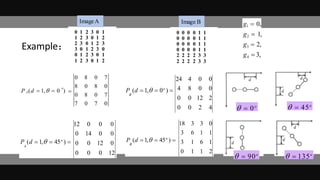
Example:
0 1 2 3 0 1
1 2 3 0 1 2
2 3 0 1 2 3
3 0 1 2 3 0
0 1 2 3 0 1
1 2 3 0 1 2
0 0 0 0 1 1
0 0 0 0 1 1
0 0 0 0 1 1
0 0 0 0 1 1
2 2 2 2 3 3
2 2 2 2 3 3
ImageA Image B
0 8 0 7
8 0 8 0
0 8 0 7
7 0 7 0
P (d  1,  0 )
o
A 
g1  0,
g2  1,
g3  2,
g4  3,
  0o   45o
  90o
  135o
P (d  1,  45o
) 
B
18 3 3 0
3
3
6
1
1
6
1
1
0 1 1 2
P (d  1,  45o
) 
A
12 0 0 0
0
0
14
0
0
12
0
0
0 0 0 12
P (d  1,  0o
) 
B
24 4 0 0
4
0
8
0
0
12
0
2
0 0 2 4
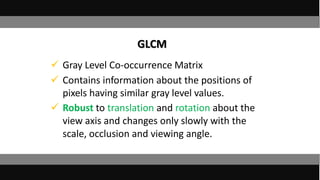
 Gray Level Co-occurrence Matrix
 Contains information about the positions of
pixels having similar gray level values.
 Robust to translation and rotation about the
view axis and changes only slowly with the
scale, occlusion and viewing angle.
GLCM
Popular Visual Features
 Global Feature
– Color
Color space
Color histogram
Color moment
– Texture
GLCM
– Shape Context
– GIST
– Color Name
 Local Feature
– Detector
Harris, LOG, DOG, MSER, Hessian Affine
KAZE, FAST
– Descriptor
SIFT, SURF, LIOP, BRIEF
ORB, FREAK, BRISK, CARD, Edge-SIFT
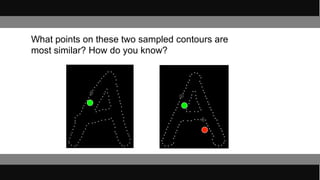
• What points on these two sampled contours are
most similar? How do you know?
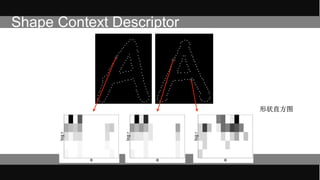
Shape Context Descriptor [Belongie et al ’02]
20
Shape context slides from Belongie et al.
Count the number of points
inside each bin, e.g.:
Count = 4
Count = 10
Compact representation of
distribution of points relative
to each point
...
NIPS’00, PAMI’02
Shape Context Descriptor
形状直方图
Global Feature
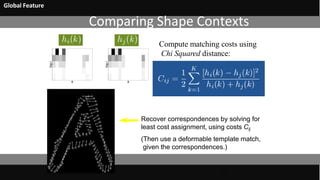
Comparing Shape Contexts
22
Compute matching costs using
Chi Squared distance:
Recover correspondences by solving for
least cost assignment, using costs Cij
(Then use a deformable template match,
given the correspondences.)
Popular Visual Features
 Global Feature
– Color
Color space
Color histogram
Color moment
– Texture
GLCM
– Shape Context
– GIST
– Color Name
 Local Feature
– Detector
Harris, LOG, DOG, MSER, Hessian Affine
KAZE, FAST
– Descriptor
SIFT, SURF, LIOP, BRIEF
ORB, FREAK, BRISK, CARD, Edge-SIFT
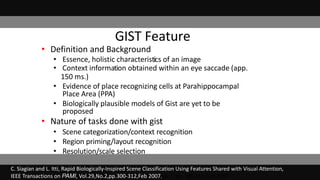
GIST Feature
• Definition and Background
• Essence, holistic characteristics of an image
• Context information obtained within an eye saccade (app.
150 ms.)
• Evidence of place recognizing cells at Parahippocampal
Place Area (PPA)
• Biologically plausible models of Gist are yet to be
proposed
• Nature of tasks done with gist
• Scene categorization/context recognition
• Region priming/layout recognition
• Resolution/scale selection
C. Siagian and L. I t , Rapid Biologically-‐Inspired Scene ClassificaOon Using Features Shared with
Visual AuenOon, IEEE Transac=ons PAMI, Vol. 29, No. 2, pp. 300-‐312, Feb 2007.
C. Siagian and L. Itti, Rapid Biologically‐Inspired Scene Classification Using Features Shared with Visual Attention,
IEEE Transactions on PAMI, Vol.29,No.2,pp.300-312,Feb 2007.
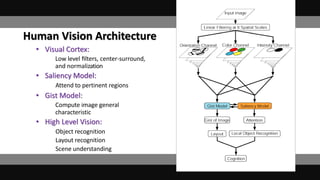
Human Vision Architecture
• Visual Cortex:
– Low level filters, center-surround,
and normalization
• Saliency Model:
– Attend to pertinent regions
• Gist Model:
– Compute image general
characteristic
• High Level Vision:
– Object recognition
– Layout recognition
– Scene understanding
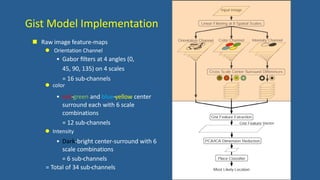
Gist Model Implementation
 Raw image feature-maps
• Gabor filters at 4 angles (0,
45, 90, 135) on 4 scales
= 16 sub-‐channels
• red-‐green and blue-‐yellow center
surround each with 6 scale
combinations
= 12 sub-‐channels
• Dark-bright center-surround with 6
scale combinations
= 6 sub-‐channels
= Total of 34 sub-‐channels
 Orientation Channel
 color
 Intensity
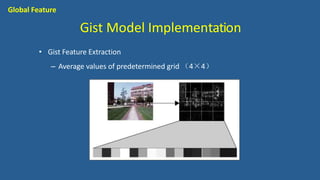
Gist Model Implementation
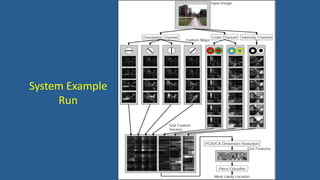
• Gist Feature Extraction
– Average values of predetermined grid (4×4)
Global Feature
• Dimension Reduction
– Original:
34 sub-‐channels x 16
features
= 544 features
– PCA/ICA reduction: 80
features
• Kept >95% of variance
Gist Model Implementation
Global Feature
System Example
Run
Global Features
• Advantages:
– Simple.
– Low computatinal complexity.
• Disadvantages:
– Low accuracy
• Why Local Feature?
– Locality: features are local, so robust to occlusion
and clutter (no prior segmentation)
– Distinctiveness: individual features can be matched
to a large database of objects
– Quantity: many features can be generated for even
small objects
– Efficiency: close to real-time performance
– Extensibility: can easily be extended to wide range of
differing feature types, with each adding robustness
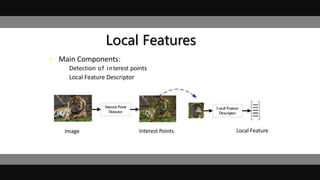
Local Features
• Main Components:
– Detection of interest points
– Local Feature Descriptor
Local Features
Image Interest Points Local Feature
Popular Visual Features
 Global Feature
– Color
Color space
Color histogram
Color moment
– Texture
GLCM
– Shape Context
– GIST
– Color Name
 Local Feature
– Detector
Harris, LOG, DOG, MSER, Hessian Affine
KAZE, FAST
– Descriptor
SIFT, SURF, LIOP, BRIEF
ORB, FREAK, BRISK, CARD, Edge-SIFT
Local Feature
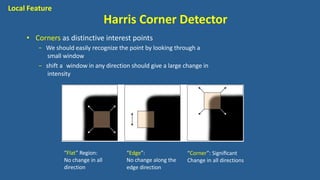
• Corners as distinctive interest points
− We should easily recognize the point by looking through a
small window
− shift a window in any direction should give a large change in
intensity
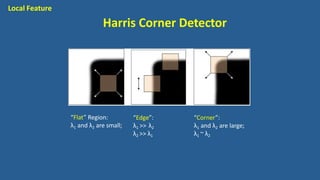
“Flat” Region:
No change in all
direction
“Edge”:
No change along the
edge direction
“Corner”: Significant
Change in all directions
Harris Corner Detector
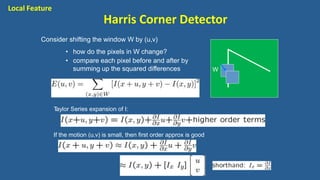
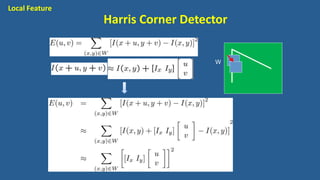
Consider shifting the window W by (u,v)
• how do the pixels in W change?
• compare each pixel before and after by
summing up the squared differences W
Taylor Series expansion of I:
If the motion (u,v) is small, then first order approx is good
Local Feature
Harris Corner Detector
W
Local Feature
Harris Corner Detector
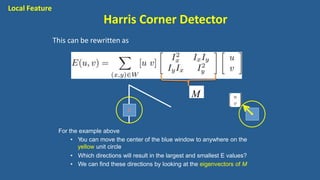
M
This can be rewritten as
For the example above
• You can move the center of the blue window to anywhere on the
yellow unit circle
• Which directions will result in the largest and smallest E values?
• We can find these directions by looking at the eigenvectors of M
Local Feature
Harris Corner Detector
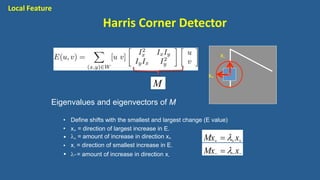
Eigenvalues and eigenvectors of M
• Define shifts with the smallest and largest change (E value)
•
•
•
•
x+ = direction of largest increase in E.
+ = amount of increase in direction x+
x- = direction of smallest increase in E.
-‐= amount of increase in direction x-
x-
x+
M
Mx   x
Mx   x  
Local Feature
Harris Corner Detector
“Flat” Region:
λ1 and λ2 are small;
“Edge”:
λ1 >> λ2
λ2 >> λ1
“Corner”:
λ1 and λ2 are large;
λ1 ~ λ2
Local Feature
Harris Corner Detector
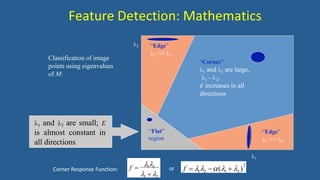
Feature Detection: Mathematics
1
2
“Corner”
1 and 2 are large,
1 ~ 2;
E increases in all
directions
1 and 2 are small; E
is almost constant in
all directions
“Edge”
1 >> 2
“Edge”
2 >> 1
“Flat”
region
Classification of image
points using eigenvalues
of M:
12
1  2
f  2
f  12 (1  2 )Corner Response Function: or
Harris Corner Detector
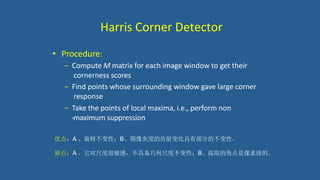
• Procedure:
− Compute M matrix for each image window to get their
cornerness scores
− Find points whose surrounding window gave large corner
response
− Take the points of local maxima, i.e., perform non
-‐maximum suppression
优点:A 、旋转不变性;B、图像灰度的仿射变化具有部分的不变性。
缺点:A 、它对尺度很敏感,不具备几何尺度不变性;B、提取的角点是像素级的。
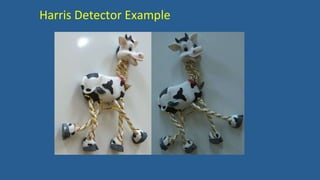
Harris Detector Example
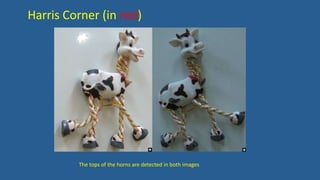
The tops of the horns are detected in both images
Harris Corner (in red)
Popular Visual Features
 Global Feature
– Color
Color space
Color histogram
Color moment
– Texture
GLCM
– Shape Context
– GIST
– Color Name
 Local Feature
– Detector
Harris, LOG, DOG, MSER, Hessian Affine
KAZE, FAST
– Descriptor
SIFT, SURF, LIOP, BRIEF
ORB, FREAK, BRISK, CARD, Edge-SIFT
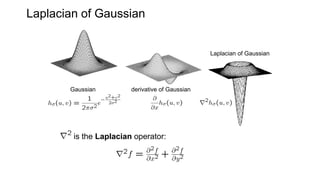
Laplacian of Gaussian
 LoG边缘检测算子是David Courtnay Marr和Ellen Hildreth(1980)共
同提出的[1] 。因此,也称为边缘检测算法或Marr & Hildreth算子。
 该算法首先对图像做高斯滤波,然后再求其拉普拉斯(Laplacian)二阶导
数。即图像与 Laplacian of the Gaussian function 进行滤波运算。最后,
通过检测滤波结果的零交叉(Zero crossings)可以获得图像或物体的边
缘。因而,也被业界简称为Laplacian-of-Gaussian (LoG)算子。
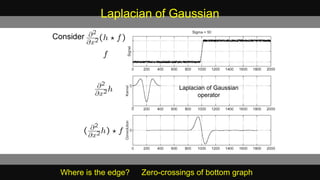
Laplacian of Gaussian
Consider
Laplacian of Gaussian
operator
Where is the edge? Zero-crossings of bottom graph
is the Laplacian operator:
Laplacian of Gaussian
Gaussian derivative of Gaussian
Laplacian of Gaussian
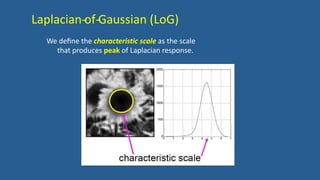
Laplacian-‐of-‐Gaussian (LoG)
We define the characteristic scale as the scale
that produces peak of Laplacian response.
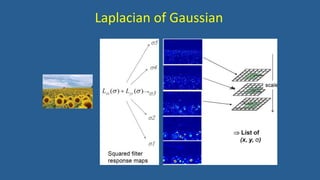
Laplacian of Gaussian
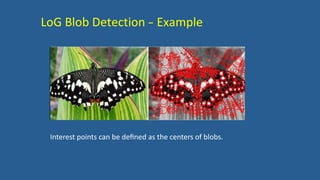
LoG Blob Detection -‐ Example
Interest points can be defined as the centers of blobs.
Popular Visual Features
 Global Feature
– Color
Color space
Color histogram
Color moment
– Texture
GLCM
– Shape Context
– GIST
– Color Name
 Local Feature
– Detector
Harris, LOG, DOG, MSER, Hessian Affine
KAZE, FAST
– Descriptor
SIFT, SURF, LIOP, BRIEF
ORB, FREAK, BRISK, CARD, Edge-SIFT
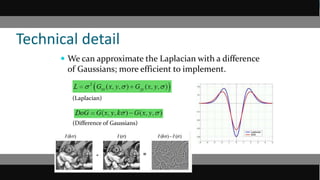
Technical detail
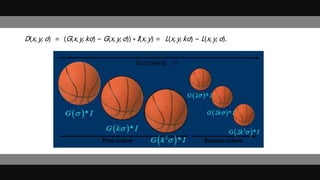
 We can approximate the Laplacian with a difference
of Gaussians; more efficient to implement.
(Laplacian)
(Difference of Gaussians)
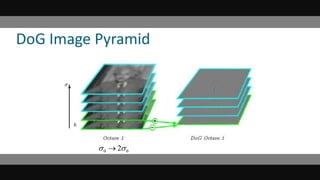
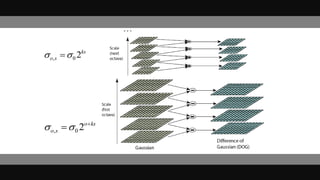
DoG Image Pyramid
0 02 
, 0 2o ks
o s  

, 0 2ks
o s 
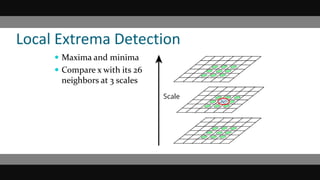
Local Extrema Detection
 Maxima and minima
 Compare x with its 26
neighbors at 3 scales
D(x, y, σ) = (G(x,y, kσ) − G(x,y, σ)) ∗ I(x, y) = L(x,y, kσ) − L(x,y, σ).
Popular Visual Features
 Global Feature
– Color
Color space
Color histogram
Color moment
– Texture
GLCM
– Shape Context
– GIST
– Color Name
 Local Feature
– Detector
Harris, LOG, DOG, MSER, Hessian Affine
KAZE, FAST
– Descriptor
SIFT, SURF, GLOH, LIOP, BRIEF
ORB, FREAK, BRISK, CARD, Edge-SIFT
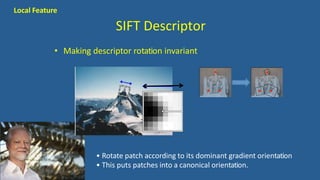
SIFT Descriptor
• Making descriptor rotation invariant
• Rotate patch according to its dominant gradient orientation
• This puts patches into a canonical orientation.
Local Feature
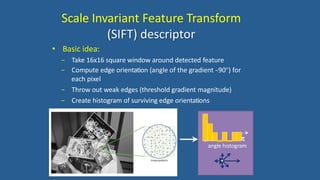
Scale Invariant Feature Transform
(SIFT) descriptor
• Basic idea:
− Take 16x16 square window around detected feature
− Compute edge orientation (angle of the gradient -‐90) for
each pixel
− Throw out weak edges (threshold gradient magnitude)
− Create histogram of surviving edge orientations
0 2
angle histogram
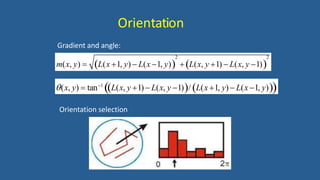
Orientation
Gradient and angle:
2 2
m(x, y)  L(x 1, y)  L(x 1, y) L(x, y 1)  L(x, y 1)
(x, y)  tan1
L(x, y 1) L(x, y 1)/ L(x 1, y)  L(x 1, y)
Orientation selection
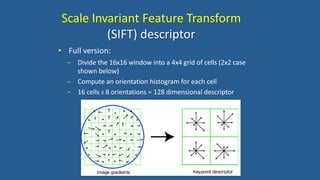
• Full version:
− Divide the 16x16 window into a 4x4 grid of cells (2x2 case
shown below)
− Compute an orientation histogram for each cell
− 16 cells X 8 orientations = 128 dimensional descriptor
Scale Invariant Feature Transform
(SIFT) descriptor
• Invariant to
– Scale
– Rotation
• Partially invariant to
– Illumination changes
– Camera viewpoint
– Occlusion, clutter
Scale Invariant Feature Transform
(SIFT) descriptor
Popular Visual Features
 Global Feature
– Color
Color space
Color histogram
Color moment
– Texture
GLCM
– Shape Context
– GIST
– Color Name
 Local Feature
– Detector
Harris, LOG, DOG, MSER, Hessian Affine
KAZE, FAST
– Descriptor
SIFT, SURF, GLOH, LIOP, BRIEF
ORB, FREAK, BRISK, CARD, Edge-SIFT
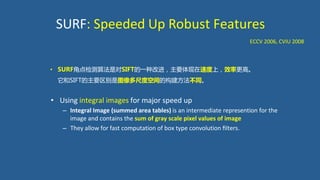
SURF: Speeded Up Robust Features
• Using integral images for major speed up
– Integral Image (summed area tables) is an intermediate represention for the
image and contains the sum of gray scale pixel values of image
– They allow for fast computation of box type convolution filters.
ECCV 2006, CVIU 2008
• SURF角点检测算法是对SIFT的一种改进,主要体现在速度上,效率更高。
它和SIFT的主要区别是图像多尺度空间的构建方法不同。
SURF
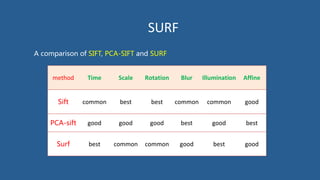
A comparison of SIFT, PCA-SIFT and SURF
method Time Scale Rotation Blur Illumination Affine
Sift common best best common common good
PCA-sift good good good best good best
Surf best common common good best good
108
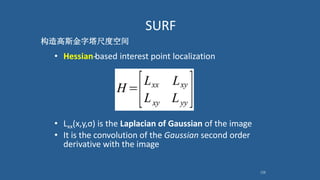
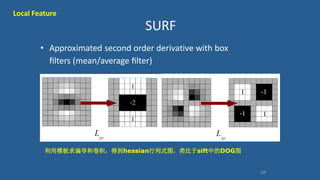
• Hessian-‐based interest point localization
• Lxx(x,y,σ) is the Laplacian of Gaussian of the image
• It is the convolution of the Gaussian second order
derivative with the image
构造高斯金字塔尺度空间
SURF
110
• Approximated second order derivative with box
filters (mean/average filter)
Local Feature
SURF
利用模板求偏导和卷积,得到hessian行列式图,类比于sift中的DOG图
111
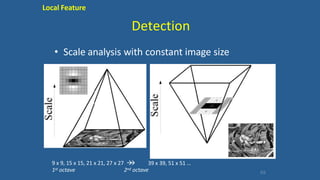
Detection
• Scale analysis with constant image size
9 x 9, 15 x 15, 21 x 21, 27 x 27  39 x 39, 51 x 51 …
1st octave 2nd octave
Local Feature
113
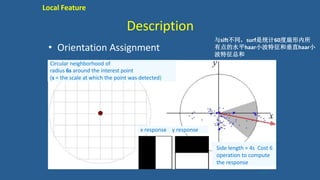
Description
• Orientation Assignment
Circular neighborhood of
radius 6s around the interest point
(s = the scale at which the point was detected)
Side length = 4s Cost 6
operation to compute
the response
x response y response
Local Feature
与sift不同,surf是统计60度扇形内所
有点的水平haar小波特征和垂直haar小
波特征总和
Popular Visual Features
 Global Feature
– Color
Color space
Color histogram
Color moment
– Texture
GLCM
– Shape Context
– GIST
– Color Name
 Local Feature
– Detector
Harris, LOG, DOG, MSER, Hessian Affine
KAZE, FAST
– Descriptor
SIFT, SURF, GLOH, LIOP, BRIEF
ORB, FREAK, BRISK, CARD, Edge-SIFT
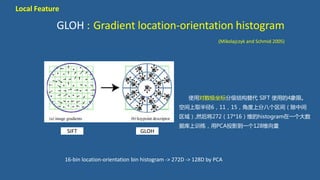
GLOH : Gradient location-orientation histogram
(Mikolajczyk and Schmid 2005)
16-bin location-orientation bin histogram -> 272D -> 128D by PCA
SIFT GLOH
Local Feature
使用对数极坐标分级结构替代 SIFT 使用的4象限。
空间上取半径6,11,15,角度上分八个区间(除中间
区域),然后将272(17*16)维的histogram在一个大数
据库上训练,用PCA投影到一个128维向量
Popular Visual Features
 Global Feature
– Color
Color space
Color histogram
Color moment
– Texture
GLCM
– Shape Context
– GIST
– Color Name
 Local Feature
– Detector
Harris, LOG, DOG, MSER, Hessian Affine
KAZE, FAST
– Descriptor
SIFT, SURF, GLOH, LIOP, BRIEF
ORB, FREAK, BRISK, CARD, Edge-SIFT
 Zhenhua Wang, Bin Fan, and Fuchao Wu,
"Local intensity order pattern for feature
description." ICCV, 2011
 Motivation: Orientation estimation error in SIFT
LIOP
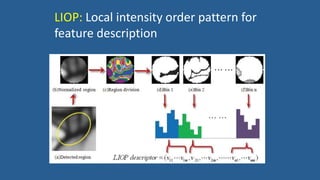
LIOP: Local intensity order pattern for
feature description
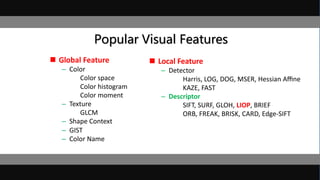
Popular Visual Features
 Global Feature
– Color
Color space
Color histogram
Color moment
– Texture
GLCM
– Shape Context
– GIST
– Color Name
 Local Feature
– Detector
Harris, LOG, DOG, MSER, Hessian Affine
KAZE, FAST
– Descriptor
SIFT, SURF, GLOH, LIOP, BRIEF
ORB, FREAK, BRISK, CARD, Edge-SIFT
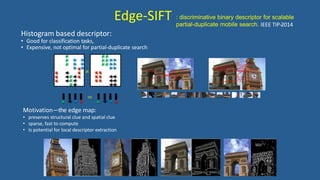
Edge-SIFT

IEEE TIP-‐2014
: discriminative binary descriptor for scalable
partial-duplicate mobile search.
Histogram based descriptor:
• Good for classification tasks,
• Expensive, not optimal for partial-duplicate search
Motivation—the edge map:
• preserves structural clue and spatial clue
• sparse, fast to compute
• Is potential for local descriptor extraction

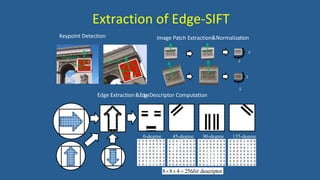
Extraction of Edge-SIFT
0-degree 45-degree 90-degree 135-degree
884  256bit descriptor
da
S
Orientation
S
S
Edge Extraction&EdgeDescriptor Computation
S
scale
db
Orientation
scale
Keypoint Detection Image Patch Extraction&Normalization
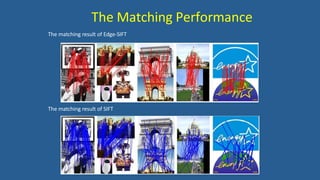
The Matching Performance
The matching result of SIFT
The matching result of Edge-SIFT
Thank you !

Cbir ‐ features

  • 1.
    Large-‐scale Visual Search: CBIR-‐Features Weimin Tan. Fudan University sep, 2014
  • 2.
    Image features Levelsofimagecontent High-level featuresSemantics  Shape  Texture  Color, lightness Low-level features / visual features (signatures, descriptors)
  • 3.
    Image features Textual Visual(low-‐level) Annotations and metadata: – tags/keywords; – Creation date; – geo tags; – name of the file; – photography conditions (exposition, aperture, flash…). Features extracted from pixel values: – color descriptors; – texture descriptors; – shape descriptors; – Spatial layout descriptors.
  • 4.
    Visual features (Low-‐level) GlobalLocal Describe the whole image: – average intensity; – average amount of red; − … Describe one part of the image: – average intensity for the left upper part; – average amount of red in the center of an image; − … All pixels of an image are processed. Segmentation of the image is performed, pixels of a particular segment are processed to extract features.
  • 5.
    Popular Visual Features Global Feature – Color Color space Color histogram Color moment – Texture GLCM – Shape Context – GIST – Color Name  Local Feature – Detector Harris, LOG, DOG, MSER, Hessian Affine KAZE, FAST – Descriptor SIFT, SURF, LIOP, BRIEF ORB, FREAK, BRISK, CARD, Edge-SIFT
  • 6.
    • Quantization ofcolor space – Quantization is important: size of the feature vector. – When no color similarity function used: • Too many bins – similar colors are treated as dissimilar. • Too little bins – dissimilar colors are treated as similar. h1 h2 hN Color Histogram
  • 7.
  • 8.
    Color Histogram Advantage : •The color histogram is easy to compute and effective in characterizing both the global and local distribution of colors in an image. • Robust to translation and rotation about the view axis and changes only slightly with the scale, occlusion and viewing angle. Disadvantage : • Without color distributions of images
  • 9.
    Popular Visual Features Global Feature – Color Color space Color histogram Color moment – Texture GLCM – Shape Context – GIST – Color Name  Local Feature – Detector Harris, LOG, DOG, MSER, Hessian Affine KAZE, FAST – Descriptor SIFT, SURF, LIOP, BRIEF ORB, FREAK, BRISK, CARD, Edge-SIFT
  • 10.
    Color Moments • Colormoments have been proved to be efficient and effective in representing color distributions of images – First order(mean) – Second order(variance) – Third order(skewness)
  • 11.
    Color Moments • Considerspatial layout – Block-‐wise
  • 12.
    Popular Visual Features Global Feature – Color Color space Color histogram Color moment – Texture GLCM – Shape Context – GIST – Color Name  Local Feature – Detector Harris, LOG, DOG, MSER, Hessian Affine KAZE, FAST – Descriptor SIFT, SURF, LIOP, BRIEF ORB, FREAK, BRISK, CARD, Edge-SIFT
  • 13.
    Texture Feature Some patternof color or intensity changes
  • 14.
  • 15.
    灰度共生矩阵 GLCM (Gray LevelCo-ocurrence Matrices)  思想 – 纹理是由灰度分布在空间位置上反复出现而 形成 – 纹理图像在图像空间中相隔某距离的两象素 间会存在一定的 灰度关系,即灰度的空间相 关性 – 共生矩阵方法用条件概率来反映纹理,是相 邻象素的灰度相关性的表现。 – 根据图像像素之间的位置关系(距离, 方 向),构造一种矩 阵,作为纹理的描述 – 矩阵的行坐标和列坐标表示不同的灰度,考 察一对对象素出现的频度,以此作为矩阵中的元 素  方法
  • 16.
    • The GLCMis defined by: – wherenij is the number of occurrences of the pixel values lying at distance d with angle  in the image. – The co-occurrence matrix P has dimension n x n, where n is the number of gray levels in the image. P(p,q,d,)  nij #{[(x , y ),(x , y )]S | f (x , y )  p & f (x , y )  q} p(p,q,d,)  1 1 2 2 1 1 2 2 #S GLCM (p,q) nij
  • 17.
    Example: 0 1 23 0 1 1 2 3 0 1 2 2 3 0 1 2 3 3 0 1 2 3 0 0 1 2 3 0 1 1 2 3 0 1 2 0 0 0 0 1 1 0 0 0 0 1 1 0 0 0 0 1 1 0 0 0 0 1 1 2 2 2 2 3 3 2 2 2 2 3 3 ImageA Image B 0 8 0 7 8 0 8 0 0 8 0 7 7 0 7 0 P (d  1,  0 ) o A  g1  0, g2  1, g3  2, g4  3,   0o   45o   90o   135o P (d  1,  45o )  B 18 3 3 0 3 3 6 1 1 6 1 1 0 1 1 2 P (d  1,  45o )  A 12 0 0 0 0 0 14 0 0 12 0 0 0 0 0 12 P (d  1,  0o )  B 24 4 0 0 4 0 8 0 0 12 0 2 0 0 2 4
  • 18.
     Gray LevelCo-occurrence Matrix  Contains information about the positions of pixels having similar gray level values.  Robust to translation and rotation about the view axis and changes only slowly with the scale, occlusion and viewing angle. GLCM
  • 19.
    Popular Visual Features Global Feature – Color Color space Color histogram Color moment – Texture GLCM – Shape Context – GIST – Color Name  Local Feature – Detector Harris, LOG, DOG, MSER, Hessian Affine KAZE, FAST – Descriptor SIFT, SURF, LIOP, BRIEF ORB, FREAK, BRISK, CARD, Edge-SIFT
  • 20.
    • What pointson these two sampled contours are most similar? How do you know?
  • 21.
    Shape Context Descriptor[Belongie et al ’02] 20 Shape context slides from Belongie et al. Count the number of points inside each bin, e.g.: Count = 4 Count = 10 Compact representation of distribution of points relative to each point ... NIPS’00, PAMI’02
  • 22.
  • 23.
    Global Feature Comparing ShapeContexts 22 Compute matching costs using Chi Squared distance: Recover correspondences by solving for least cost assignment, using costs Cij (Then use a deformable template match, given the correspondences.)
  • 24.
    Popular Visual Features Global Feature – Color Color space Color histogram Color moment – Texture GLCM – Shape Context – GIST – Color Name  Local Feature – Detector Harris, LOG, DOG, MSER, Hessian Affine KAZE, FAST – Descriptor SIFT, SURF, LIOP, BRIEF ORB, FREAK, BRISK, CARD, Edge-SIFT
  • 25.
    GIST Feature • Definitionand Background • Essence, holistic characteristics of an image • Context information obtained within an eye saccade (app. 150 ms.) • Evidence of place recognizing cells at Parahippocampal Place Area (PPA) • Biologically plausible models of Gist are yet to be proposed • Nature of tasks done with gist • Scene categorization/context recognition • Region priming/layout recognition • Resolution/scale selection C. Siagian and L. I t , Rapid Biologically-‐Inspired Scene ClassificaOon Using Features Shared with Visual AuenOon, IEEE Transac=ons PAMI, Vol. 29, No. 2, pp. 300-‐312, Feb 2007. C. Siagian and L. Itti, Rapid Biologically‐Inspired Scene Classification Using Features Shared with Visual Attention, IEEE Transactions on PAMI, Vol.29,No.2,pp.300-312,Feb 2007.
  • 26.
    Human Vision Architecture •Visual Cortex: – Low level filters, center-surround, and normalization • Saliency Model: – Attend to pertinent regions • Gist Model: – Compute image general characteristic • High Level Vision: – Object recognition – Layout recognition – Scene understanding
  • 27.
    Gist Model Implementation Raw image feature-maps • Gabor filters at 4 angles (0, 45, 90, 135) on 4 scales = 16 sub-‐channels • red-‐green and blue-‐yellow center surround each with 6 scale combinations = 12 sub-‐channels • Dark-bright center-surround with 6 scale combinations = 6 sub-‐channels = Total of 34 sub-‐channels  Orientation Channel  color  Intensity
  • 28.
    Gist Model Implementation •Gist Feature Extraction – Average values of predetermined grid (4×4) Global Feature
  • 29.
    • Dimension Reduction –Original: 34 sub-‐channels x 16 features = 544 features – PCA/ICA reduction: 80 features • Kept >95% of variance Gist Model Implementation Global Feature
  • 30.
  • 31.
    Global Features • Advantages: –Simple. – Low computatinal complexity. • Disadvantages: – Low accuracy
  • 32.
    • Why LocalFeature? – Locality: features are local, so robust to occlusion and clutter (no prior segmentation) – Distinctiveness: individual features can be matched to a large database of objects – Quantity: many features can be generated for even small objects – Efficiency: close to real-time performance – Extensibility: can easily be extended to wide range of differing feature types, with each adding robustness Local Features
  • 33.
    • Main Components: –Detection of interest points – Local Feature Descriptor Local Features Image Interest Points Local Feature
  • 34.
    Popular Visual Features Global Feature – Color Color space Color histogram Color moment – Texture GLCM – Shape Context – GIST – Color Name  Local Feature – Detector Harris, LOG, DOG, MSER, Hessian Affine KAZE, FAST – Descriptor SIFT, SURF, LIOP, BRIEF ORB, FREAK, BRISK, CARD, Edge-SIFT
  • 35.
    Local Feature • Cornersas distinctive interest points − We should easily recognize the point by looking through a small window − shift a window in any direction should give a large change in intensity “Flat” Region: No change in all direction “Edge”: No change along the edge direction “Corner”: Significant Change in all directions Harris Corner Detector
  • 36.
    Consider shifting thewindow W by (u,v) • how do the pixels in W change? • compare each pixel before and after by summing up the squared differences W Taylor Series expansion of I: If the motion (u,v) is small, then first order approx is good Local Feature Harris Corner Detector
  • 37.
  • 38.
    M This can berewritten as For the example above • You can move the center of the blue window to anywhere on the yellow unit circle • Which directions will result in the largest and smallest E values? • We can find these directions by looking at the eigenvectors of M Local Feature Harris Corner Detector
  • 39.
    Eigenvalues and eigenvectorsof M • Define shifts with the smallest and largest change (E value) • • • • x+ = direction of largest increase in E. + = amount of increase in direction x+ x- = direction of smallest increase in E. -‐= amount of increase in direction x- x- x+ M Mx   x Mx   x   Local Feature Harris Corner Detector
  • 40.
    “Flat” Region: λ1 andλ2 are small; “Edge”: λ1 >> λ2 λ2 >> λ1 “Corner”: λ1 and λ2 are large; λ1 ~ λ2 Local Feature Harris Corner Detector
  • 41.
    Feature Detection: Mathematics 1 2 “Corner” 1and 2 are large, 1 ~ 2; E increases in all directions 1 and 2 are small; E is almost constant in all directions “Edge” 1 >> 2 “Edge” 2 >> 1 “Flat” region Classification of image points using eigenvalues of M: 12 1  2 f  2 f  12 (1  2 )Corner Response Function: or
  • 42.
    Harris Corner Detector •Procedure: − Compute M matrix for each image window to get their cornerness scores − Find points whose surrounding window gave large corner response − Take the points of local maxima, i.e., perform non -‐maximum suppression 优点:A 、旋转不变性;B、图像灰度的仿射变化具有部分的不变性。 缺点:A 、它对尺度很敏感,不具备几何尺度不变性;B、提取的角点是像素级的。
  • 43.
  • 44.
    The tops ofthe horns are detected in both images Harris Corner (in red)
  • 45.
    Popular Visual Features Global Feature – Color Color space Color histogram Color moment – Texture GLCM – Shape Context – GIST – Color Name  Local Feature – Detector Harris, LOG, DOG, MSER, Hessian Affine KAZE, FAST – Descriptor SIFT, SURF, LIOP, BRIEF ORB, FREAK, BRISK, CARD, Edge-SIFT
  • 46.
    Laplacian of Gaussian LoG边缘检测算子是David Courtnay Marr和Ellen Hildreth(1980)共 同提出的[1] 。因此,也称为边缘检测算法或Marr & Hildreth算子。  该算法首先对图像做高斯滤波,然后再求其拉普拉斯(Laplacian)二阶导 数。即图像与 Laplacian of the Gaussian function 进行滤波运算。最后, 通过检测滤波结果的零交叉(Zero crossings)可以获得图像或物体的边 缘。因而,也被业界简称为Laplacian-of-Gaussian (LoG)算子。
  • 47.
    Laplacian of Gaussian Consider Laplacianof Gaussian operator Where is the edge? Zero-crossings of bottom graph
  • 48.
    is the Laplacianoperator: Laplacian of Gaussian Gaussian derivative of Gaussian Laplacian of Gaussian
  • 49.
    Laplacian-‐of-‐Gaussian (LoG) We definethe characteristic scale as the scale that produces peak of Laplacian response.
  • 50.
  • 51.
    LoG Blob Detection-‐ Example Interest points can be defined as the centers of blobs.
  • 52.
    Popular Visual Features Global Feature – Color Color space Color histogram Color moment – Texture GLCM – Shape Context – GIST – Color Name  Local Feature – Detector Harris, LOG, DOG, MSER, Hessian Affine KAZE, FAST – Descriptor SIFT, SURF, LIOP, BRIEF ORB, FREAK, BRISK, CARD, Edge-SIFT
  • 53.
    Technical detail  Wecan approximate the Laplacian with a difference of Gaussians; more efficient to implement. (Laplacian) (Difference of Gaussians)
  • 54.
    DoG Image Pyramid 002 
  • 55.
    , 0 2oks o s    , 0 2ks o s 
  • 56.
    Local Extrema Detection Maxima and minima  Compare x with its 26 neighbors at 3 scales
  • 57.
    D(x, y, σ)= (G(x,y, kσ) − G(x,y, σ)) ∗ I(x, y) = L(x,y, kσ) − L(x,y, σ).
  • 58.
    Popular Visual Features Global Feature – Color Color space Color histogram Color moment – Texture GLCM – Shape Context – GIST – Color Name  Local Feature – Detector Harris, LOG, DOG, MSER, Hessian Affine KAZE, FAST – Descriptor SIFT, SURF, GLOH, LIOP, BRIEF ORB, FREAK, BRISK, CARD, Edge-SIFT
  • 59.
    SIFT Descriptor • Makingdescriptor rotation invariant • Rotate patch according to its dominant gradient orientation • This puts patches into a canonical orientation. Local Feature
  • 60.
    Scale Invariant FeatureTransform (SIFT) descriptor • Basic idea: − Take 16x16 square window around detected feature − Compute edge orientation (angle of the gradient -‐90) for each pixel − Throw out weak edges (threshold gradient magnitude) − Create histogram of surviving edge orientations 0 2 angle histogram
  • 61.
    Orientation Gradient and angle: 22 m(x, y)  L(x 1, y)  L(x 1, y) L(x, y 1)  L(x, y 1) (x, y)  tan1 L(x, y 1) L(x, y 1)/ L(x 1, y)  L(x 1, y) Orientation selection
  • 62.
    • Full version: −Divide the 16x16 window into a 4x4 grid of cells (2x2 case shown below) − Compute an orientation histogram for each cell − 16 cells X 8 orientations = 128 dimensional descriptor Scale Invariant Feature Transform (SIFT) descriptor
  • 63.
    • Invariant to –Scale – Rotation • Partially invariant to – Illumination changes – Camera viewpoint – Occlusion, clutter Scale Invariant Feature Transform (SIFT) descriptor
  • 64.
    Popular Visual Features Global Feature – Color Color space Color histogram Color moment – Texture GLCM – Shape Context – GIST – Color Name  Local Feature – Detector Harris, LOG, DOG, MSER, Hessian Affine KAZE, FAST – Descriptor SIFT, SURF, GLOH, LIOP, BRIEF ORB, FREAK, BRISK, CARD, Edge-SIFT
  • 65.
    SURF: Speeded UpRobust Features • Using integral images for major speed up – Integral Image (summed area tables) is an intermediate represention for the image and contains the sum of gray scale pixel values of image – They allow for fast computation of box type convolution filters. ECCV 2006, CVIU 2008 • SURF角点检测算法是对SIFT的一种改进,主要体现在速度上,效率更高。 它和SIFT的主要区别是图像多尺度空间的构建方法不同。
  • 66.
    SURF A comparison ofSIFT, PCA-SIFT and SURF method Time Scale Rotation Blur Illumination Affine Sift common best best common common good PCA-sift good good good best good best Surf best common common good best good
  • 67.
    108 • Hessian-‐based interestpoint localization • Lxx(x,y,σ) is the Laplacian of Gaussian of the image • It is the convolution of the Gaussian second order derivative with the image 构造高斯金字塔尺度空间 SURF
  • 68.
    110 • Approximated secondorder derivative with box filters (mean/average filter) Local Feature SURF 利用模板求偏导和卷积,得到hessian行列式图,类比于sift中的DOG图
  • 69.
    111 Detection • Scale analysiswith constant image size 9 x 9, 15 x 15, 21 x 21, 27 x 27  39 x 39, 51 x 51 … 1st octave 2nd octave Local Feature
  • 70.
    113 Description • Orientation Assignment Circularneighborhood of radius 6s around the interest point (s = the scale at which the point was detected) Side length = 4s Cost 6 operation to compute the response x response y response Local Feature 与sift不同,surf是统计60度扇形内所 有点的水平haar小波特征和垂直haar小 波特征总和
  • 71.
    Popular Visual Features Global Feature – Color Color space Color histogram Color moment – Texture GLCM – Shape Context – GIST – Color Name  Local Feature – Detector Harris, LOG, DOG, MSER, Hessian Affine KAZE, FAST – Descriptor SIFT, SURF, GLOH, LIOP, BRIEF ORB, FREAK, BRISK, CARD, Edge-SIFT
  • 72.
    GLOH : Gradientlocation-orientation histogram (Mikolajczyk and Schmid 2005) 16-bin location-orientation bin histogram -> 272D -> 128D by PCA SIFT GLOH Local Feature 使用对数极坐标分级结构替代 SIFT 使用的4象限。 空间上取半径6,11,15,角度上分八个区间(除中间 区域),然后将272(17*16)维的histogram在一个大数 据库上训练,用PCA投影到一个128维向量
  • 73.
    Popular Visual Features Global Feature – Color Color space Color histogram Color moment – Texture GLCM – Shape Context – GIST – Color Name  Local Feature – Detector Harris, LOG, DOG, MSER, Hessian Affine KAZE, FAST – Descriptor SIFT, SURF, GLOH, LIOP, BRIEF ORB, FREAK, BRISK, CARD, Edge-SIFT
  • 74.
     Zhenhua Wang,Bin Fan, and Fuchao Wu, "Local intensity order pattern for feature description." ICCV, 2011  Motivation: Orientation estimation error in SIFT LIOP
  • 75.
    LIOP: Local intensityorder pattern for feature description
  • 76.
    Popular Visual Features Global Feature – Color Color space Color histogram Color moment – Texture GLCM – Shape Context – GIST – Color Name  Local Feature – Detector Harris, LOG, DOG, MSER, Hessian Affine KAZE, FAST – Descriptor SIFT, SURF, GLOH, LIOP, BRIEF ORB, FREAK, BRISK, CARD, Edge-SIFT
  • 77.
    Edge-SIFT  IEEE TIP-‐2014 : discriminativebinary descriptor for scalable partial-duplicate mobile search. Histogram based descriptor: • Good for classification tasks, • Expensive, not optimal for partial-duplicate search Motivation—the edge map: • preserves structural clue and spatial clue • sparse, fast to compute • Is potential for local descriptor extraction 
  • 78.
    Extraction of Edge-SIFT 0-degree45-degree 90-degree 135-degree 884  256bit descriptor da S Orientation S S Edge Extraction&EdgeDescriptor Computation S scale db Orientation scale Keypoint Detection Image Patch Extraction&Normalization
  • 79.
    The Matching Performance Thematching result of SIFT The matching result of Edge-SIFT
  • 80.